Have you ever looked at a picture in a book and thought, "I know what will happen next"? That is something strong readers do. Even before we read the words, pictures can help us think. A picture might show a baby reaching for a cookie, a cat hiding behind a chair, or dark clouds over a playground. Those little details help us make a guess about what may come next in the story.
[Figure 1] When we look closely at a book's pictures, we can learn a lot. We may see who is in the story, where the story happens, and what the characters are doing. These details help us get ready to understand the story. Looking at pictures first helps our brains start thinking.
A picture is called an illustration. Illustrations are not just pretty to look at. They help tell the story. Sometimes an illustration gives a big clue about what will happen next.
Prediction means a smart guess about what may happen next. We make a prediction by looking and thinking carefully.
When we make a prediction, we do not just guess wildly. We use clues. We might say, "I think the girl will jump in the puddle because she is wearing boots and smiling at the rain." That is a good prediction because it tells what might happen and why.
A prediction is an idea about what may happen later in a story. It is like saying, "Maybe this will happen next." Good readers make predictions before they read and while they read.
Predictions help us pay attention. If we think a bear will wake up, we watch to see if it does. If we think a balloon will pop, we keep looking for clues. Predicting makes reading active and exciting.
Very young children can begin making predictions before they can read many words. Pictures alone can give enough clues to start thinking like a reader.
Sometimes our prediction is right. Sometimes it is different from what really happens. Both are okay. The important part is using clues from the picture and the story.
Pictures give us clues about a story through weather, objects, and what people are doing. We can look at faces, hands, toys, animals, clothes, and the place in the picture. Each clue helps us think about what may happen next.
If a child is smiling and holding a wrapped present, we may predict there will be a birthday party. If a squirrel is near an acorn, we may predict it will pick up the acorn. If a boy is holding a spoon near a bowl, we may predict he will eat.
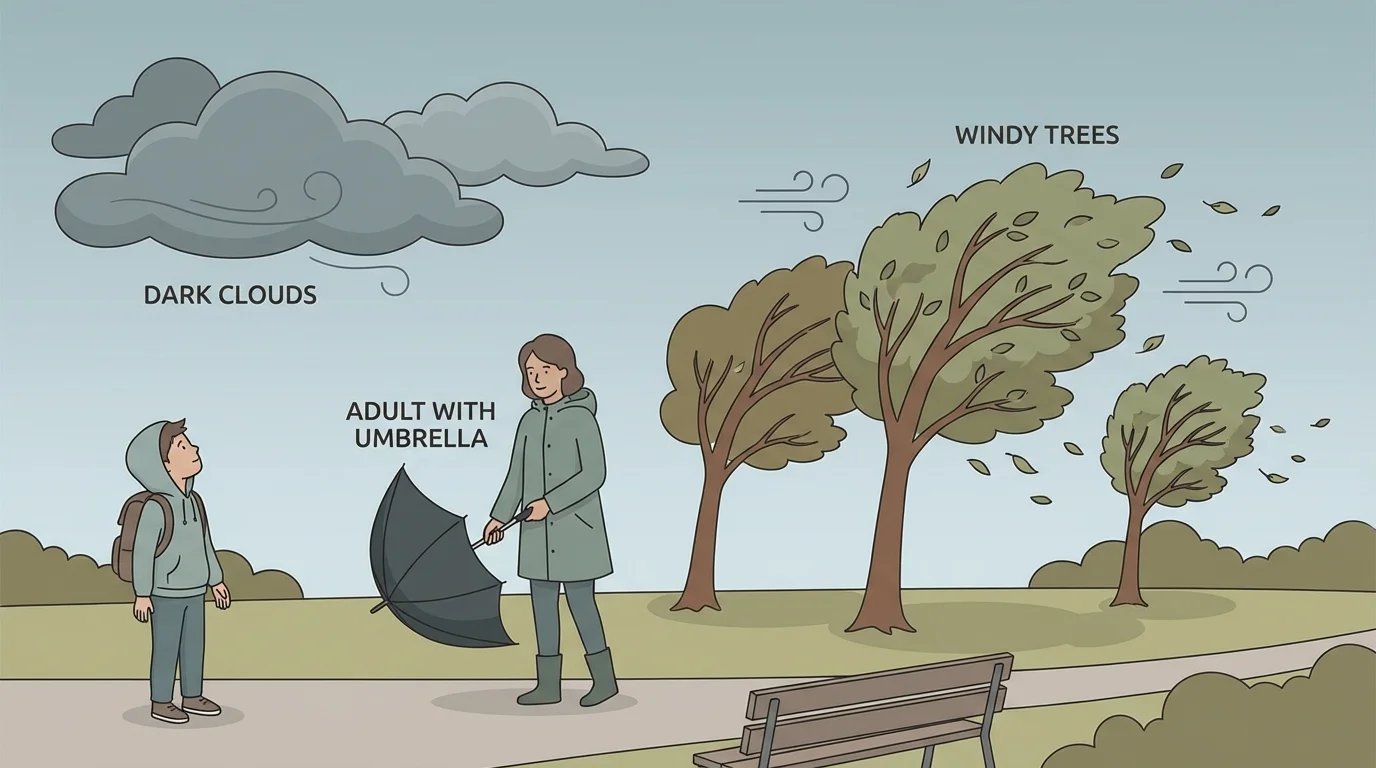
Some clues come from feelings. A face can look happy, sad, scared, sleepy, or surprised. If a girl has wide eyes and open arms, we may predict she sees something exciting. If a baby rubs tired eyes, we may predict nap time is coming.
Some clues come from the setting. The setting is where the story happens. A beach, a snowy hill, a kitchen, or a farm can help us predict different actions. At the beach, we may predict swimming or building a sandcastle. In the kitchen, we may predict cooking or eating.
Colors and weather can also help. Dark clouds may mean rain. Bright sun may mean a picnic. Snow on the ground may mean sledding. The weather clues in [Figure 1] help us think about what may happen very soon.
Look, think, predict
First, look carefully at the picture. Next, think about the clues you see. Last, say your prediction: "I think ___ will happen because ___." This helps connect the picture to the story.
Objects matter too. A backpack near the door may mean someone is going to school. A bowl on the floor may mean the dog is about to eat. A kite in a child's hand may mean the child will run outside.
A good prediction is a smart guess. It is not random. It comes from what we see in the illustration.
Here are some simple ways to make a prediction: "I think the duck will swim because it is standing by the pond." "I think the baby will cry because the toy is broken." "I think the children will paint because there are brushes and paper on the table."
Picture examples
Step 1: Look at the picture.
A boy is wearing boots and standing by a big puddle.
Step 2: Find the clue.
He is smiling and lifting one foot.
Step 3: Make the prediction.
"I think he will jump in the puddle."
We can also use more than one clue. If a dog is looking at a ball and wagging its tail, we may predict it wants to play fetch. Using many clues can make a prediction stronger.
[Figure 2] Sometimes we see new clues and make a new prediction. That is a good reading habit. We are learning more, so our thinking changes too.
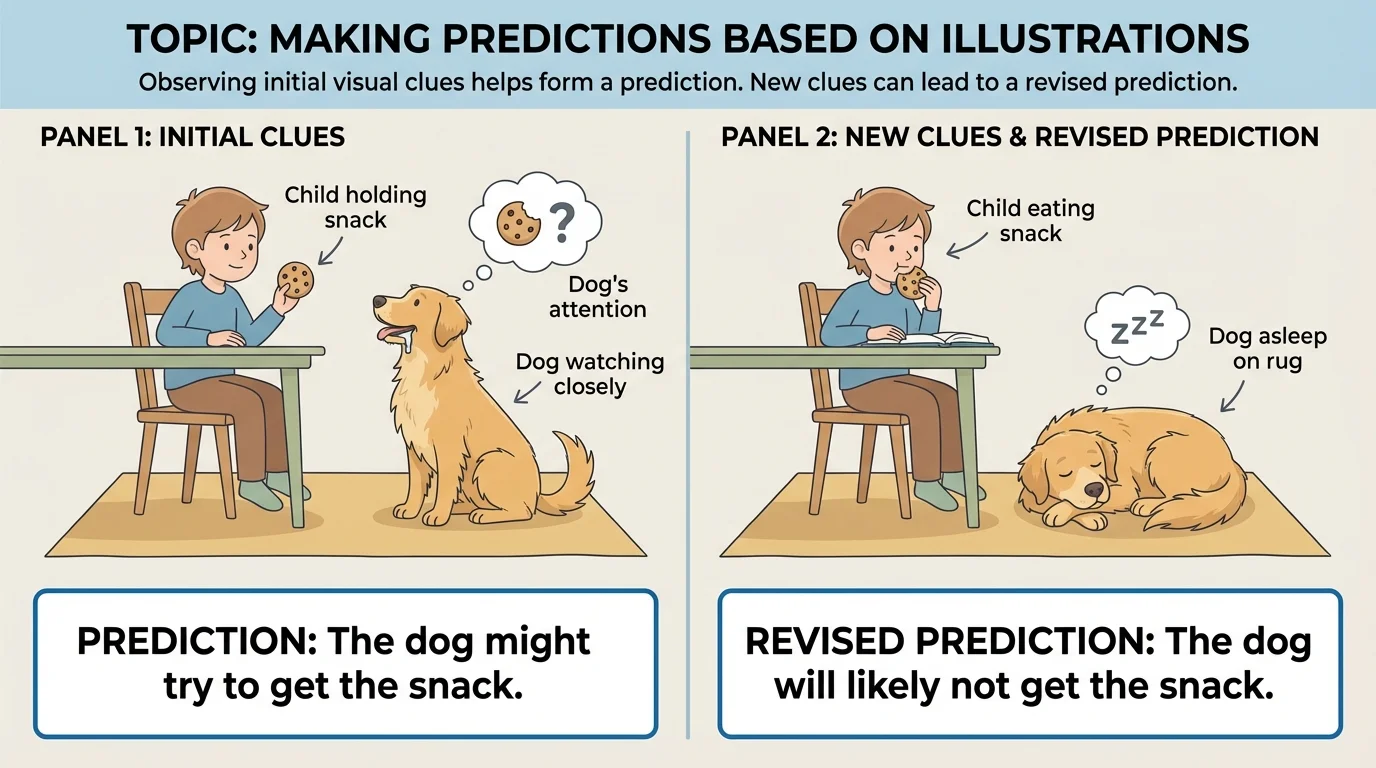
At first, we may see a dog looking at a sandwich and predict, "The dog will eat the sandwich." Then we turn the page and see the dog curled up asleep. Now we can change our prediction to, "The child will eat the sandwich."
Changing a prediction does not mean the first idea was bad. It means we are paying attention. Readers keep looking, keep thinking, and keep updating their ideas.
Stories give us information a little at a time. As we learn more, our ideas can grow and change.
The story sequence in [Figure 2] reminds us that one new picture can change what we think will happen next.
We make predictions in real life too. If we see shoes by the door and a coat in someone's hand, we may predict they are going outside. If we hear thunder and see black clouds, we may predict rain. If we see cake, candles, and hats, we may predict a party.
Books work the same way. Illustrations show clues, and we use them to think ahead. This helps us understand stories better and enjoy them more.
"Good readers look, think, and guess what comes next."
When a teacher, parent, or friend asks, "What do you think will happen next?" they are asking for a prediction. You can look at the picture, find clues, and share your idea.
These sentence starters can help: "I think..." "Maybe..." "I predict..." "I think this because..." These words help us explain our thinking clearly.
For example, you can say, "I think the kitten will climb the chair because it is reaching up." Or, "Maybe the boy will share because he has two cookies." These answers use the picture to support the idea.
When we look closely at illustrations, we become thoughtful readers. We notice details, use clues, and make predictions that help stories make sense.
