Clap, clap, pause. Clap, clap, pause. Your ears can notice that pattern even before anyone explains it. Words and music work that way too. When children hear songs, storytelling, and poetry, they begin to notice that sounds can repeat, match, and follow a beat. That listening helps language grow.
When we listen carefully, we can hear little parts inside words and lines. A child may hear that la-la-la comes again in a song, or that a storyteller says the same fun line each time. These repeating parts make language easier to remember and more exciting to hear.
Some patterns are loud and soft. Some are fast and slow. Some are made of words that sound alike. Some begin with the same sound, like b in baby, ball, and bounce.
Sound pattern is a sound we hear again and again in a predictable way. Rhyme means words end with the same or almost the same sound, like cat and hat. Beat is the steady pulse we can clap, tap, or march to.
Listening for these patterns is part of phonological awareness. That means hearing and noticing sounds in spoken language. Children do not need to see printed words first. They can learn a great deal just by listening, joining in, and enjoying playful language.
A sound pattern can happen in many ways. A word may repeat. A line may repeat. A beat may repeat. The ending sound in two words may match. The beginning sound in several words may match too.
Here are some common kinds of sound patterns young children hear:
These patterns help children predict what may come next. When children can anticipate the next beat or sound, listening becomes active and joyful.
[Figure 1] shows how songs are wonderful for hearing patterns because they repeat sounds and beats in a clear way. A song may have the same line again and again. It may also have a steady rhythm that children can clap, tap, or sway to.
Think of a simple song with a repeated line like Row, row, row your boat. The word row repeats. The beat stays steady. The tune helps the words come in order. Children begin to expect what comes next, and that helps them join in.
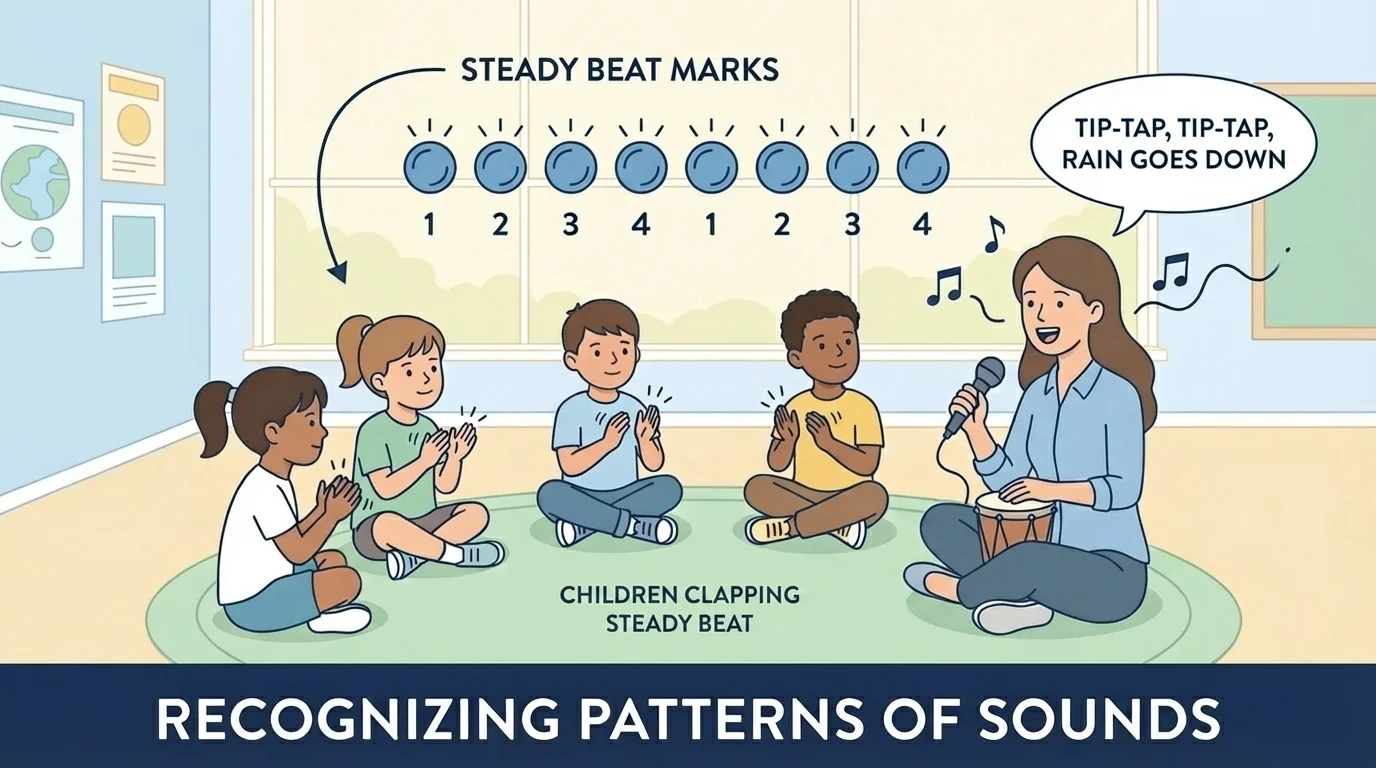
Some songs use an echo pattern. One person sings a short part, and others repeat it. Some songs use a call-and-response pattern. One voice calls, and another voice answers. These are meaningful listening experiences because children hear the pattern and take part in it.
When children sing names in a song, they also hear how sounds fit into the same tune: Hello, Maya, Hello, Leo. The pattern stays, but one word changes. That helps children notice sameness and difference in spoken language.
Very young children often remember song words before they can say long sentences in conversation. Rhythm and repetition make language stick in the mind.
Later, the same careful listening helps children hear parts of words. As we saw in [Figure 1], clapping a steady beat lets the ear organize language into pieces that are easier to notice and remember.
Storytelling is not only about what happens. It is also about how the words sound. Many stories include repeated lines such as I'll huff and I'll puff or a refrain that returns each time something happens. Children learn to listen for that familiar part.
A storyteller may make one character speak softly and another loudly. A scary part may slow down. A funny part may bounce quickly. These changes help children hear patterns in pacing and expression.
Repeated phrases in stories give children a chance to join in. When they know a line is coming, they can say it with the speaker. This builds confidence with language and helps them hear the pattern as a whole.
Why repeated lines matter
When a line comes back again and again in a story, children begin to expect it. That expectation is important. It means they are listening closely enough to notice a pattern. This kind of noticing helps children prepare to hear smaller parts of words later.
Story sounds can also include playful noise words such as swish, tap tap, and boom. These sound words are easy to hear and fun to repeat, so they make storytelling rich with listening opportunities.
[Figure 2] illustrates how poetry is full of sound play and how children can hear both rhyming endings and matching beginning sounds. Poems are often short, so children can listen to the whole piece and notice how the sounds fit together.
A poem may rhyme: star, car. It may use the same beginning sound: big brown bear. It may also have a strong beat that invites tapping or rocking. These patterns make poetry musical, even when it is spoken and not sung.
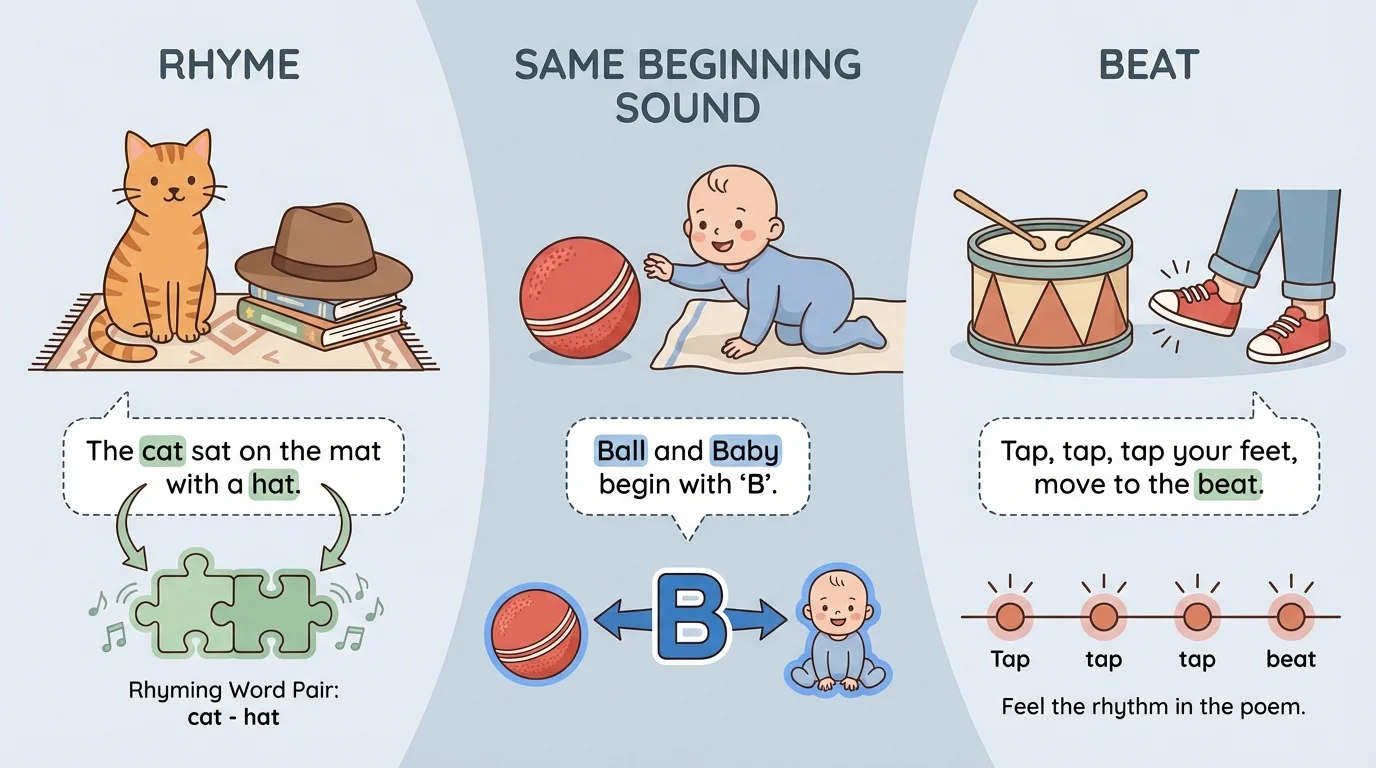
Here are simple sound-play examples:
Not every poem rhymes, and that is fine. Some poems use rhythm more than rhyme. Some use repeated words. Some use silly sounds. The important part is listening for what repeats or matches.
Listening example
A teacher says: The bug in the box goes bump, bump, bump.
Step 1: Hear the repeated word
The word bump comes again and again.
Step 2: Hear the beat
The phrase can be tapped in a steady pattern.
Step 3: Hear the beginning sound
Bug and box both begin with the /b/ sound.
One short line can hold several kinds of sound patterns at the same time.
When children hear cat and hat together, as in [Figure 2], they are learning to notice that words can sound alike at the end. When they hear ball and baby, they can also notice the same starting sound.
Hearing patterns in spoken language supports memory, attention, and participation. It also helps children notice that words are made of smaller sound parts. That idea is a big step toward later reading and writing.
When children can hear repeated beats, rhymes, and matching beginning sounds, they are building a strong base for understanding language. They begin to sort sounds, compare sounds, and enjoy how words work.
Before children read printed words, they learn a great deal by listening and speaking. Ears do important language work long before eyes track letters on a page.
This early sound noticing does not need to feel formal. It grows through songs at cleanup time, a bedtime story with a repeated line, a poem chanted while jumping, or a silly phrase repeated during play.
Sound patterns are everywhere in daily life. A child hears them in nursery rhymes, family chants, fingerplays, name games, and stories told aloud. Even everyday talk can carry patterns, such as wash, wash, wash at sink time or tiptoe to the table.
Nature and the world around us have patterns too. Rain can go pitter-patter. A train may go chug-chug. Footsteps can go tap-tap. When adults notice these sounds and say them aloud, children connect meaningful experiences with the patterns they hear.
Language becomes easier to love when it feels playful, repeated, and shared. Songs, storytelling, and poetry invite children to listen closely, join in happily, and discover that sounds are full of patterns.
