Have you ever heard the word sun and noticed it starts with a hissing sound like ssss? That is a letter sound. Letters are not just shapes we see on a page. They are signs that help us hear and say parts of words. When children begin to notice letter sounds, books, names, labels, and songs start to make more sense.
The alphabet is a group of letters. Each letter has a name, and each letter also has one or more sounds. When we talk, words are made of sounds. When we write, letters help show those sounds.
Letter sound means the sound a letter can stand for in a word. For example, the letter m can stand for the sound you hear at the start of mom.
Vowel means one of these letters: a, e, i, o, u. Vowels are special because every word needs a vowel sound.
Consonant means the other letters of the alphabet, like b, m, s, t, and p.
We can hear sounds in words all day long. In ball, we hear the beginning sound /b/. In dog, we hear /d/. In milk, we hear /m/. Learning to connect sounds to letters is part of early reading.
Many letters have a sound children can notice easily, as [Figure 1] shows with simple picture matches. The consonant m often stands for the /m/ sound, as in mom, moon, and milk. The letter s often says /s/ like in sun and sock.
The letter t often says /t/ like in top and turtle. The letter b often says /b/ like in ball and baby. These are helpful first sound-letter matches because the sounds are easy to hear at the start of words.
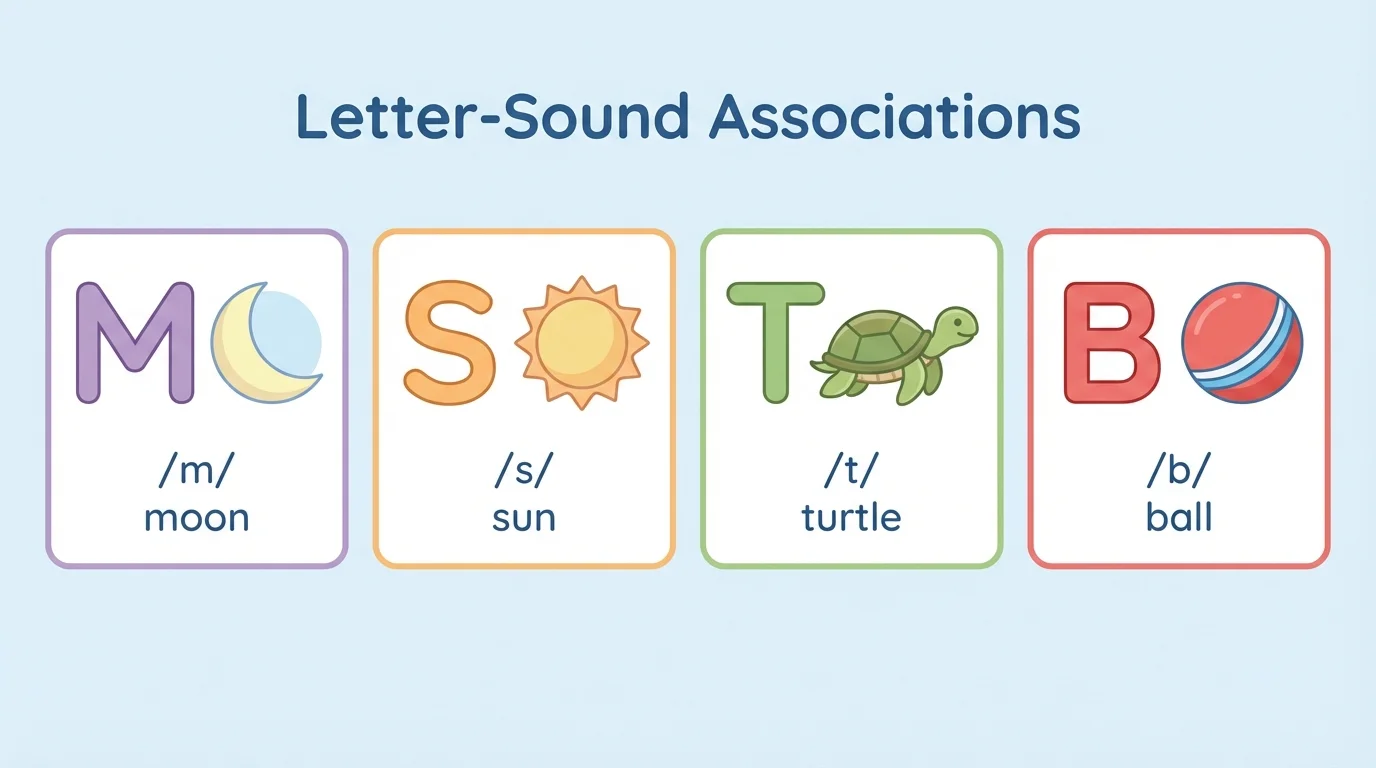
When children hear a word like sun, they can listen for the first sound: /s/. Then they can connect that sound to the letter s. This is how sound matching begins.
Some children notice letter sounds first in their own names. A child named Mia may learn that M says /m/ very quickly because it feels important and familiar.
Later, this same idea helps with many other words. The sound-letter match for m in mom also helps in map and muffin, just like we saw earlier in [Figure 1].
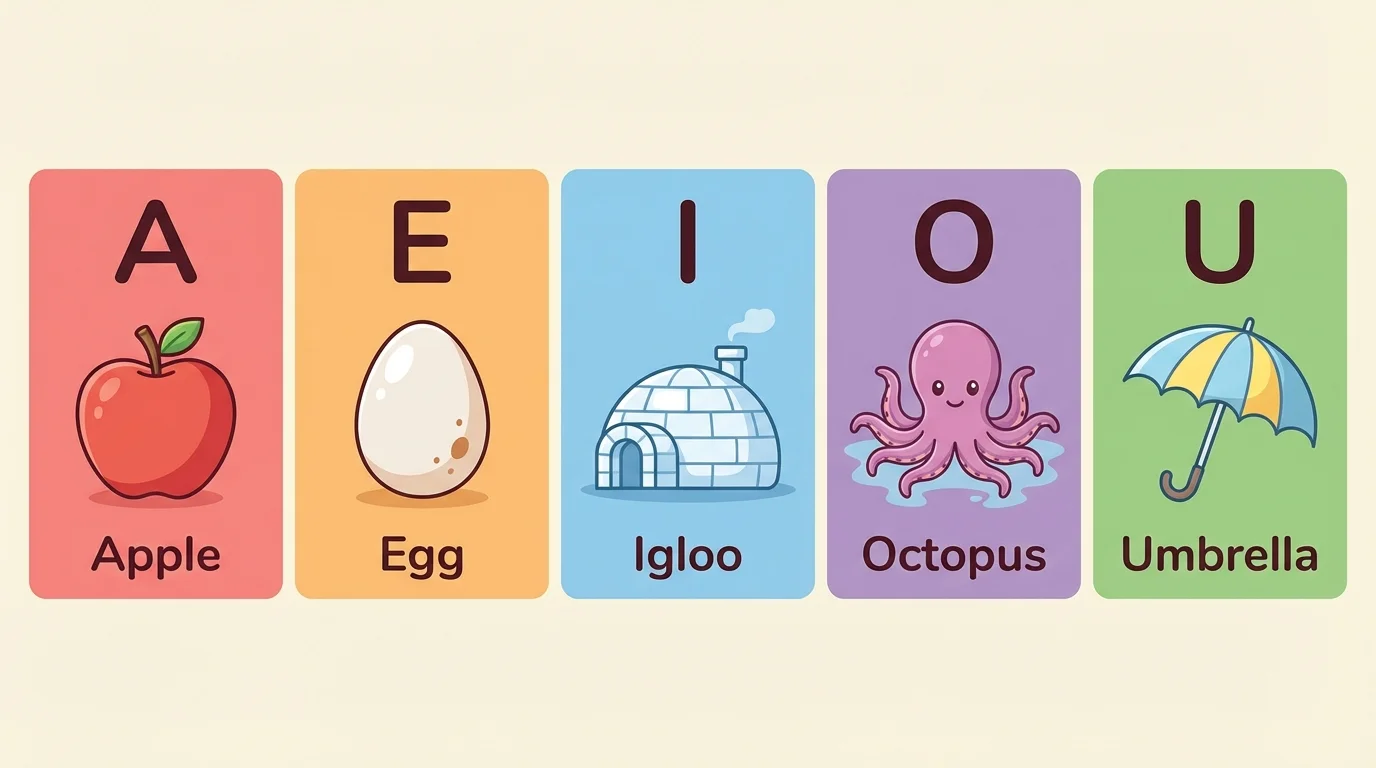
Vowels are very important, and [Figure 2] introduces the five vowel letters with picture clues. The vowels are a, e, i, o, u. Young children often start by hearing short vowel sounds in simple words.
We can hear a in apple, e in egg, i in igloo, o in octopus, and u in umbrella. These examples help children connect each vowel letter to a sound.
Vowel sounds can be a little tricky because a vowel may sound different in different words. For now, it helps to begin with easy, familiar words and listen carefully.
Why vowels matter
Vowels are in the middle of many short words. In cat, the middle sound is /a/. In bed, the middle sound is /e/. In pig, the middle sound is /i/. When children can hear these middle sounds, they are building strong early reading skills.
Even when vowel sounds change in other words, children still learn that the letters a, e, i, o, u are special. The picture set in [Figure 2] helps children remember a first sound for each vowel letter.
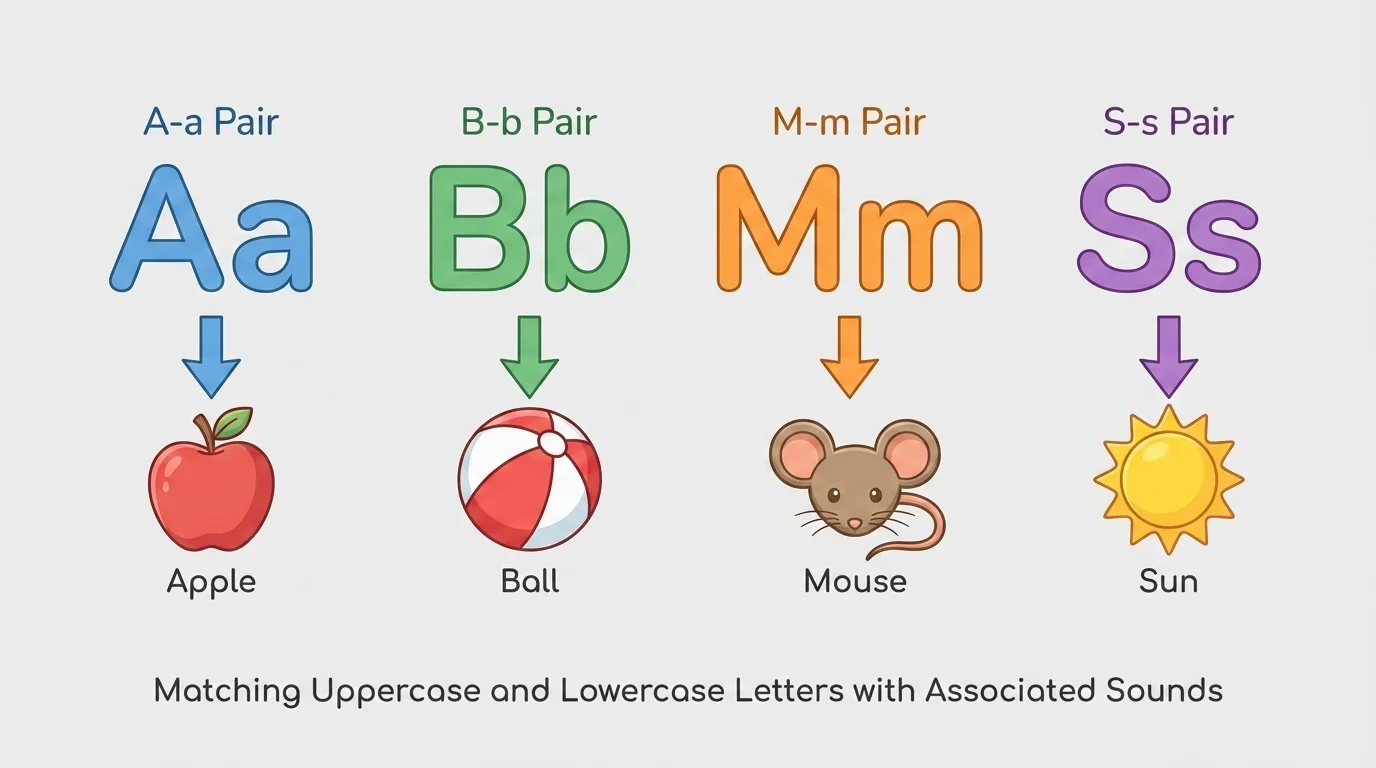
Letters can look big or small, and [Figure 3] shows pairs that belong together. An uppercase letter is a big form, like A. A lowercase letter is a small form, like a. They look different, but they are the same letter.
That means M and m both connect to the /m/ sound. S and s both connect to /s/. Children need to recognize both forms because books, signs, and names use both uppercase and lowercase letters.
Many names start with an uppercase letter, like Liam or Sofia. Inside books, most letters are lowercase. Knowing both forms helps children see that a letter keeps its sound even when its shape changes a little.
One useful early skill is hearing the first sound in a word. If a child hears ball, the first sound is /b/. If a child hears tiger, the first sound is /t/. If a child hears moon, the first sound is /m/.
This is called listening for the beginning sound. Children hear it in names, foods, toys, animals, and songs. The same matching idea from [Figure 1] works in many places: hear the sound, then connect it to the letter.
Everyday sound matches
Step 1: Hear the word banana.
Step 2: Listen for the first sound: /b/.
Step 3: Match the sound to the letter b.
The word banana begins with the letter b.
Children can also hear sounds at the end of words or in the middle, but beginning sounds are often the easiest place to start.
Most preschool lessons begin with the most common letter sounds. That is the best first step. Still, it is helpful to know that some letters can make more than one sound.
For example, the letter c can sound like /k/ in cat and like /s/ in city. The letter x often sounds like /ks/ in box. Children do not need to memorize every special case at once. They just need to begin noticing that letters and sounds work together in words.
You already know that spoken words are made of sounds. Now you are learning that written letters help show those sounds.
This is one reason adults often start with easy examples first. A child learns common matches such as m, s, t, and b, then grows ready for trickier sound patterns later.
Knowing letter sounds helps children read labels, hear parts of their names, sing alphabet songs with more meaning, and begin writing with marks that match sounds. A child who wants to write mom may start with the letter m because the /m/ sound is easy to hear.
Letter sounds also help when adults read aloud. When a teacher points to a word and says it slowly, children can begin to notice which letters match the sounds they hear. Uppercase and lowercase matching, like the pairs in [Figure 3], makes printed words feel more familiar.
Over time, children build alphabet knowledge. They learn letter names, letter shapes, and letter sounds together. This knowledge becomes a strong base for reading and writing.
