Have you ever looked at a stop sign, a cereal box, or your name on a cubby and noticed that little shapes are everywhere? Those shapes are letters. Letters help us read words, and words help us share ideas, sing songs, and tell stories. When we learn letters, we are learning a secret code for spoken language.
A letter is a shape we can see. A sound is what we hear and say with our mouth. When we put letters and sounds together, we begin to read. For example, the letter A can help us hear the beginning sound in apple. The letter B can help us hear the beginning sound in ball.
Letter means a written symbol in the alphabet. Sound means the speech sound we hear in a word. Alphabet means all the letters we use for reading and writing.
Some letters have names and also help us make sounds. We can look at a letter, say its name, and practice the sound it often makes in words. This helps our brains connect what our eyes see and what our ears hear.
The alphabet has many letters, and we can start by getting to know some important ones. In [Figure 1], the letters and pictures match because the words begin with the same sound. Here are ten letters and common beginning sounds: A for apple, B for ball, C for cat, D for dog, M for moon, S for sun, T for turtle, P for pig, L for leaf, and R for rabbit.
When we say these words slowly, we can hear the first sound. Apple begins with /ă/. Ball begins with /b/. Cat begins with /k/. These beginning sounds help us match spoken words to letters.
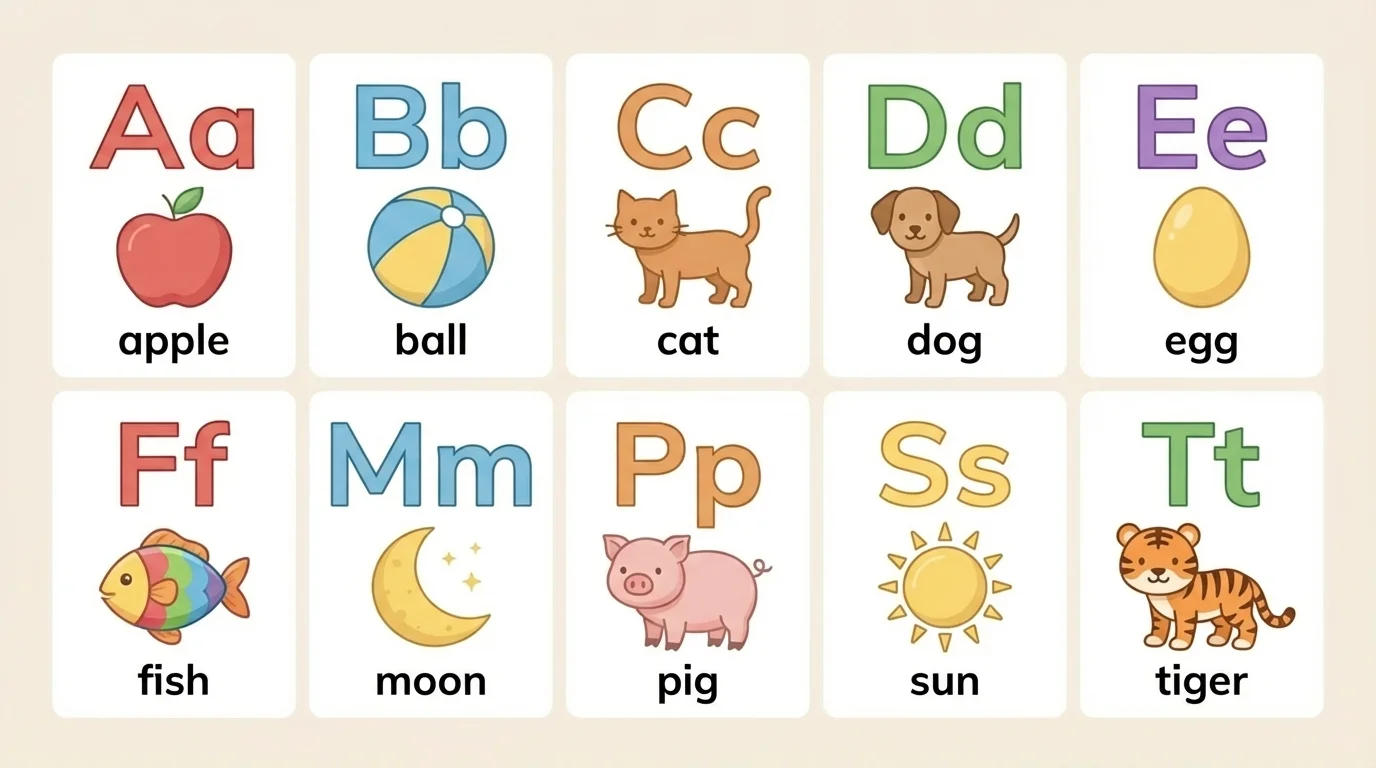
It is helpful to use words children know well. D is for dog. M is for mom or moon. S is for sun. T is for toy or turtle. P is for pig. L is for lion or leaf. R is for rain or rabbit. The more often children hear and say these sound matches, the stronger the connection becomes.
Young children often learn letter sounds more easily when the letter is connected to a favorite object, animal, or person they already know.
As we keep noticing letters, the match between a letter and its sound starts to feel familiar, just like recognizing a favorite song when you hear the first note.
Letters can be big or small. In [Figure 2], each pair shows that an uppercase letter and a lowercase letter are the same letter, even if they look a little different. For example, A and a are both A. B and b are both B. M and m are both M.
We often see uppercase letters at the beginning of names, like Mia or Sam. We often see lowercase letters in the rest of the word. Learning both forms helps children recognize letters in books, labels, and signs.
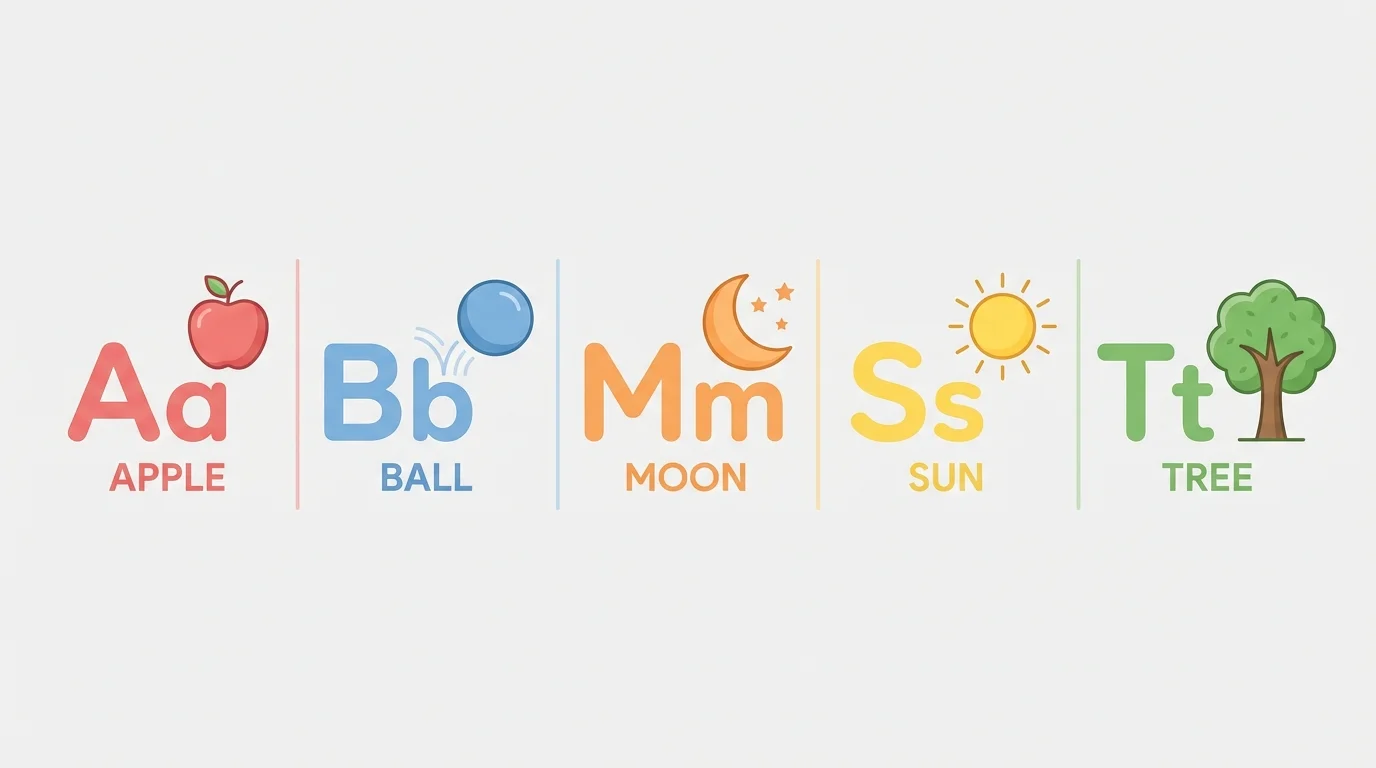
Even when the shape changes, the letter still stands for the same name and sound. That means S and s both connect to the sound we hear at the start of sun. T and t both connect to the sound at the start of turtle.
A child's own name is one of the best places to find letters. A name letter is a letter that appears in someone's name. In [Figure 3], the name is made of letters, and the first letter is easy to notice. If a child's name is Sam, the letters are S, a, and m. If a child's name is Mia, the letters are M, i, and a.
The first letter in a name is special because children see it often. They may notice it on artwork, folders, and cubbies. When a child learns, "My name starts with M," that child is building strong letter knowledge.
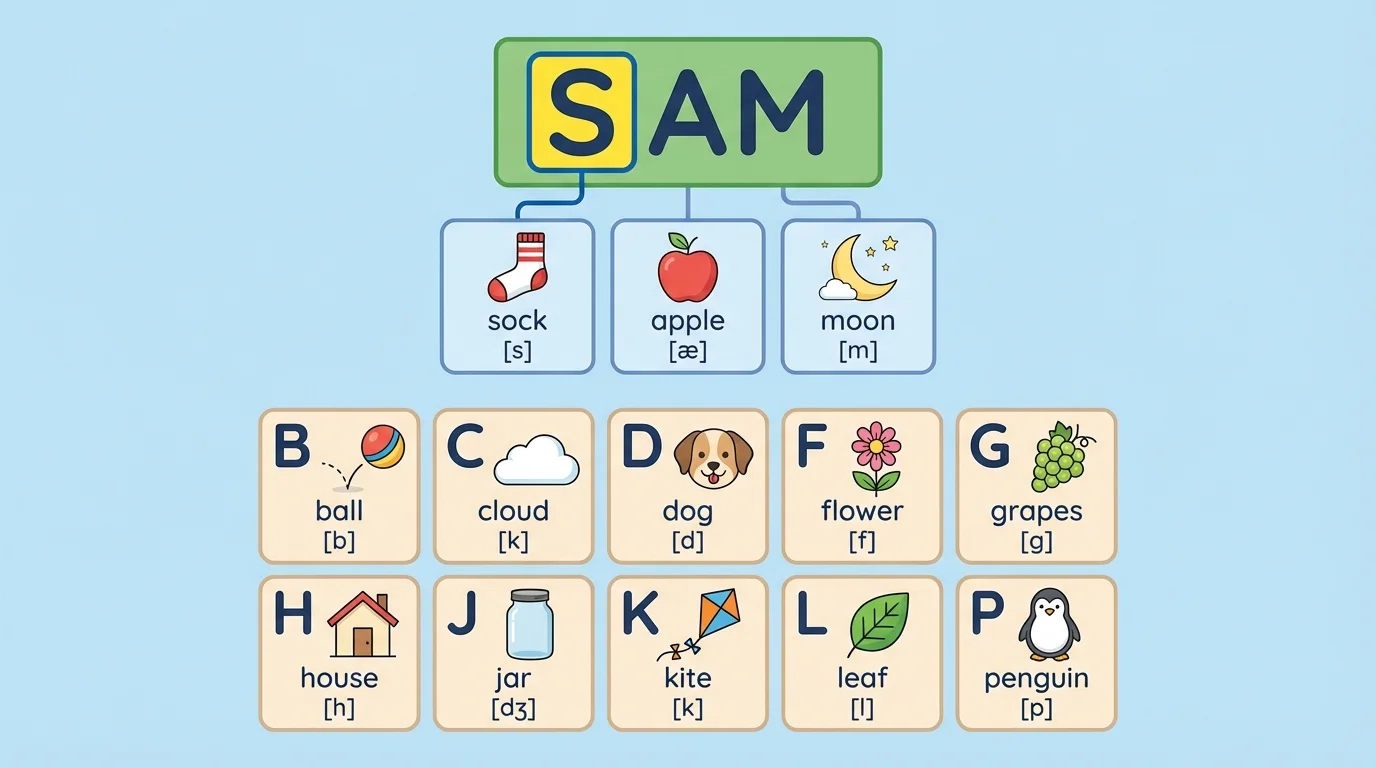
Children can also notice letters in family names and friends' names. A child named Leo can find L. A child named Rosa can find R. A child named Ben can find B. This makes alphabet learning personal and meaningful.
Why names help
Names matter to children. Because children care about their own names, they often remember those letters quickly. From there, they can connect those same letters to other words, like M in Mia and moon, or S in Sam and sun.
The same idea works for classroom friends. If one child is named Tara and another is named Tom, both names begin with T. That helps children see that one letter can appear in many words and names.
A beginning sound is the sound we hear first in a word. When we hear ball, the first sound is /b/. When we hear dog, the first sound is /d/. When we hear sun, the first sound is /s/.
Listening is important because sounds come before printed words make sense to us. Children learn to hear a word, notice its first sound, and then connect that sound to a letter. As we saw earlier in [Figure 1], a picture of a cat helps us think of the letter C because cat starts with that sound.
Sometimes words begin with the same sound. Moon and mom both begin with /m/. Pig and pizza both begin with /p/. Hearing that match helps children sort and recognize words by sound.
Sound matches in simple words
Step 1: Hear the word rabbit.
Step 2: Listen to the first sound: /r/.
Step 3: Match the sound to the letter R.
The word rabbit begins with the letter R.
Children do not need to know every sound all at once. Learning a few clear letter-sound matches at a time helps them feel successful and ready for more.
Letters are not only in books. They are on signs, food boxes, shirts, toys, and art labels. When children see a letter in many places, they begin to remember it better. The pair M and milk or B and banana can appear during snack time. The pair S and sock can appear while getting dressed.
Real objects strengthen letter learning. A child may hold a ball and say, "B for ball." A child may point to the sun in a picture and say, "S for sun." A child may see a toy turtle and hear the /t/ sound that goes with T. These everyday connections make abstract symbols feel real.
Later, children can notice that the same letter appears again and again. B might appear in ball, baby, and book. L might appear in leaf, lion, and lamp. As shown earlier in [Figure 2], children also learn that big and small versions of the same letter still match these sounds.
Learning letters and sounds takes time, and that is okay. Children grow by hearing words, seeing letters, and making connections again and again. A child who notices the first letter in a name today may notice the same letter in a book tomorrow.
When children can identify letters and connect them to sounds, they are building a strong base for reading. They start to understand that spoken words can be written down with letters. That is a big and exciting step.
Names stay especially powerful. As we saw in [Figure 3], a name can be a friendly first place to learn letters, sounds, and the idea that print carries meaning.
