Look around a room, a street, or a store, and you can find print almost everywhere. Print is on books, doors, toy boxes, shirts, food packages, and signs. Even before children read many words, they can begin to notice that these marks mean something. They can learn that print helps people share ideas, give directions, and label important things.
Print is visible written language and symbols. Print includes letters, numbers, words, and names. It can also be part of familiar logos and signs. When children notice print, they begin to understand that these shapes are not just decorations. They carry messages.
Print means written marks that we can see and use for meaning. Print can be letters, numbers, names, words, logos, or signs.
A letter is one of the symbols in the alphabet, like A, B, or M. A number is a symbol used to show how many, like \(1\), \(2\), or \(3\). A word is made of letters, and a name is a special word that tells who someone is. Children often learn to notice their own name very early because it is important to them.
Letters and numbers appear in many places each day, as [Figure 1] shows. Letters are on book covers, cereal boxes, shirts, and posters. Numbers are on clocks, phones, houses, and calendars. When children begin to spot these symbols, they are learning that print is part of everyday life.
A child might notice the number \(3\) on a birthday cake, the number \(2\) on a shoe box, or the letter S at the start of a friend's name. These small discoveries matter. They help children connect symbols they see with things they already know.
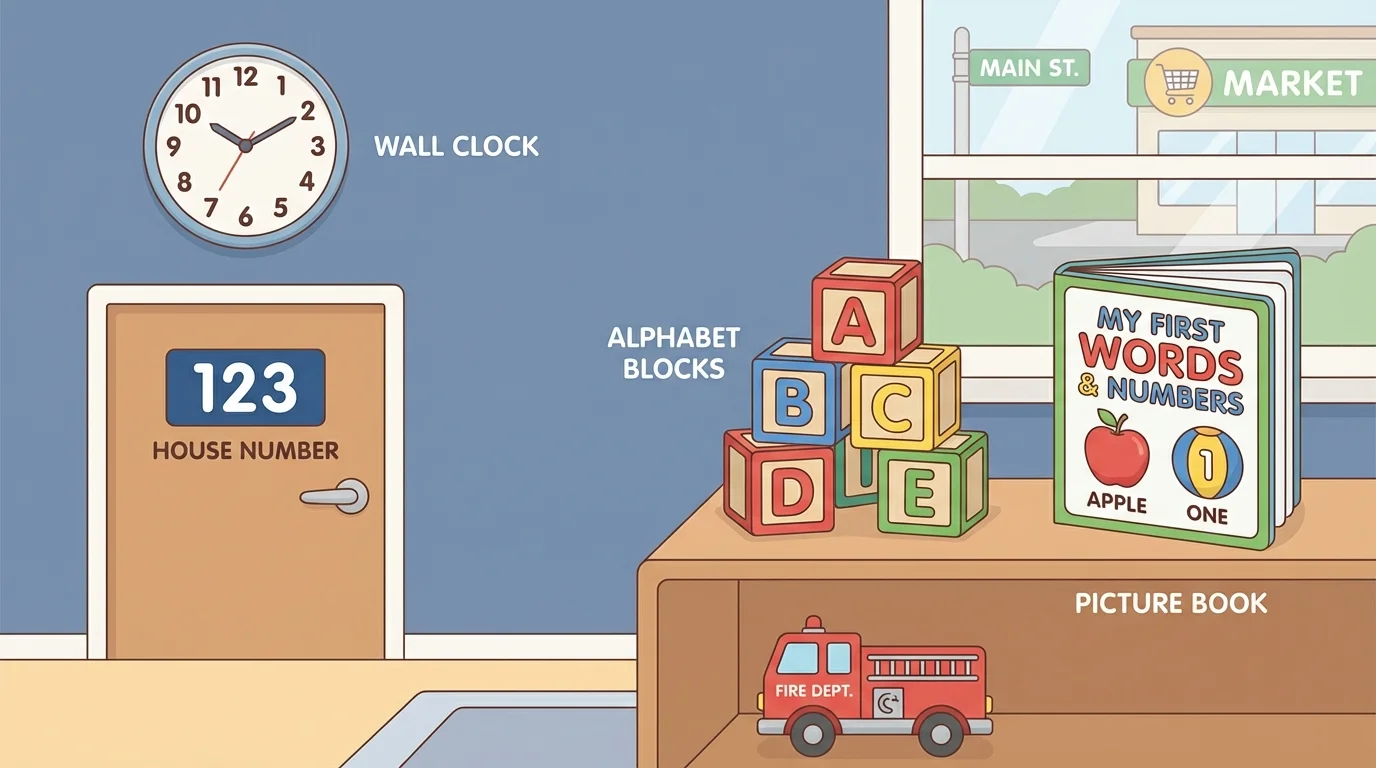
Some print is big, and some print is small. Some letters are uppercase, like A, and some are lowercase, like a. Children do not need to know every letter yet. It is enough to start noticing that letters have different shapes and that numbers look different from letters.
Many children recognize a few favorite letters before they can read words. The first letter in their own name is often one of the earliest print symbols they remember.
When children see the same letters and numbers again and again, they begin to remember them. Seeing print often helps it become familiar.
A name is one of the most important kinds of print for a young child. Children may see their name on a cubby, on a coat hook, or on a piece of artwork, as [Figure 2] illustrates. Recognizing one's own name helps children understand that print can stand for a person.
Names are made of letters in a special order. If the letters change places, the name is not the same. This helps children learn that print is exact. The order of letters matters.
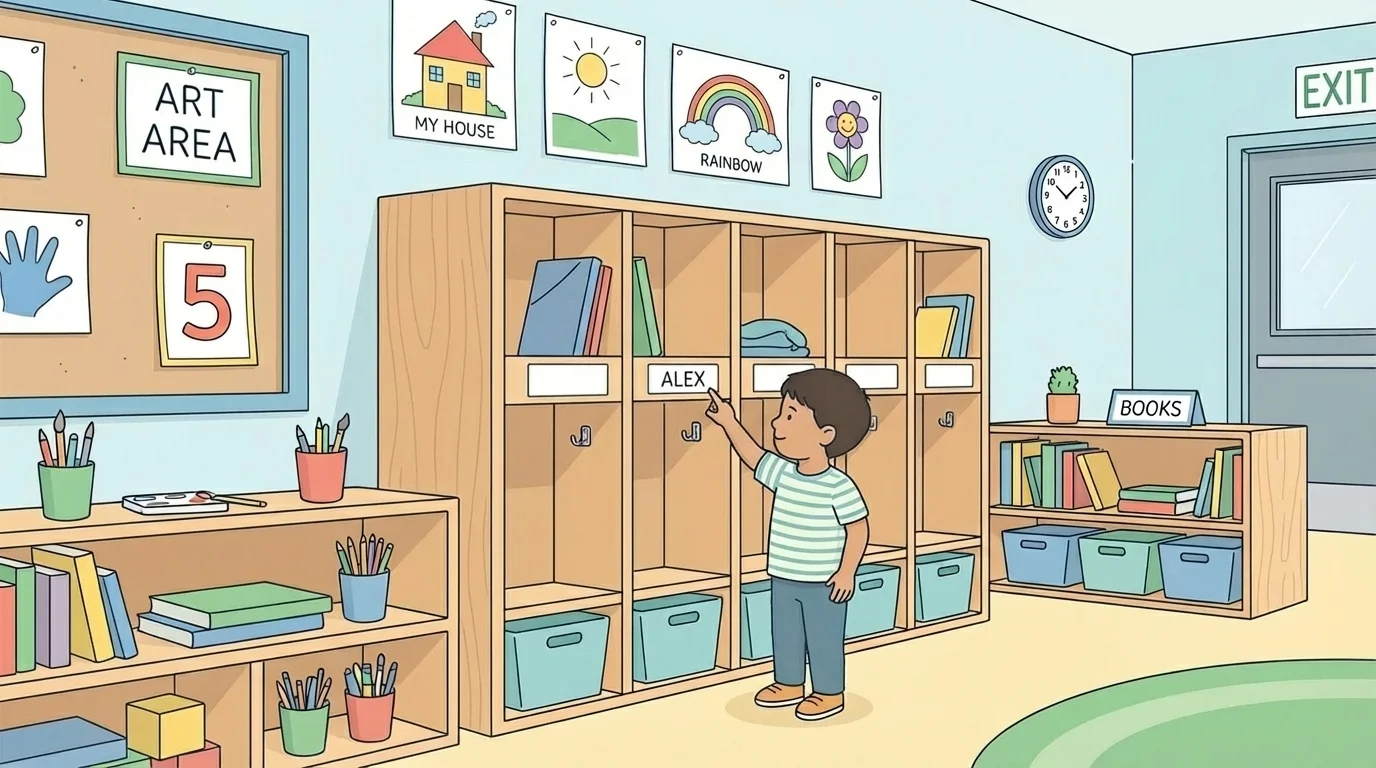
Children may also begin to notice friends' names. One name may start with L, while another starts with T. Looking at names helps children compare letters and shapes. It also helps them understand that each written name looks a certain way every time.
Why a name matters in early reading
A child's name is meaningful, familiar, and seen often. Because of that, name recognition becomes a strong first step in understanding that print carries meaning and stays the same each time it is written.
Later, when children see labels at school or at home, they can use name print to find their own things. Print helps organize the world around them.
Children also notice words, logos, and signs in the world around them, as [Figure 3] shows. A word may be on a favorite snack box. A logo may be on a restaurant cup or a shoe. A sign may be on a door, in a parking lot, or near a crosswalk.
A familiar logo often helps children recognize something quickly. They may know a store or food brand by its color, shape, and print. This is an early form of print recognition. The child is learning that certain printed designs always go with certain places or products.
Signs are especially important because they give information. A stop sign tells drivers to stop. A restroom sign tells people where to go. A school sign tells where the school is. Even if children cannot read every word yet, they can begin to understand that signs use print to send messages.
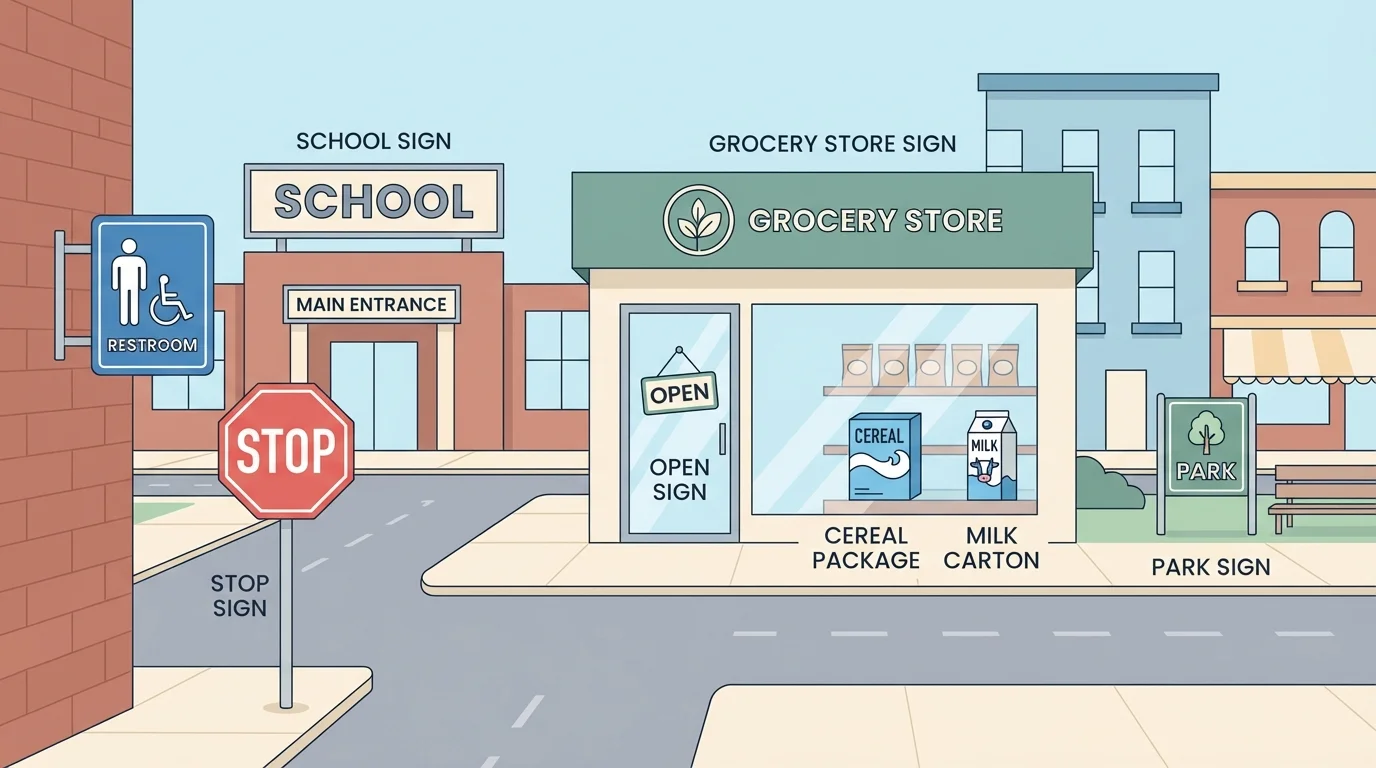
Children can also learn that some signs keep us safe. Red, bold shapes, and clear print often mean we should pay attention. This helps children connect print with real action in daily life.
Later, when they see community signs again, they may remember them from before. As with the examples in [Figure 3], familiar print can be recognized by its repeated look and use.
Print helps people in many ways. It tells us where to go, what something is, and who something belongs to. Labels on bins show where toys go. Signs on doors show what room we are entering. Name cards show whose seat or folder it is.
Print also helps people share ideas. Books use print to tell stories. Lists use print to help us remember. Menus, tickets, and labels all use print for a purpose. Children begin to understand that print is useful, not random.
Everyday print examples
Step 1: A child sees the number \(5\) on an apartment door.
The number helps identify that home.
Step 2: A child sees their name on a painting.
The name shows who made the art.
Step 3: A child sees a stop sign outside.
The sign gives an important safety message.
Each kind of print has a job to do.
When children understand that print has a purpose, they become more ready to learn how reading works. They start to look at print with care and curiosity.
Recognizing print means looking carefully. Children can notice whether something is a letter, a number, a name, a word, or a sign. They may look at shape, size, color, and place. A logo on a snack box may be easy to remember because it always looks similar. A written name may be easy to find because the letters stay in the same order.
This careful noticing is part of early reading. Children learn that print can be recognized by looking carefully and that it stays stable. The same book title looks the same each time. The same sign by the road keeps the same message. The same name label on a cubby stays the same from one day to the next, just as we saw earlier in [Figure 2].
You already know that pictures and objects can give clues. Print is another kind of clue. It uses symbols to tell us something important.
As children keep seeing print in meaningful places, they grow more confident. They begin to connect the print they see with people, places, objects, and actions in their world. This is an important beginning step in becoming a reader.
