Have you ever watched an adult read a book and seen their eyes move across the page? Print has a special path. When we read a book in English, we do not jump all around the page. We follow the words in order. That helps the story make sense.
Reading is a little like taking a walk on a path. The path tells us where to start and where to go next. On a page, the path of print helps us know how to read the words in the correct order.
[Figure 1] When we look at print, our eyes and often our finger move across the line from left to right. We start on the left side of the line and move to the right side.
If a page says, "I see a dog," we begin with the first word on the left. Then we move to the next word, and then the next. We do not start in the middle. We do not start at the end. We follow the words in order.
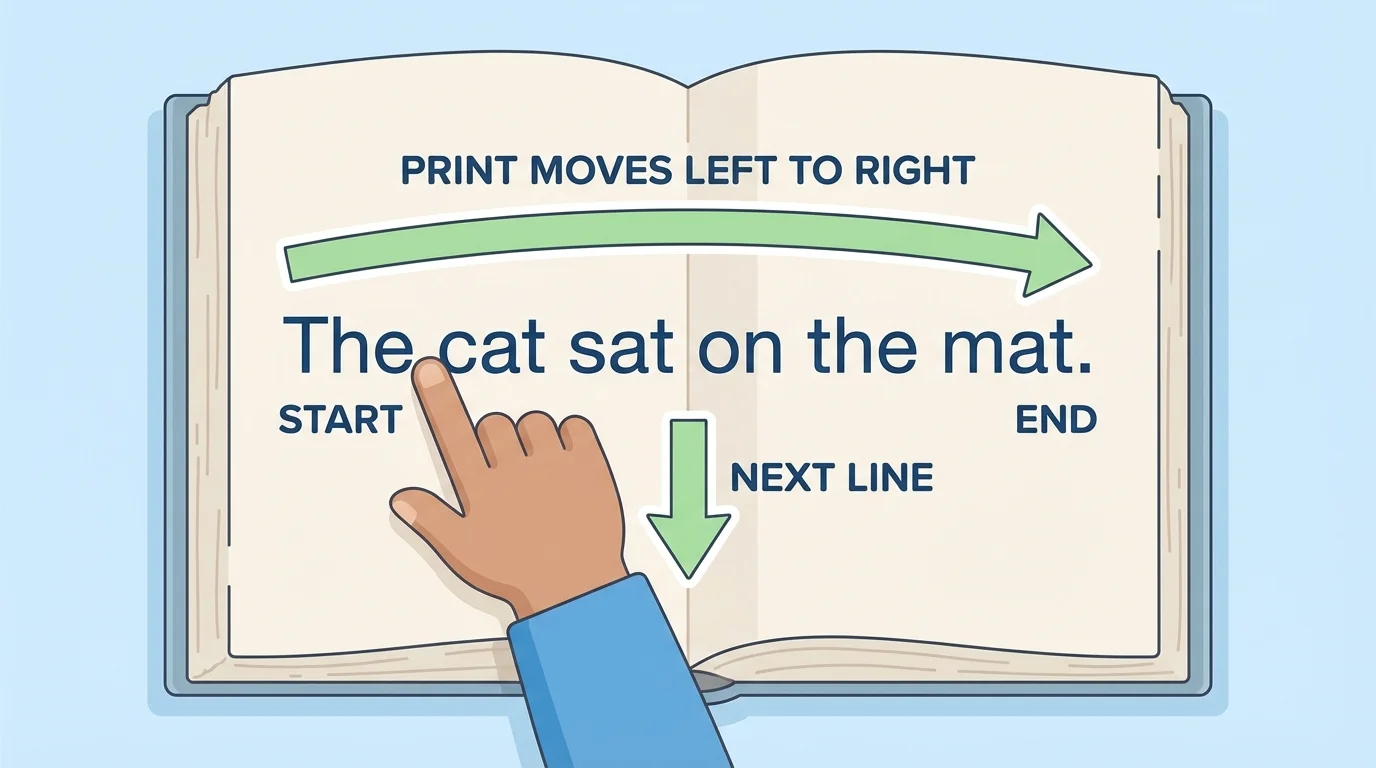
This helps us hear the sentence correctly. If the words are read in the wrong order, the sentence will not sound right. The print path helps our brains match the spoken words to the words we see.
Print is the letters and words we read. Left to right means we begin on the left side and move across to the right side. Top to bottom means we start near the top of the page and move down.
Some books have only a few words on each page. Some books have many words. No matter how many words there are, we still move across the line in the same direction.
Think of a page with three short lines. First we read the top line. Next we move down to the line under it. Then we move down again. This keeps the words in the right order.
Think of a page with three short lines. First we read the top line. Next we move down to the line under it. Then we move down again. This keeps the words in the right order.
Think of a page with three short lines. First we read the top line. Next we move down to the line under it. Then we move down again. This keeps the words in the right order.
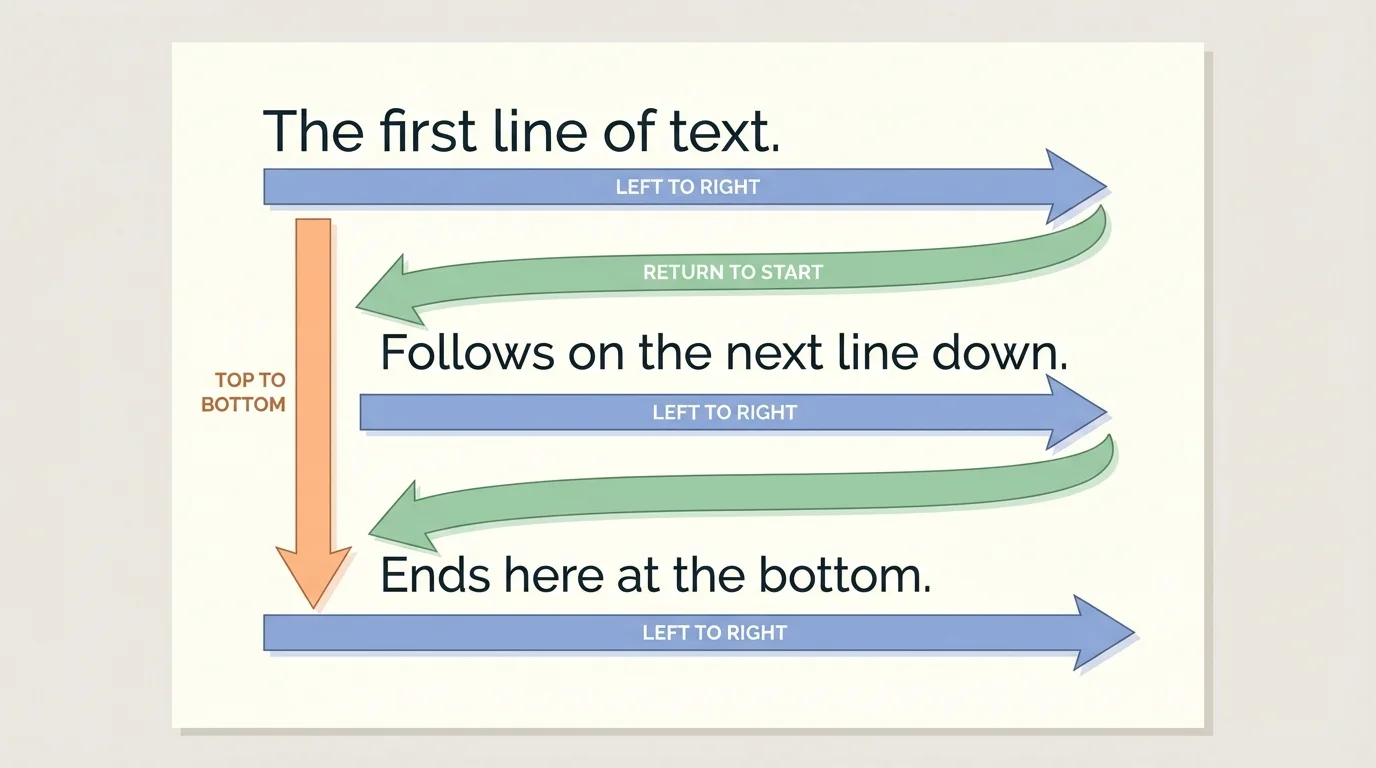
Pages work this way in storybooks, alphabet books, and many signs. A reader follows the path across one line and then down to the next. That is how the whole page is read.
Later, when children know more letters and words, this same page pattern still matters. The path of print stays the same even when the words get bigger and longer.
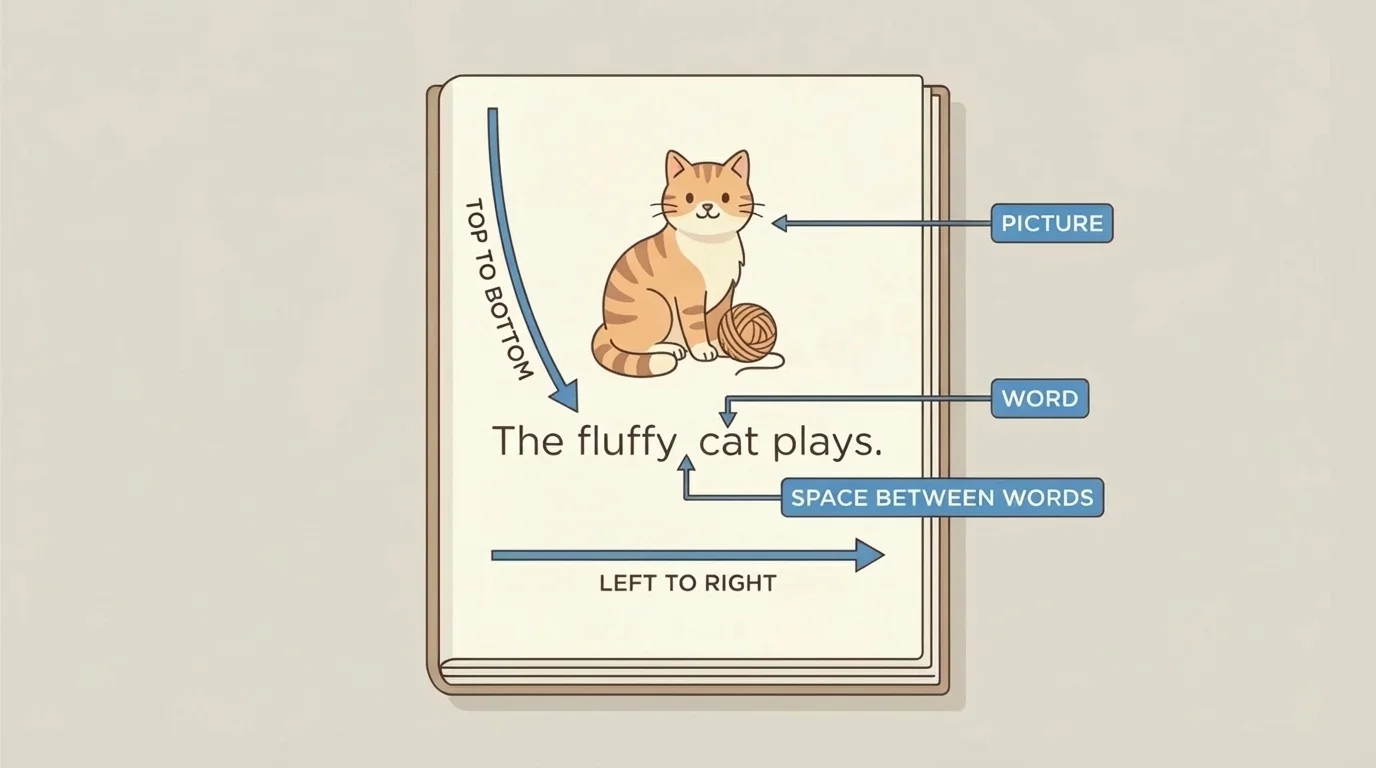
If a page has a picture of a cat and the words "The cat naps," the picture helps us think about the idea, but the printed words are what we read. The spaces between the words help us know there are three words, not one long word.
If a page has a picture of a cat and the words "The cat naps," the picture helps us think about the idea, but the printed words are what we read. The spaces between the words help us know there are three words, not one long word.
If a page has a picture of a cat and the words "The cat naps," the picture helps us think about the idea, but the printed words are what we read. The spaces between the words help us know there are three words, not one long word.
Print can be big or small. It can be black, blue, or another color. It can be in a book, on a box, or on a sign. If it is print, readers still follow the same reading conventions.
Some children notice print before they can read words. They may point to a cereal box, a stop sign, or their name on a cubby because they are learning that print carries meaning.
When we look back at the page, we can see that the picture gives us clues, but the print shows the exact words. This is why readers learn to notice both, while knowing that print is what gets read aloud.
Sometimes a teacher, parent, or caregiver points under the words while reading. This is called tracking. Tracking helps children see where the reading starts and where it goes next.
When a finger slides under the words, it matches spoken words to printed words. The finger begins on the left, moves to the right, and then goes down for the next line. That movement helps children learn that books have a reading path.
Why following print matters
Children learn to read more easily when they understand how print is organized. Knowing where to start, which way to move, and where the next line begins helps them pay attention to letters, words, and meaning.
Tracking does not mean touching every page all the time. It simply means noticing where the print is and following it in order. As children grow, their eyes can follow the print even when their finger is not there.
We can connect this to [Figure 1] and [Figure 2]. One shows how we move across a line, and the other shows how we move down the page. Together, these two directions help us read in order.
Print is not only in storybooks. We see it on labels, cards, posters, and menus. When someone reads a birthday card or a bedtime story, they still follow the same path of print.
A name tag is print. A sign on a door is print. Words on a favorite snack box are print too. Children begin to understand that print is useful everywhere, and it is always read in an organized way.
Everyday examples
Example 1: In a picture book, an adult starts at the first word on the left and reads across the line.
Example 2: On a page with two lines, the reader finishes the top line first and then moves down to the next line.
Example 3: On a label, the child may notice letters and words, while also seeing that spaces separate one word from another.
When children understand these print conventions early, books become easier to explore. They know where to look, what to follow, and how the words work together on the page.
