On a shelf in a museum in Mexico City lies a screenfold book painted on deer skin. It was created hundreds of years ago by Indigenous artists, and it tells a story without using a single word of English or Spanish. That book is a clue from the past — and learning how to "read" clues like this is what makes history feel like detective work 🔍.
The Western Hemisphere is the half of Earth that lies mostly west of the Prime Meridian (0° longitude) and east of 180° longitude. It includes famous places you may already know: the United States and Canada in North America, Brazil and Argentina in South America, Mexico and the countries of Central America, and island nations such as Cuba, Haiti, and Jamaica in the Caribbean. Historians study how people in all these regions have lived, fought, traded, believed, and changed over time, as shown in [Figure 1].
These regions together make up a huge area with many different cultures, languages, and environments — from Arctic ice in northern Canada to tropical rainforests in the Amazon.
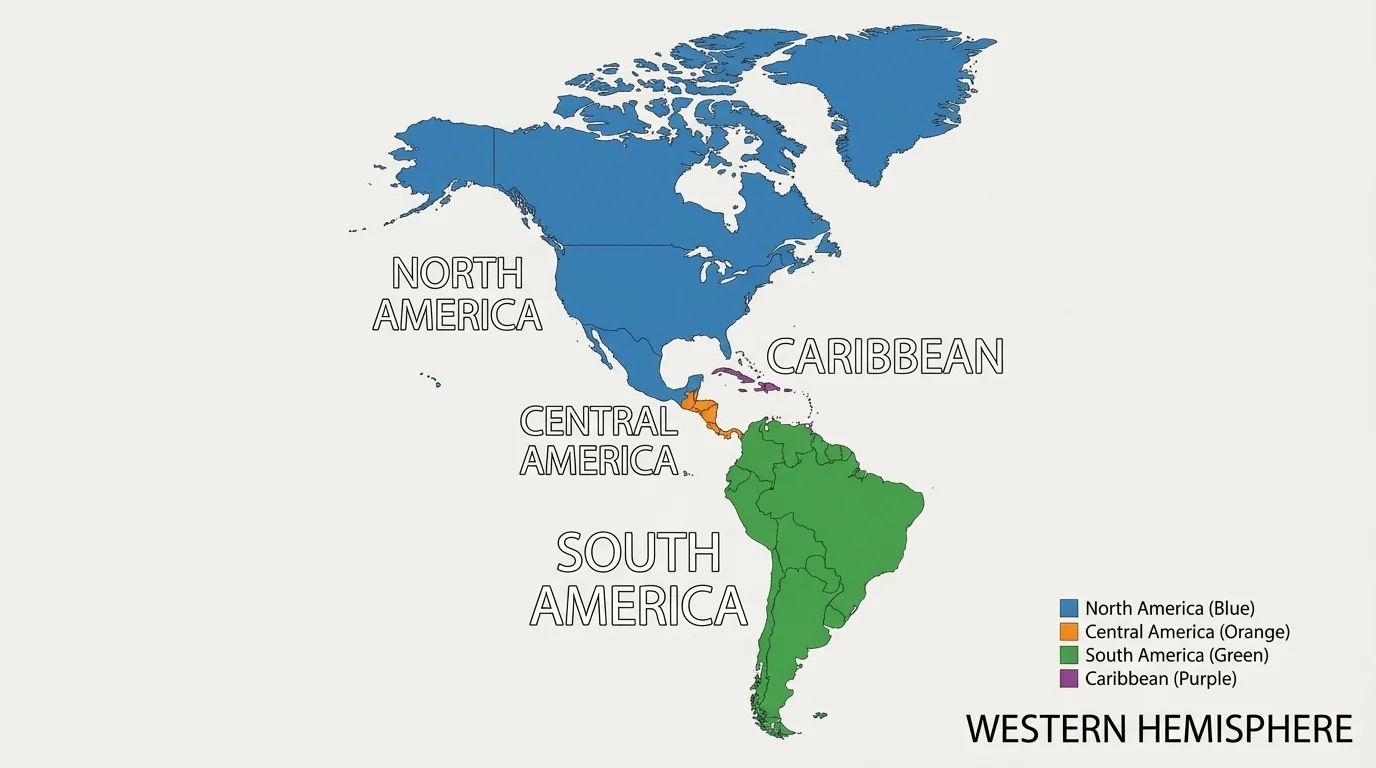
When we ask historical questions about the Western Hemisphere, we might focus on different time periods, such as:
| Time Period | Approximate Dates | Example Events in the Western Hemisphere |
|---|---|---|
| Early Indigenous Civilizations | before 1500s | Maya cities in Central America; Inca Empire in South America; Mississippian mound builders in North America |
| Age of Exploration and Colonization | late 1400s–1700s | Voyages of Columbus; Spanish conquest of the Aztec and Inca; founding of colonies |
| Revolutions and Independence | late 1700s–1800s | American Revolution; Haitian Revolution; independence movements in Latin America |
| Modern Era | 1900s–today | Civil rights movements; growth of cities; environmental issues like rainforest destruction |
Table 1. Major eras and sample events in Western Hemisphere history.
To understand these events, historians use different kinds of clues, called sources. Two of the most important types are primary sources and secondary sources.
A primary source is a piece of evidence that comes directly from the time period or event being studied. It is like hearing the past speak in its own voice.
Primary sources are original materials from the time being studied, such as letters, diaries, government records, speeches, artifacts, maps, photographs, or oral stories.
Here are some examples of primary sources from different parts of the Western Hemisphere:
Primary sources can tell us:
However, primary sources do not always tell the whole story. The person who created the source had their own viewpoint, background, and goals. That is why we also need another type of source.
A secondary source is created after an event has happened, usually by someone who was not there. The creator studies many primary sources, thinks carefully about them, and then explains what they believe happened and why.
Secondary sources are works such as textbooks, history books, articles, and documentaries that interpret or explain the past using primary sources and other research.
Common examples of secondary sources about the Western Hemisphere include:
Secondary sources are helpful because they:
But secondary sources also have limits. The author chooses which information to include and which to leave out. Two historians might look at the same primary sources and come to different conclusions.
Historians often use both kinds of sources. Seeing them next to each other, as in [Figure 2], makes their differences and connections clearer.
| Type of Source | Comes From | Examples | Strengths |
|---|---|---|---|
| Primary | The time of the event | Letter from a soldier in the American Revolution; Aztec codex; photo of a 1960s protest | Shows feelings, details, and voices from the time |
| Secondary | Later, after studying the past | Textbook chapter; article about Mayan ruins; biography of an independence leader | Explains causes, effects, and the "big picture" |
Table 2. Comparison of primary and secondary sources.
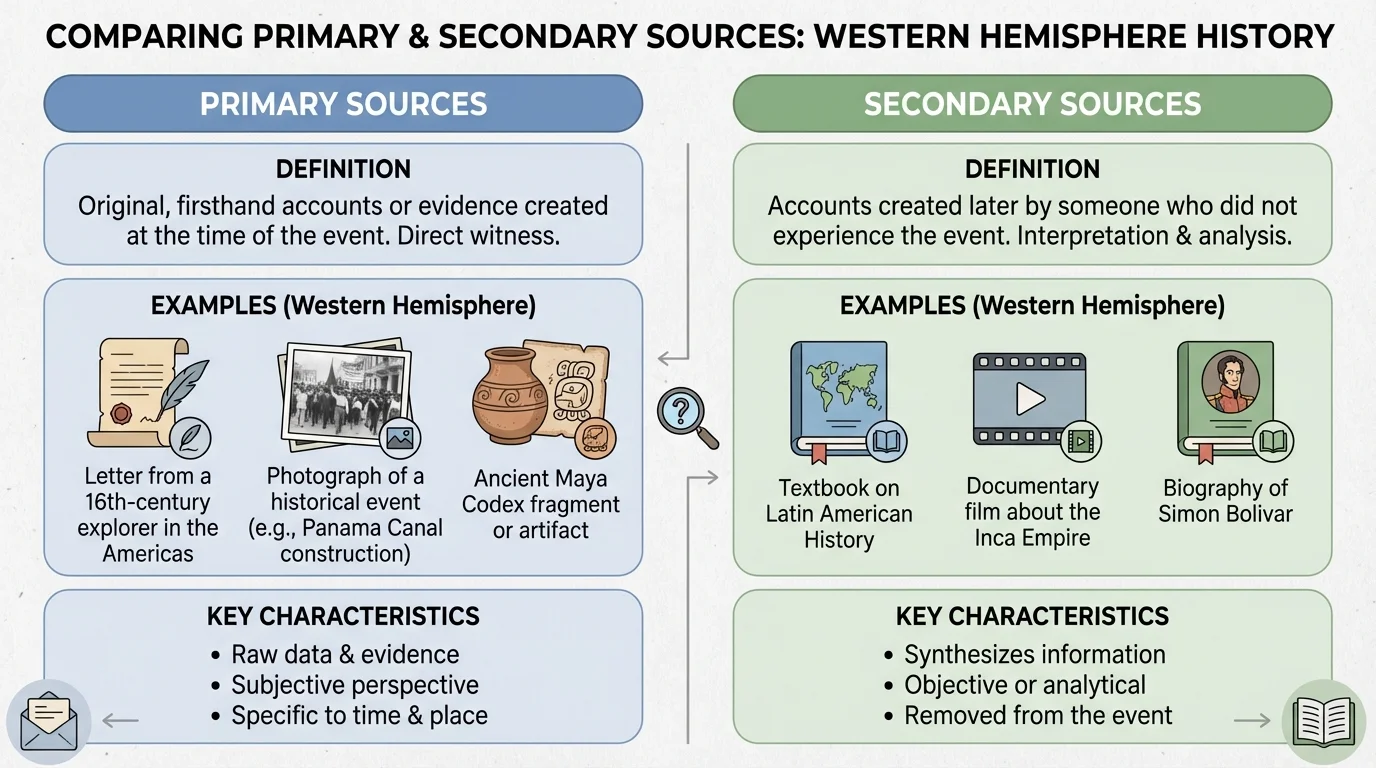
You can think of them like this:
For example, if you want to understand what life was like in a Caribbean port city in the 1700s, you might look at:
Using both together gives you a stronger, fuller answer than using only one type.
Good history begins with good questions. Historians do not just ask, "What happened?" They ask deeper questions, such as "Why did this happen?" and "What was it like for different kinds of people?"
A historical question should be:
Here are some strong historical questions about the Western Hemisphere:
Each of these questions points you toward certain sources. For example, to study civil rights activism, you might search for photographs of marches, speeches, song lyrics, and news articles.
You can think of the research process as a path, like the one in [Figure 3]. Let's walk through an example question: "What was daily life like for enslaved people on a Caribbean sugar plantation in the 1700s?"
Case Study: Life on a Caribbean Sugar Plantation
We will use both primary and secondary sources in clear steps.
Step 1: Begin with a secondary source.
You read a textbook section about the Atlantic slave trade and plantations in Jamaica and Barbados. The textbook explains that enslaved people worked long hours cutting cane, that many died from disease and overwork, and that some resisted by running away or slowing their work.
Step 2: Look for primary sources that show daily life.
You find:
Step 3: Ask, "What does each source show?"
From the manager's letter, you learn what a plantation owner thought. From the illustration, you see clothing, tools, and how crowded the fields were. From the formerly enslaved man's story, you hear what the work felt like from his point of view.
Step 4: Compare and combine.
The textbook gives the big picture. The primary sources add details and human voices. Together they help you answer the question: daily life was long, exhausting, and violent, with harsh punishments — but also included acts of resistance and courage.
By the end, you have used several types of sources as evidence to answer your question, not just your own opinions.
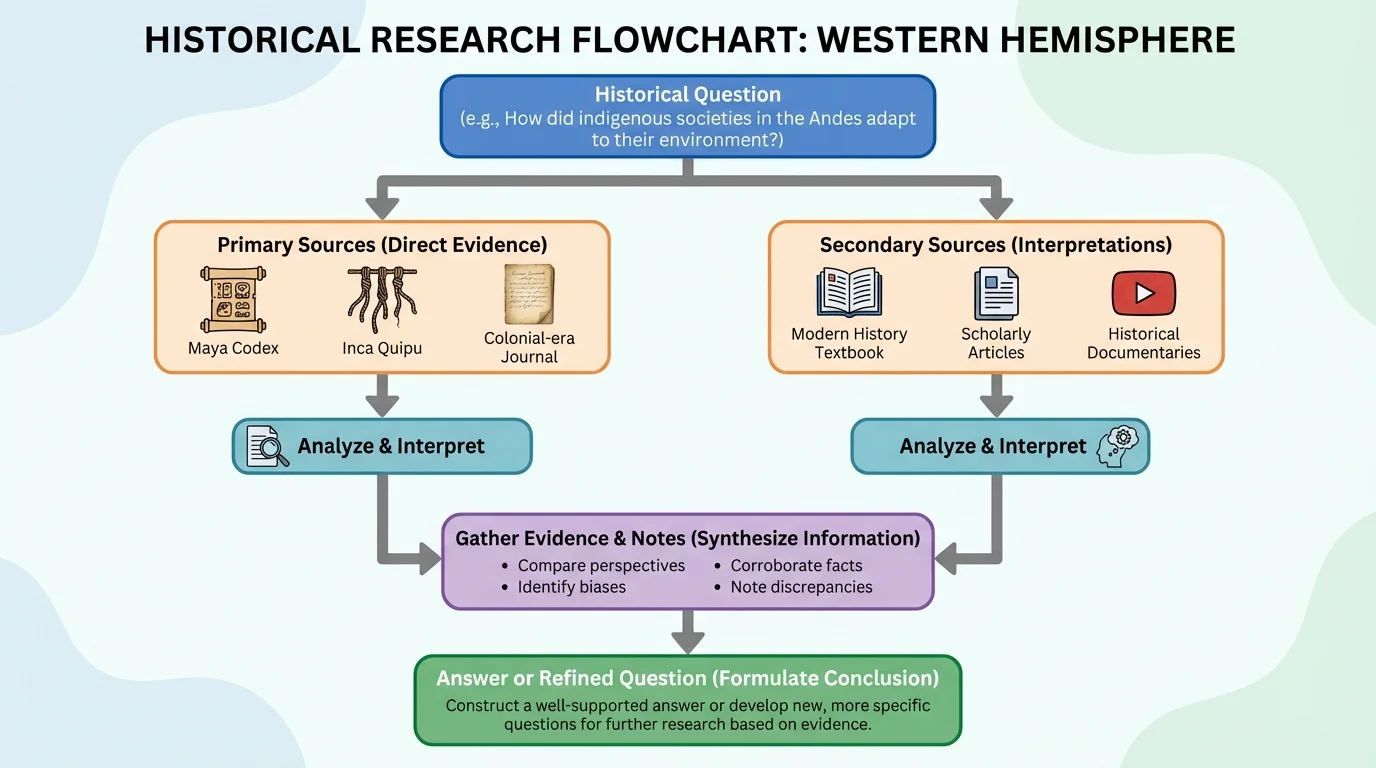
Later, when you investigate other topics — such as the Inca road system in South America or the Dust Bowl migration in North America — you can follow the same steps shown in [Figure 3]: ask a question, gather sources, take notes, and form an answer supported by evidence.
Not all sources are equally trustworthy. Historians must decide how much to trust a source by asking careful questions. This is called source evaluation.
When you study a source about the Western Hemisphere, ask:
Each creator has a perspective, or point of view. Perspective is not always bad — it just means we need to recognize it.
Consider these two descriptions of the same event — the Spanish conquest of the Aztec capital, Tenochtitlan:
Both are primary sources, but their perspectives are very different. A good historian uses both, plus secondary sources, to build a fairer picture of what happened.
"History is not the past itself, but the stories we tell about the past using the evidence it leaves behind."
— Saying often used by historians
Because of perspective, we also talk about bias. Bias means leaning strongly toward one side, sometimes in an unfair way. For example, a colonial government report about a Native uprising may describe Indigenous people as "savages," which shows the writer's bias. When you notice bias, you do not have to throw out the source, but you should be careful about how you use it.
Some famous "old" paintings and stories about Christopher Columbus were created long after his life and show him as a perfect hero. They often leave out the violence and enslavement that his voyages brought to Indigenous peoples in the Caribbean.
By asking smart questions and noticing perspective and bias, you become a more powerful history reader 💡.
Now put everything together. Suppose you want to explore this question: "How did building the Panama Canal change trade and daily life in Central America and North America?" This question is about the Western Hemisphere and can be answered with evidence.
A simple research plan could look like this:
Historians follow similar steps whether they are studying the Amazon rainforest, immigration through Ellis Island, or independence movements in Latin America. As you ask strong questions, use both primary and secondary sources, and carefully evaluate each one, you are doing real historical work — not just memorizing dates and names ⭐.
