Did you know that the foods on your plate, the sports you watch, and even some of the words you speak are the result of hundreds of years of people moving, trading, fighting, and sharing ideas across the Americas? 🌮⚽ From ancient cities in the rainforest to modern skyscrapers, the Western Hemisphere’s history is full of connections between people, places, and powerful ideas.
In this lesson, you will explore how different historical eras, individuals, groups, ideas, and themes in the Western Hemisphere are related to each other. You will see that history is not just a list of dates—it is a story of relationships: between Indigenous nations and European empires, between enslaved Africans and plantation owners, and between ordinary people and big ideas like freedom and equality.
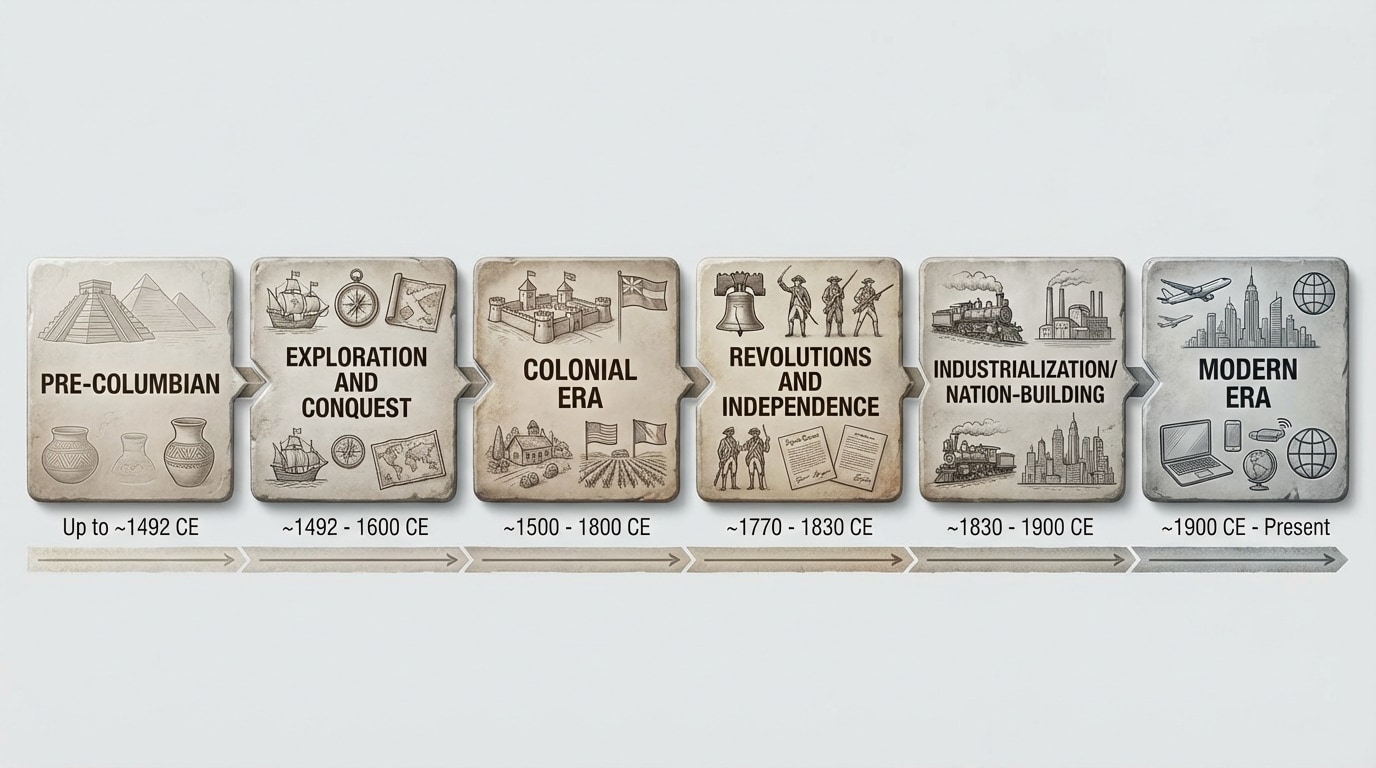
Historians divide the past into eras to make it easier to understand change over time. An era is a large block of time when certain things—like types of governments, technologies, or beliefs—are common. A timeline, like the one shown in [Figure 1], helps us see how these eras follow one another and sometimes overlap.
For the Western Hemisphere (the Americas and nearby islands), some major eras include:
These eras are not walls—they blend into each other. Ideas and problems from earlier eras continue into later ones. For example, conflicts over land that began in the Age of Exploration still affect Indigenous communities today.
Long before Europeans arrived, the Americas were full of complex and diverse societies. Different Indigenous nations developed their own governments, religions, and technologies, shaped by the environments they lived in. Their locations across the hemisphere, as shown in [Figure 2], helped determine how they interacted with one another.
Some important examples include:
These groups had relationships with one another. They:
The Haudenosaunee Confederacy, for example, formed a united government made up of several nations working together. Some historians think that their ideas about shared decision‑making influenced later democratic ideas in the United States.
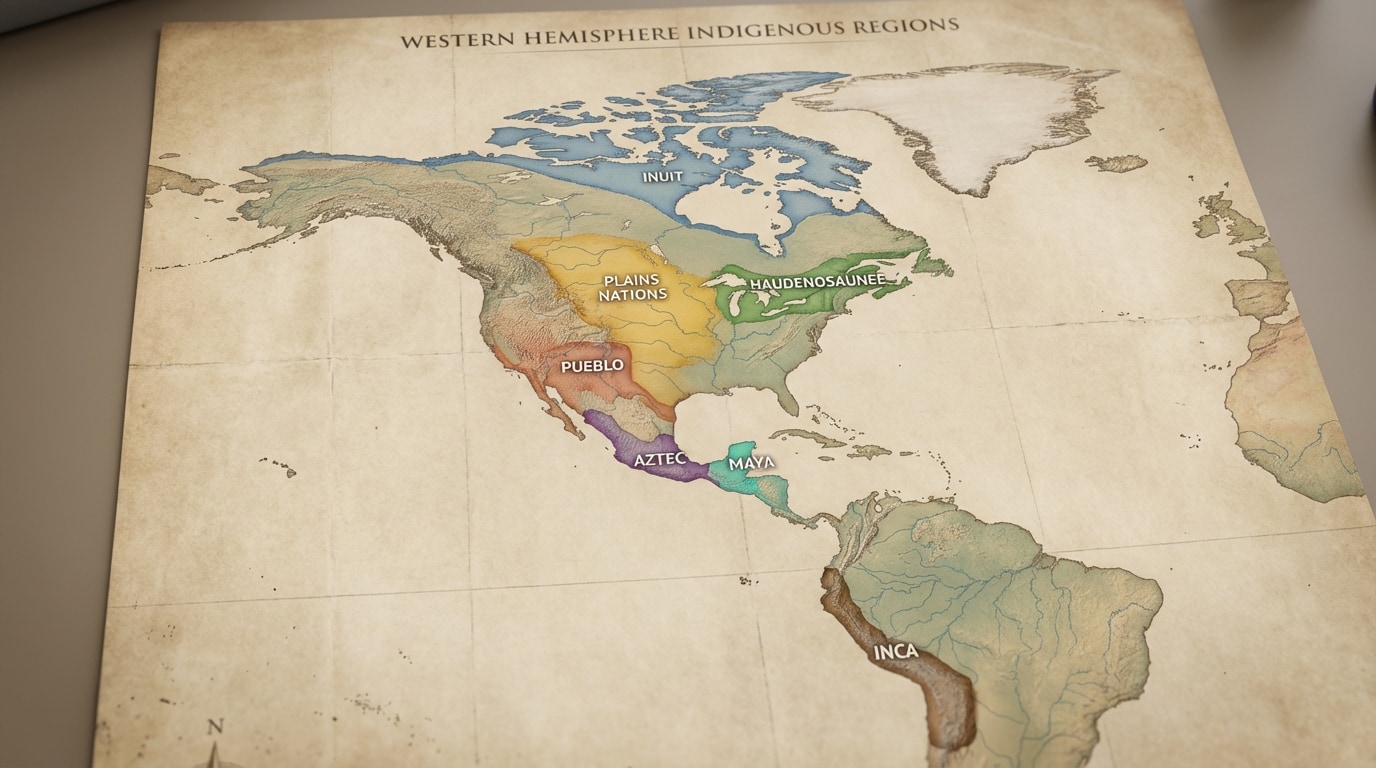
The environments shown in [Figure 2] also shaped Indigenous life. Mountain empires like the Inca used terrace farming, while peoples in the Arctic relied on hunting and fishing. Geography influenced what they could grow, what they could trade, and how easily they could contact other groups.
In the late 1400s, European kingdoms like Spain and Portugal wanted new sea routes to Asia for spices and luxury goods. When Christopher Columbus sailed west in 1492, he reached islands in the Caribbean instead of Asia. His voyage began a new era of contact between Europe, Africa, and the Americas.
Important figures and groups in this era include:
The relationships in this era were often violent and unequal:
This era is part of what historians call the Columbian Exchange—the movement of plants, animals, people, and diseases across the Atlantic. Foods from the Americas like corn, potatoes, and tomatoes spread to Europe, Africa, and Asia, while wheat, sugarcane, and coffee came to the Americas. These exchanges connected distant regions in powerful ways that changed diets, economies, and even populations.
After conquest, European powers set up colonies throughout the Western Hemisphere. Spain controlled much of Latin America, Portugal took Brazil, France and Britain claimed parts of the Caribbean and North America, and later the Netherlands and others joined in.
Colonial societies were shaped by relationships between different groups:
The Atlantic slave trade was part of a larger system sometimes called triangular trade:
Enslaved Africans did not simply accept their situation. They:
The cultures of the Western Hemisphere today—music, religion, language, food—have been deeply shaped by African, Indigenous, and European influences mixing together in this era. For example, many Caribbean and Latin American musical styles blend African rhythms with European instruments.
By the late 1700s, many people in the Americas were unhappy with colonial rule. New ideas from Europe, known as the Enlightenment, spread beliefs that people had natural rights and that governments should protect these rights. These ideas traveled across borders, inspiring revolutions in different regions, as shown in [Figure 3].
Some key independence movements include:
The relationships between these revolutions are important:
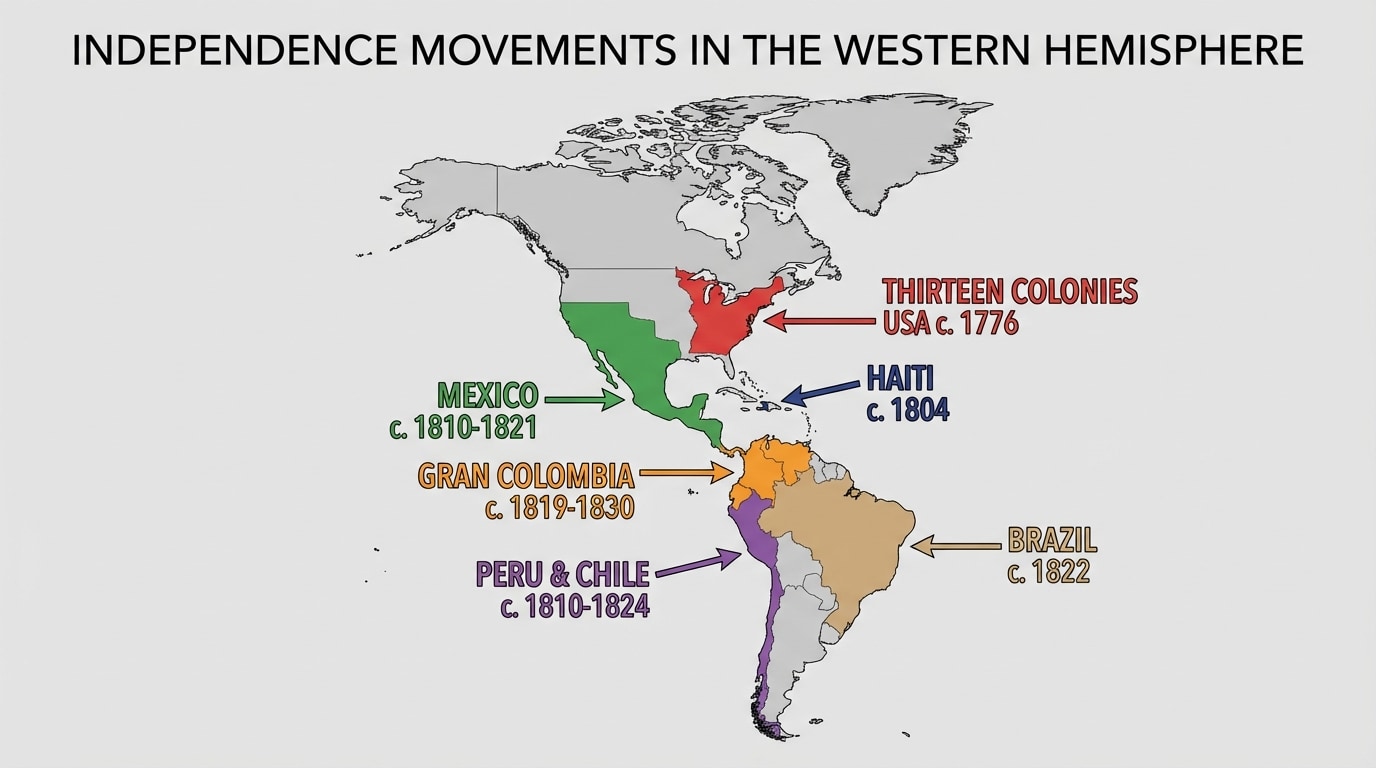
As you can see in [Figure 3], independence did not happen all at once. It spread over several decades and across different regions, connected by shared ideas like liberty, but also shaped by local conditions and leaders.
After independence, countries in the Western Hemisphere had to decide how to govern themselves, who belonged in the new nations, and how to use their land and resources. This era involved both growth and conflict.
Some major developments included:
Relationships between countries also shifted:
Across the hemisphere, people kept debating who should have power: large landowners or small farmers, factory owners or workers, government leaders or ordinary citizens.
In the 1900s and 2000s, countries in the Western Hemisphere became even more connected through technology, trade, and global problems. At the same time, many groups continued their struggles for rights and recognition. 🌎
Some important modern themes include:
Today, people in the Western Hemisphere are connected not only by history but also by cell phones, social media, sports, music, and shared worries about the planet. The past eras you have studied help explain why these modern connections look the way they do.
Across all these eras, certain themes appear again and again. These themes help us understand how individuals, groups, and ideas relate to each other over time. They also help us compare what happened in different parts of the Western Hemisphere.
1. Migration and Movement
People have always moved: the first humans who settled the Americas, Indigenous nations shifting territory, enslaved Africans forced across the ocean, European immigrants arriving by ship, and modern families crossing borders for work or safety. Movement changes cultures, mixes languages, and often causes conflict over who belongs.
2. Power, Conquest, and Resistance
From the Spanish conquest of the Aztec and Inca, to colonial governors, to modern governments, some groups have tried to control others. At the same time, those without power have resisted. You saw this in the Haitian Revolution, in slave rebellions, in Indigenous resistance to removal, and in civil rights movements. These struggles over power connect different eras into one long story.
3. Exchange of Goods and Ideas
The Columbian Exchange was only the beginning. Sugar, silver, coffee, and later oil and manufactured goods moved between regions. Along with goods, ideas traveled: Enlightenment ideas of liberty, religious beliefs, artistic styles, and political systems. The revolutions highlighted in [Figure 3] are good examples of how ideas about freedom crossed oceans and inspired people in many places.
4. Environment and Geography
Mountains, rivers, rainforests, and plains—all these features shape where people can live, what they can grow, and how easily they can travel. The Inca’s mountain roads, the Caribbean’s plantation islands, and the Amazon rainforest today all show how the environment affects human choices and relationships. The map of Indigenous cultures in [Figure 2] reminds us that even before Europeans arrived, geography helped determine who met, traded, or fought.
5. Identity and Culture
As groups meet and mix, new identities form. In many Western Hemisphere countries, people have mixed ancestry—Indigenous, African, European, and sometimes Asian. Languages like Spanish, English, Portuguese, French, and hundreds of Indigenous languages exist side by side. Music styles like samba, jazz, and reggae blend influences from several continents. These cultural identities are the result of centuries of relationships between different peoples.
🎯 The Western Hemisphere’s history is organized into eras—such as Indigenous civilizations, exploration, colonization, revolutions, nation‑building, and the modern era—but these eras are connected, not separate boxes.
🎯 Indigenous peoples built advanced societies long before European contact, trading and interacting across diverse environments.
🎯 European exploration and conquest created new relationships between Europe, Africa, and the Americas, including the Columbian Exchange and the Atlantic slave trade, which deeply changed populations, economies, and cultures.
🎯 Revolutions and independence movements in the United States, Haiti, and Latin America were linked by powerful ideas about rights and freedom, even though each had its own leaders and local causes.
🎯 In the 1800s and 1900s, new nations expanded, industrialized, and struggled over land, labor, and power, affecting Indigenous peoples, immigrants, and workers.
🎯 Modern times bring new connections through organizations, trade, technology, and shared challenges like environmental change, while movements for civil rights and equality continue the long struggle for justice.
🎯 Big themes—migration, power and resistance, exchange of goods and ideas, environment, and identity—help us see how people, groups, and regions in the Western Hemisphere have always been linked to one another. 🌍
