Examine civic participation within different governmental systems of the Western Hemisphere.
Examine Civic Participation Within Different Governmental Systems of the Western Hemisphere
Imagine you and your friends are trying to decide what game to play at recess. You could vote, let one person decide, or work together to make a plan. Each way of deciding changes who gets a say and how fair it feels. Governments work in similar ways—but for whole countries, not just games.
In this lesson, you explore how people in the Western Hemisphere (North, Central, and South America, plus the Caribbean) can take part in their governments. This is called civic participation. You see that different types of governments give people different levels of power and different ways to be involved.
What Is Civic Participation?
Civic participation means the ways people take part in their community and government. It is how everyday people help make rules, choose leaders, and solve problems where they live.
Civic participation can be:
Formal – official ways set up by the government, like voting in elections or serving on a jury.
Informal – everyday actions that are not official but still powerful, like talking about issues, protesting, or helping in community projects.
Some examples of civic participation include:
Voting for president, governor, or mayor.
Signing a petition to change a rule at school or in your town.
Attending a city council meeting with your family.
Peacefully marching to support a cause you care about.
Posting respectful messages about issues online and starting conversations.
Volunteering to clean up a park or help after a disaster.
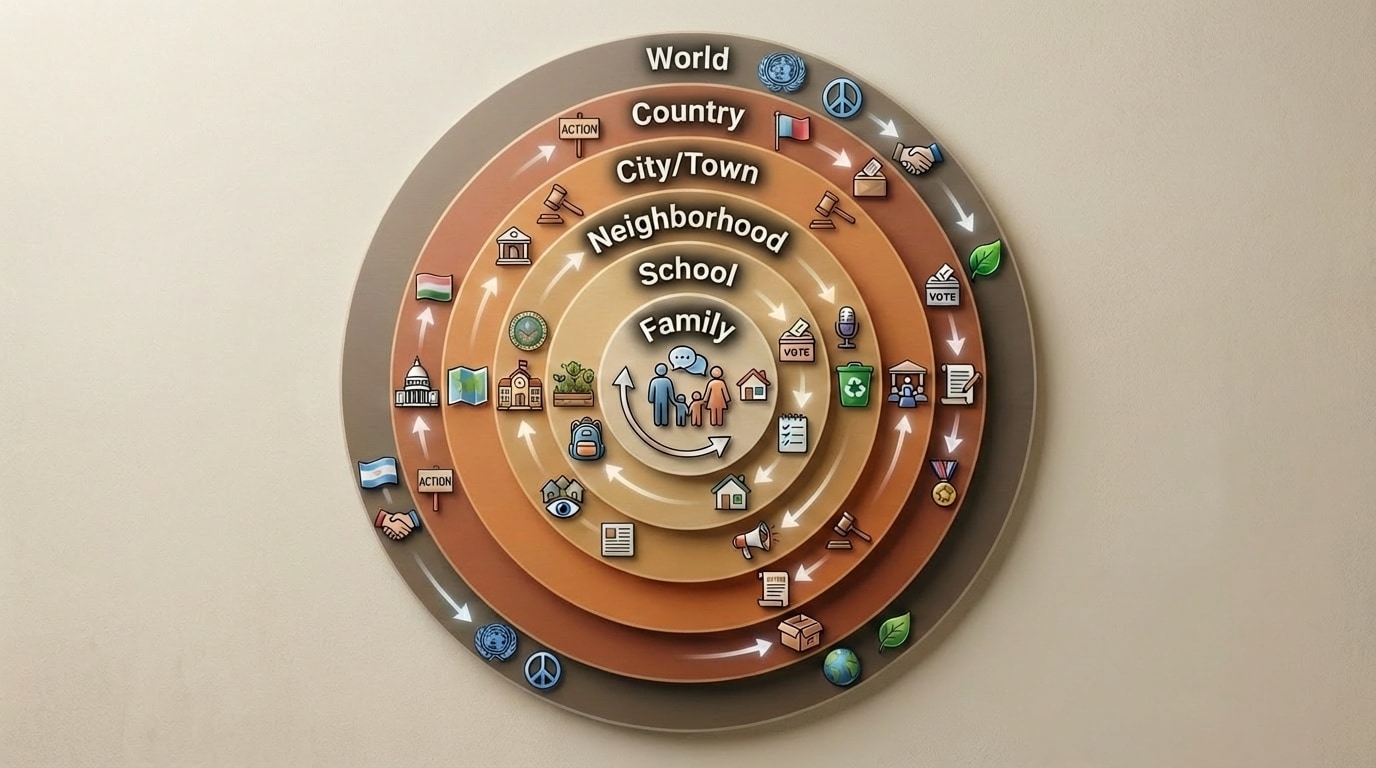
As shown in [Figure 1], civic participation can happen in many “levels” of community, from local neighborhoods up to whole countries.
Concentric circles labeled from inside to outside: 'Family', 'School', 'Neighborhood', 'City/Town', 'Country', 'World', with arrows and icons showing different civic actions like voting, volunteering, protesting at each level
Why Civic Participation Matters
Civic participation is important because:
It protects rights. When people speak up, it is harder for leaders to ignore or take away their rights.
It solves problems. Communities face issues like pollution, crime, or unfair rules. Participation helps find solutions.
It shares power. Instead of one person or a small group controlling everything, more people get a voice.
It builds community. Working together helps people trust each other and feel responsible for their shared space.
Did you know? In some countries, people risk arrest or even danger just to vote or speak out. That shows how powerful civic participation can be.
Different Types of Government in the Western Hemisphere
The Western Hemisphere includes many countries with different systems of government. The main types you learn about are:
Democracies – people have strong rights to participate.
Authoritarian systems – one leader or a small group holds most power, and participation is limited or controlled.
Mixed or changing systems – some democratic parts and some authoritarian parts, or governments that are in transition.
Government type affects how people can participate. To understand this, you look closely at civic participation in several countries.
Civic Participation in Democratic Systems
Most countries in the Western Hemisphere today are democracies or have democratic features. In a democracy, the basic idea is: the people rule. People do not run everything directly, but they choose leaders and help shape the laws.
Here are some key democratic features that affect civic participation:
Regular free elections where adults can vote without being forced or punished.
Multiple political parties to choose from.
Freedoms like freedom of speech, press, and assembly, so people can share opinions and protest.
Rule of law, meaning leaders must follow the law too.
Now look at a few examples.
Example 1: Civic Participation in the United States
The United States is a large federal democracy. Power is shared between the national government and the states. Citizens have many ways to participate.
Formal ways people participate in the United States:
Voting: Citizens 18 and older vote for president, members of Congress, governors, state lawmakers, mayors, school board members, and more.
Jury duty: Adults may be called to serve on a jury in a court case. This helps make trials fair.
Running for office: Adults who meet certain rules can run to be a leader, such as city council member or senator.
Contacting representatives: People can call, email, or write letters to their elected leaders to share opinions.
Informal ways people participate in the United States:
Protesting and marching: People gather to support or oppose laws and decisions (for example, marches for civil rights or climate action).
Joining groups: People join organizations that focus on the environment, voting rights, or helping the poor.
Community service: Many people volunteer at food banks, shelters, or clean-up days.
Online participation: People share information, sign online petitions, and join digital campaigns, especially on social media.
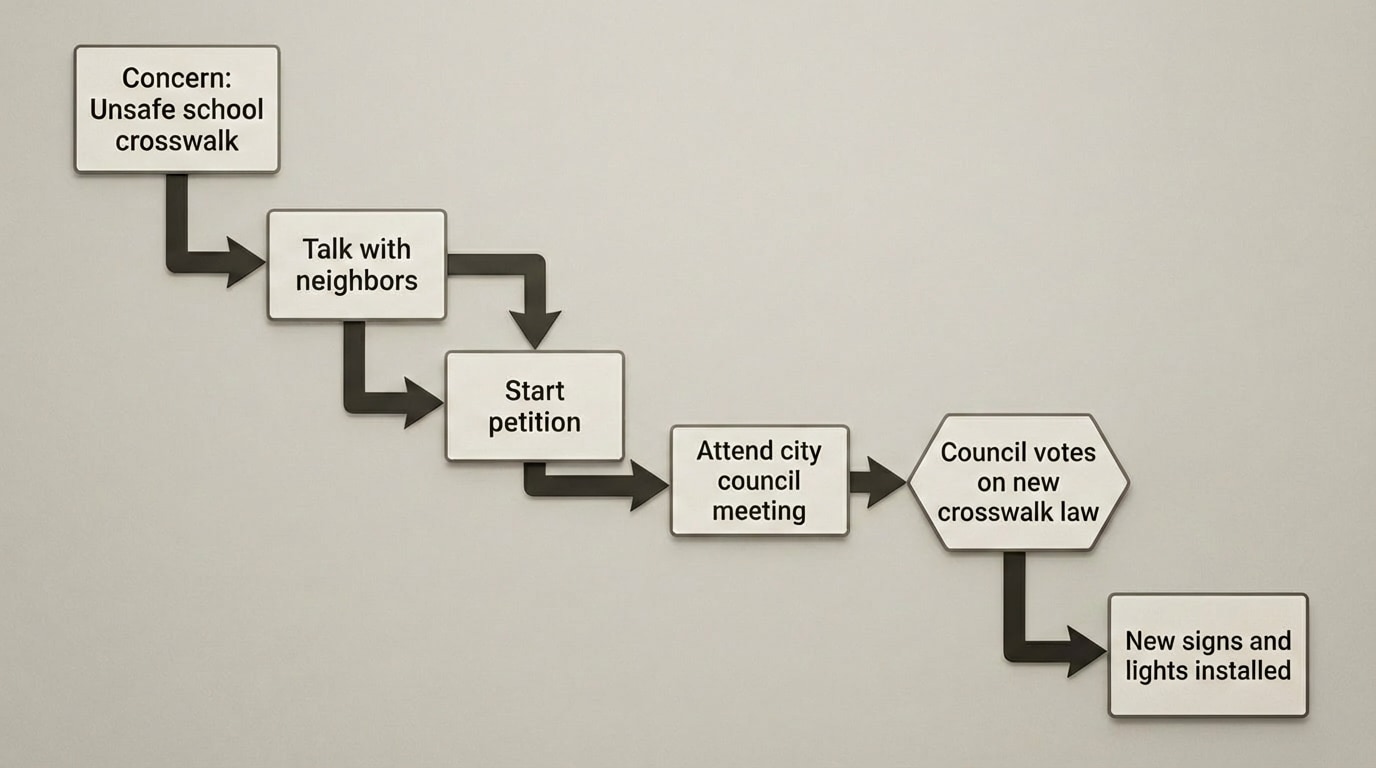
[Figure 2] shows a flowchart of how a citizen in the United States can turn an idea (like “safer school crossings”) into real change through civic participation.
Flowchart starting with 'Concern: Unsafe school crosswalk' leading to 'Talk with neighbors', 'Start petition', 'Attend city council meeting', 'Council votes on new crosswalk law', ending with 'New signs and lights installed'
Story example: Imagine students in a U.S. town notice cars speeding near their school. They talk to their parents, collect signatures from neighbors, and speak at a city council meeting. The council votes to add speed bumps and crossing guards. This is civic participation in action.
Example 2: Civic Participation in Canada
Canada is also a democracy, but it is a constitutional monarchy. This means it has a king or queen as a symbol, but elected leaders run the government day to day.
How Canadians participate:
Voting for members of Parliament who choose the prime minister.
Joining political parties or working on election campaigns.
Contacting Members of Parliament (MPs) to share concerns.
Participating in peaceful protests, for example, marches about climate change or Indigenous rights.
Canada also has strong protections for rights in its Charter of Rights and Freedoms, which helps people speak up without fear, as long as they follow the law.
Example 3: Civic Participation in Mexico
Mexico is a federal republic and a democracy. People vote for a president, Congress, governors, and mayors.
Formal participation in Mexico:
Voting in national and local elections.
Joining political parties that represent different ideas.
Serving in public office if they are elected.
Informal participation in Mexico:
Public demonstrations about safety, wages, or government actions.
Community organizations that help neighborhoods with safety, water, or housing.
Media and social media, where journalists and citizens share information and criticism.
In Mexico, like in many countries, civic participation can be challenging when people feel unsafe or do not trust the government. Still, many citizens continue to engage and push for change.
Civic Participation in Caribbean Democracies
Many Caribbean islands, such as Jamaica, Barbados, and Trinidad and Tobago, are democracies. They often have parliaments, prime ministers, and regular elections.
People participate by:
Voting in elections.
Joining labor unions or community groups.
Attending town meetings.
Taking part in peaceful demonstrations, sometimes about tourism, the environment, or workers’ rights.
Although these are smaller countries, civic participation still plays a big role in shaping laws and protecting beaches, forests, and cultural traditions.
Civic Participation in South American Democracies
Countries like Brazil, Argentina, Chile, and Colombia are democracies with strong traditions of civic participation, but they have also faced military rule or dictatorships in the past. This history affects how people think about their role today.
Example: Brazil
Brazil is a large democracy where citizens vote for president, Congress, and state and local leaders.
People participate by:
Voting (voting is officially required for many adults).
Joining social movements, like groups focused on the Amazon rainforest, workers’ rights, or fighting racism.
Participating in big demonstrations, sometimes with millions of people in the streets.
Example: Chile
Chile had a military dictatorship in the late 1900s. People protested and eventually voted in a referendum to end the dictatorship and return to democracy. Today, Chileans vote in elections and have recently voted on new ideas for a constitution. This shows how civic participation can change a whole country over time.
Civic Participation in Authoritarian or Less Free Systems
Not all governments in the Western Hemisphere are fully democratic. Some are more authoritarian, meaning a small group or one leader has most of the power. In these systems, civic participation is often limited or controlled.
Common features of authoritarian systems:
Elections may be unfair or tightly controlled.
There may be only one main political party, or other parties are blocked.
Media (TV, newspapers, internet) may be censored by the government.
Protests can be banned or punished.
People may be afraid to criticize leaders.
This does not mean people stop caring. Instead, civic participation might move underground or become quieter.
Example: Civic Participation in Cuba
Cuba is often described as a one-party state with strong government control.
Formal participation in Cuba:
Cubans can vote in elections, but only for candidates approved by the ruling Communist Party.
There is one main political party, and other parties have very limited power.
Informal or limited participation:
Some community meetings and local councils allow people to talk about local problems.
Some people express opinions privately or on social media, but they may face risks if they criticize the government strongly.
In systems like this, civic participation is present, but it is often more controlled and less free than in democracies.
Comparing Civic Participation Across Systems
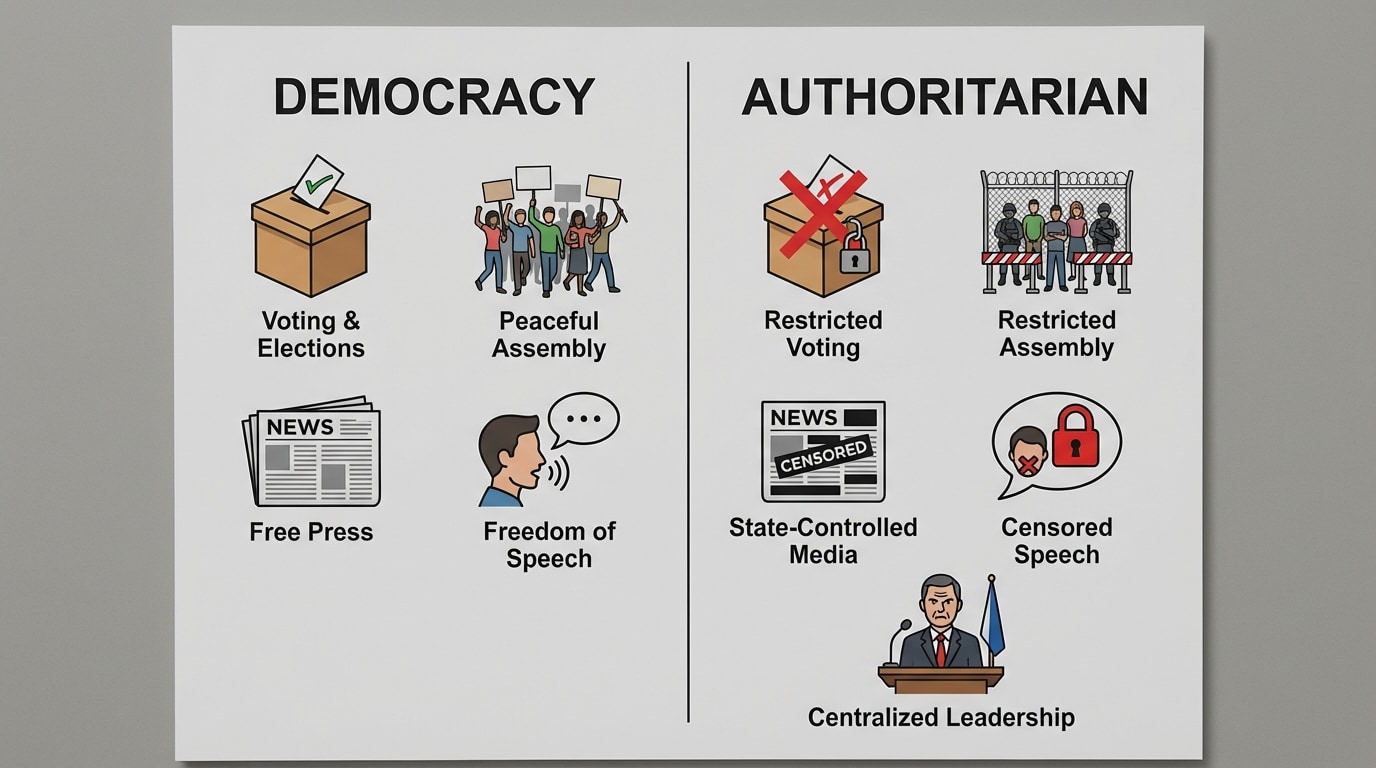
[Figure 3] compares how civic participation looks in a democracy versus an authoritarian system.
Two-column comparison chart. Left column titled 'Democracy' with icons for ballot box, protest march, newspaper, speech bubble; right column titled 'Authoritarian' with icons showing restricted or crossed-out versions of the same actions, plus a single leader at a podium
In democracies (like the United States, Canada, Brazil, Jamaica):
People have more ways to participate (voting, protests, independent media, many parties).
Rights like free speech and free press are protected by law.
Leaders can lose power in fair elections if people are unhappy.
In authoritarian systems (like Cuba or past military dictatorships):
People have fewer safe ways to participate.
Criticizing leaders can be dangerous.
Elections, if they exist, may not really allow change.
This does not mean people in democracies always use their power. For example, many eligible voters in the United States do not vote, even though they can. When people choose not to participate, they give up some of their power.
Ways Young People Can Participate (Even Before Age 18)
You might think, “I am only 11. I cannot vote yet.” That is true, but you still can be an active citizen. Civic participation is not just for adults.
Here are ways kids your age can participate:
Student government: Run for class representative or vote in school elections.
School rules: Speak respectfully to teachers and principals about making rules fairer or safer.
Community service: Join clean-up days, food drives, or charity events.
Learning and discussing: Talk with family about news and issues, ask questions, and share ideas.
Clubs and groups: Join or start clubs that help others, like environmental clubs.
Respectful online behavior: Share truthful information, avoid bullying, and use your online voice carefully.
These actions build habits and skills you can use later when you can vote and take part more directly.
Rights, Responsibilities, and Good Citizenship
Rights are freedoms or protections you have, such as:
The right to speak your opinion.
The right to practice your religion.
The right to a fair trial.
The right to vote (when you are old enough).
Responsibilities are duties you should follow to help your community, such as:
Obeying fair laws.
Paying taxes when you are an adult.
Serving on a jury if called (as an adult).
Respecting others’ rights, even when you disagree.
Staying informed about important issues.
A good citizen tries to balance both—using their rights and also meeting their responsibilities.
How History Shapes Civic Participation
The history of each country in the Western Hemisphere affects how people participate today.
United States: Movements like the civil rights movement fought to expand voting rights for African Americans and others. This history encourages many people to keep working for equality.
Canada: Indigenous peoples and other groups continue to participate to protect their land, culture, and rights.
Latin America: Many countries experienced dictatorships or military rule. People protested, organized, and eventually helped bring back democracy. Today, some people are very active to prevent a return to dictatorship.
Caribbean: People fought against colonial rule and for independence. Civic participation helped them gain more control over their own governments.
Knowing this history helps you understand why some people feel very strongly about voting, protesting, or defending free speech.
Challenges to Civic Participation
Even in democracies, not everyone participates equally. Some common challenges include:
Lack of information: People may not know when elections are or what the issues are.
Low trust: Some people do not trust leaders or think their vote matters.
Barriers: In some places, it is hard to get to polling stations, or rules make it more difficult for some groups to vote.
Fear or pressure: In less free systems, people may be afraid to speak out.
Many groups—like human rights organizations, youth groups, and educators—work to reduce these challenges so more people can take part.
Key Ideas to Remember
Across the Western Hemisphere, governments may look different, but one big question stays the same: How much voice do people have? Democracies give people many ways to participate, while authoritarian systems limit them. Your actions, even as a young person, can help shape your school, your neighborhood, and someday, your country.
Civic participation is not just something that happens far away in parliaments and presidential palaces. It starts wherever people come together to solve problems—on your street, in your classroom, and in your community.