What if a news story you heard today actually began hundreds of years ago? 🤔 Many of the most important events and problems in our world are not new at all. They are part of long stories that started in the past. To really understand what is happening now, especially in places across Asia, Africa, and Europe, we need to understand their history.
This skill is called using historical context. When we look at current events inside their bigger, older story, we make better judgments, ask smarter questions, and think more fairly about other people and places.
When you watch a movie starting in the middle, characters' choices feel confusing. You keep asking, "Why did they do that?" Historical context works the same way: it is the "first half of the movie" for real-life events.
Historical context is the background of events, people, and ideas from the past that helps explain what is happening in the present.
Current events are important things happening in the world right now, such as elections, protests, new laws, wars, or peace agreements.
When we add historical context to current events, we can:
This is especially important in the Eastern Hemisphere, where some of the world's oldest civilizations began, and where many cultures, religions, and empires have interacted for thousands of years.
The Eastern Hemisphere is the half of the Earth that lies mostly east of the Prime Meridian (0° longitude) and west of 180° longitude. On a world map of the Eastern Hemisphere, like the one in [Figure 1], you can clearly see that it includes three main continents and many important regions:
These lands are connected by major bodies of water such as the Mediterranean Sea, the Red Sea, the Indian Ocean, and the South China Sea. For thousands of years, people have traveled across deserts, mountains, and oceans in this hemisphere to trade goods, share beliefs, and sometimes fight over power and resources.
Because the Eastern Hemisphere is so interconnected, what happens in one part can quickly affect others. A war in one country can change the price of oil or food in many different places. A new trade agreement between two countries can raise or lower the cost of everyday products for people far away.
For a long time, the Eastern Hemisphere has been tied together by trade. Merchants have carried goods like silk, spices, gold, and ideas across great distances. These trade routes created relationships that still matter today, as we see in [Figure 2].
Two of the most important historical trade systems were:
The Silk Road was not just one road. It was a network of land routes connecting China, Central Asia, the Middle East, and Europe. From around 200 BCE to the 1400s CE, traders moved goods like silk, porcelain, horses, spices, and precious metals along these paths.
But people did not only trade objects. They also carried:
The Indian Ocean trade routes connected East Africa, the Arabian Peninsula, India, Southeast Asia, and China. Sailors used seasonal monsoon winds to travel back and forth. Coastal cities, like those along the Swahili Coast in East Africa, became wealthy trading centers.
On these sea routes, traders exchanged:
Today, many modern shipping routes follow similar paths over water as the old Indian Ocean trade, and railways and highways often run near historic Silk Road routes. When you hear news about shipping delays in the Suez Canal or about new rail lines from China toward Europe, you are seeing new chapters in a very old story that began along these routes.
Some historians call the modern network of roads, railways, and ports that connect China to Europe and Africa a "New Silk Road" because it continues the old pattern of long-distance trade across the Eastern Hemisphere.
Understanding these past connections helps explain why certain ports and cities are still powerful today and why countries argue or cooperate over control of sea lanes and pipelines.
When you see borders on a map, it is easy to forget that someone decided where to draw those lines. In much of the Eastern Hemisphere, earlier rulers and foreign empires shaped borders that still affect people today. A map of one of these empires, like the one in [Figure 3], helps you see how its territory compares to modern borders.
The Ottoman Empire was a powerful state that lasted from the late 1200s to the early 1900s. At its height, it ruled parts of Southeast Europe, Western Asia (including much of the Middle East), and North Africa.
For centuries, people of many different religions and languages lived under Ottoman rule. The empire controlled important trade routes and cities such as Istanbul (formerly Constantinople), Cairo, and Baghdad.
In the 1800s and early 1900s, the Ottoman Empire became weaker, and European powers became more involved in its lands. After World War I, the empire collapsed. New borders were drawn in the Middle East, often by European leaders who did not fully understand or respect the local ethnic, religious, and tribal groups.
Some of these new borders cut across areas where one ethnic group lived or forced different groups into a single new country. This history helps explain why certain border regions in the Middle East have experienced long-lasting conflicts, civil wars, and debates over identity and independence, which connect back to the map in [Figure 3].
Similarly, many African and Asian lands were controlled by European colonial powers such as Britain, France, Portugal, and the Netherlands. Colonial rulers often drew borders to benefit themselves—dividing resources, people, and cultures without asking the local populations.
When African and Asian countries gained independence in the 1900s, they usually kept the old colonial borders to avoid even more conflicts. But those borders sometimes created tensions between groups that had not chosen to be in the same country.
Today, when you read about disputes inside or between countries in Africa or Asia, you can ask: How did past empires or colonial rulers help create this situation? Knowing that history gives you important clues for understanding what is happening now and why certain solutions are difficult.
Besides goods and armies, powerful ideas also move across regions of the Eastern Hemisphere. Religions, political beliefs, and cultural practices have spread and changed over time, connecting people far apart, as suggested by the flows in [Figure 4].
Three of the world's major monotheistic religions—Judaism, Christianity, and Islam—began in the Eastern Mediterranean and the Arabian Peninsula.
These religions shaped laws, cultures, and daily life across large areas. They also sometimes clashed as empires and leaders used religion to gain support or justify wars. At the same time, religious ideas encouraged art, learning, and charity.
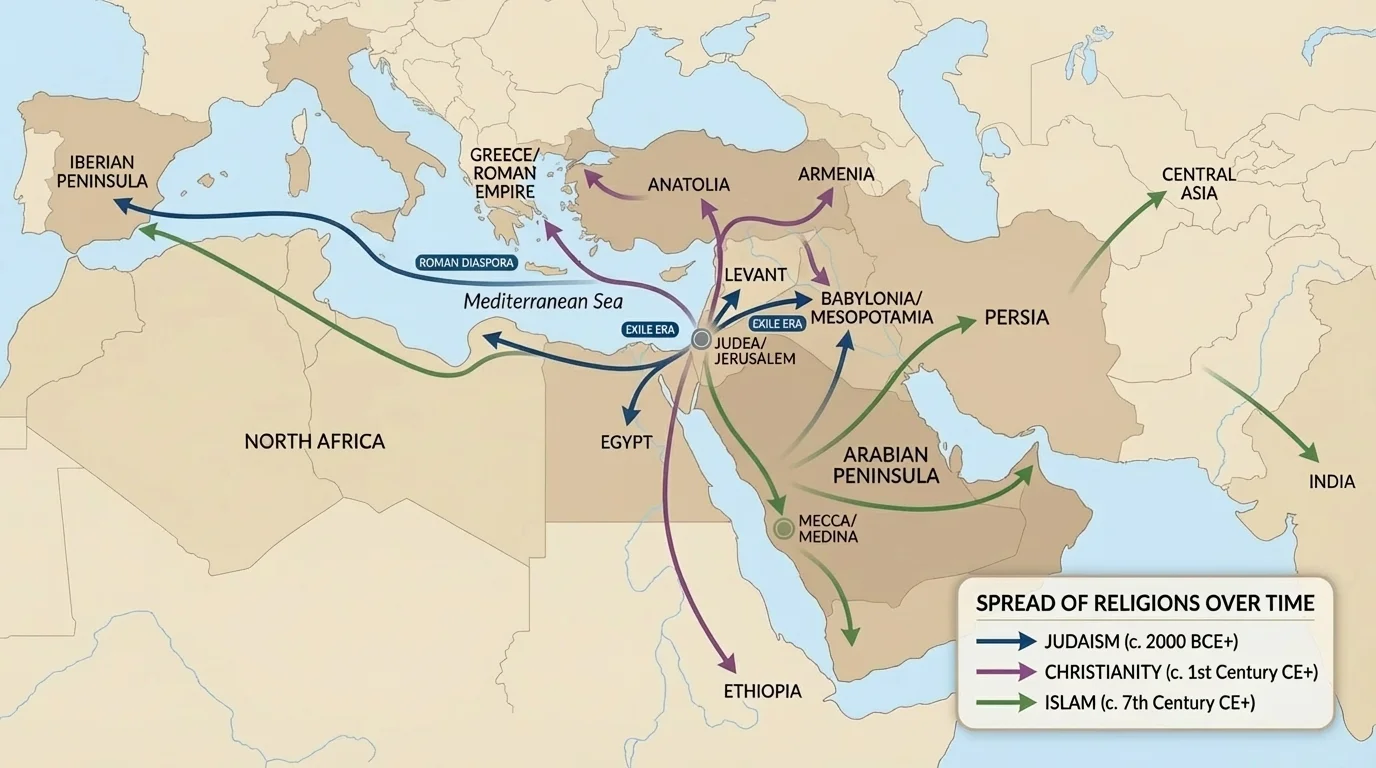
Many current events—such as debates about religious freedom, conflicts over holy sites, or efforts at interfaith dialogue—only make sense when we remember this long history of religious spread and interaction.
Another powerful idea is nationalism—the belief that people who share a common culture, language, or history should rule themselves as a nation. In the 1800s and 1900s, nationalism inspired many independence movements in the Eastern Hemisphere.
Today, when you see news about people demanding more self-rule, protesting foreign control, or arguing over national symbols, you are often seeing new versions of these older nationalist struggles.
To apply historical context correctly, we need evidence. Historians and students use two main kinds of sources to understand the past and connect it to the present.
Primary sources are original records from the time being studied, such as letters, diaries, government documents, speeches, photos, or objects.
Secondary sources are later accounts that interpret or explain the past, such as textbooks, documentaries, or articles written by historians.
For example, to understand a current protest in a Middle Eastern country, you might:
By combining both, you see not just what is happening now, but also how earlier events prepared the way for today's situation.
When you read or watch the news, always ask: "What happened here before that might help explain this?" Even a quick search in an encyclopedia or a reliable website can give you basic historical context.
The Eastern Hemisphere is full of examples where one region's history and choices strongly affect another. Thinking about these connections helps you draw smarter conclusions about modern problems.
Some examples include:
When you connect these present-day issues back to older trade routes, past empires, and long histories of migration and cultural exchange, you begin to see the world as a web of relationships, not just separate countries.
Historical context is not just for knowing more facts. It helps you think like a problem-solver. Here is a simple way to use it when you face a question about a current event:
Mini Case Study Example
Imagine you read a news story about two neighboring countries in Central Asia arguing over water from a river.
Step 1: Describe the event.
Two countries that share a river are in conflict because one is building a dam, and the other fears losing water for farms.
Step 2: Look backward.
You learn that, in the 1900s, these regions were part of a larger empire that built irrigation systems and decided water rules. After independence, new borders left some water sources in one country and farmlands in another.
Step 3: Find patterns.
You see that other regions in the Eastern Hemisphere, like the Nile River basin in Africa, have also had disputes over shared rivers and dams.
Step 4: Draw conclusions.
You might conclude that today's water conflict is partly caused by old border decisions and past irrigation projects that did not consider the future needs of independent countries.
Step 5: Suggest solutions.
Learning from history, you might suggest regional agreements that share water fairly, joint dam projects, or international organizations to help mediate, because similar solutions have helped in other river disputes.
By using historical context, you move beyond simple blame and toward realistic, fair solutions.
Understanding the historical context of current events in the Eastern Hemisphere means connecting:
When you combine all of these, you are not just memorizing names and dates. You are practicing a powerful way of thinking that helps you become an informed, thoughtful person in a complicated, interconnected world. 🌐
