Many people think of history as a settled story: dates, names, and events that “already happened.” But if you compare two textbooks from different countries describing the same war, you may feel like you are reading about two different conflicts. That tension is exactly where real historical thinking starts. Historians do not just memorize facts; they investigate questions, argue over evidence, and defend interpretations using sources.
This lesson explains how to apply the historical method of inquiry: how to ask compelling questions, evaluate primary and secondary sources, analyze and interpret data, and argue for an interpretation supported by textual evidence. These are the same skills professional historians use—and they are also powerful tools for understanding news, politics, and debates in the world you live in today.
A story can be made up. History, by contrast, is an evidence-based reconstruction of the past. It is never perfect or complete, but it is grounded in documents, artifacts, and data that come from the time being studied.
The historical method of inquiry is a process that includes:
Because humans leave behind incomplete and sometimes biased evidence, historians must constantly weigh sources, look for patterns, and be transparent about the limits of their conclusions.
Every historical investigation begins with a question. Weak questions lead to shallow answers; strong questions open the door to deep analysis.
Types of historical questions:
For serious historical work, descriptive questions are a starting point, but analytical and evaluative questions are usually more compelling because they require interpretation and argument.
Features of a strong historical question:
Example: refining a question
Notice how the stronger questions focus on a time period (1955–1965), specify a topic (tactics, or legal challenges vs protests), and invite argument rather than a simple yes/no answer.
Once you have a question, you need evidence. Historians divide sources into two big categories: primary and secondary.
Primary sources are created during the time period you are studying or by people who directly experienced the events. They provide first-hand evidence or direct records of the past.
Examples of primary sources:
Secondary sources are created after the events, usually by people who did not directly experience them. They analyze, interpret, or synthesize primary sources.
Examples of secondary sources:
Both types of sources are useful. Primary sources bring you closer to the voices and images of the past; secondary sources help you see the bigger picture and learn how other historians have interpreted the same events.
When you use either type, you practice sourcing: asking critical questions about who created a document, when, for whom, and why.
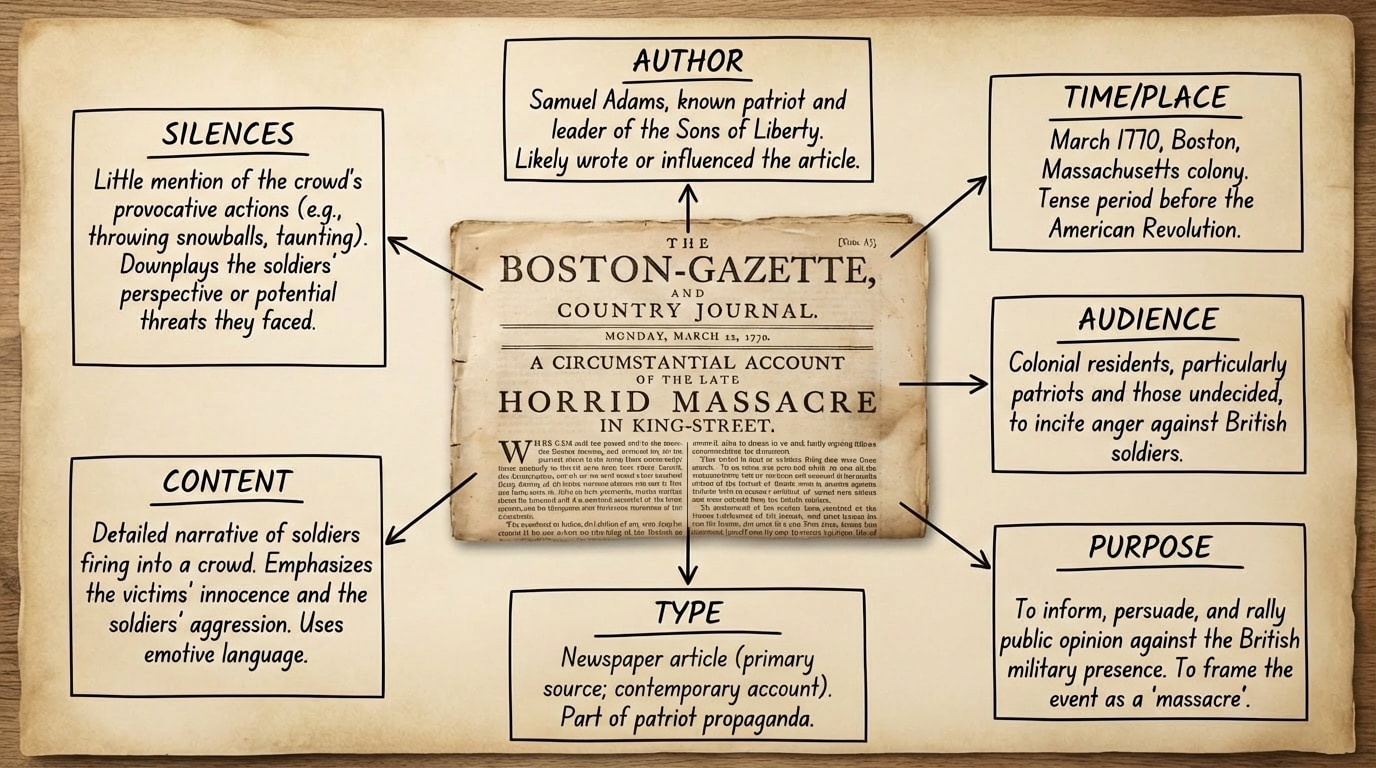
Not all sources are equally useful for every question. Historians systematically evaluate sources by asking a set of recurring questions, often organizing their thinking with a source-analysis chart like the one in [Figure 1].
This kind of chart helps you keep track of key information about each document you examine.
Core sourcing questions:
You also need to consider perspective and bias. Every source has a point of view. For example, a British officer writing about the Boston Massacre in 1770 will likely describe events differently than a Boston Patriot who hated British rule. Bias does not automatically make a source “bad”; it tells you how to interpret its claims.
Corroboration means comparing multiple sources to see where they agree or disagree. If three independent witnesses report that soldiers fired into a crowd, that detail is more trustworthy than if only one person says it.
Mini-case: the Boston Massacre (1770)
Imagine you have three sources about the Boston Massacre: a British officer’s report to his superior, a Patriot engraving by Paul Revere showing soldiers firing on peaceful colonists, and a later textbook chapter. Evaluating them might look like this:
By sourcing and corroborating, you can build a more nuanced understanding than any single document provides. When you later build an argument, you will rely on this careful evaluation, just as the organizer in [Figure 1] encourages you to do.
In history, “data” does not only mean numbers. It includes both quantitative (numerical) and qualitative (descriptive) information. Timelines, charts, and graphs can make patterns visible.
Qualitative data includes words and images: quotes from speeches, diary entries, newspaper headlines, propaganda posters, photographs, and maps. You analyze this kind of data by looking at language, tone, symbolism, and what is emphasized or ignored, as you can see in [Figure 2].
For example, a World War I recruitment poster showing heroic soldiers might reveal how governments wanted citizens to view the war, even if the reality was far more brutal.
Quantitative data includes numbers: population statistics, economic figures, election results, and casualty counts. Historians use this data to identify trends such as growth, decline, inequality, or the impact of policies.
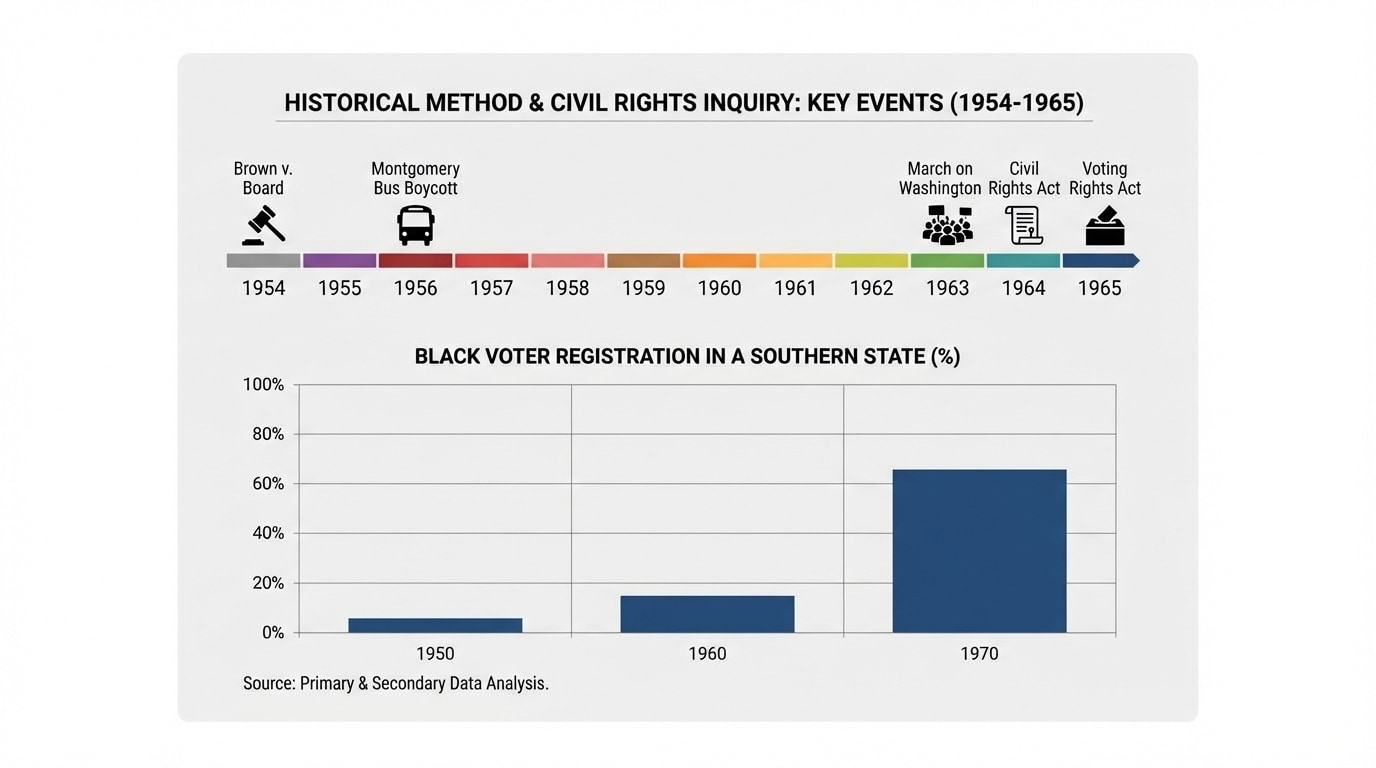
Example: Civil Rights timeline and voter registration data
Imagine a timeline with key events in the U.S. Civil Rights Movement between 1954 and 1965 (Brown v. Board of Education, Montgomery Bus Boycott, March on Washington, Civil Rights Act of 1964, Voting Rights Act of 1965) paired with a bar graph showing African American voter registration rates in one Southern state in 1950, 1960, and 1970. This kind of combined visual helps you see how legal and protest events relate to measurable change over time.
To analyze this, you might ask:
Interpreting data always connects back to your question. If your question is “How effective was federal legislation in expanding Black voting rights in the 1960s?”, you would use the timeline and data to argue for your interpretation of “how effective.”
Whether you are working with a chart of industrial production in 19th-century Britain or a map of trade routes in the Indian Ocean, you are always asking: What patterns do I see? How might those patterns help explain causes, consequences, or significance?
An interpretation is a historian’s explanation of the past: what happened, why it happened, and why it matters. Crucially, interpretations are not random opinions; they must be grounded in evidence from sources.
Different historians, looking at the same set of sources, can reach different but still reasonable interpretations. This is not a weakness of history; it is part of what makes it an active and intellectual discipline.
A clear historical argument usually follows a claim–evidence–reasoning structure:
Example of a claim (analytical question about the Industrial Revolution): “The rapid growth of industrial cities in 19th-century Britain was driven more by changes in agricultural productivity than by new transportation technologies.”
To support this claim, you would select sources such as:
You would then use reasoning to connect these pieces of evidence to your claim, explaining step by step how agricultural changes forced people off farms and into factories, while transportation played a smaller role.
Strong historical arguments do not just list evidence; they use evidence strategically and explain it clearly.
Quoting and paraphrasing
You should quote when the original wording is powerful, revealing, or precise. However, flooding your writing with quotes can make it hard to follow your own argument. Most of the time, you will paraphrase and then explain.
Avoiding “quote dropping”
“Quote dropping” happens when someone inserts a quote without explaining why it matters. Instead, you should introduce the source, present the quote or paraphrase, and then analyze it.
Example:
Instead of just writing: “According to a speech by Martin Luther King Jr., ‘Now is the time to make justice a reality for all of God’s children,’” you might write:
“In his 1963 ‘I Have a Dream’ speech, delivered at the March on Washington, Martin Luther King Jr. urged Americans to act immediately, declaring that ‘now is the time to make justice a reality for all of God’s children.’ By repeating the phrase ‘now is the time,’ King emphasized the urgency of civil rights reforms and rejected gradual approaches that would delay equality for Black Americans.”
Notice how this example names the source, provides context (when and where), presents the quote, and then explains its significance.
When deciding which evidence to include, think back to the evaluation work you did using tools like the organizer in [Figure 1] and the patterns you observed in data like that in [Figure 2]. The more carefully you have evaluated and analyzed your sources, the more convincing your use of evidence will be.
To see how the pieces fit together, consider a brief example using the Montgomery Bus Boycott (1955–1956) in the U.S. Civil Rights Movement.
1. Formulate a question
Question: “Why did the Montgomery Bus Boycott succeed in ending bus segregation?”
This question is analytical (it asks “why”), focused (one city, one event), and debatable (historians might emphasize different causes).
2. Identify relevant sources
You might look at:
3. Evaluate sources
For each source, you would ask: Who created it? When? For whom? Why? For instance, a local white-owned newspaper might describe the boycott as disruptive or illegal, while a Black-run newspaper might depict it as a courageous stand for justice. Recognizing these perspectives helps you weigh and interpret their claims.
4. Analyze and interpret data
You might see that the boycott lasted over a year, that thousands of Black residents walked or joined carpools, and that the city lost significant bus fare revenue. A timeline might show connections between the boycott, court cases, and national media attention, similar to how timelines and graphs highlight patterns in [Figure 2].
5. Build an interpretation
Using this evidence, you could develop a thesis such as:
“The Montgomery Bus Boycott succeeded because it combined disciplined local organization with effective legal challenges and national media attention, which together pressured both the city government and the federal courts to end bus segregation.”
You would then choose your strongest evidence for each part of this claim:
Your paragraphs would link specific pieces of evidence to each part of the thesis, with reasoning that explains how that evidence shows organization, legal pressure, or media influence.
Applying the historical method of inquiry is not just a technical skill set. It also involves ethical responsibilities.
When you evaluate sources carefully and argue transparently, you contribute to more honest and informed conversations about the past and the present.
To effectively apply the historical method of inquiry, keep these essentials in mind:
By following these steps, you move beyond memorizing facts and start thinking and arguing like a historian—skills that matter not only for understanding the past, but also for navigating the complex world you live in today.
