Have you ever looked outside and thought, "The sun was over there before!" or "The moon looks different tonight"? The sky is full of patterns. A pattern is something that happens again and again in a way we can notice. When we watch the sky carefully, we can learn what usually happens next.
People have watched the sky for a very long time. We can look up and observe the sun in the daytime, the moon at many times, and stars at night. When we make observations, we use our eyes and other tools to notice what is happening.
Scientists look for things that repeat. If something repeats, we may be able to make a prediction. A prediction is a smart guess based on what we already noticed. For example, if the sun goes down every evening, we can predict that evening will come again today.
Pattern means something happens in a repeated way. Prediction means telling what will probably happen next by using observations. Observe means to look carefully and notice details.
The sky gives us many chances to find patterns. Some patterns happen every day, and some take longer. The sun has a daily pattern. The moon has a repeating pattern of shapes. Stars can be seen at night, and their positions in the night sky follow patterns too.
The sun appears in the sky during the day. It seems to move across the sky from one side to the other each day, as shown in [Figure 1]. We see it in one part of the sky in the morning, higher up around the middle of the day, and lower again later in the day.
This pattern helps us tell parts of the day. Morning, midday, and evening happen in a regular order. After daytime comes nighttime. Then a new day begins. Because this pattern repeats, we can predict that after night, the sun will appear again the next day.
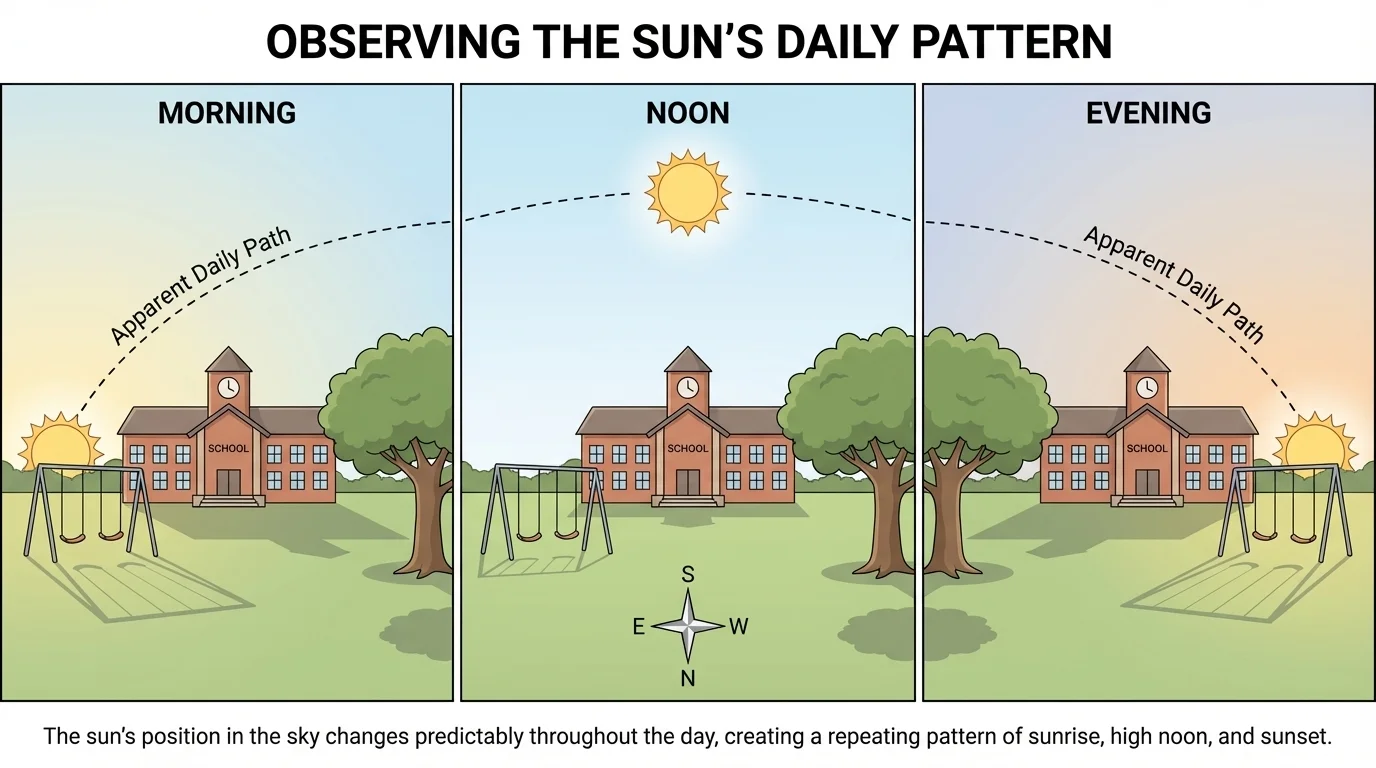
The sun also helps make shadows. In the morning, a shadow may point one way. Later, it changes. At midday, the shadow may look shorter. By evening, it points another way. These changes happen because the sun seems to move across the sky.
People use the sun's pattern in real life. Families know when it is time to wake up, play outside, or go home when the sky gets darker. Farmers, builders, and gardeners also pay attention to sunlight during the day. The daily pattern in [Figure 1] helps people plan what they do.
Some animals use the sun's daily pattern too. Birds, bees, and many other living things change what they do at different times of day.
The sun is bright and important to observe, but it is never safe to look directly at it. Scientists use safe tools and careful methods when they study the sun.
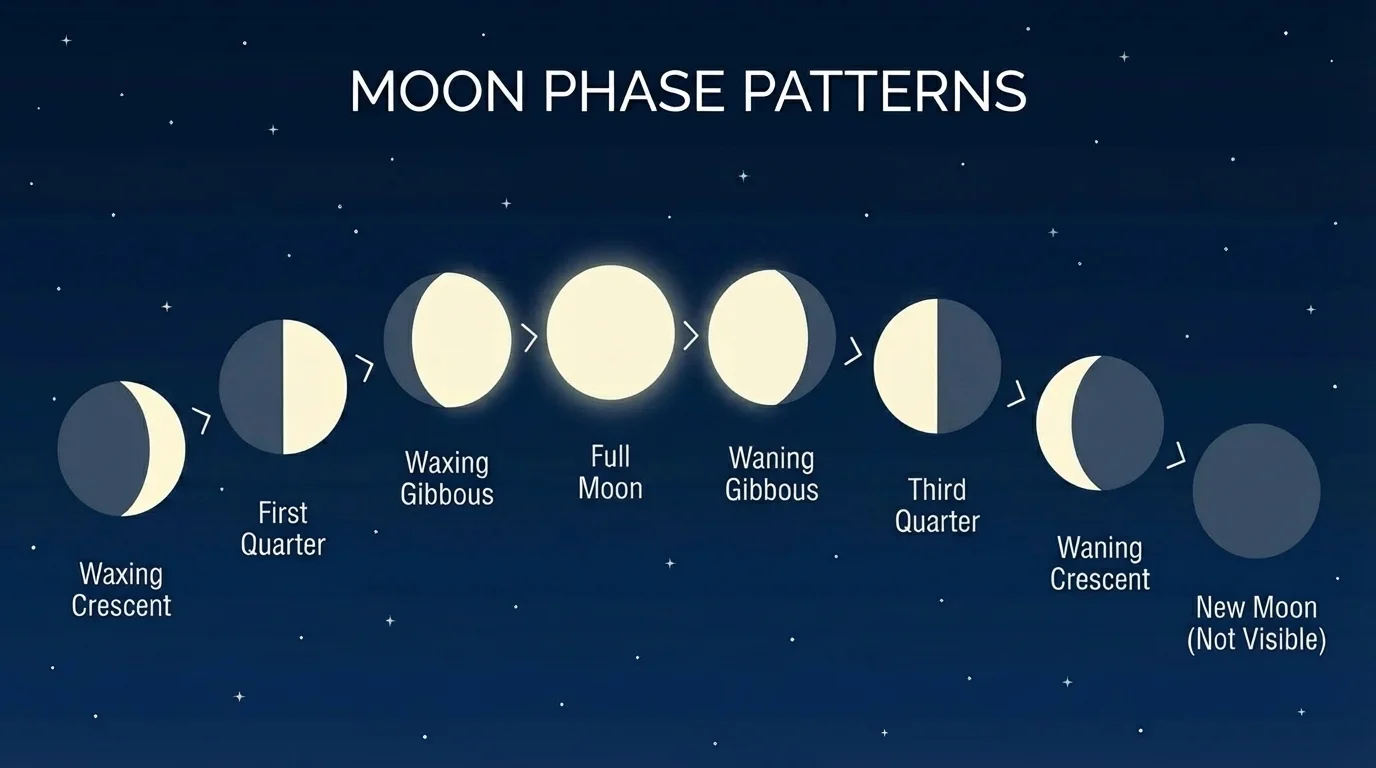
The moon is not always the same shape when we look at it from Earth. Its shape seems to change in a repeating cycle, as shown in [Figure 2]. Sometimes we see a thin crescent. Sometimes we see a half moon. Sometimes the moon looks full and round.
These moon shapes repeat again and again over time. That means we can observe the moon for many nights and begin to predict what shape we may see next. If the moon is a thin crescent tonight, it will not stay exactly that way forever. It will continue changing as part of its pattern.
The moon is sometimes seen at night, and it can also be seen at some times during the day. What matters for this lesson is that its appearance changes in a pattern we can notice and describe. We do not need to know every name of every moon shape to understand that the pattern repeats.
People have used moon patterns for a long time. A family might notice a bright full moon lighting up the night. Someone camping may see that some nights are darker and some are brighter. Looking back at [Figure 2], we can remember that the moon's changing shape is not random. It follows a repeating cycle.
Patterns help us predict
When something changes in a regular way, we can use that pattern to make a prediction. The moon does not look the same every night, but its changes repeat over time. That is why careful watching helps us know what to expect.
If you draw the moon's shape over many days, you may notice the pattern more clearly. Scientists often record what they see so they can compare one day to another.
[Figure 3] On a clear night, we can see many stars in the sky. Stars are seen at night and not during the day in this lesson. Some stars seem to make groups or pictures. When we watch for a while, the star groups seem to move across the sky together.
Even though the stars seem to move across the night sky, the pattern inside a star group looks mostly the same. If one bright star is next to two smaller stars tonight, that group will still look like the same group later. This means star patterns can be observed, described, and predicted.
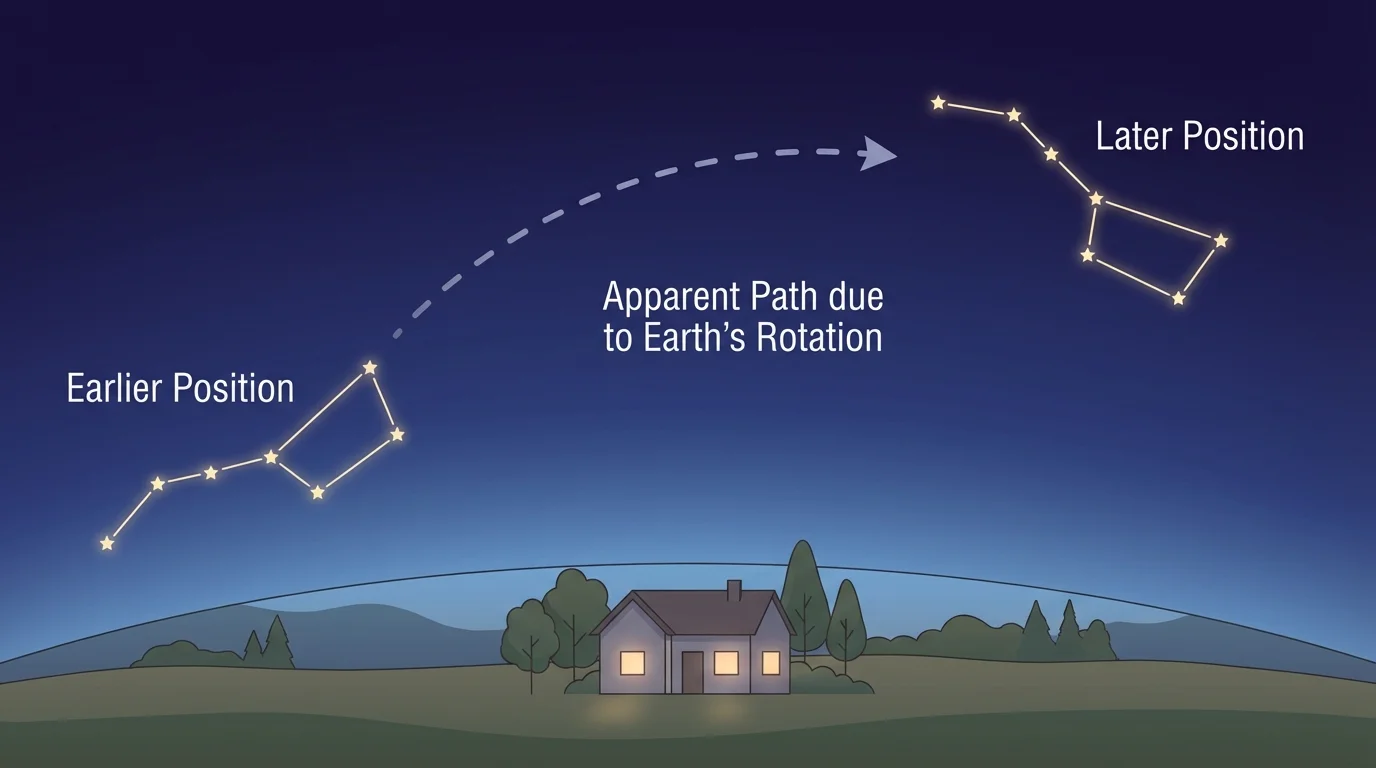
Stars can help people know that it is nighttime. If you go outside after dark and then later look again, the stars may appear in a different part of the sky. That change is a pattern. We can predict that stars will be visible again on another clear night.
Sailors and travelers long ago used stars at night to help them find directions. Today, people still enjoy finding the same star groups again and again. The repeating night pattern in [Figure 3] shows why sky watching can be useful as well as beautiful.
Weather can affect what we see. Clouds may hide the sun, moon, or stars, but the sky patterns still continue even when we cannot see them clearly.
Because stars are only part of this lesson when they are seen at night, we focus on nighttime observations. We describe what we can notice with our eyes: stars appear after dark, they can form patterns, and their positions in the sky change over the night in ways we can observe.
Observing sky patterns helps us in everyday life. We know when to get ready for school because daytime begins after sunrise. We know bedtime comes after it gets dark. We can look for the moon at night and notice if it is thin, half, or full. We can look for stars on clear nights and see familiar groups.
Scientists keep notes, drawings, or simple charts of what they observe. If a child notices the moon for several nights in a row, that child is doing science. If a class watches where the sun is at morning recess and afternoon recess, that class is doing science too.
| Sky object | What we notice | What we can predict |
|---|---|---|
| Sun | It appears in the daytime and seems to move across the sky each day. | Day will come again after night, and the sun will appear again. |
| Moon | Its shape seems to change in a repeating cycle. | The moon will keep changing shape in a pattern. |
| Stars | They are seen at night and seem to move across the night sky. | Stars will be visible again on clear nights, and star groups keep their pattern. |
Table 1. Examples of observations and predictions for the sun, moon, and stars.
Patterns do not mean everything is exactly the same every moment. A cloudy day may hide the sun. A rainy night may hide the stars. But when the sky is clear, the same kinds of patterns can be observed again and again.
A scientist watches carefully, compares what happens, and talks about what is the same or different. You can observe where the sun is in the sky at different times of day. You can notice the moon's shape on different nights. You can look for stars at night and see whether a star group appears in a new place later.
Using words such as before, after, same, change, and repeat helps describe sky patterns clearly. Those words help us explain what we observe and what we predict.
Real-world example: Watching one week of sky patterns
Step 1: In the morning, notice where the sun appears.
Step 2: After sunset, look for the moon and describe its shape.
Step 3: On a clear night, look for stars and see whether you recognize a group from an earlier night.
When these observations are repeated over several days, patterns become easier to spot and describe.
The sky is always changing, but it is also wonderfully regular. That is why observing the sun, moon, and stars helps us learn how to describe patterns and make predictions.
