Have you ever looked for a toy after the room got dark and suddenly it seemed to disappear? The toy was still there, but your eyes could not see it well. That is because seeing needs light. When there is no light on an object, it cannot be seen.
Think about your bedroom at night. When the lamp is on, you can see your blanket, books, and stuffed animals. When the lamp is off and the room is very dark, those same things are still in the room, but they are much harder to see. This is an important science idea: objects do not have to move away to become unseen. Sometimes they are unseen because there is not enough light.
Scientists learn by making observations. An observation is something we notice by using our senses. We can observe that a red ball on a table is easy to see in a bright room. We can also observe that the same ball is difficult to see in a dark closet. These observations give us evidence.
Light is what helps us see. Darkness means there is little or no light. Illuminate means to shine light on something.
Evidence is information that helps us know something is true. If you shine a flashlight into a dark space and suddenly see your shoe, that is evidence that the shoe can be seen when it is illuminated.
Light source means something that makes light. The Sun is a light source. A lamp is a light source. A flashlight is a light source. A candle can be a light source too, but children should only use candles with an adult for safety.
Some things make their own light, and some things do not. The Sun makes light. A firefly makes light. But a book, a chair, and a teddy bear do not make their own light. We see those objects when light from somewhere else shines on them.
The Moon looks bright in the night sky, but it does not make its own light like the Sun. We see it because sunlight shines on it.
This helps us understand why a toy on the floor can seem to vanish in the dark. The toy is not gone. It simply is not lit well enough for your eyes to see it clearly.
Seeing happens when light reaches our eyes. In a simple way, light travels from a source, shines on an object, and then light from that object reaches our eyes, as shown in [Figure 1]. If the object is in darkness and no light shines on it, there is no light from the object reaching our eyes, so we cannot see it.
For example, a lamp shines on a yellow raincoat hanging by a door. Because the raincoat is illuminated, you can see its color and shape. If the lamp is turned off and the room becomes dark, the raincoat is still hanging there, but now it is hard to see or not visible at all.
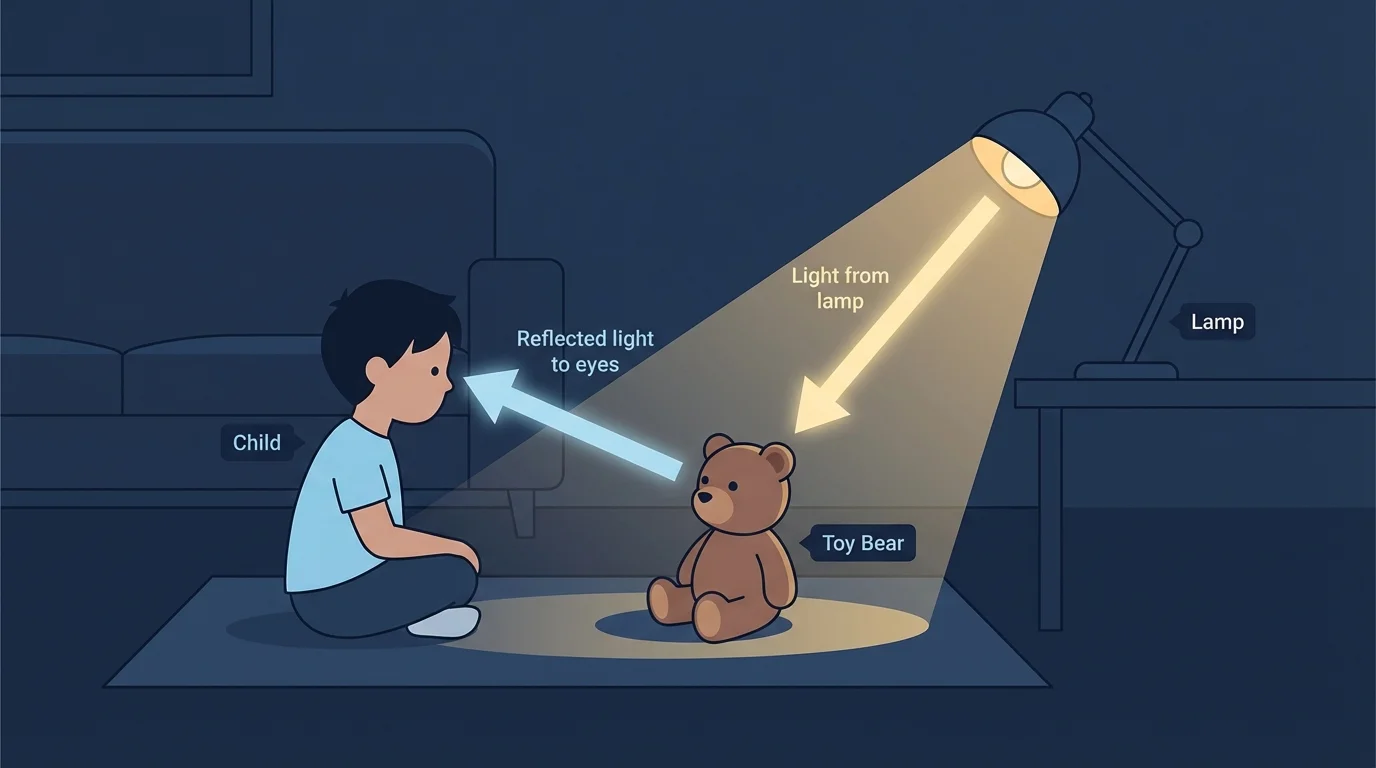
This is why flashlights are so useful. A flashlight does not make your lost sock appear. It shines light on the sock so your eyes can see it. The flashlight gives evidence that the object was there all along.
How scientists build an evidence-based account
Scientists do not just guess. They observe what happens again and again. If an object is seen when a light is turned on and not seen when the light is turned off, the observations support the idea that objects in darkness can be seen only when illuminated.
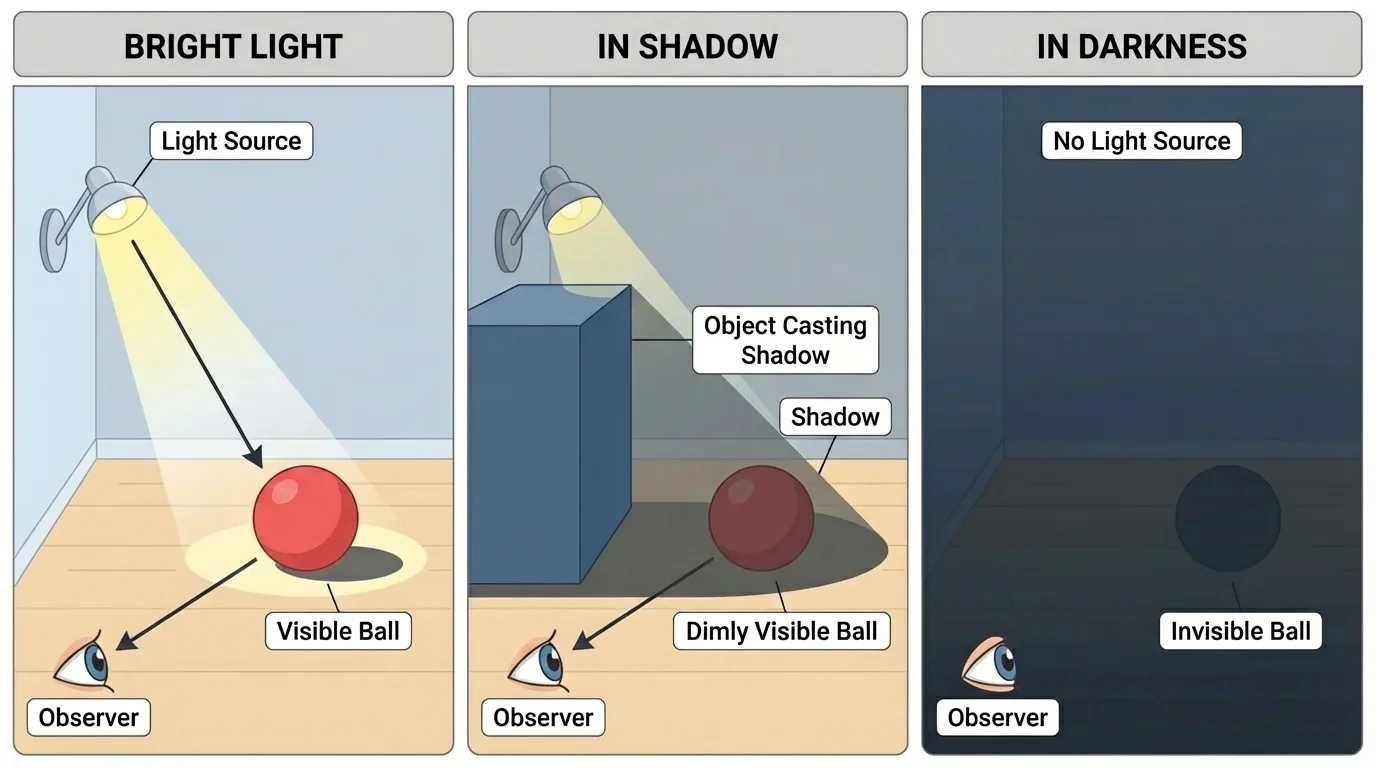
You can notice this in many places: under a bed, inside a backpack, in a tunnel, or outside at night. When light is added, more objects become visible. That pattern is strong evidence, as shown in [Figure 2].
A dark area has little or no light. A shadow is a place where some light is blocked. The ball is easiest to see in bright light, less easy to see in shadow, and hardest to see in darkness.
Shadows are not the same as total darkness. If you stand under a tree on a sunny day, you are in shade, but there is still some light around you. You can still see your shoes, the grass, and the tree trunk. In a very dark room with no light, you may not see those things at all.
Sometimes an object is hidden because something is covering it, like a book under a blanket. Other times it is hidden because it is too dark. Scientists pay attention to this difference. If the blanket is removed, the book can be seen. If the room is dark, the book may still need light to be seen.
This is why turning on a light helps more than just looking harder. Your eyes need light from the object. Looking harder cannot make an unlit object in darkness visible by itself.
Scientists compare what they notice. Suppose a class looks at a blue crayon on a desk. First, the desk is near a sunny window, and everyone can see the crayon. Next, the crayon is placed inside a box with the lid open in a darker corner, and fewer students can see it well. Then a flashlight shines into the box, and the crayon becomes easy to see again. Those observations are evidence.
An evidence-based account is a simple explanation built from what we observe. A good account for these observations is: the crayon can be seen clearly only when light shines on it. In darkness, it cannot be seen well or at all.
Observation example: Finding a shoe under the bed
Step 1: A child looks under the bed in a dark room and cannot see the shoe.
Step 2: The child shines a flashlight under the bed.
Step 3: The shoe becomes visible.
The observation supports the idea that the shoe was seen only when illuminated.
When we make observations, we use careful words such as bright, dim, dark, seen, and not seen. These words help us describe exactly what happened.
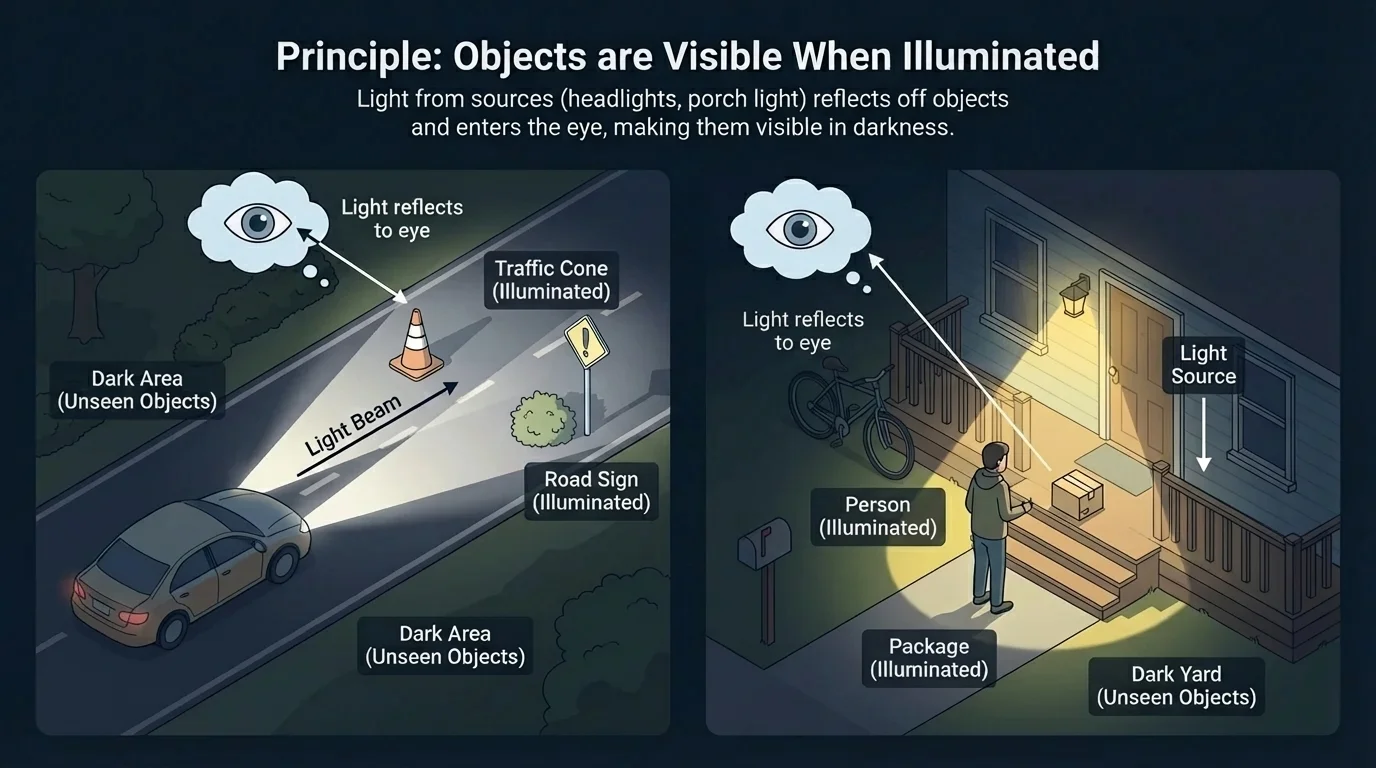
People use light every day because it helps them see. Car headlights brighten the road at night, as shown in [Figure 3]. Porch lights help families see steps. Streetlights help people walk more safely. A reading lamp helps someone see the words in a book.
Doctors use bright lights to look in your ears and mouth. Campers use lanterns to see inside a tent. On a stage, spotlights help the audience see the actors. In each case, the objects are visible because they are illuminated.
We can connect this to safety too. Riding a bike at dusk is safer when people can see where they are going and when others can see them. Light helps both ways: it lights objects, and it helps eyes notice them.
Your ears help you learn about the world through sound, and your eyes help you learn through light. Sound and light are different, but both give information about what is around you.
Later, when you think again about the toy in the dark room, remember the path in [Figure 1]. The toy becomes visible when light shines on it and then reaches your eyes. The same idea explains why headlights and porch lights work, just as we saw in [Figure 3].
Sound can make matter vibrate, and vibrating matter can make sound. That is an important science idea, but sound is not what lets us see objects. For seeing, we need light. A bell can ring in a dark room, so you can hear it, but you still need light to see the bell.
This shows that our senses gather different kinds of information. We may hear something in darkness, but to see an object, it must be illuminated. That is why evidence from observations again and again supports the same idea: objects in darkness can be seen only when light shines on them.
