Have you ever seen a tiny puppy next to a big dog or a small sprout next to a tall plant? It can feel like a little mystery. How can something so small belong to something so much bigger? When we look closely, we find a big science idea: young living things are a lot like their parents, but they are not exactly the same.
Scientists learn by making careful observations. An observation is something we notice with our eyes and other senses. We can observe animals in a yard, plants in a garden, or pictures in a book. Then we can describe what we see.
Living things grow and change. A baby animal grows into an adult animal. A tiny plant grows into a larger plant. Even when they are young, they already have many features that match their parents. These matching features help us know they are the same kind of living thing.
Evidence is information that helps us know something is true. In science, evidence often comes from observations. If a puppy has fur, ears, paws, and a tail like the adult dog, those observations are evidence that the puppy is like its parent.
When we study families of living things, we look for body parts, colors, shapes, and patterns. We also notice size. Young organisms are usually smaller than their parents, but small size does not mean they are a different kind.
[Figure 1] Young animals often have the same body parts as their parents. A puppy and a dog both have fur, four legs, ears, eyes, a nose, and a tail. A kitten and a cat both have whiskers, paws, ears, and soft fur. A duckling and a duck both have a beak, feathers, wings, and feet for walking or paddling.
We can also observe colors and shapes. A brown puppy may grow into a brown dog. A black kitten may grow into a black cat. The young animal may have a face shape or ear shape that looks like the parent. These matching features are important clues about an organism.
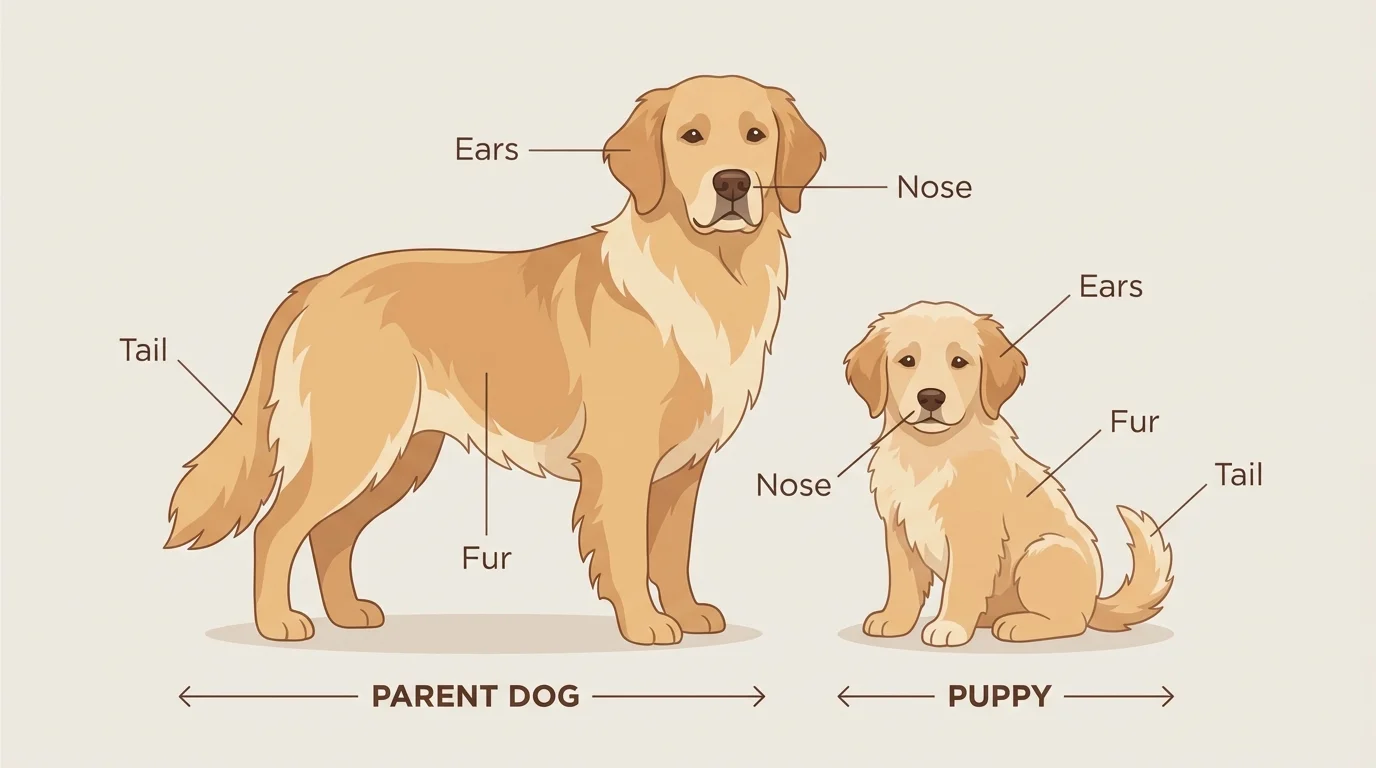
Young animals may also act in ways that are like their parents. A chick pecks for food like a hen. A young rabbit hops like an adult rabbit. A calf can stand on its legs like a cow, even though it is much smaller. We can observe these actions and use them as evidence too.
Some baby animals can recognize their parents' voices or stay close to their parents soon after they are born. Watching this helps scientists learn how young animals survive and grow.
When we compare parent and young animals, we should look carefully at what is the same and what is different. The same body plan matters a lot. A puppy is smaller than a dog, but it still has the same main parts.
[Figure 2] Plants also have young forms. A small sprout or seedling can look a lot like the parent plant. A bean seedling and a full-grown bean plant both have stems and leaves of the same kind. A young sunflower plant and an adult sunflower plant both grow the same kind of leaves and stem.
If we grow seeds in cups, we may first see a tiny stem and small leaves. Later, the plant gets taller and grows more leaves. Even when the young plant is little, its leaf shape can match the older plant. That is good evidence that the young plant is like its parent plant.
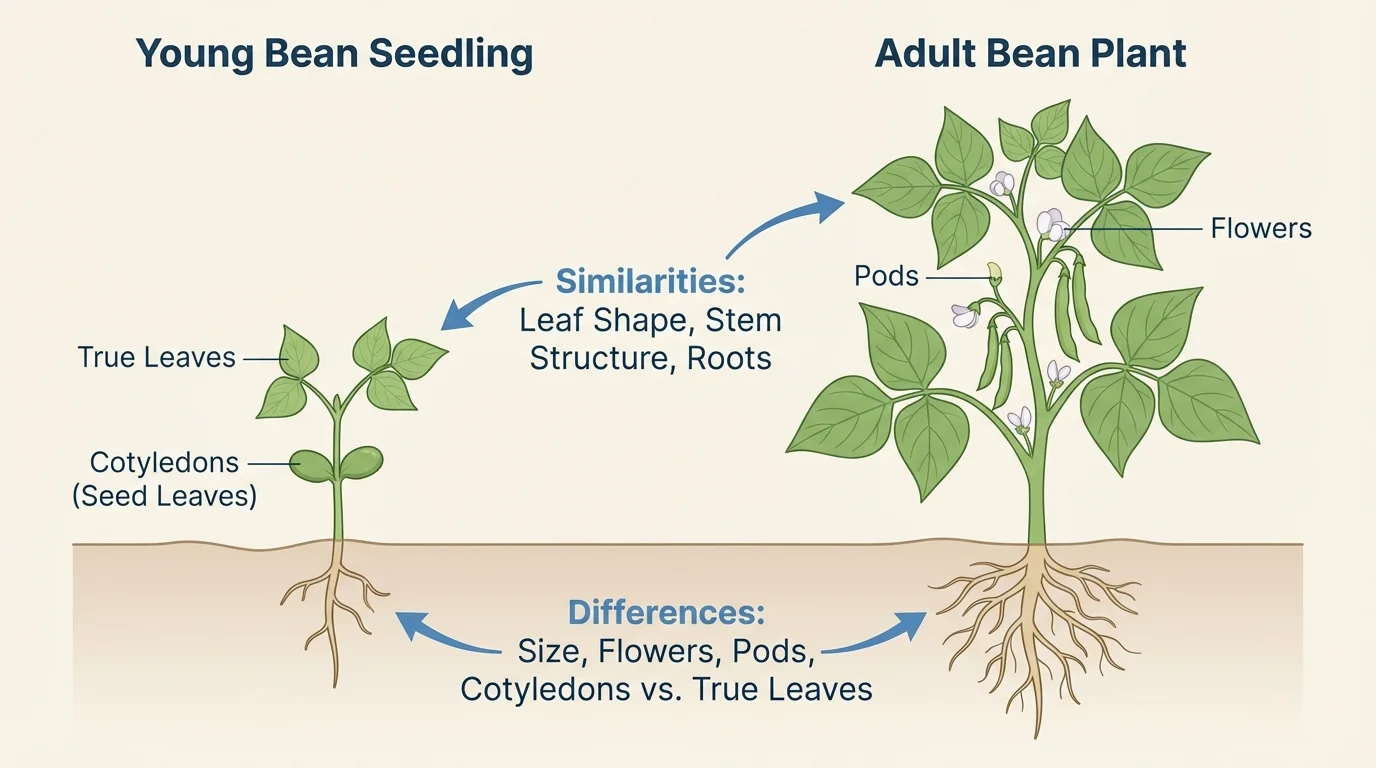
Fruit plants give us more examples. A young tomato plant and a larger tomato plant both have the same kind of leaves and stems. A small apple tree and a larger apple tree both have the same kind of trunk, branches, and leaves. The young plant is not exactly the same size or shape, but it is still very much like the parent plant.
Growing does not change the kind
When a plant grows, it gets bigger and may grow new parts, such as more leaves, buds, flowers, or fruit. But it remains the same kind of plant. Observing the parts that stay alike helps us connect the young plant to the parent plant.
Gardeners and farmers use these observations in real life. They look at young plants to tell what is growing in a garden or field. They know a tiny corn plant will not look exactly like a tall corn plant yet, but it still shows important matching features.
This idea is important: young living things are like their parents, but not exactly like them. A puppy is smaller than its parent dog. A young rabbit may have softer-looking fur or shorter ears than the adult. A seedling is shorter and has fewer leaves than the adult plant.
Sometimes the differences are easy to see. The parent may be taller, heavier, or darker in color. The young one may have shorter legs, a rounder face, or smaller leaves. These differences do not mean they are different kinds. They show that living things grow.
Living things need food, water, air, and space to live and grow. As they grow, their size changes, but they still keep important features of their kind.
We can compare living things by asking simple questions: Do they have the same kind of body parts? Do their leaves look alike? Do they have similar colors or patterns? These questions help us notice both sameness and difference.
Scientists do not just say, "I think so." They use evidence. We can make a simple chart with two living things and write what we observe. For example, we can compare an adult rabbit and a baby rabbit: both have long ears, fur, and a short tail. The baby rabbit is smaller. Those observations help us make an evidence-based account, as [Figure 3] shows.
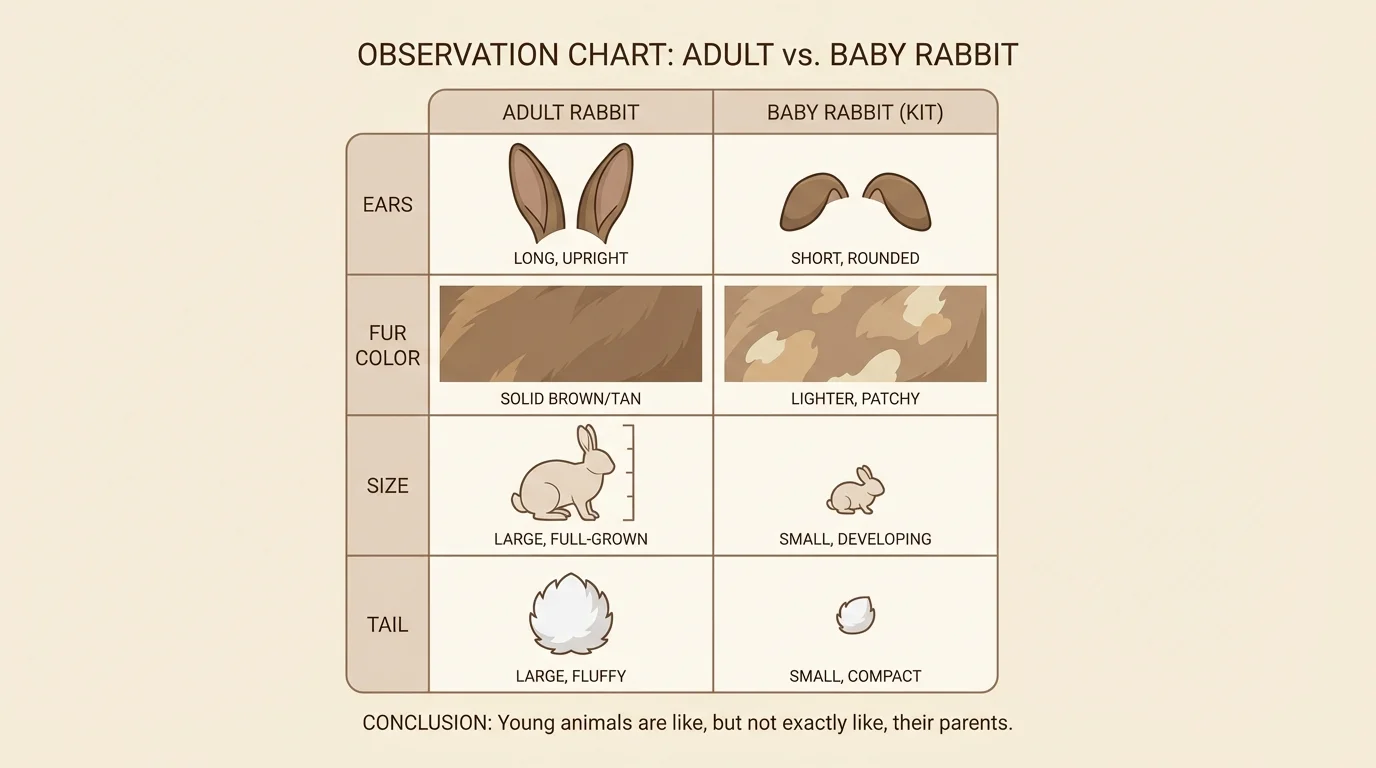
An evidence-based account is a statement that tells what we know from observations. For example, we might say, "The young rabbit is like the parent because both have long ears, fur, and a short tail. The young rabbit is not exactly the same because it is smaller." That is a science explanation based on evidence.
Example of using observations
Step 1: Look carefully at the parent and young living thing.
Notice body parts, color, shape, and size.
Step 2: Find what is the same.
The parent cat and kitten both have fur, whiskers, ears, paws, and tails.
Step 3: Find what is different.
The kitten is smaller and may have a rounder face.
Step 4: Say your evidence-based account.
The kitten is like the parent cat because they share many body parts, but it is not exactly the same because it is smaller.
Observation charts help us stay organized. Later, when we think again about similarities and differences, it makes it easier to point to real evidence instead of guessing.
| Living thing | Like the parent | Not exactly like the parent |
|---|---|---|
| Puppy | Has fur, ears, tail, four legs | Smaller body |
| Kitten | Has whiskers, paws, ears, tail | Smaller and lighter |
| Bean seedling | Has stem and same kind of leaves | Shorter, fewer leaves |
| Young sunflower | Same kind of stem and leaves | Not as tall as adult plant |
Table 1. Examples of ways young organisms are like, but not exactly like, their parents.
People use these ideas every day. A family can look at a new puppy and know it will grow to look more like the adult dog. A gardener can spot tiny vegetable plants and know what they will become. Farmers watch young animals and young plants to help care for them as they grow.
Nature watchers also use observation skills. If you see a small bird near a larger bird of the same kind, you can compare beaks, feathers, and body shape. If you see a sprout in the school garden, you can compare its leaves to larger plants nearby. Science begins with looking closely and noticing patterns.
"The more carefully we look, the more nature tells us."
By observing similarities and differences, we learn that young organisms belong to the same kind as their parents. They share important features, and they grow over time. That is why careful observation is such a powerful science tool.
