Have you ever noticed that sometimes it is still light outside when you eat dinner, but at other times of year it gets dark much earlier? That is a real pattern in nature. The amount of daylight changes during the year. We can observe these changes by looking outside in the morning and in the evening across many months.
When we talk about daylight, we mean the time when the Sun is up and the sky is light enough for daytime activities. As [Figure 1] shows, the same place can have a shorter light part of the day at one time of year and a longer light part of the day at another time of year. We do not need to count the hours. We only need to notice whether there is more daylight or less daylight.
In some parts of the year, the Sun seems to come up earlier in the morning and stay up later in the evening. In other parts of the year, the Sun seems to come up later and go down earlier. That means the daytime light changes through the year. These are careful observations that children can make by looking out the window before school or during the evening.
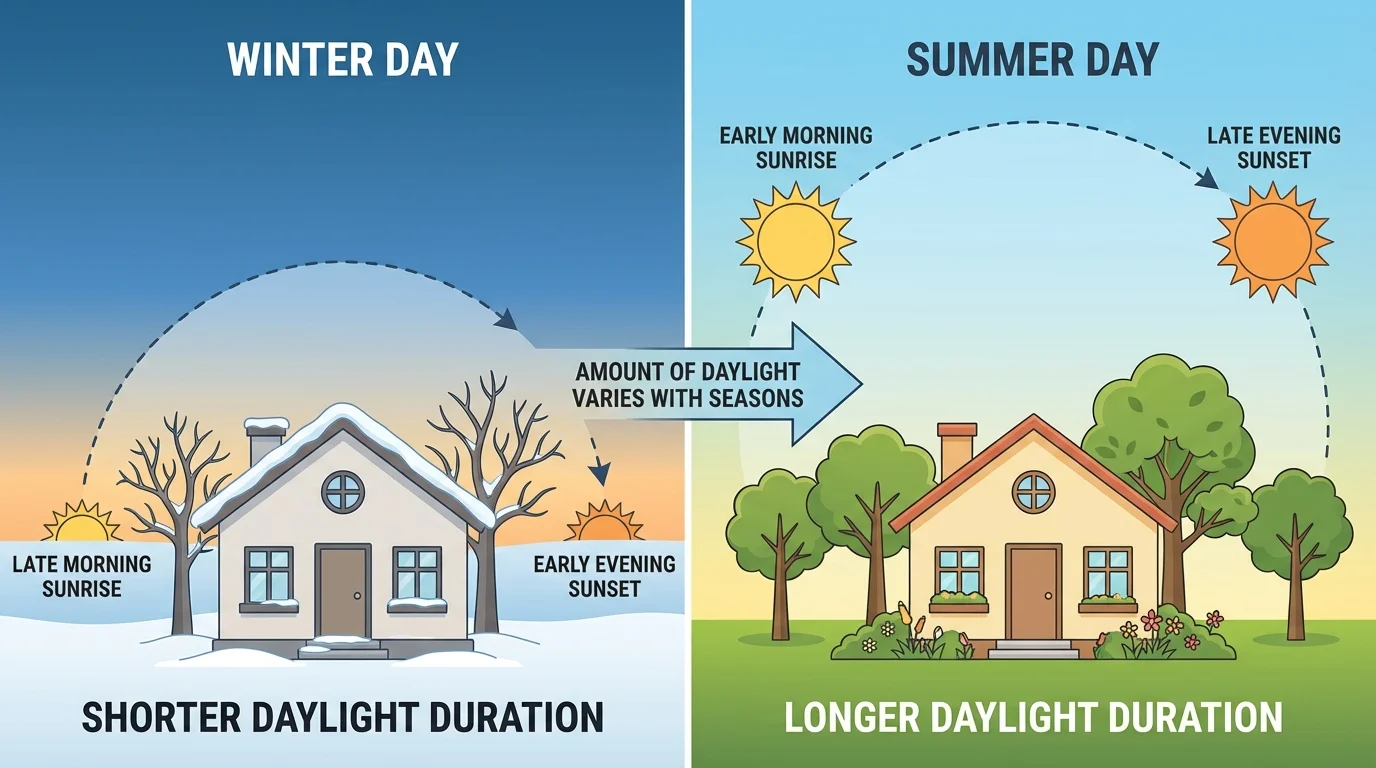
The Sun appears to move across the sky each day. We see it rise, move higher, and later go down. Even though this happens every day, the amount of time we see daylight is not always the same. That is why some days feel long and bright, and other days feel short and dim.
Daylight is the light we have from the Sun during the day.
Observation is something we notice using our senses, such as seeing that it is light outside earlier or later.
Pattern is something that happens again and again in a way we can notice.
These changes are not random. They happen in a pattern that repeats every year. When scientists study the sky, they often begin by looking for patterns like this one.
The season of the year helps us describe these changes. We often talk about winter, spring, summer, and fall. As [Figure 2] illustrates, winter usually has the least daylight, spring has more, summer has the most, and fall begins to have less again. This is a pattern many students can notice in their own lives.
In winter, mornings may stay dark longer, and evenings may get dark sooner. It can feel like the daytime is shorter.
In spring, we start to notice more light in the morning and more light in the evening. The days seem to grow longer.
In summer, there is usually the most daylight. It may be bright early in the morning and still light later in the evening. Many children notice this because they can still play outside while it is light.
In fall, the pattern begins to change back. There is still daylight, of course, but compared with summer there is less. Evenings begin to get darker earlier again.
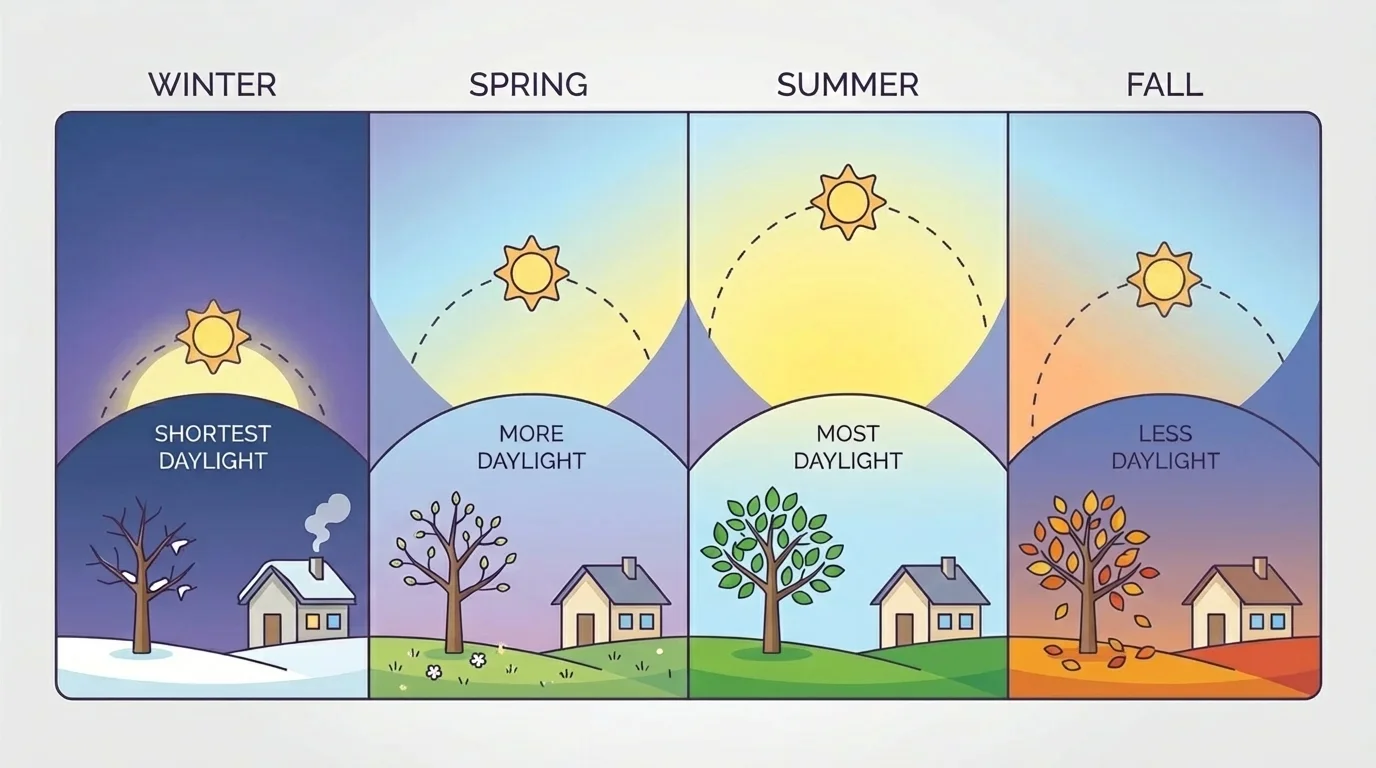
This seasonal pattern helps us relate the amount of daylight to the time of year. We are not saying exact numbers of hours. We are only comparing: more, less, most, and least.
Many animals respond to changing daylight. Some birds sing more in spring mornings, and some animals become more active at different times of year.
Later in the year, when you notice that it is already dark outside earlier in the evening, you can connect that observation back to the pattern we saw in [Figure 2]. The time of year helps explain the change.
Patterns in nature become easier to see when we observe the same place again and again. As [Figure 3] shows, a student can look at the same playground, yard, or window view during different times of year and notice whether it is lighter or darker in the morning or evening. This is how scientists learn about repeated events.
When we make observations, we can use simple words such as lighter, darker, more daylight, and less daylight. We can also compare one time of year to another. For example, a child might say, "There is more daylight now than in winter," or "It gets dark earlier now than in summer."
Observations work best when we look carefully and compare over time. If you only look once, you know what one day is like. If you look many times across the year, you can find a pattern.
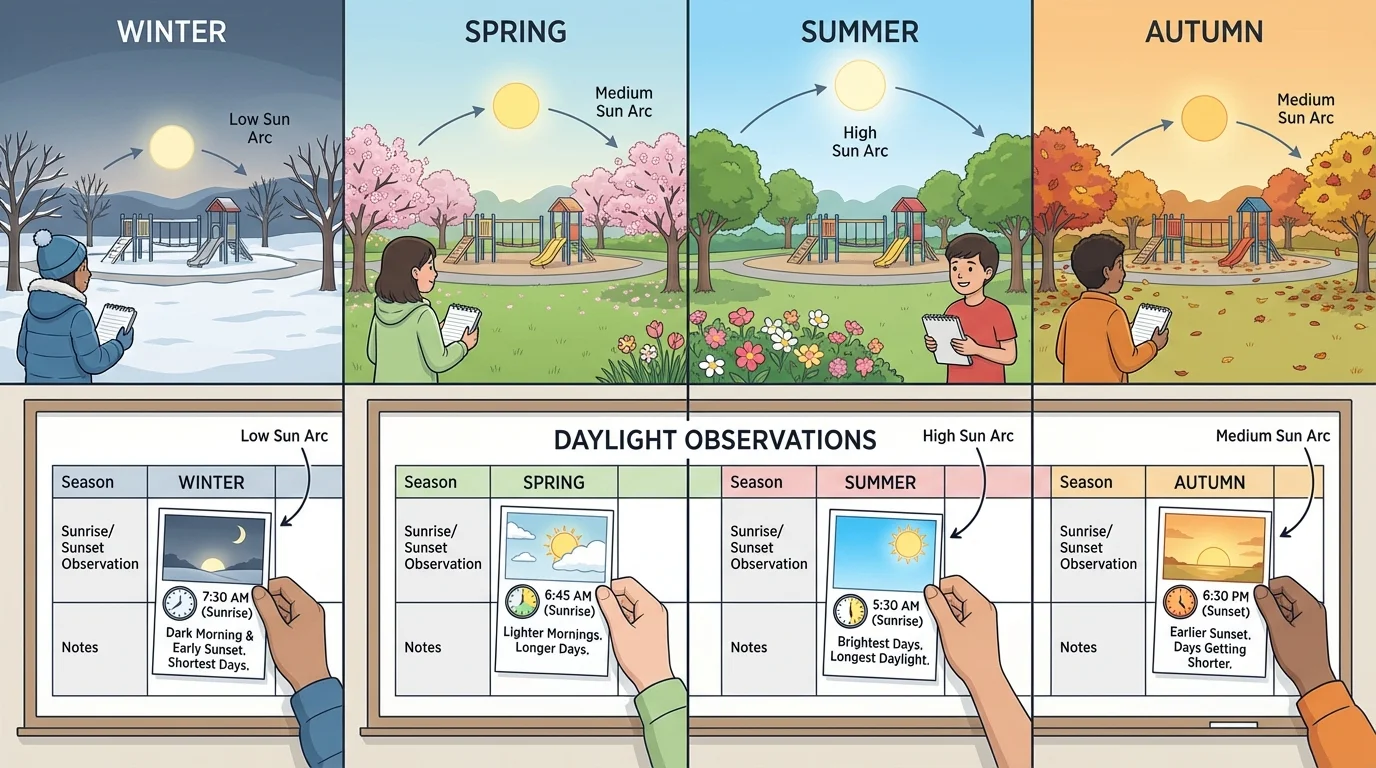
Real-world observation example
Step 1: Look outside in winter before school. You may notice it is still fairly dark.
Step 2: Look outside in summer before school. You may notice it is brighter.
Step 3: Compare the two observations. Summer has more daylight in the morning than winter.
This kind of simple comparison helps us relate daylight to the time of year.
Scientists often repeat observations because repeating helps them trust what they notice. When the same kind of change happens year after year, it is a strong pattern. The observation routine in [Figure 3] reminds us that we learn more by watching over time, not by guessing.
Changes in daylight matter to people. Families may eat dinner when it is still bright outside in summer, but in winter it may already be dark. Children may wear coats and come home when the sky is darker in winter afternoons. In summer, evening walks and outdoor games may happen while it is still light.
Plants also respond to the time of year. In spring and summer, many plants grow strongly because the season brings warmer weather and more daylight. In fall and winter, many trees change, and some lose leaves. Daylight is one of the clues that seasons are changing.
Animals respond too. Some animals wake up, search for food, or rest at different times of day depending on the season. Farmers, gardeners, and people who work outdoors all pay attention to daylight because it helps them plan what they do.
Why repeated observations are useful
One observation tells what is happening on one day. Many observations across the year help us discover a pattern. When we compare winter, spring, summer, and fall, we can explain that the amount of daylight changes with the time of year.
The winter-and-summer comparison from [Figure 1] connects to real life. If there is less daylight, the day may feel shorter for outdoor activities. If there is more daylight, there is more natural light in the morning or evening.
The Sun appears to move across the sky every day, but the amount of light we get during the day changes during the year. This is an Earth-and-space pattern we can observe from where we live.
By watching carefully in different seasons, we learn that winter usually has less daylight and summer usually has more daylight. Spring and fall are in between. These changes repeat each year, so they are predictable.
You do not need exact hour numbers to understand this idea. What matters is noticing the relative amount of daylight: some times of year have more, and some have less.
