A frozen ice pop can become a drippy liquid on a warm day, and melted butter can turn solid again in the refrigerator. That is because it is still the same kind of matter, even when it changes form. The world is full of matter, and matter can look different depending on how warm or cool a substance is.
Matter is anything that takes up space. A rock is matter. Water is matter. Air is matter too, even though we cannot see it easily. Your toy car, your shoes, and the milk in a cup are all made of matter.
Some things are not matter. A shadow is not matter. Light is not matter. Sound is not matter. We can notice them, but they do not take up space the way a chair or a drop of rain does.
Solid is a kind of matter that keeps its own shape. Liquid is a kind of matter that can flow and take the shape of its container. Temperature tells how hot or cold something is.
Everything around us is made of different kinds of matter. Some matter is hard, some is soft, some is smooth, and some is rough. We can learn about matter by looking carefully and noticing what it does.
[Figure 1] A solid keeps its shape, while a liquid flows and takes the shape of its container. A book, a pencil, and a block are solids. Juice, soup, and paint are liquids.
If you put a block on a table, it keeps the shape of a block. If you pour water into a round cup, the water takes the shape of the cup. If you pour the same water into a tall bottle, it takes the shape of the bottle instead.
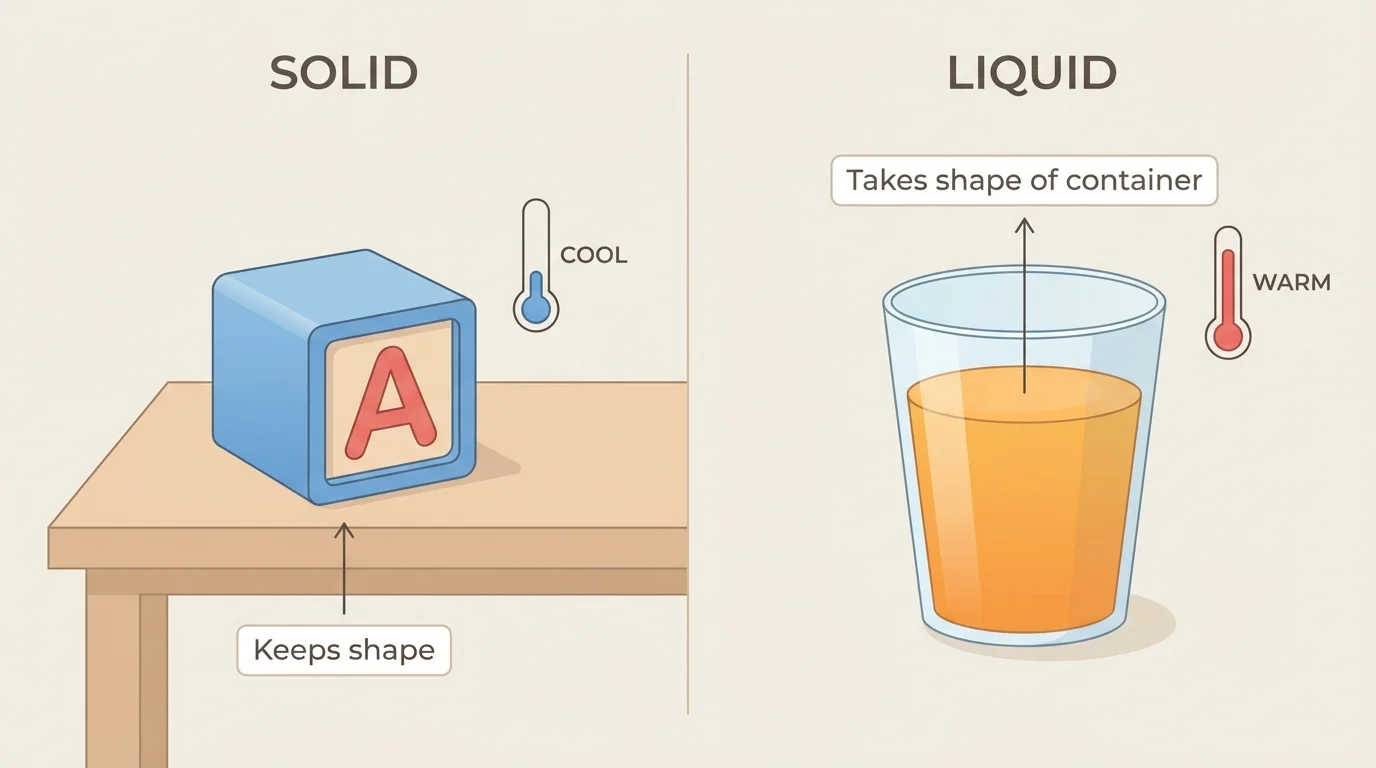
Solids and liquids are both matter. They both take up space. They can both be held, moved, and measured. But they do not behave in the same way. Solids usually stay where you put them unless you push or carry them. Liquids can be poured.
Some solids are stiff, like a metal spoon. Some solids are bendy, like clay. Some liquids are runny, like water. Some liquids are thicker, like honey. They are still grouped by what we can observe.
Honey pours much more slowly than water, but both are liquids because both can flow and take the shape of a container.
Later, when we sort materials, the ideas in [Figure 1] help us notice an important clue: does it hold its own shape, or does it flow?
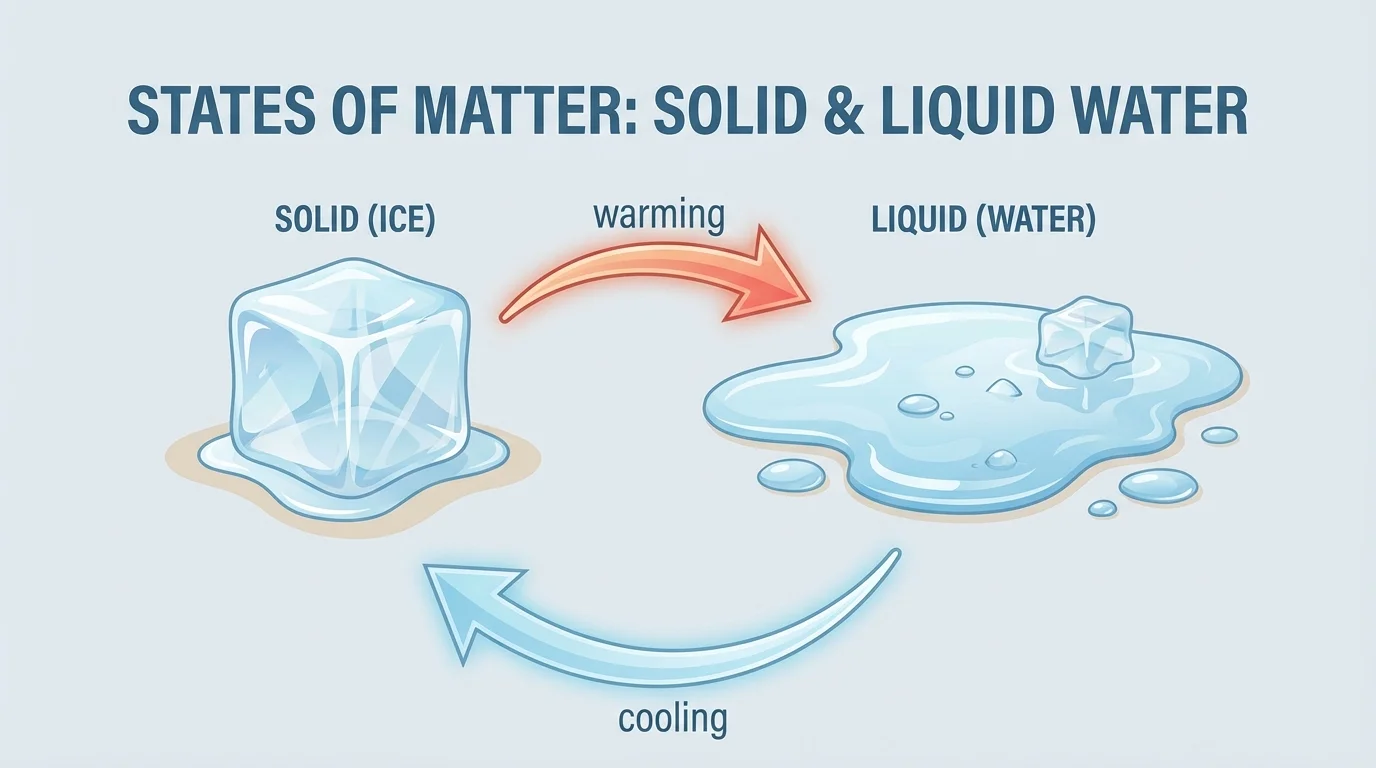
[Figure 2] Temperature can change how some matter looks and feels. For example, water can change between ice and liquid water. When some kinds of matter get warmer, they melt. When some kinds of matter get cooler, they freeze.
Water is a common example. Ice is solid water. When ice gets warm enough, it melts and becomes liquid water. When liquid water gets cold enough, it freezes and becomes solid ice again. Scientists write water as \(\textrm{H}_2\textrm{O}\).
Other materials can change too. Butter can be hard when it is cold and soft or melted when it is warm. Chocolate can melt in your hand on a hot day. Candle wax can melt when heated and become solid again after it cools.
This means the same kind of matter can sometimes exist as a solid or a liquid, depending on temperature. The matter is not gone. It has changed form. That is why an ice cube in a cup does not disappear like magic. It changes into liquid water.
Changing form without changing what it is
When ice melts, it is still water. When melted butter cools and becomes solid, it is still butter. A change in temperature can change the form of matter without turning it into a different material.
When we watch weather, we see this too. Water can freeze into ice outside in winter, and ice can melt back into water when the day becomes warmer. The changes shown in [Figure 2] help explain puddles, icicles, and melting snow.
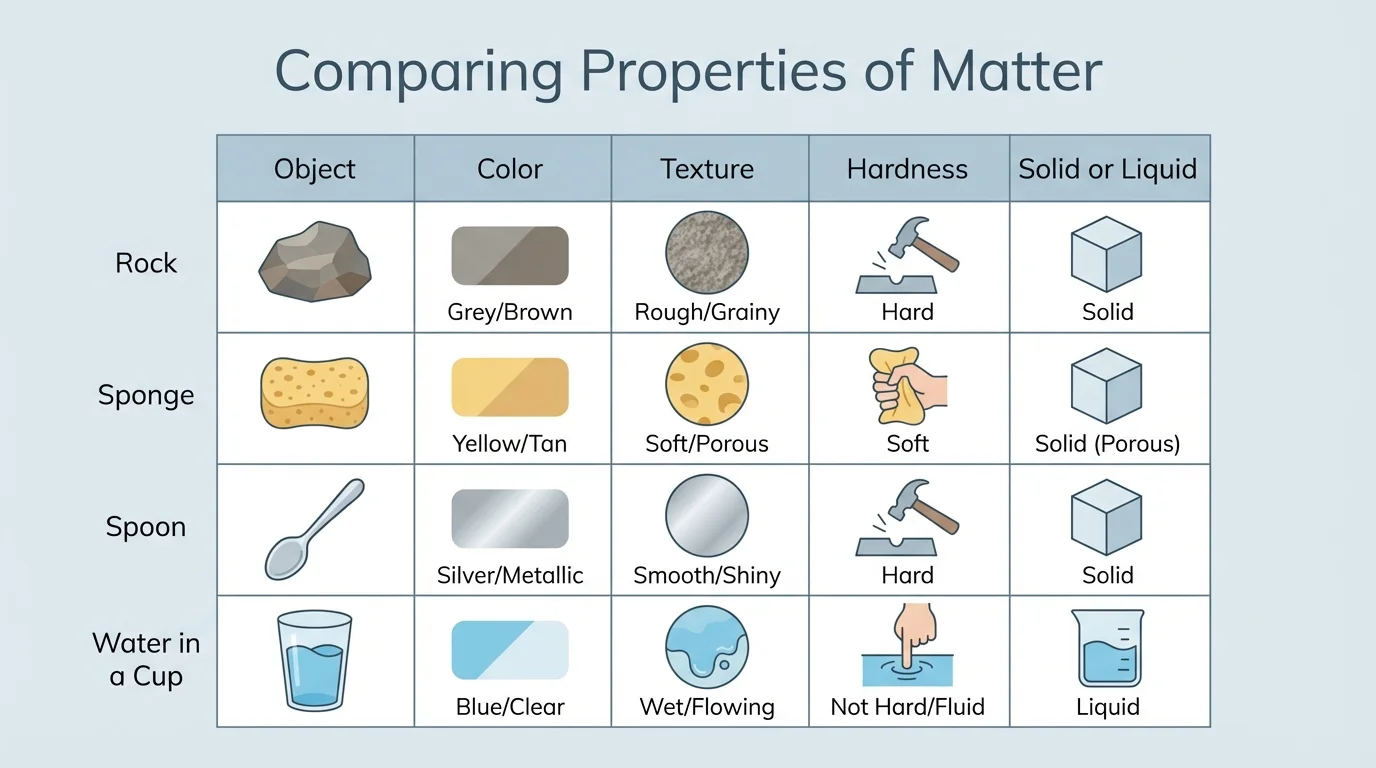
[Figure 3] Scientists use properties to describe matter. Properties are things we can observe, and they help us sort objects by what we notice with our eyes and hands. We can describe matter by color, size, shape, texture, hardness, and whether it is a solid or a liquid.
A rock may be gray, hard, and rough. A sponge may be soft, porous, and squishy. A glass marble may be smooth, hard, and round. Water may be clear and able to flow easily.
When we classify matter, we put things into groups by shared properties. We might put all the objects that are smooth in one group. We might put all the liquids in another group. We might sort objects into hard and soft groups.
| Object | Color | Texture | Hard or Soft | Solid or Liquid |
|---|---|---|---|---|
| Rock | Gray | Rough | Hard | Solid |
| Sponge | Yellow | Soft | Soft | Solid |
| Water | Clear | Smooth | Not hard | Liquid |
| Spoon | Silver | Smooth | Hard | Solid |
Table 1. Examples of observable properties used to describe and sort matter.
Sometimes two things have one property that is the same but other properties that are different. A spoon and a rock can both be hard, but one may be smooth and the other rough. A cup of milk and a cup of juice are both liquids, but they may have different colors.
Real-world example: Sorting classroom objects
Step 1: Look at the object carefully.
A crayon is small, colorful, and solid.
Step 2: Name its observable properties.
It may be smooth, hard enough to hold, and able to keep its shape.
Step 3: Place it in a group.
It can go into the group for solids, or into a group for smooth objects.
One object can fit more than one group because matter has many properties.
The sorting ideas in [Figure 3] help us compare objects in a careful way instead of just saying they are "different."
People use properties of matter every day. Builders choose hard materials for walls and roads. Cooks melt butter and chocolate when baking. We drink liquids from cups because liquids flow and need containers.
On a rainy day, water falls as a liquid. On a very cold day, water can become ice. In the kitchen, soup pours easily, but a plate does not. At the playground, a rubber ball and a metal slide are both solids, but they feel different because they have different properties.
You already know how to use your senses to learn about the world. In science, we use careful observing to describe matter by what we can see, touch, and compare safely.
Knowing about matter helps us choose the right material for a job. A paper cup may hold juice for a short time, but a metal pot is better for hot soup. A wooden block is good for building because it keeps its shape.
All matter is made of tiny particles too small to see without special instruments. These particles are always present, even when matter changes from solid to liquid or back again.
In a solid, the tiny particles stay packed closely and help the matter keep its shape. In a liquid, the tiny particles can move past one another more easily, so the liquid can flow. This simple idea helps explain why ice is solid and why liquid water can flow.
We do not need to see the tiny particles to know matter is there. We can learn about matter by observing what it does: whether it pours, whether it stays shaped, whether it feels hard or soft, and how it changes when temperature changes.
