Why is a window made of glass, a towel made of cloth, and a spoon often made of metal? The answer has to do with the fact that different materials have different properties we can observe. When scientists study materials, they look closely, ask questions, and compare what they observe. That helps them understand why a raincoat keeps water out, why a sponge soaks water up, and why a plastic cup can bend more than a glass cup.
Everything around us is made of materials. A chair may be made of wood, metal, plastic, or fabric. A toy might be made of rubber and plastic. A book has paper, glue, and sometimes a shiny cover. A material is what something is made from.
Scientists describe materials by their properties. A property is something you can notice or test. Some properties are easy to see right away, like color or shape. Others need a simple test, like whether a material bends, soaks up water, or sticks to a magnet.
Observable properties are features of a material that we can notice with our senses or simple tools. Examples include color, texture, flexibility, shininess, and whether it absorbs water.
When we study materials in grade 2, we focus on what we can observe. We do not need to name exactly what every material is made of. Instead, we describe what we see, feel, and test in simple ways.
Scientists compare materials by their observable properties, as [Figure 1] shows with common classroom and home objects. One material may be smooth, while another is bumpy or rough. One may be clear, while another blocks light. One may feel stiff, while another bends easily.
Here are some important properties you can observe:
Color: Materials can be red, blue, brown, clear, silver, or many other colors.
Texture: Texture tells how something feels. It may feel rough, smooth, fuzzy, soft, or hard.
Shiny or dull: Some materials reflect light and look shiny, like metal foil. Others do not look shiny, like cardboard.
Flexible or rigid: A flexible material bends easily. A rigid material keeps its shape and does not bend much.
Absorbent or waterproof: An absorbent material takes in water, like a sponge. A waterproof material keeps water out, like plastic wrap.
Transparent, translucent, or opaque: Transparent materials let you see through them clearly, like a clean glass window. Translucent materials let some light through, but not a clear picture, like wax paper. Opaque materials block light, like wood.
Magnetic properties: Some materials are attracted to a magnet, and some are not.
Float or sink: When placed in water, some objects float and some sink. This is something we can observe during an investigation.
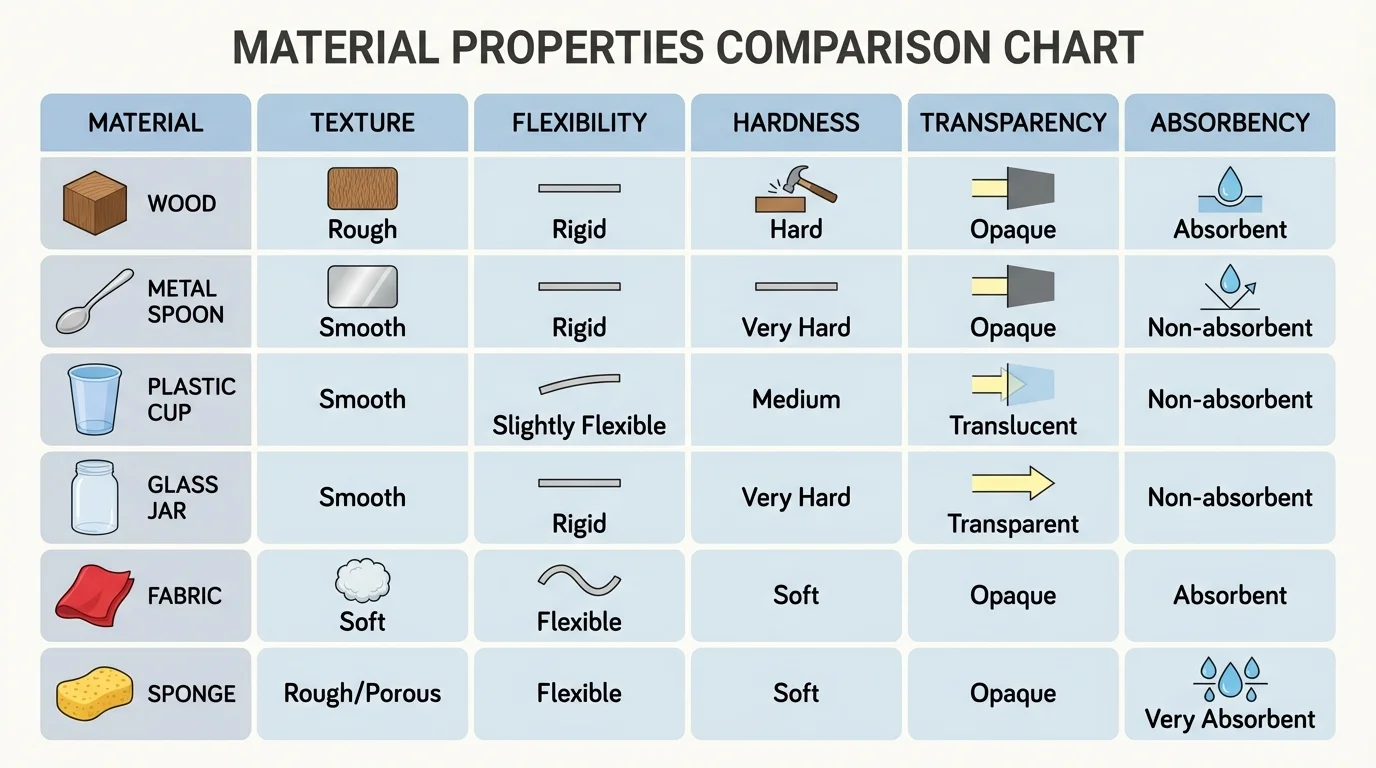
A cotton ball and a metal spoon are both useful, but they have very different properties. The cotton ball is soft and absorbent. The spoon is smooth, shiny, and rigid. Because of these differences, they are used for different jobs.
Some objects are made from more than one material. A sneaker may have fabric, rubber, foam, and plastic, and each material is chosen because of its special properties.
Even when two objects look similar, they may not act the same. A paper cup and a plastic cup can both hold liquid for a short time, but paper can become soggy, while plastic usually stays waterproof longer.
A good investigation begins with a plan, and [Figure 2] shows that scientists move step by step instead of guessing. Planning helps us stay safe, make fair observations, and remember what we learned.
First, ask a question. A question might be, Which materials absorb water? or Which materials are flexible? A clear question helps you know what to observe.
Next, choose the materials you will test. You might use a sponge, wax paper, fabric, aluminum foil, wood, plastic, and cardboard. It is helpful to test several materials so you can compare them.
Then make a prediction. A prediction is what you think may happen before you test. For example, you might predict that the sponge will absorb the most water and the foil will not absorb any.
After that, decide how you will observe or test the materials. You may look closely, touch carefully, bend gently, place a drop of water on each material, or try a magnet. You also need a way to record what you notice.
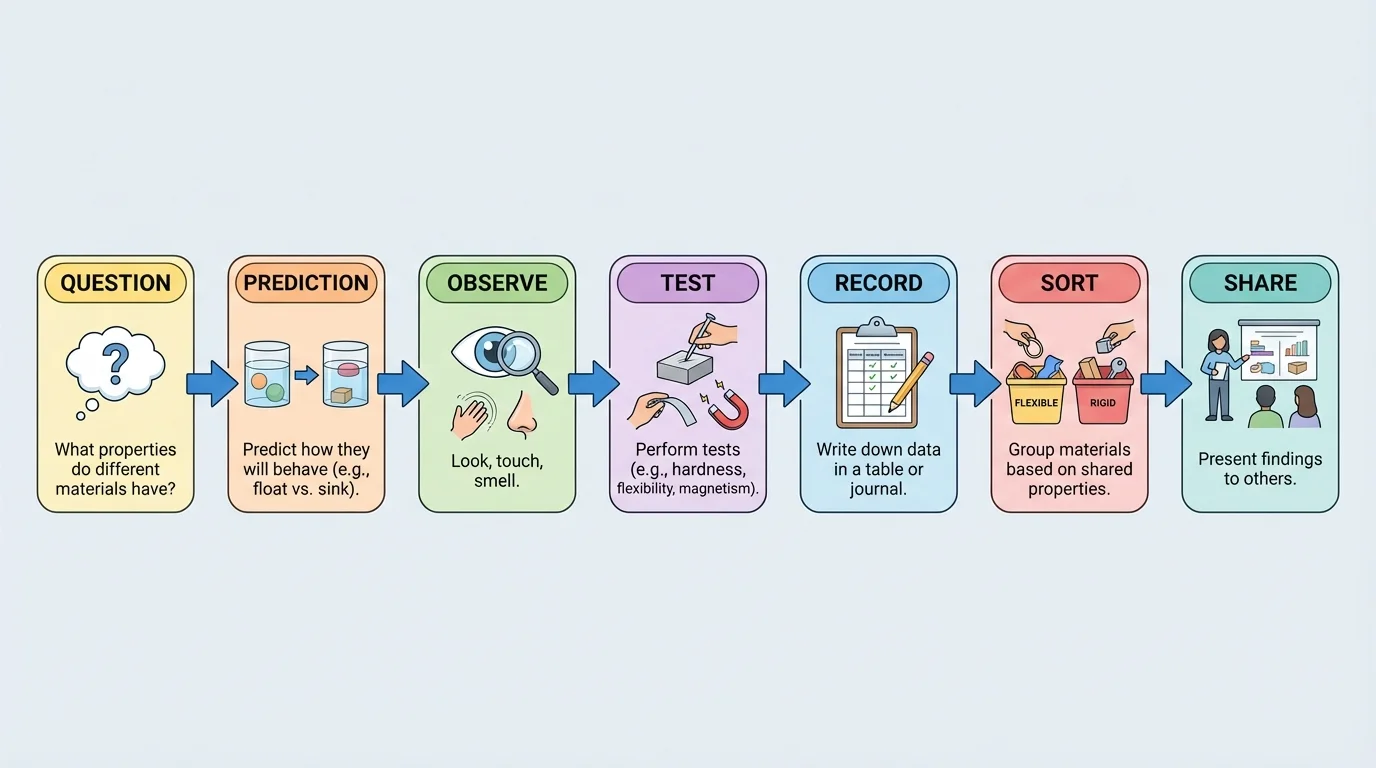
A simple recording chart can help. You can write the material names in one column and the properties in other columns. Then you can mark what you observe.
| Material | Smooth or Rough | Flexible or Rigid | Absorbent or Waterproof |
|---|---|---|---|
| Sponge | Rough | Flexible | Absorbent |
| Plastic lid | Smooth | Rigid | Waterproof |
| Fabric | Soft | Flexible | Absorbent |
Table 1. A sample chart for recording observations about material properties.
When you conduct an investigation, you follow your plan carefully, and [Figure 3] illustrates how each test focuses on one property at a time. This helps your observations stay clear and organized.
Start by looking at each material. Notice color, size, and whether it is shiny or dull. Then touch it carefully to notice texture. Is it smooth, rough, soft, or bumpy?
Next, test flexibility by bending the material gently if it is safe to do so. Fabric may bend and fold easily. A wooden block may not bend at all. A plastic lid might bend a little.
To test absorbency, place a small drop of water on each material. Watch what happens. A sponge or cloth may soak up the water quickly. Wax paper or foil may let the water stay on top.
To test magnetic response, place a magnet near each object. A metal paper clip may move toward the magnet, while wood or plastic will not.
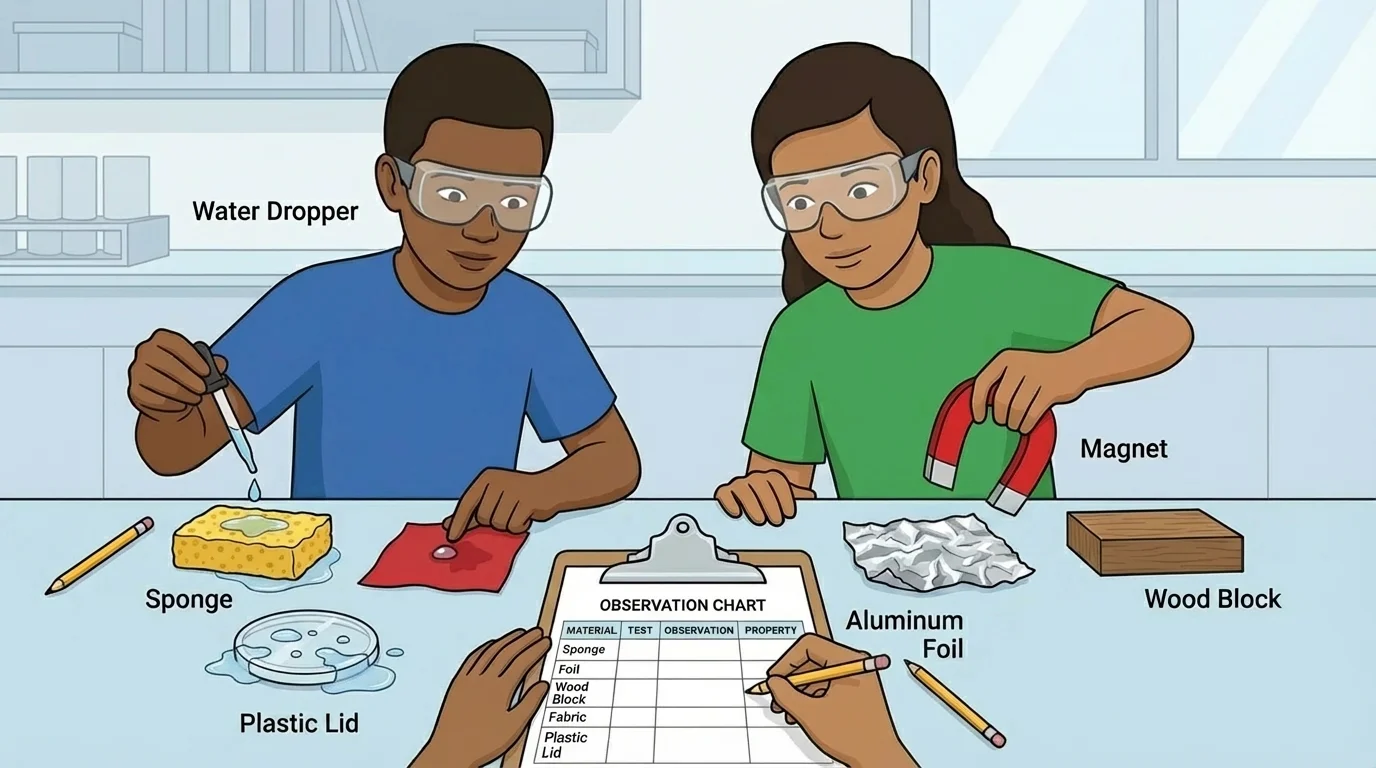
It is important to test in the same way each time. If one material gets only one drop of water, then the others should also get one drop. If you bend one object gently, bend the others gently too. This helps make the investigation fair.
Example: Testing absorbency
A class wants to know which material absorbs water best: sponge, fabric, foil, or plastic.
Step 1: Ask the question
Which material absorbs water the most?
Step 2: Test fairly
Put the same amount of water on each material.
Step 3: Observe
The sponge and fabric soak up water. The foil and plastic do not.
Step 4: Classify
Group sponge and fabric as absorbent. Group foil and plastic as waterproof.
The observations help the class describe and sort the materials.
Good scientists write or draw carefully what they observe. They do not just say, "This one is better." Instead, they say, "The sponge soaked up the water, but the foil did not." Those details make the results stronger.
To classify means to sort things into groups by shared properties, and [Figure 4] shows that the same material can fit into more than one group. A material can be smooth and waterproof. Another can be rough and absorbent.
You can classify materials in many ways. You might make a smooth group and a rough group. You might make a flexible group and a rigid group. You might sort materials into absorbent and waterproof groups.
Sometimes one object belongs in more than one group. A plastic bag can be smooth, flexible, and waterproof. A towel can be soft, flexible, and absorbent. This is important because materials have more than one property.
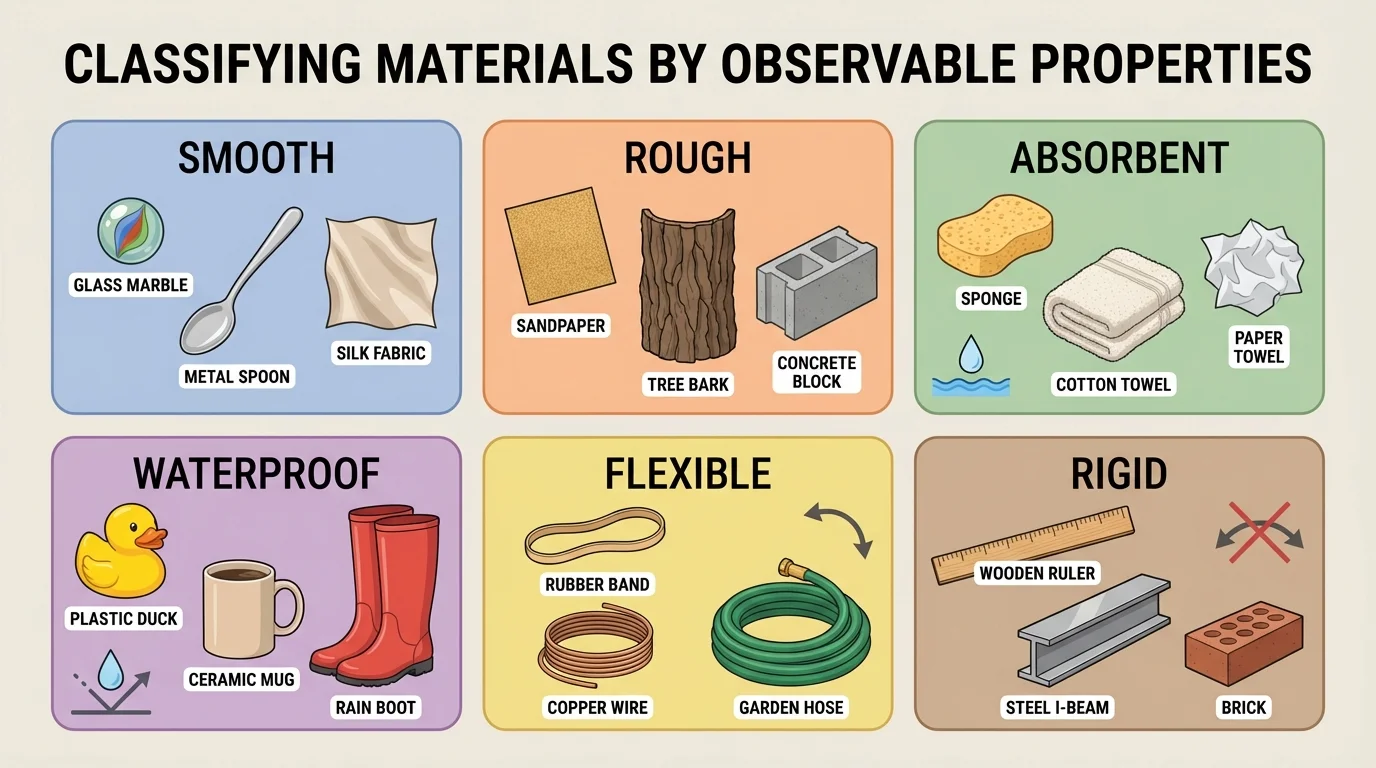
Classifying helps us notice patterns. If many waterproof objects are also smooth, that is a useful pattern. If many absorbent materials are soft, that is another pattern. Patterns help scientists describe the world clearly.
Later, when you compare new materials, you can use the same kinds of groups. As we saw earlier in [Figure 1], comparing materials side by side helps you notice shared and different properties more easily.
Why classification matters
Classification helps us organize information. When scientists sort materials by observable properties, they can compare them more easily, talk about them clearly, and choose the best material for a job.
Classification does not mean there is only one correct way to sort. If your question is about water, you may sort by absorbent and waterproof. If your question is about bending, you may sort by flexible and rigid. The best groups depend on the question you are asking.
People use material properties every day. Builders choose strong and rigid materials for walls and floors. Clothing makers choose soft and flexible materials for shirts and socks. Cooks use metal pans because they are sturdy and useful in the kitchen.
A raincoat is usually made from material that does not absorb water. A towel is made from material that does absorb water. A window is made from transparent material so light can pass through and people can see outside. These choices are based on observable properties.
When you use a lunch box, backpack, blanket, or toy, you are using objects made from materials chosen for a reason. A backpack should be flexible but also strong. A blanket should be soft. A toy block should keep its shape. The investigation ideas in [Figure 3] connect to these real-life choices because people test materials before using them in products.
Remember: Scientists use observations to learn about the world. An observation is something you notice using your senses or simple tools.
Engineers also care about material properties. They design things people use, and they must choose materials that fit the job. For example, a clear plastic face shield must be transparent, while a mop head should be absorbent.
Safety matters during every investigation. Only test materials your teacher or adult says are safe. Do not taste materials. Be careful with glass, sharp edges, or hot objects. Clean up water spills so no one slips.
Careful scientists also stay honest. If a material does not do what you predicted, that is okay. The goal is not to make your prediction come true. The goal is to learn from what you observe.
When you finish an investigation, you can share what you found using clear words: smooth, rough, flexible, rigid, absorbent, waterproof, shiny, dull, transparent, or opaque. Those words help explain how materials are alike and different.
As shown before in [Figure 4], sorting materials into groups makes your results easier to understand. Good science starts with careful looking, simple tests, and clear descriptions.
