Why is a raincoat not made of paper? Why is a towel not made of metal? The answer is important because it shows how science helps us choose the best material for a job. Materials are the substances objects are made from, like paper, plastic, wood, metal, fabric, or rubber. When scientists and engineers choose a material, they look at its properties and ask, "Will this material do the job well?"
Everything around us is made of matter, but different kinds of matter have different properties. A spoon and a napkin are both made of matter, yet they do not behave the same way. A spoon is hard and stiff. A napkin is soft and absorbent. That is why we use them for different purposes.
When we talk about the material of an object, we mean what it is made of. A chair might be made of wood, plastic, or metal. A cup might be made of glass, paper, or plastic. Different materials can sometimes be used to make the same kind of object, but one may work better than another.
The job an object needs to do is called its intended purpose. If an object must keep water out, the best material should not soak up water. If an object must bend without breaking, the best material should be flexible. If an object must stay straight, the best material should be stiff.
Property means a feature of a material that we can observe or test. Examples include hard, soft, rough, smooth, flexible, stiff, waterproof, and absorbent.
Scientists do not just guess. They test materials and collect information. Then they look at the results to decide which material is best for the job.
A property is something we can notice about a material. Some properties can be seen with our eyes or felt with our hands. Materials can be compared by their properties, as shown in [Figure 1]. For example, fabric may feel soft, while wood feels hard. Plastic may bend a little, while metal may stay stiff.
Some important properties for young scientists to study are:
Sometimes we also use a simple measurement. In this topic, the only number measurement we use is length. For example, if two strips are each cut to the same length, such as \(10 \textrm{ cm}\), we can test them fairly because they start out the same size.
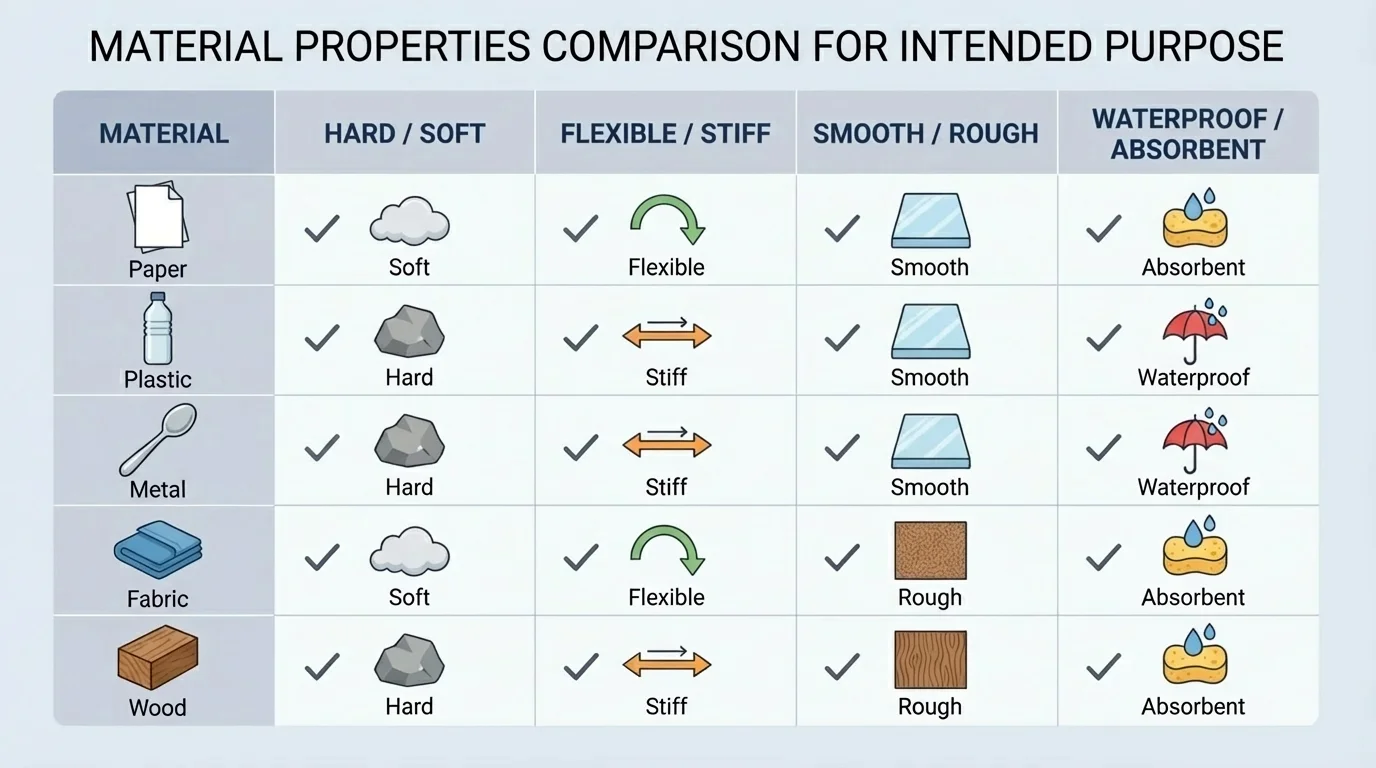
A material can have more than one property at the same time. A plastic folder can be smooth and waterproof. A cotton towel can be soft and absorbent. A wooden ruler can be hard and stiff. These combinations help us understand why some materials are better than others for certain uses.
Some objects are made from more than one material because one material alone cannot do every job well. A sneaker might have soft fabric, stretchy rubber, and firm foam all working together.
Later, when you compare test results, you will use these properties to explain your thinking. The properties have to match the job the object needs to do.
Scientists use a test to learn about materials. To make a fair comparison, they try each material in the same way, as [Figure 2] shows. If one strip is much longer than another, the test may not be fair. That is why equal lengths, such as \(8 \textrm{ cm}\) and \(8 \textrm{ cm}\), are helpful.
A fair test means changing only the material and keeping other things the same. If you are testing which strip bends best, each strip should be the same length. If you are testing which material keeps water out, each piece should get the same amount of water.
Scientists observe carefully. They may look, touch, and compare. They may also measure length with a ruler. Then they record what happened. Recording results is important because it helps us remember what we learned.
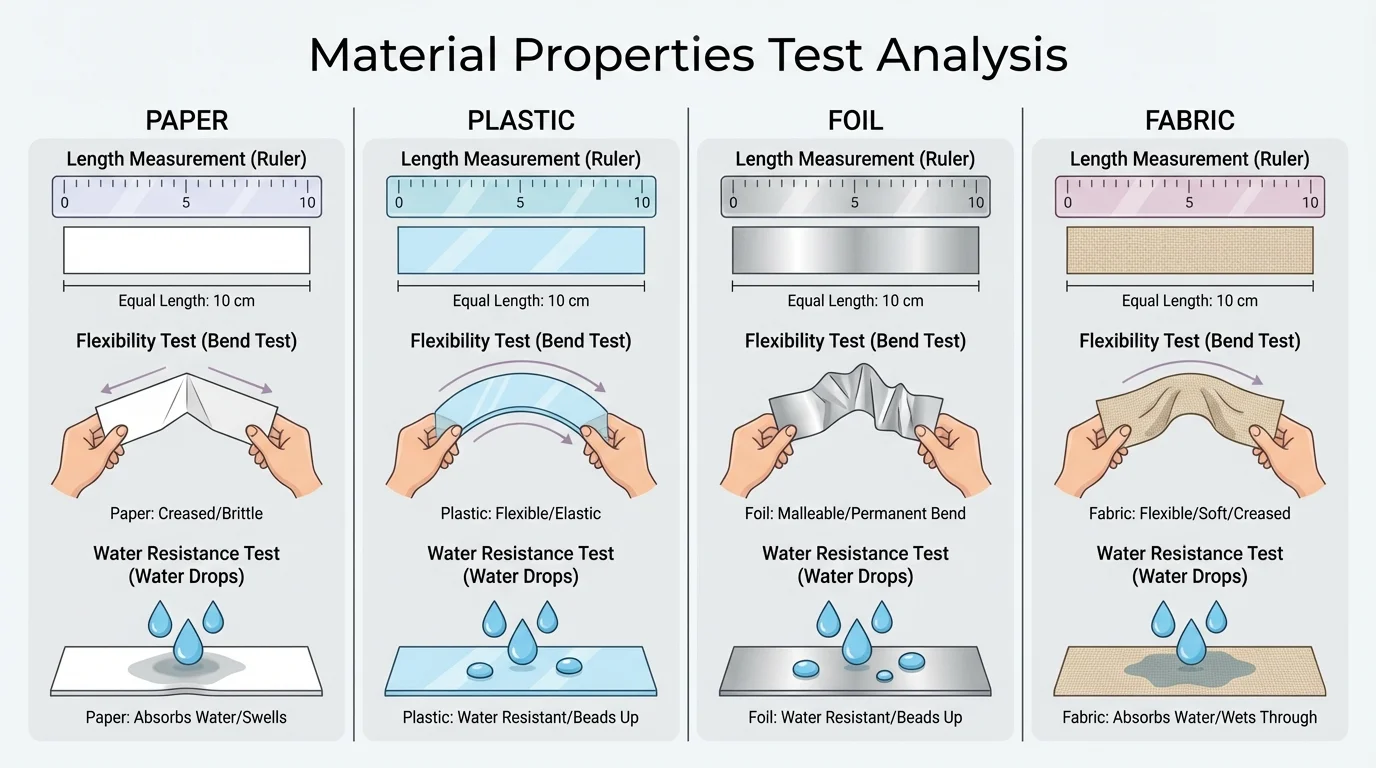
Suppose a class tests four materials for making a bookmark: paper, fabric, thin plastic, and foil. Each piece is cut to \(12 \textrm{ cm}\). Students might ask: Which one stays flat? Which one tears easily? Which one bends too much? Their data helps them decide which material is best.
Example: Testing materials for a bookmark
Step 1: Cut each material to the same length, \(12 \textrm{ cm}\).
Step 2: Bend each piece gently and observe whether it stays stiff or flops.
Step 3: Try to tear each piece gently and observe whether it stays strong.
Step 4: Record the results and choose the material that is stiff enough and not easy to tear.
The best choice might be thin plastic if it is smooth, strong, and stays fairly straight.
Good science uses evidence. Evidence means the facts and observations you got from the test, not just what you hoped would happen.
After a test, scientists study the data. Data is the information collected from observations and measurements. It can be words, check marks, or simple measurements of length. Looking at data helps us make smart choices.
[Figure 3] If you are choosing a material for a towel, you would want it to absorb water and feel soft. If your data shows that cotton fabric absorbs water but plastic does not, then cotton fabric is a better choice for that purpose.
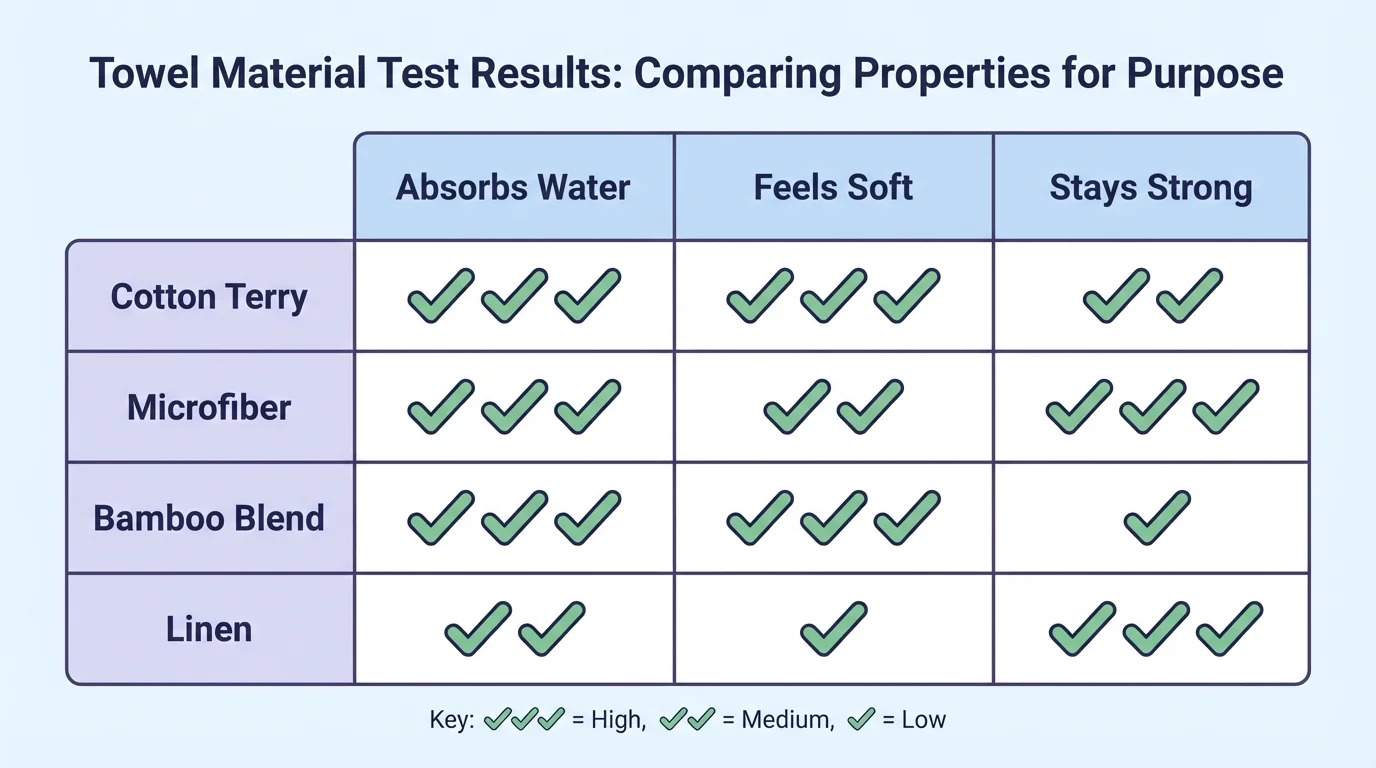
Here is an example of how data can help:
| Material | Absorbs Water | Soft | Best for Towel? |
|---|---|---|---|
| Plastic | No | No | No |
| Cotton Fabric | Yes | Yes | Yes |
| Foil | No | No | No |
| Wood | No | No | No |
Table 1. A simple comparison of materials tested for making a towel.
The data does not just tell us which material is "good" or "bad." It tells us which material is best for a certain use. Plastic is not good for a towel, but it may be great for a rain poncho because it can keep water out.
Choosing by evidence
The best material is the one whose properties match the job. A material that works well for one purpose may work poorly for another. Scientists and engineers use test results to match properties to needs.
This is why reading data carefully matters. We look for the material whose properties fit the intended purpose most closely.
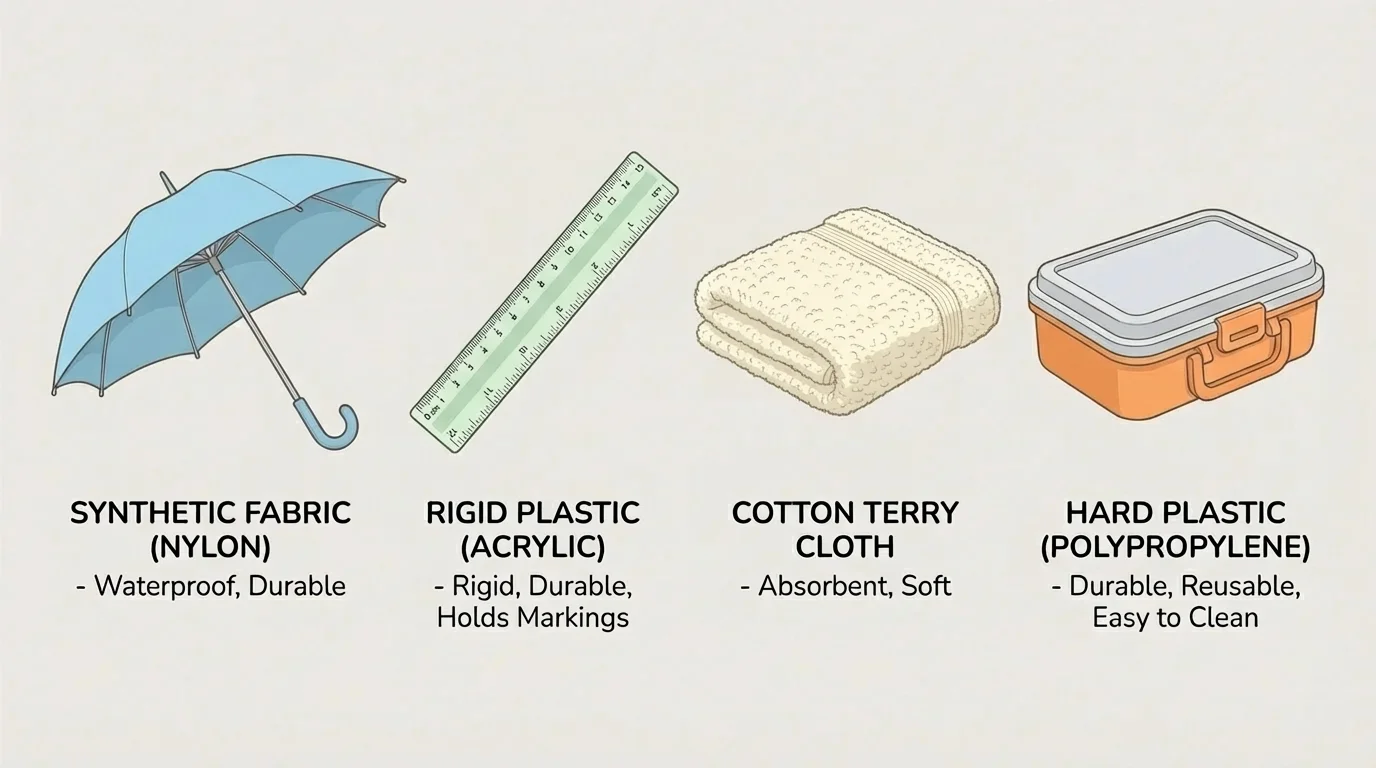
Different jobs need different properties, and [Figure 4] helps show this idea with common objects. A ruler needs to stay straight, so a stiff material such as wood or hard plastic works well. A towel needs to soak up water, so soft absorbent fabric works well.
An umbrella needs a material that keeps rain out. Fabric that is waterproof works better than paper. A lunch box needs to hold its shape and protect food, so strong plastic or metal may work better than a soft cloth bag.
Think about a bandage. It should be soft and flexible so it can wrap around your skin. Think about a window. It should be hard, smooth, and see-through. The properties must fit the use.
We can also compare strips or pieces that are the same length. If one \(15 \textrm{ cm}\) strip of fabric bends easily and one \(15 \textrm{ cm}\) strip of cardboard stays straight, that tells us something important about flexibility and stiffness. The equal length makes the comparison fair.
Real-world example: Picking a material for a rain hat
Step 1: Decide what the hat must do. It should keep water off a person's head.
Step 2: Look at test results for paper, cloth, and plastic.
Step 3: Ask which material is waterproof and still light enough to wear.
Step 4: Choose the material whose properties fit the purpose best.
Plastic may be the best choice because it does not soak up rain.
As we saw earlier in [Figure 1], one quick look at a list of properties can already suggest which materials may work best. Testing gives stronger evidence.
No material is perfect for every job. A metal spoon is great for stirring soup because it is hard and strong. But a metal pillow would be terrible because it is not soft. Paper is useful for drawing and writing, but it is not a good choice for boots because it tears and gets soggy.
This is an important science idea: the "best" material depends on the purpose. To choose wisely, we ask what properties are needed. Then we test and compare.
Sometimes two materials both seem useful. Then the data helps us choose. For example, both cardboard and plastic can make a folder, but if the folder may get wet, plastic may be better because it is more waterproof.
You already know that objects can be sorted by what they are like. Testing materials is a deeper way of sorting because it uses evidence from observations and simple measurements.
Fair tests matter here too. If cardboard is cut to \(10 \textrm{ cm}\) and plastic is cut to \(20 \textrm{ cm}\), it may be harder to compare them. Keeping lengths the same gives clearer results.
Scientists and engineers use these ideas every day. Builders choose materials for houses. Clothing designers choose materials for coats, socks, and gloves. Toy makers choose materials that are safe, strong, and suitable for children.
A chef might choose a wooden spoon because it is strong. A doctor might use soft bandage material because it bends around the body. A sports company might choose rubber for the outside of a ball because it bounces and grips well.
When engineers design something new, they test materials before making the final product. Just like students, they gather data and look for the best match between properties and purpose. The kind of thinking shown in [Figure 4] is part of real design work in the world around us.
Using evidence helps us make smart choices. Instead of guessing, we can say, "This material is best because the test showed it is strong," or "That material is better because it is absorbent." Science helps us explain why a choice makes sense.
