Have you ever turned a small pile of blocks into a house, then changed that same pile into a car or a robot? That is a big science idea. Sometimes an object looks completely new, but it is still made from the same pieces. When we look closely and describe what we see, we can explain how one object was taken apart and made into another object.
In science, we learn by noticing details. [Figure 1] We look at an object and ask questions such as: How many pieces are there? What shapes are they? What colors are they? How do the pieces fit together? Careful noticing helps us tell a true story about what changed and what stayed the same.
To observe means to look carefully and notice details. Scientists make observations using their senses. When an object is made of a small number of pieces, we can study each piece one by one. A small block house shows how one object can be built from just a few parts, and the separated pieces make those parts easier to notice.
When you observe, you may notice the properties of each piece. A property is something you can notice about a piece, such as its color, shape, size, or how it feels. A red square block and a long blue block are different because they have different properties. These details matter because they help us know which piece is which.
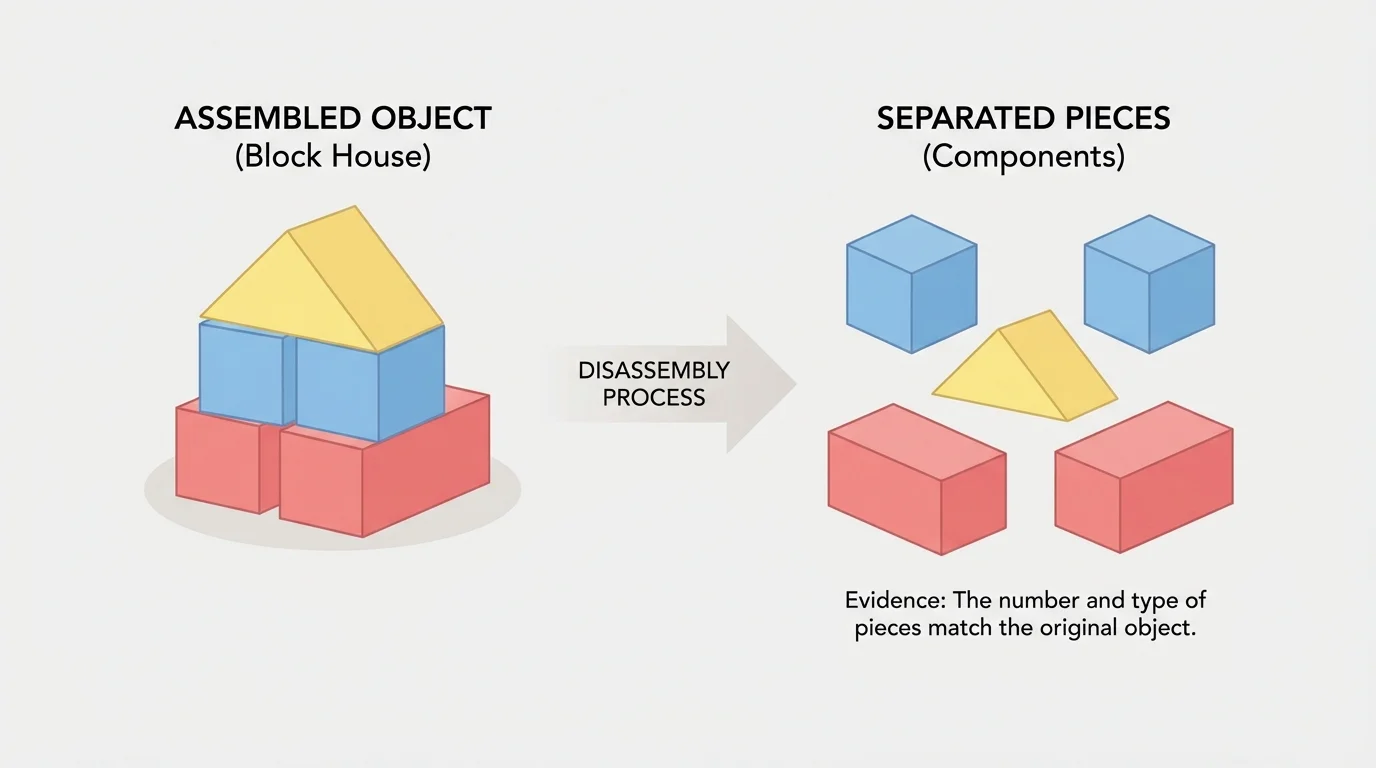
Suppose you see an object made from four blocks: one long blue block, two small red blocks, and one yellow triangle block. You can describe the object by naming the pieces and how they are connected. Maybe the long blue block is on the bottom, the two red blocks are in the middle, and the yellow triangle is on top. That description is based on observation, not guessing.
Piece means one part of a larger object. Object means the whole thing made from those parts. Evidence means the details we observe and use to support what we say.
When an object is taken apart, the whole object changes, but the separate pieces can still be identified. The long blue block is still the long blue block. The yellow triangle is still the yellow triangle. This is why careful observation is so important. If we know the pieces well, we can follow what happens when the object changes.
[Figure 2] An object can be disassembled by separating its pieces. That means the pieces are no longer connected in the same way. Then the same pieces can be connected again to make a new object. A small block car can be taken apart and then rebuilt as a tower using the very same pieces.
This kind of change happens in many places. A child may build a boat from interlocking blocks and later use those blocks to make a bridge. A puzzle picture can be broken into pieces and then put back together. Paper shapes can be moved around to make a fish, then a bird. The pieces are rearranged. They are not turning into a different material.
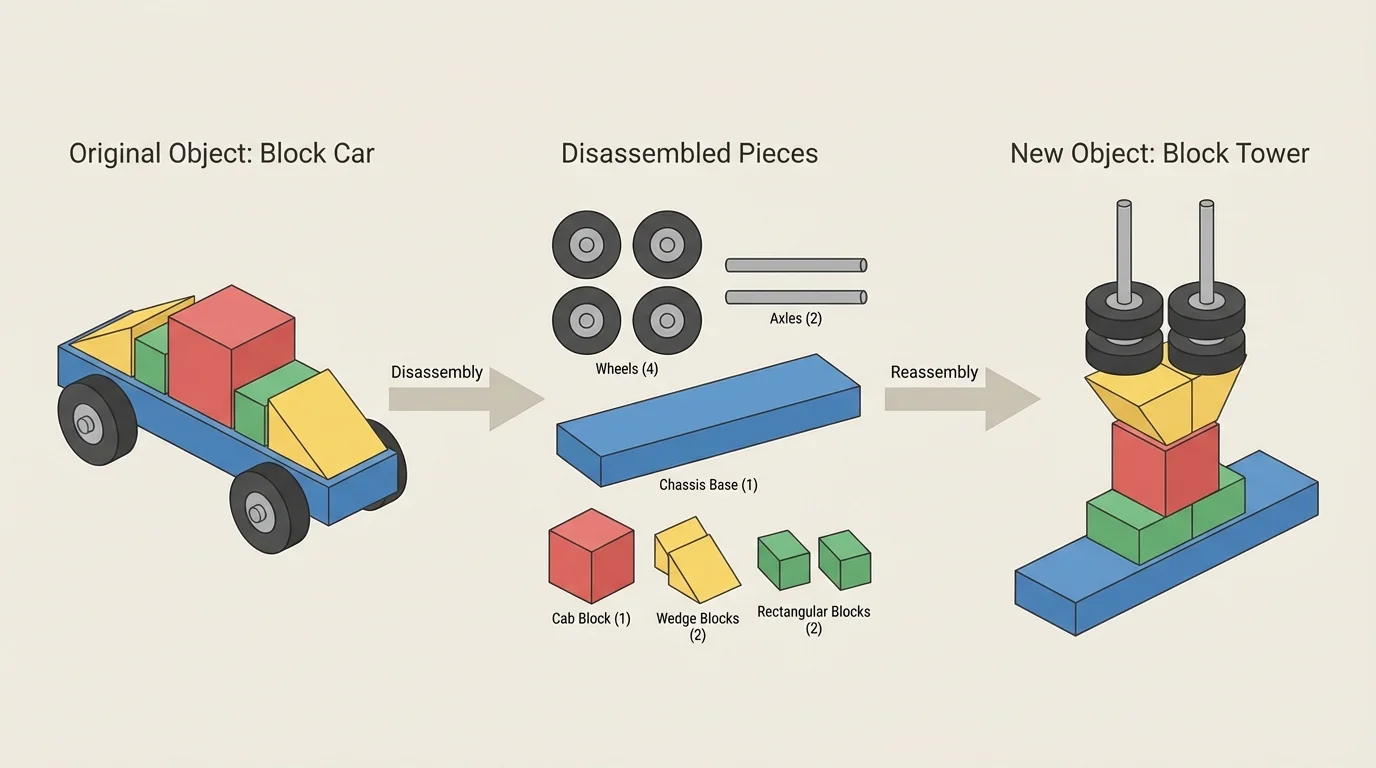
Think about building blocks. If a car is made from five pieces, and then you take it apart, you still have those five pieces. You may place them in a new order or turn them in a different direction. A piece that was on the bottom before might be on the top now. A flat piece might become the roof of a house instead of the seat of a car.
This is why the arrangement of pieces matters. The same set of pieces can make different objects because the pieces can connect in different ways. Changing the arrangement changes the whole object. A square, a triangle, and a rectangle might make a little house when arranged one way, but they might make a rocket when arranged another way.
Same pieces, new object
A new object can be made when the same pieces are separated and put together in a new pattern. The object changes because the pieces are arranged differently, even though the pieces themselves can stay the same.
You can also notice this with snap-together toys, tangram shapes, magnetic tiles, or even a sandwich cut into parts and placed in a different order on a plate. In each case, looking carefully helps us explain how the first object became the next one.
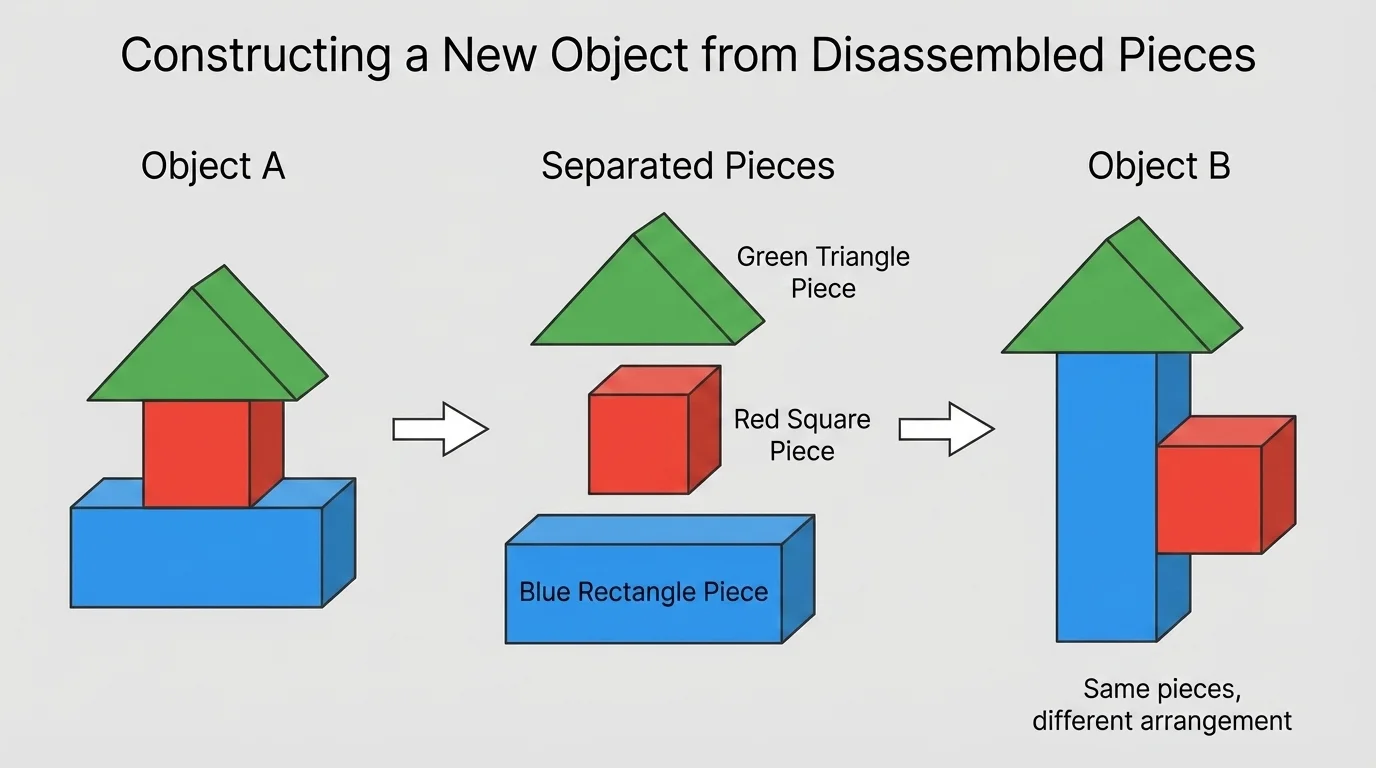
[Figure 3] Science explanations should be based on what we can notice. An account based on evidence tells what happened by using observations. The comparison between the first object, the separated pieces, and the new object helps us use real details as evidence.
Good evidence might include the number of pieces, the colors of the pieces, the shapes of the pieces, and where the pieces are placed. If the first object has one green square, two yellow rectangles, and one red triangle, and the second object has those same pieces, that is important evidence. It helps show that the second object was made from the first object's pieces.
Here are some kinds of observations that can be used as evidence:
| Observation | How it helps |
|---|---|
| Same number of pieces | Shows no pieces were added or removed. |
| Same colors | Helps identify the same pieces in the new object. |
| Same shapes | Shows which pieces were reused. |
| Different positions | Shows the pieces were rearranged. |
| Different overall object | Shows a new object was created from the pieces. |
Table 1. Observations that can be used as evidence when an object is taken apart and rebuilt.
If you only say, "It changed," that is not a strong science explanation. But if you say, "I saw four pieces before and four pieces after. The same blue rectangle, red square, yellow triangle, and green square were used, but they were in different places," then you are using evidence. Your explanation becomes clear and strong.
Example: Using evidence to explain a change
A child builds a small picture with pattern blocks. First it looks like a house. Later it looks like a boat.
Step 1: Observe the first object.
The house has one square, one triangle, and two small rectangles.
Step 2: Observe the pieces after taking it apart.
The same four pieces are separated on the table.
Step 3: Observe the new object.
The boat also uses one square, one triangle, and two small rectangles, but the pieces are in different positions.
An evidence-based account is: The house was taken apart into four pieces and those same four pieces were arranged in a new way to make a boat.
Later, when you explain another example, the same idea still works. As we saw in [Figure 3], the best explanation includes what stayed the same and what changed. The pieces stayed the same, but the arrangement changed.
This science idea is all around you. A toy made from connecting bricks can become many things. A set of train tracks can be taken apart and rebuilt into a new path. Some furniture comes in separate parts before it is put together. Builders follow directions to join the pieces into one object.
People who design and build things use this idea often. An engineer may test one shape, take it apart, and build a better one from the same parts. A child making a model with craft sticks may try a triangle shape, then move the sticks and make a square shape. Observing which pieces are used helps the builder explain the change.
Some toys are designed so one small set of pieces can make dozens of different objects. That happens because the same pieces can be arranged in many different ways.
Sorting and reusing materials also connects to this idea. For example, if bottle caps, cardboard pieces, and string are used to make an art project, the artist can take the project apart and use the same items to make a new design. The materials do not need to become something brand-new by themselves. People can rearrange them into a new object.
A strong science explanation tells the story in order. First, name the beginning object. Next, tell how it was taken apart. Then, describe the new object. Finally, use evidence from your observations to support your explanation. In many cases, [Figure 2] helps us remember this order: object, separate pieces, new object.
You might say, "First, there was a car made from five blocks. Then the blocks were separated. Next, the blocks were connected in a new way. The same five blocks made a tower." That is clear because it names the beginning, the middle, and the end.
Words that help in an evidence-based account include first, next, then, same, different, pieces, arranged, and observed. These words help explain the change clearly.
You already know that objects can have different shapes, sizes, colors, and textures. Those observable properties help you identify pieces before and after an object is changed.
Sometimes two objects may look very different at first glance. But careful observation shows they are made from the same set of pieces. A tall tower and a flat bridge may use the same blocks. A new shape does not always mean new pieces were added. Looking closely helps us tell the difference.
When an object is made from a small set of pieces, you can study how it is built. You can notice each part, describe it, and see where it connects. Then, if the object is taken apart, you can follow those same pieces into a new object.
Science is not only about seeing that something changed. It is also about explaining how it changed and using evidence to support that explanation. As we saw earlier in [Figure 1], noticing details about each piece makes the explanation much stronger.
By observing carefully, identifying the pieces, and describing how they are rearranged, you can construct an evidence-based account of how one object is disassembled and made into a new object.
