Have you ever watched an ice pop drip on a hot day or smelled toast cooking in the morning? Heat and cold can change things all around us. Some of these changes are easy to undo, but some are not. Scientists pay close attention to what they see so they can make a strong argument about what is happening.
When we study matter, we look at the materials objects are made of and the properties we can observe. Heating and cooling can change the way matter looks, feels, or behaves. We can use those observations to decide whether the change can go back to the way it was before.
When something is heated, it gets warmer. When something is cooled, it gets colder. Heat and cold can make materials softer, harder, melt, freeze, bend, dry out, or cook. We can often notice these changes with our eyes, hands, or nose.
For example, a frozen ice cube left on a table begins to turn into liquid water. A tray of water placed in a freezer turns into solid ice. Chocolate can get soft when it is warm and harder again when it cools. These are changes we can observe carefully.
You already know that materials have different properties. Some are hard, some are soft, some are liquids, and some are solids. Heating and cooling can change those observable properties.
Scientists do not just say, "It changed," and stop there. They ask, Can it change back? That question helps us sort changes into two groups: changes that can be reversed and changes that cannot.
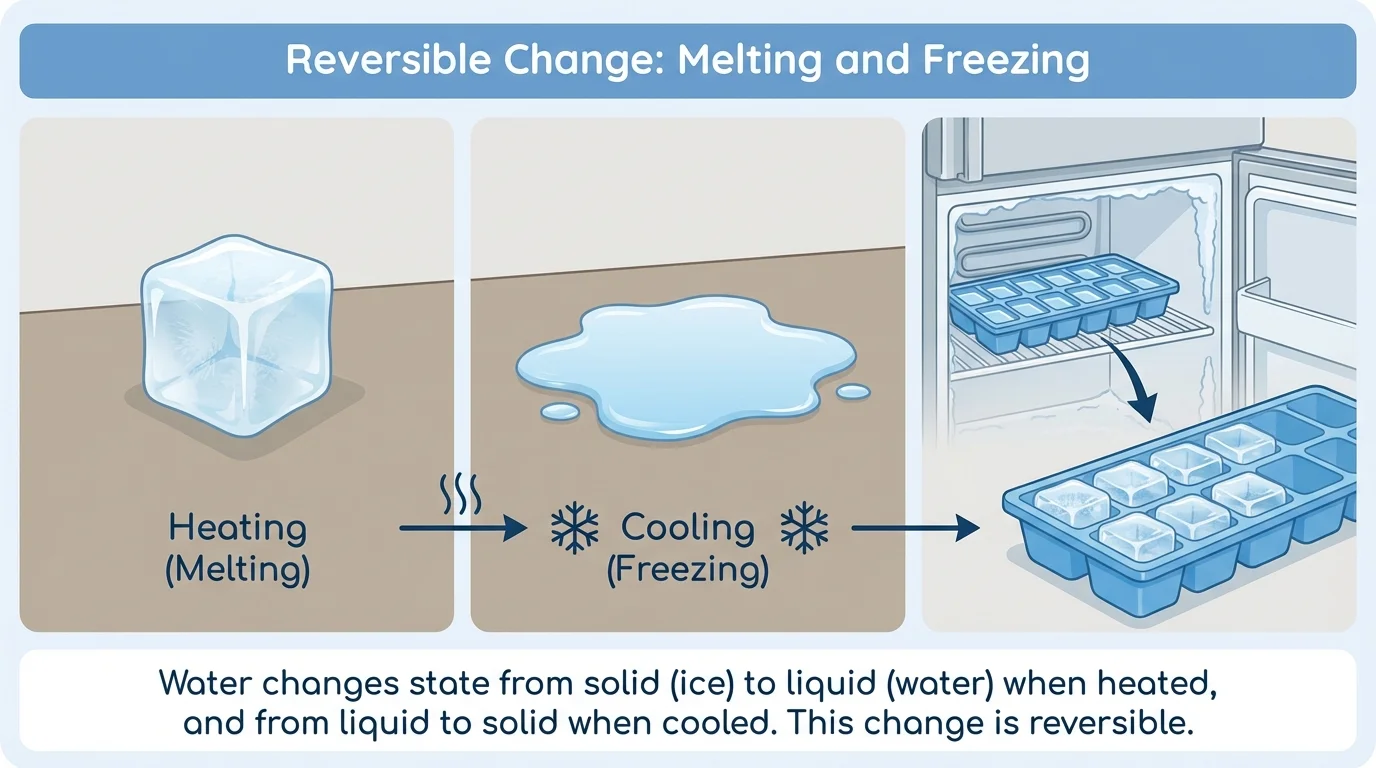
A reversible change is a change that can go back to the way it was before. Water is a great example. Ice melts when it is heated and becomes liquid water. Then the liquid water can be cooled and turn back into ice.
[Figure 1] This means the change can be undone. If you start with ice, heat changes it to water. If you cool the water, it becomes ice again. The material is still water, written as \(\textrm{H}_2\textrm{O}\), even though it looks different as a solid or a liquid.
Butter can also show a reversible change. Warm butter melts and becomes softer or more liquid. If the melted butter is cooled, it becomes firmer again. Chocolate does this too. That is why a chocolate bar can get melty in a warm hand but become hard again in a cool place.
Reversible changes do not always look exactly perfect after changing back, but the important idea is that the material can return to its earlier form. Looking again at water in [Figure 1], we see clear evidence of a change that goes in both directions: melting and freezing.
Heating means adding warmth to something.
Cooling means taking away warmth so something gets colder.
Evidence is what you observe that helps prove an idea.
We can collect evidence for reversible changes by watching closely. We may see a solid turn into a liquid, then later a liquid turn into a solid again. We can touch carefully and notice a material becoming softer when warm and harder when cool. These observations help us support our ideas.
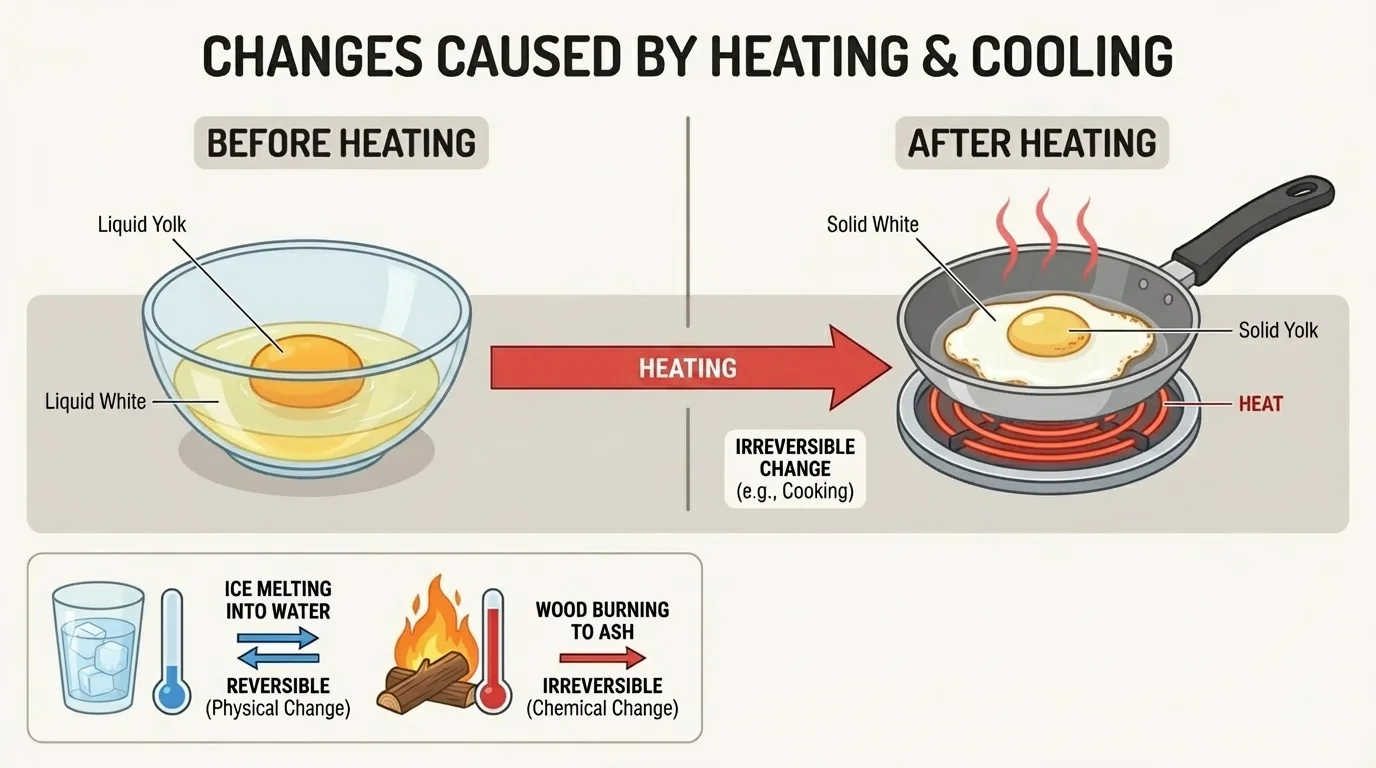
Some changes from heating do not go back to the way they were before. An irreversible change is a change that cannot be turned back into the original material. An egg is a strong example. A raw egg changes when it is cooked. After heating, it does not turn back into a raw egg.
[Figure 2] Toast is another example. Bread placed in a toaster becomes toast. The color, smell, and texture change. You cannot cool the toast and get soft bread again. The heating caused a change that stays.
A pancake shows the same idea. Wet pancake batter starts as a pourable liquid. After heating on a griddle, it becomes a solid pancake. Cooling it later does not turn it back into batter. Clay that is baked in a kiln also becomes hard and does not return to soft clay.
These examples help us understand that heating can cause very different results. Some materials, like water or butter, can change back. Others, like eggs, toast, and pancakes, stay changed. The egg example in [Figure 2] gives clear evidence because we can compare the uncooked and cooked forms and see that the original state does not return.
People use reversible changes to make treats like ice pops and shaped chocolates. They also use changes that cannot be reversed when they bake bread, cookies, and cakes.
It is important to base our ideas on what we observe. We do not need fancy words to explain every tiny detail. We just need to notice what happened and whether the material can go back to how it was before.
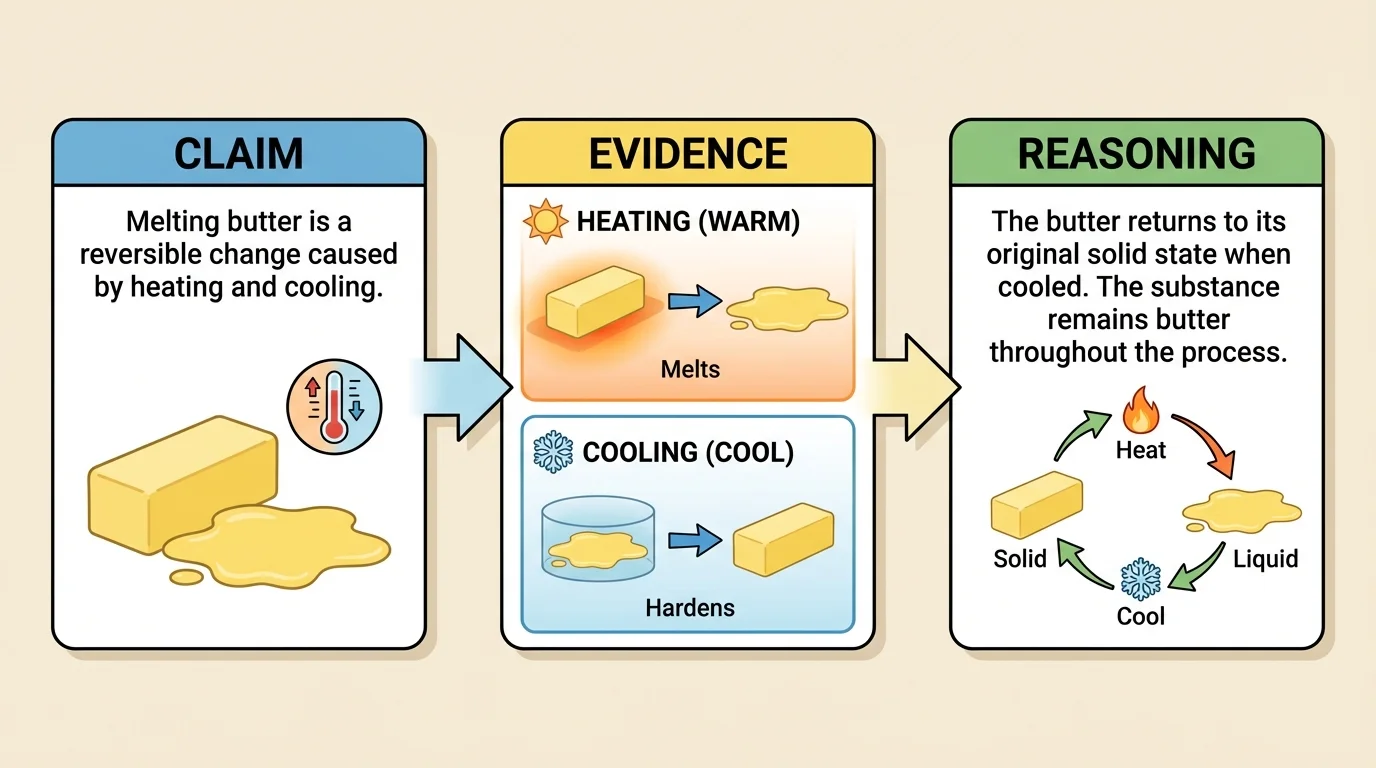
Scientists make an argument when they give an idea and support it with facts and observations. A simple science argument has three parts: a claim, evidence, and reasoning.
[Figure 3] A claim is what you think is true. Evidence is what you observed. Reasoning tells how the evidence supports the claim. This helps your thinking sound clear and strong.
Example argument: Ice and water
Step 1: Claim
The change between ice and water can be reversed.
Step 2: Evidence
Ice melts when it is heated. Water freezes when it is cooled.
Step 3: Reasoning
Because the water can become ice again, the change goes back to the way it was before.
This pattern works for many examples. The organizer in [Figure 3] helps us keep our ideas in order so we do not forget to include what we saw.
Example argument: Toast
Step 1: Claim
The change from bread to toast cannot be reversed.
Step 2: Evidence
Bread becomes browner, crisper, and smells different after heating in a toaster.
Step 3: Reasoning
Cooling the toast does not turn it back into soft bread, so the change does not go back.
Notice that the evidence comes from observations: what we see, feel, or smell. Good science arguments use real observations, not guesses.
Let us compare several everyday materials. Ice cream that melts in the sun may get liquid, but if it is put back in the freezer it can harden again. That gives evidence for a reversible change, even if the shape is messy. A crayon can soften when heated and become hard again when cool.
Now think about baking cookies. Dough goes into the oven soft and sticky. Cookies come out warm, solid, and shaped. After they cool, they stay cookies. They do not turn back into dough. That is evidence for a change that cannot be reversed.
| Material | What heating or cooling does | Can it go back? |
|---|---|---|
| Ice | Melts to water; water freezes to ice | Yes |
| Butter | Melts when warm; firms when cool | Yes |
| Chocolate | Softens or melts when warm; hardens when cool | Yes |
| Egg | Cooks when heated | No |
| Bread | Becomes toast when heated | No |
| Cookie dough | Bakes into cookies | No |
Table 1. Examples of changes caused by heating or cooling and whether they can return to the original state.
When we make an argument, we can say, "I think this change can be reversed because I saw it change back," or "I think this change cannot be reversed because it stayed changed after cooling." Those are strong statements because they are based on evidence.
People use what they know about heating and cooling every day. In kitchens, cooks melt butter, freeze juice into ice pops, bake bread, and fry eggs. In each case, they understand whether the change will go back or stay changed.
Weather gives us examples too. Water outside can freeze into ice when the air gets very cold and melt again when it warms up. This matters for roads, ponds, and plants. Reversible changes in water are important in nature and in our homes.
Safety matters as well. Hot pans, ovens, and toasters can change food quickly and can also hurt skin. Knowing that heat can cause big changes reminds us to be careful around things that are hot.
Scientists and engineers also care about these changes. They choose materials that melt when needed and materials that stay strong when heated. A chocolatier wants chocolate to melt and harden at the right times. A baker wants dough to turn into bread and stay that way.
Using evidence to decide
To decide whether a change is reversible, ask two questions: What did I observe after heating or cooling? Can the material return to how it was before? The answers help build a clear scientific argument.
When you look at changes carefully, you are acting like a scientist. You are not just noticing that something is different. You are asking whether the difference can be undone and using evidence to support your answer.
