A tiny bee can help plants reproduce, and other animals can help seeds reach places far away from the parent plant. That sounds almost like magic, but it is real science. Plants stay in one place, so they often need help from animals. Some animals help by moving pollen from flower to flower. Other animals help by moving seeds to new places. Scientists and engineers can make simple models to show how these jobs happen.
Plants need water and light to grow. They also need a way to make new plants. Many plants depend on animals for this. An animal may brush against a flower and carry pollen away. An animal may also eat fruit or walk through grass and move seeds to a new spot.
When plants get this help, their seeds may end up in places where new plants can grow. This is one reason we see flowers, bushes, and trees in many different places. Animals do not do this on purpose all the time, but their actions can still help plants.
Plants make flowers, fruits, and seeds. A seed can grow into a new plant when it has the things it needs, such as water, light, and space.
We will focus on two ways animals help plants: pollination and seed dispersal. We will not study food webs or the health of whole ecosystems here. Instead, we will look closely at how one animal action can help one plant job get done.
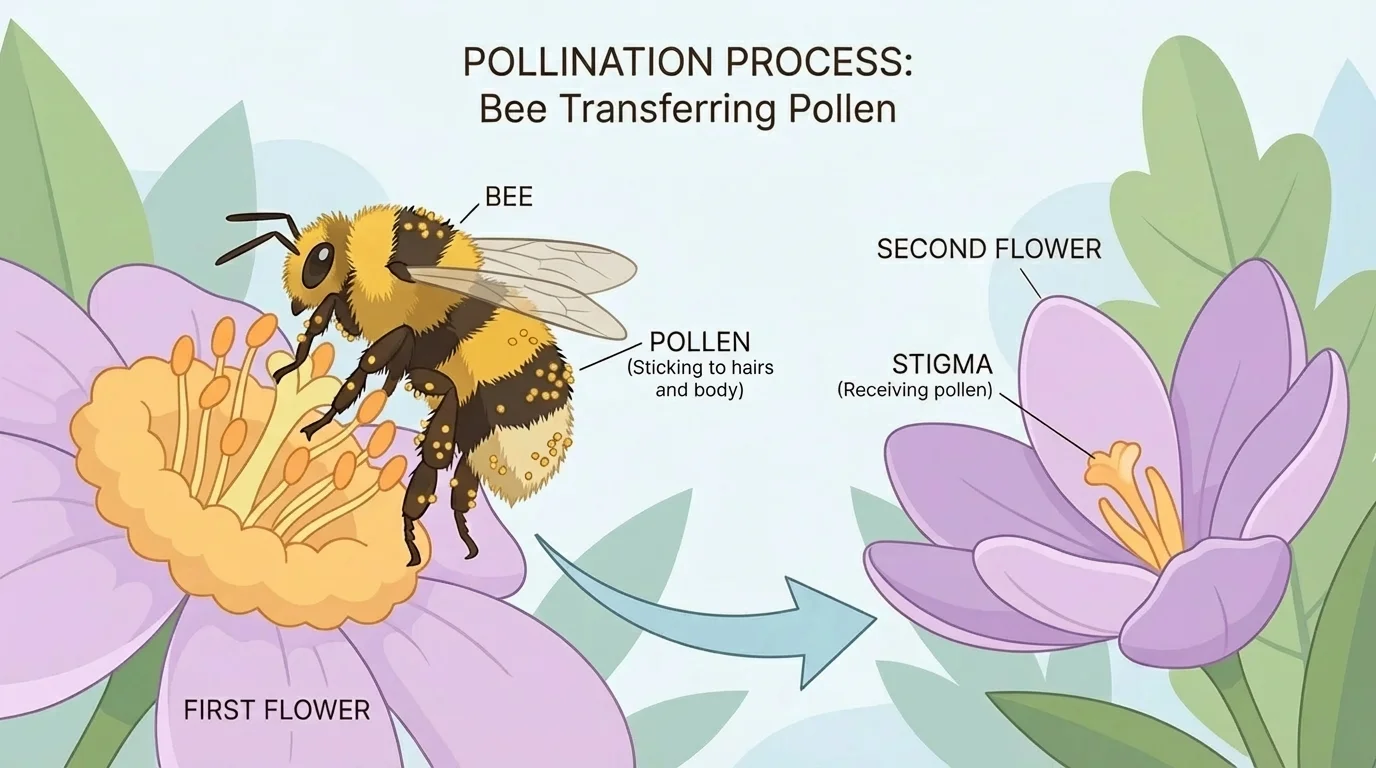
Pollination happens when pollen moves from one flower to another flower, as [Figure 1] shows. Pollen is a fine powder made by flowers. When an animal such as a bee visits a flower, some pollen can stick to its body. When the animal visits another flower, some of that pollen can rub off.
This movement of pollen helps the plant make seeds. Bees are common pollinators, but they are not the only ones. Butterflies, hummingbirds, moths, and bats can also help move pollen.
Flowers often have colors, smells, or nectar that attract animals. Nectar is a sweet liquid in many flowers. While the animal drinks nectar or looks for food, pollen may stick to feathers, fur, legs, or a fuzzy body.
A pollination model should show the important parts of this job. It should include something that stands for a flower, something that stands for pollen, and something that stands for the animal. The model does not need to be alive. It just needs to help us see what is happening.
Pollination is the movement of pollen from one flower to another. Seed dispersal is the movement of seeds away from the parent plant. Model is a simple representation that helps us show or test how something works.
Later, when we compare models, we can look back at [Figure 1] and notice the most important idea: the animal is a carrier. It picks up pollen in one place and leaves some in another place.
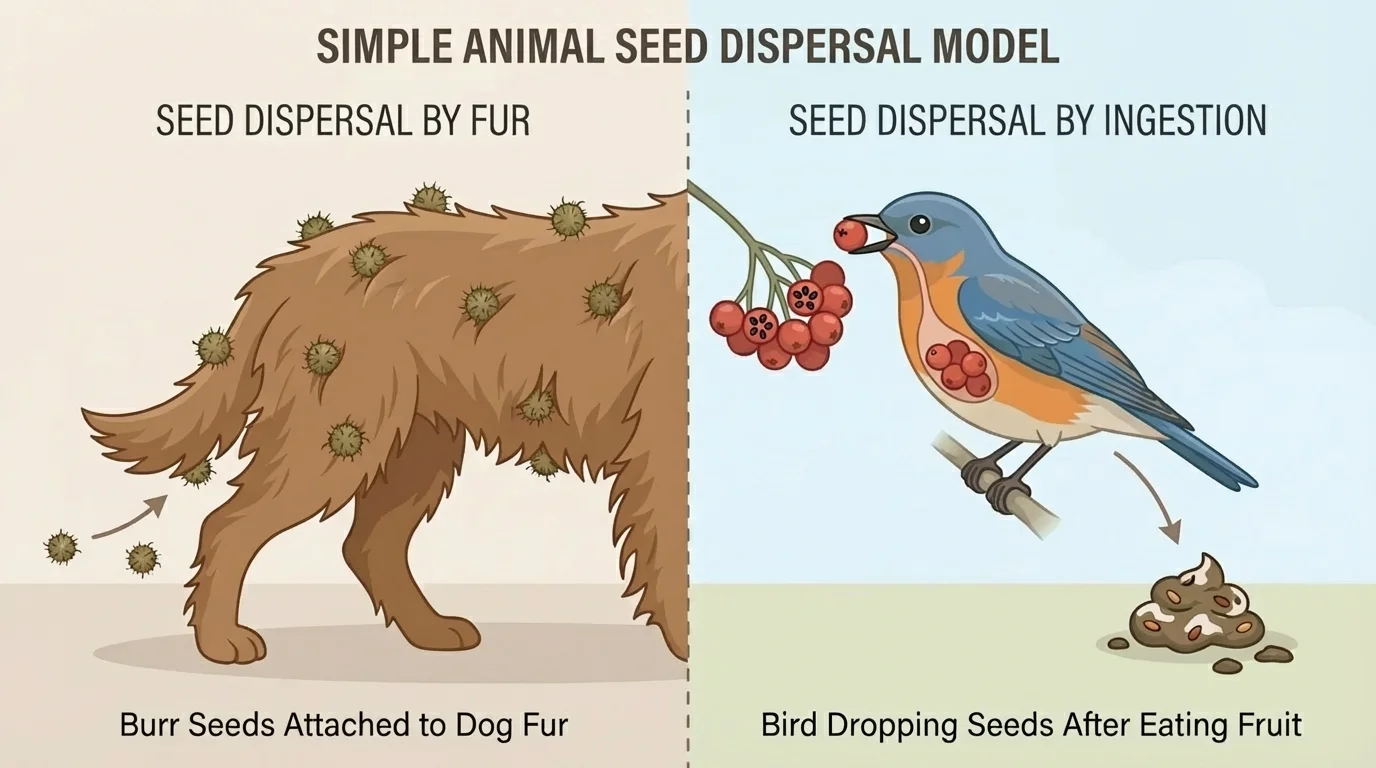
Seed dispersal means seeds move away from the parent plant, and animals can help in more than one way, as [Figure 2] illustrates. Some seeds have tiny hooks or rough parts that catch on fur or feathers. Other seeds are inside fruits that animals eat.
If a seed sticks to a dog's fur, the dog may carry it far from the plant before it falls off. If a bird eats a berry, the seed may travel with the bird and later be dropped somewhere else. In both cases, the seed is moved to a new place.
This movement matters because seeds do not always grow best when they all fall in one small spot. A new place may give a seed more room. The main idea is simple: the animal helps the seed travel.
Some familiar examples are burrs that cling to socks, a squirrel carrying nuts, or birds eating cherries and moving the pits. These are all ways seeds can be spread. A model can copy one of these actions in a simple way.
Burr seeds were one idea that helped inspire hook-and-loop fasteners. A scientist noticed how the seeds stuck to fur and clothing and studied their tiny hooks.
When we think again about [Figure 2], we can compare two seed-moving methods: sticking on the outside of an animal or traveling inside after the animal eats fruit. Both are examples of animals helping plants move seeds.
A model is a simpler version of something real, and [Figure 3] shows how a classroom model can match the jobs of a flower, pollen, and an animal. Scientists use models when the real thing is too small, too fast, too slow, or too hard to study directly.
A good model keeps the important parts. For pollination, the important parts are the flower, the pollen, and the animal that carries the pollen. For seed dispersal, the important parts are the seed and the animal that moves it.
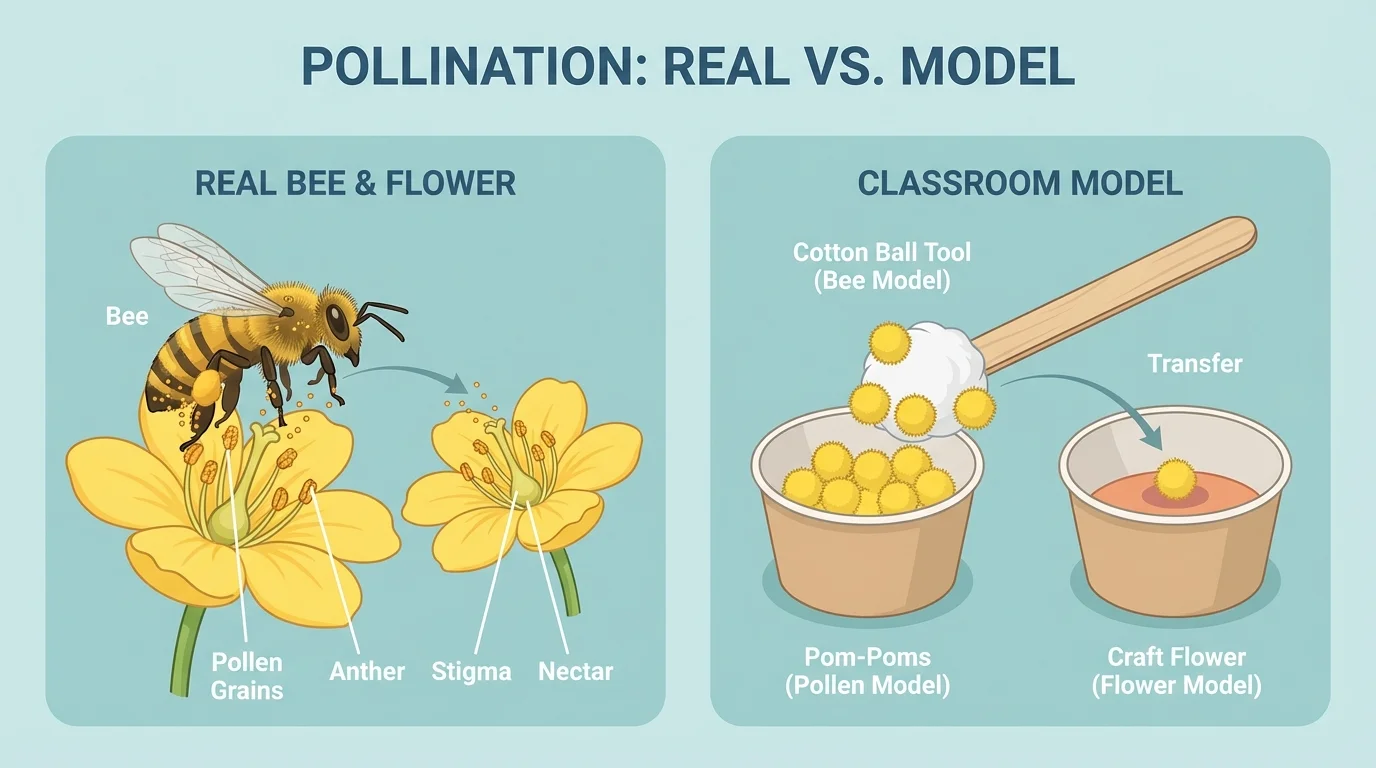
A model is not exactly the same as the real thing. A pom-pom is not real pollen. A cotton ball on a stick is not a real bee. But if the pom-pom pieces stick to the cotton and then move to another paper flower, the model still shows the important action clearly.
That is why models are useful. They help us think about what is happening. Looking back at [Figure 3], we can see that the model leaves out many details, like buzzing wings or flower smell, but it still keeps the key job of moving pollen.
One simple pollination model can use paper flowers, a small amount of colored powder, and a cotton ball clipped to a clothespin or spoon. The paper flowers stand for real flowers. The colored powder stands for pollen. The cotton ball stands for a fuzzy animal, like a bee.
When the cotton ball touches the first flower, some powder sticks to it. Then the cotton ball touches a second flower, and some powder rubs off. This copies the way pollen can move from flower to flower.
Example: Matching the parts in a pollination model
Step 1: Choose the flower part.
Paper flowers can stand for real flowers.
Step 2: Choose the pollen part.
Yellow powder, glitter, or small paper dots can stand for pollen.
Step 3: Choose the animal part.
A cotton ball, pom-pom, or fuzzy glove can stand for a bee or another pollinator.
Step 4: Show the action.
Touch one flower and then another so the "pollen" moves.
This model works because it shows transfer, which is the most important part of pollination.
Some pollination models might use a feather to stand for a bird instead of a cotton ball for a bee. That is fine if the model still shows pollen being picked up and moved. Different models can represent different animals.
A seed dispersal model can copy burr seeds that catch on fur, and [Figure 4] presents this clearly with a simple classroom setup. A strip of felt or fuzzy fabric can stand for animal fur. Small paper pieces with hook material or tape loops can stand for burr seeds.
When the fuzzy strip brushes past the paper burrs, some stick to it. Then the strip moves to another place, and the burrs can be pulled off there. This shows how seeds can travel on the outside of an animal.
Another seed dispersal model can copy fruit-eating animals. A small box or cup can stand for an animal's body, and beads or paper dots can stand for seeds inside a fruit. Moving the "animal" to a new spot and dropping the beads shows the seeds being moved elsewhere.
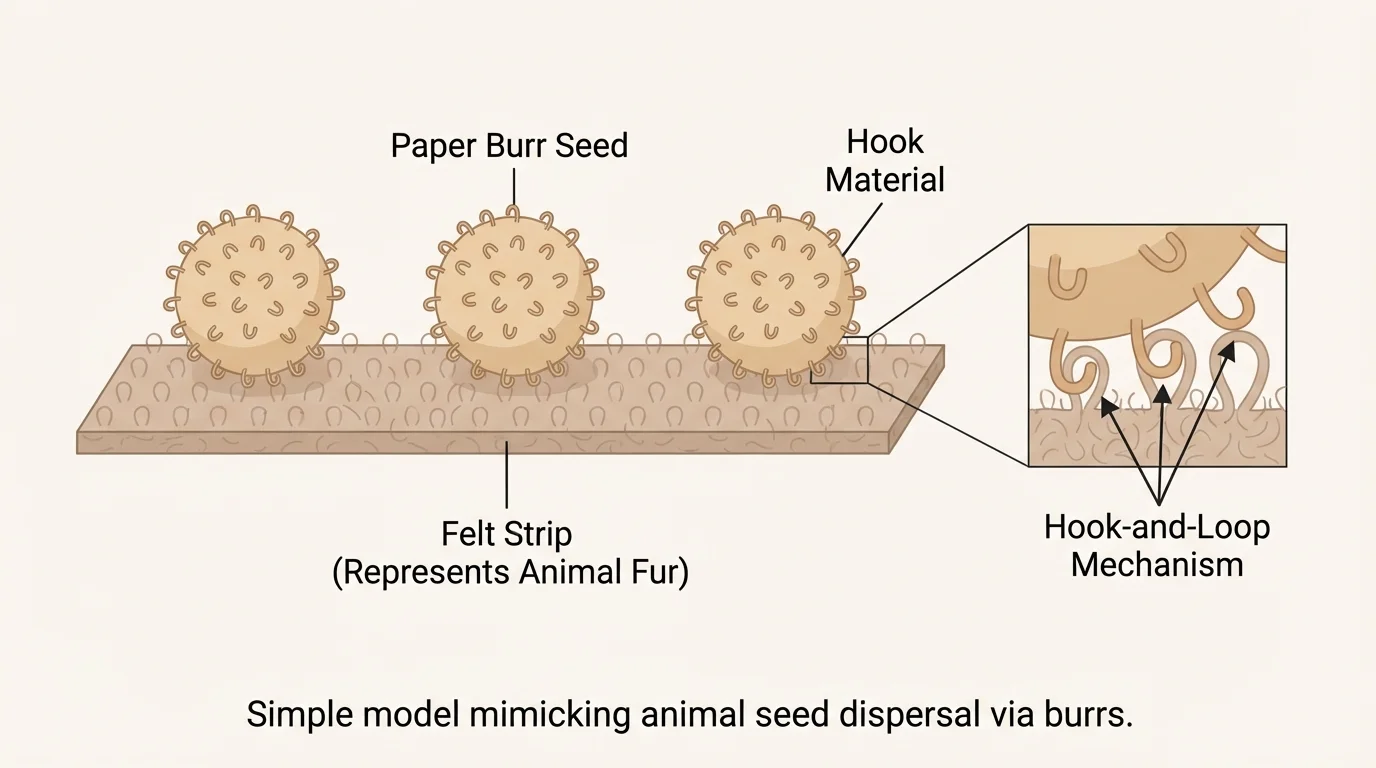
The model in [Figure 4] focuses on one special seed feature: sticking. It does not show every detail of a real animal, but it clearly shows how travel can happen.
How models help us think
A model is strongest when each part stands for something real and when the action in the model matches the action in nature. The model does not have to be fancy. It needs to make the important relationship easy to see.
Some seeds are light and blow in the wind, but that is not the kind of dispersal we are studying here. Our focus is on seeds moved by animals. That keeps the idea clear and helps us stay on the main topic.
To decide if a model is useful, ask simple questions. Does it show what the animal does? Does it show what moves: pollen or seeds? Does it show where the material starts and where it ends up?
A strong model for pollination shows pollen starting at one flower and reaching another flower. A strong model for seed dispersal shows seeds starting near the parent plant and ending in a new place. If the model shows those changes, it is doing its job.
Models also have limits. A model may not show size correctly. It may not show time correctly. Real pollination may happen many times in a day, and real seed dispersal can happen over long distances. The model is much simpler, but it still teaches the key idea.
In a garden, bees visit flowers such as squash, sunflowers, and clover. As they move from bloom to bloom, they can carry pollen. Farmers and gardeners notice that animal visitors can help flowering plants make seeds and fruits.
On a walk outside, you may find burrs stuck to your socks or a pet's fur. That is a real-life example of seed dispersal by animals. The seeds are built to catch a ride.
Birds also help move seeds when they eat fruits such as berries. Later, the seeds may be dropped in another place. This is a simple but powerful way plants spread.
Example: Choosing the right model for a real situation
Step 1: Look at the plant-animal action.
A bee moves powder from one flower to another.
Step 2: Pick materials that act in a similar way.
Use a fuzzy tool and colored powder.
Step 3: Check the match.
If the powder sticks and then transfers, the model matches the real action well.
The same thinking can be used for seeds that stick to fur or travel after being eaten.
These examples from gardens, parks, and fields show that plant-animal partnerships happen around us often. Once you know what to look for, you can notice many ways plants get help moving pollen or seeds.
If you want to show pollen moving between flowers, a pollination model is the best choice. If you want to show a seed traveling with an animal, a seed dispersal model is the best choice. The best model depends on the question you are trying to answer.
Some models are better for showing sticking. Others are better for showing dropping or carrying. What matters most is that the model is clear, simple, and connected to the real plant job.
| Plant job | What moves | Animal help | Simple model idea |
|---|---|---|---|
| Pollination | Pollen | Animal carries pollen from flower to flower | Powder on a fuzzy tool touches two paper flowers |
| Seed dispersal | Seeds | Animal carries or drops seeds in a new place | Paper burrs stick to felt, or beads are moved and dropped |
Table 1. A comparison of pollination and seed dispersal models.
When scientists and students build models, they are doing more than making crafts. They are thinking carefully about cause and effect. If the animal touches the flower, pollen can move. If the animal carries the seed, the seed can travel. A simple model makes these hidden actions easier to see.
