The ground under your feet may feel still, but Earth is always changing. Sometimes the change happens all at once, like when a storm causes a flood. Other times the change is so slow that people may only notice it after many years, like a river shaping the land little by little. Learning about these changes helps us understand our world.
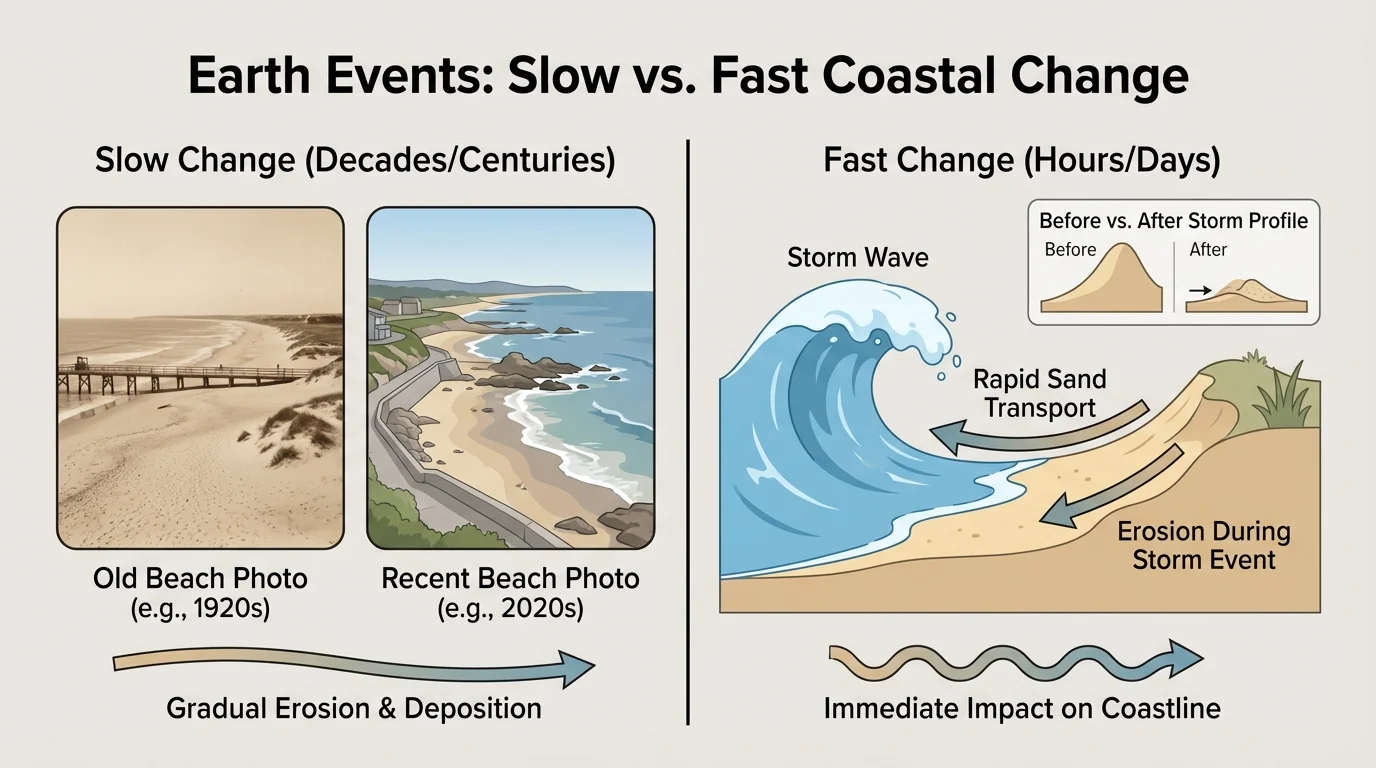
An Earth event is something that happens on Earth and changes the land, water, or air. Some Earth events happen very fast. A landslide can rush down a hill, and an earthquake can shake the ground suddenly. Other Earth events happen very slowly. Wind and water can wear away rock and soil over a long time, as shown in [Figure 1], where fast and slow changes affect land in different ways.
When we talk about fast and slow changes, we do not need exact numbers. We just need to know that some changes happen quickly enough for people to notice right away, while others happen little by little over a long time. Both kinds of changes are important because both can shape Earth.
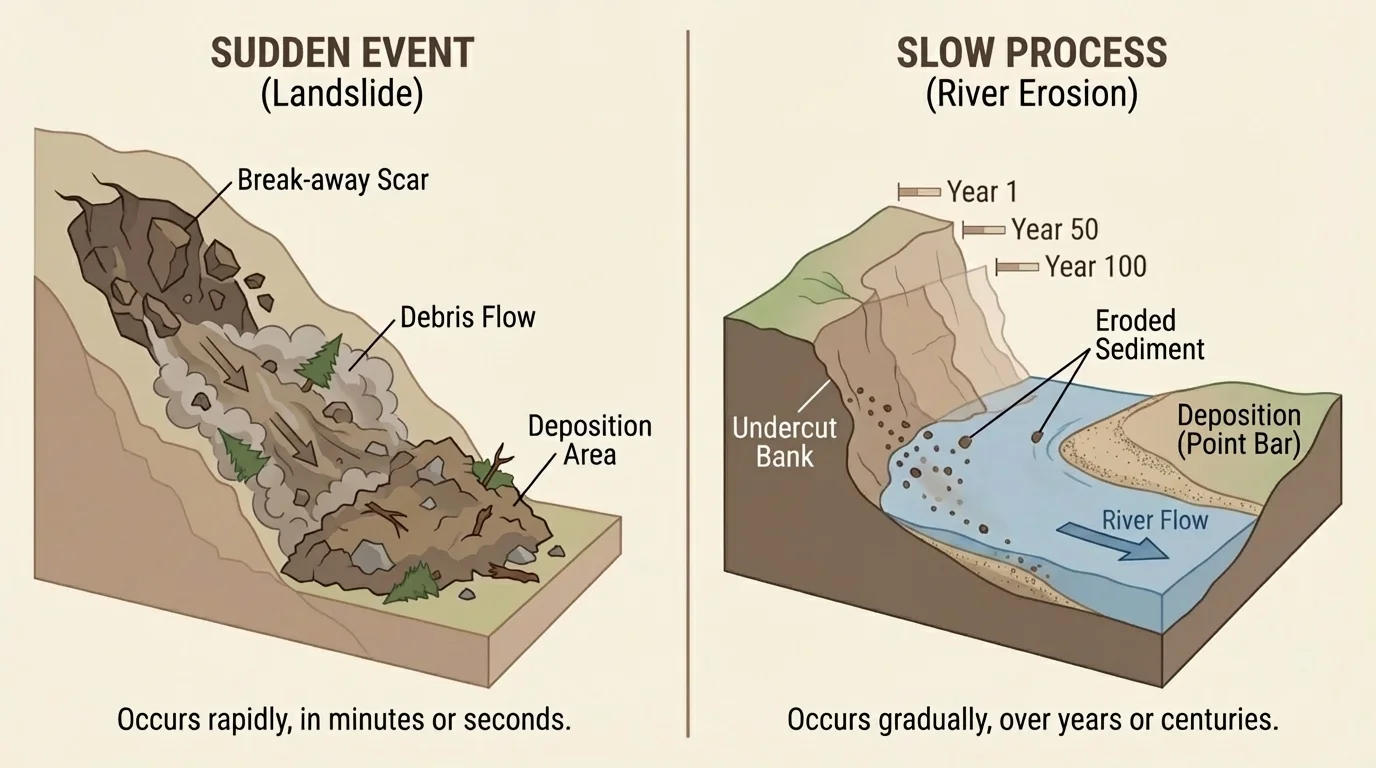
A quick change might break, move, or cover land in a short time. A slow change might be harder to see from one day to the next. But if we compare what a place looks like now to what it looked like before, we can find evidence of change.
Weathering is the breaking down of rocks into smaller pieces. Erosion is the movement of rock and soil from one place to another by water, wind, ice, or gravity. These processes often happen slowly.
Earth changes are all around us. A puddle after rain may dry up quickly, but a stream can slowly shape a bank. A storm may blow branches down in one night, but waves can slowly move sand on a beach over time.
To understand what happened on Earth, scientists and students use more than one source of information. A source is a place where information comes from. A source can be a photograph, a book, a map, a video, a news report, or an eyewitness observation. Using several sources gives stronger evidence, as [Figure 2] illustrates with different clues about the same event.
For example, if we want to learn about an earthquake, one source might be a picture of cracked ground. Another source might be a map showing where the shaking happened. A third source might be a news report telling what people felt and saw. When these sources match, they help us know the event really happened and learn more about it.
We can also use the land itself as evidence. Piles of rock at the bottom of a hill may show a landslide happened. A river with muddy water may show that soil is being carried away. A beach that looks different in old and new photos shows that waves moved the sand.
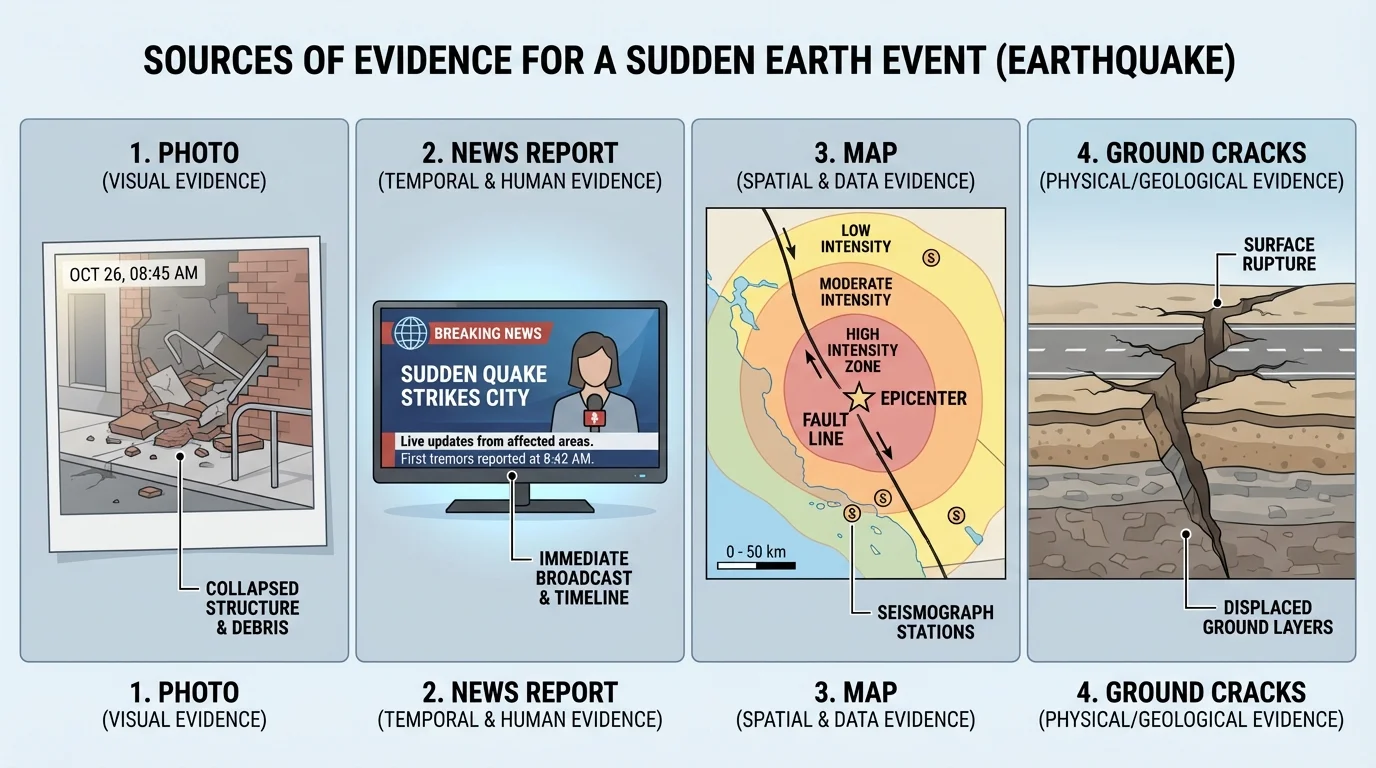
One source is helpful, but several sources together are even better. A picture may show what changed. A report may tell when it changed. A map may show where it changed. When we put the information together, we get a clearer answer.
Scientists often compare satellite pictures taken at different times to study how Earth changes. These images help people notice changes that are too large or too slow to see easily from the ground.
This is called using evidence. Evidence is information that helps show whether an idea is true. In Earth science, evidence can come from many places, including pictures, landforms, observations, and written reports.
[Figure 3] Some Earth events happen so fast that people must react right away. An earthquake can make the ground shake suddenly. A volcano can erupt and send out ash, rock, and molten rock. A flood can cover land with water very quickly. Strong storms can knock down trees and move sand or soil. These are fast changes.
Think about a heavy rainstorm. One source of information could be a weather report saying a lot of rain fell. Another source could be a photo of water covering a road. Another source could be mud left behind after the water goes away. Together, these sources provide evidence that a flood happened quickly.
A landslide is another quick event. Rocks and soil can move down a hill fast. People may see fresh dirt, broken plants, or a new pile of rocks at the bottom. A before-and-after picture can help us see how much the hill changed.
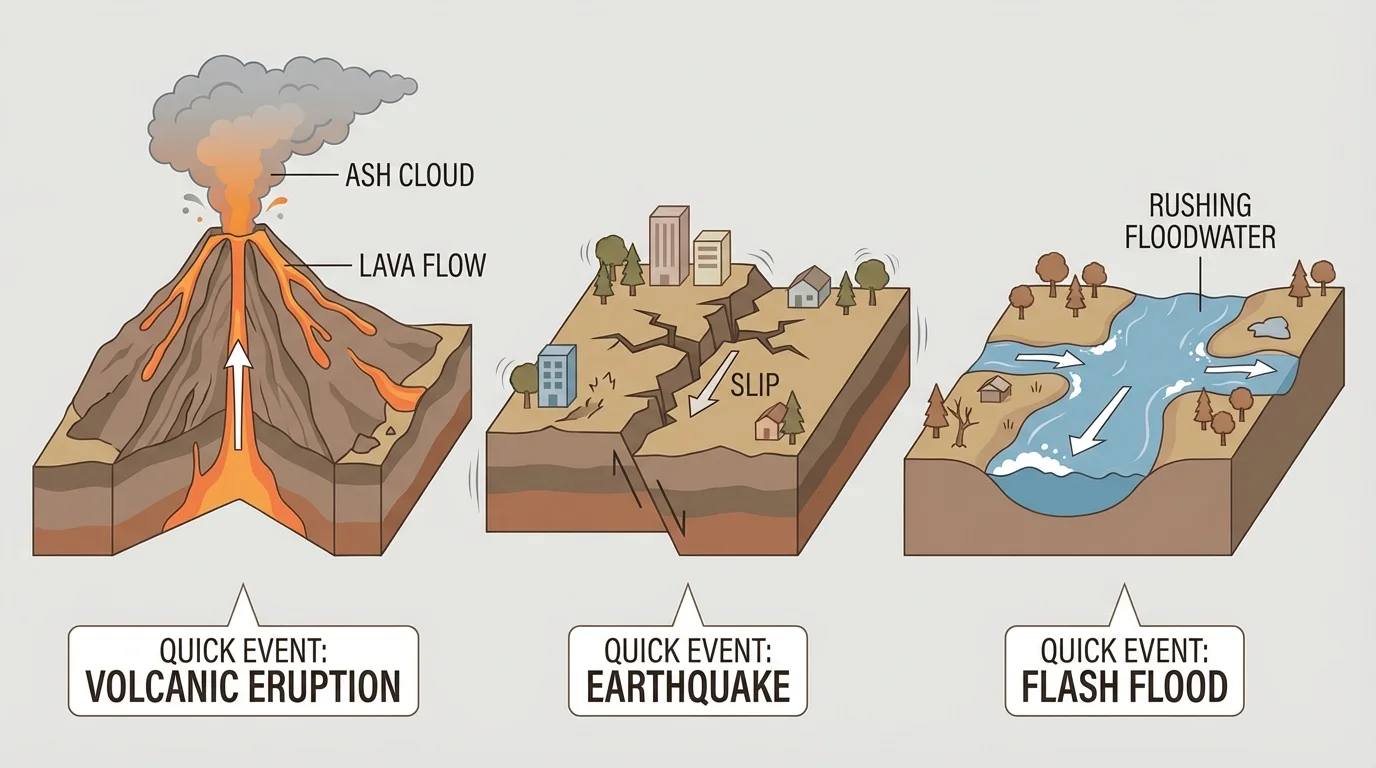
Quick changes can be surprising, but they are part of how Earth works. Sometimes they happen because of movement inside Earth, such as earthquakes and volcanoes. Sometimes they happen because of weather, such as storms and floods.
Example: Finding evidence for a fast event
A class wants to know if a strong storm changed a playground area.
Step 1: Look at a photo from before the storm.
The class sees flat sand and no puddles.
Step 2: Look at a photo from after the storm.
The class sees puddles, moved sand, and fallen branches.
Step 3: Read a weather report.
The report says there was heavy rain and strong wind.
Step 4: Put the sources together.
The photos and report give evidence that the storm changed the land quickly.
As we saw earlier in [Figure 1], quick changes are often easy to notice because they happen in a short time. They can leave clear clues right away.
Other Earth events happen slowly and quietly. Water, wind, ice, and gravity can slowly change the shape of land over time. These forces can cause erosion, and we often notice it only by comparing a place over a longer period. Water carrying tiny pieces of soil and rock is one example, and [Figure 4] shows how this slow process changes land little by little.
Weathering breaks rocks into smaller pieces. Then erosion can move those pieces away. Rain can wash soil downhill. Wind can blow sand from one place to another. Waves can slowly move sand along a beach. Rivers can slowly wear away their banks and carve paths through the land.
Even though slow changes are not sudden, they are powerful. A tiny bit of change, happening again and again, can make a big difference. A smooth stone in a stream was once rougher, but water wore it down. A cliff near the ocean may look different after many seasons of waves hitting it.
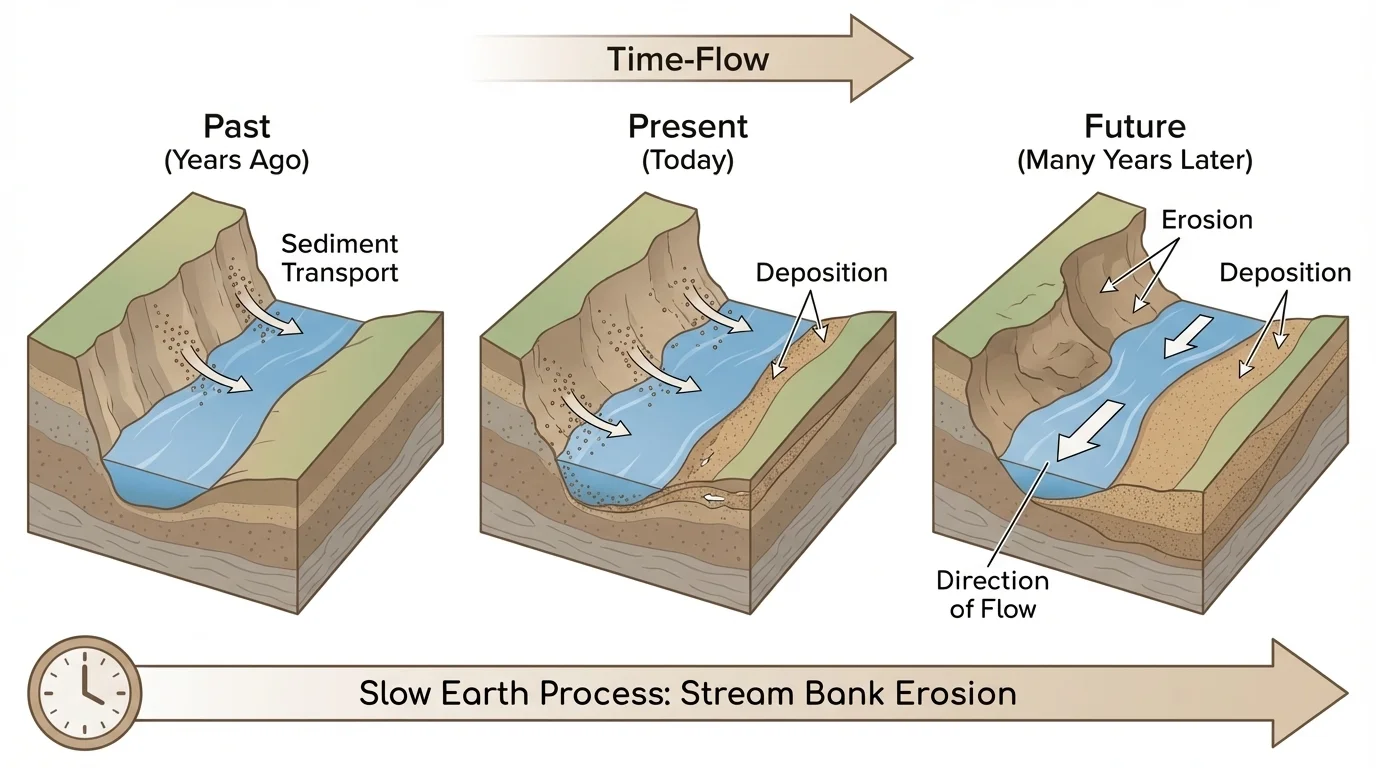
Old photographs are very useful for studying slow Earth changes. If a beach looks wider in one photo and narrower in another, that is evidence that waves moved sand. If a hillside has fewer plants and more exposed soil over time, that can be evidence of erosion.
Landforms are natural features on Earth such as hills, rivers, beaches, and mountains. Earth events can change landforms either quickly or slowly.
Slow change does not mean unimportant change. In many places, slow Earth processes shape the land we see every day. Rivers, beaches, valleys, and rocky slopes all show signs of change over time.
When we look for clues about Earth changes, it helps to compare more than one kind of information. A student might compare old and new pictures, read a short article, and observe the ground outside. This combination gives stronger evidence, and [Figure 5] shows how the same place can be studied with more than one source.
Suppose we want to know whether a beach changed slowly. One source could be an old photo. Another source could be a newer photo. A third source could be a drawing or diagram showing waves moving sand. If all of these show the beach edge changing, we have evidence that the beach changed slowly.
Now suppose we want to know whether an event happened quickly. We could look for signs of sudden change: cracked ground, fresh ash, piles of rock, floodwater marks, or broken trees. A newspaper story, a map, and photos from the same day would help support the idea that the change happened fast.
Using several sources also helps us avoid mistakes. One picture may not tell the whole story. Maybe the picture was taken from a different angle, or maybe part of the area is hidden. Another source can add missing information.
| Earth change | Usually quick or slow? | Possible evidence sources |
|---|---|---|
| Earthquake | Quick | Photos, maps, news reports, cracks in the ground |
| Flood | Quick | Weather reports, photos, mud lines, eyewitness observations |
| Landslide | Quick | Before-and-after photos, rock piles, damaged plants |
| Beach sand moving | Slow | Old and new photos, shoreline observations, wave diagrams |
| Riverbank wearing away | Slow | Photos over time, soil in water, changes in bank shape |
Table 1. Examples of Earth changes, whether they are usually quick or slow, and sources of evidence for each one.
Comparing sources is a smart science habit. It helps us ask good questions, notice patterns, and make careful decisions about what happened on Earth.
Learning about fast and slow Earth events helps people stay safe and take care of places where they live. If people know floods can change land quickly, they can be careful during strong storms. If people know beaches and riverbanks change slowly, they can watch those places and protect them.
Scientists, engineers, and communities use evidence to make choices. They may study maps, photos, and land clues before building roads, homes, or parks. Understanding Earth changes can help people prepare for sudden events and notice slow changes before they become bigger problems.
The next time you see a rocky hill, a beach, a stream, or storm damage, remember that Earth is active. Some changes happen in a flash. Others happen little by little. By using evidence from several sources, we can learn the story of how Earth changes.
