Look out a window, turn on a faucet, or think about a rainy day. Water is part of your life every single day. It is in huge oceans, in puddles after a storm, frozen on snowy mountains, and even under the ground. Earth is sometimes called the "water planet" because so much water can be found in so many places.
Water is found in many parts of Earth, as [Figure 1] shows. Some water is easy to see, such as the ocean, a river, a lake, a stream, or a pond. Some water is harder to see because it is underground in the soil and rocks. Water is also in ice on cold mountains and in large sheets of ice near the poles.
When scientists and students look for water, they gather information from what they can observe. They may look at the beach and see ocean water. They may visit a pond or stream. They may look at pictures of snowy mountains or icy places near the North Pole and South Pole. All of these give evidence that water is found in many places on Earth.
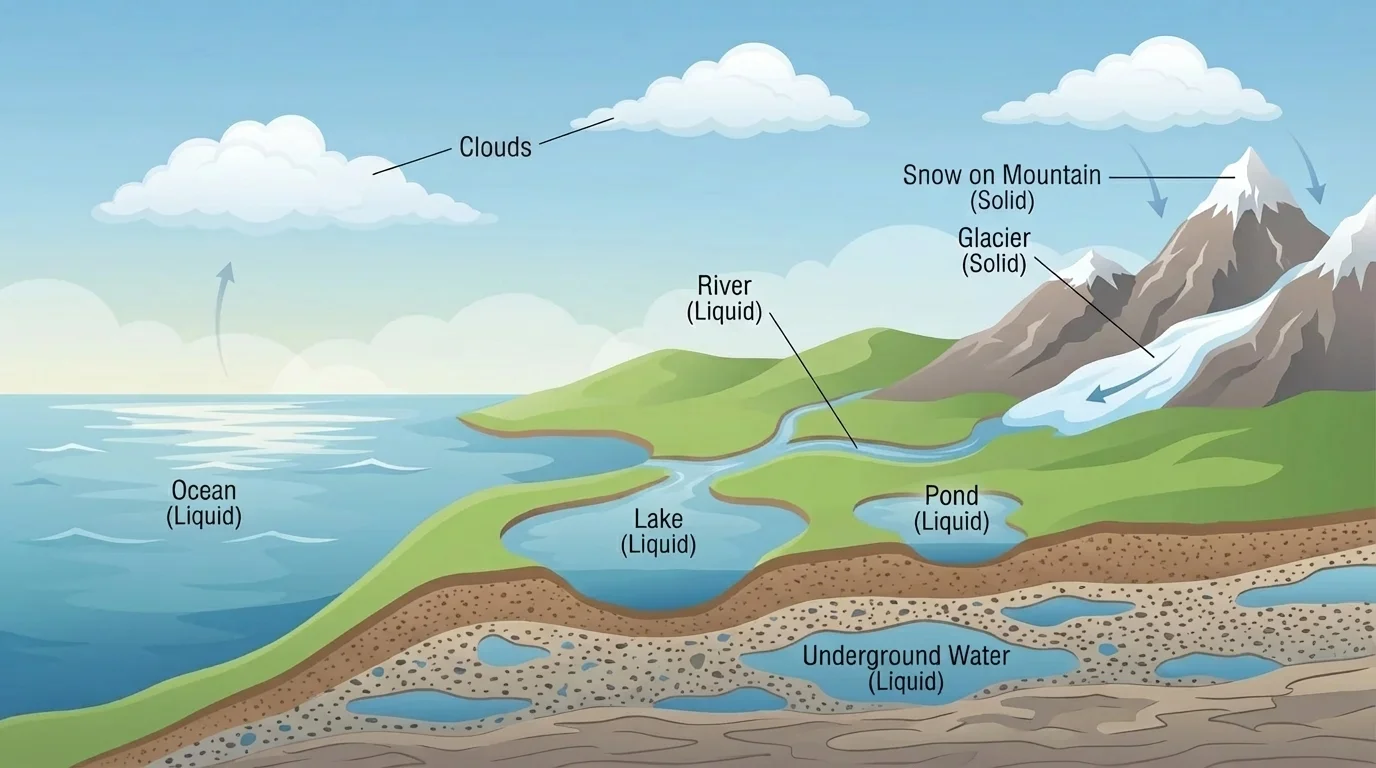
Water can also be found in the air as tiny drops in clouds. Clouds are not solid cotton in the sky. They are made of tiny bits of water or ice. Water is also inside plants, animals, and people. When you drink water, you are helping your body do its work.
Oceans are the largest places where water is found. Rivers and streams move water across the land. Lakes and ponds hold water in one place. Underground water can soak into the ground and fill spaces between tiny pieces of rock and soil. Snow and ice store water in cold places.
Ocean is a very large body of water on Earth. River is moving water that flows across land. Lake is a body of water surrounded by land. Glacier is a large, slow-moving mass of ice on land.
Some places near your home may have water you can see every day. You may know a puddle forms after rain. You may have seen dew on grass in the morning. You may have walked near a creek or watched water move through a ditch after a storm. These are all clues that water moves and collects in different places.
Water can be in different forms, as [Figure 2] shows. For this topic, the most important forms are liquid and solid. Liquid water flows and takes the shape of its container. Solid water keeps its own shape. When water freezes, it becomes ice.
You already know many examples of liquid water. Water in a cup, bathtub, pond, river, lake, and ocean is liquid. Rain is liquid water falling from clouds. Liquid water can drip, pour, splash, and flow downhill.
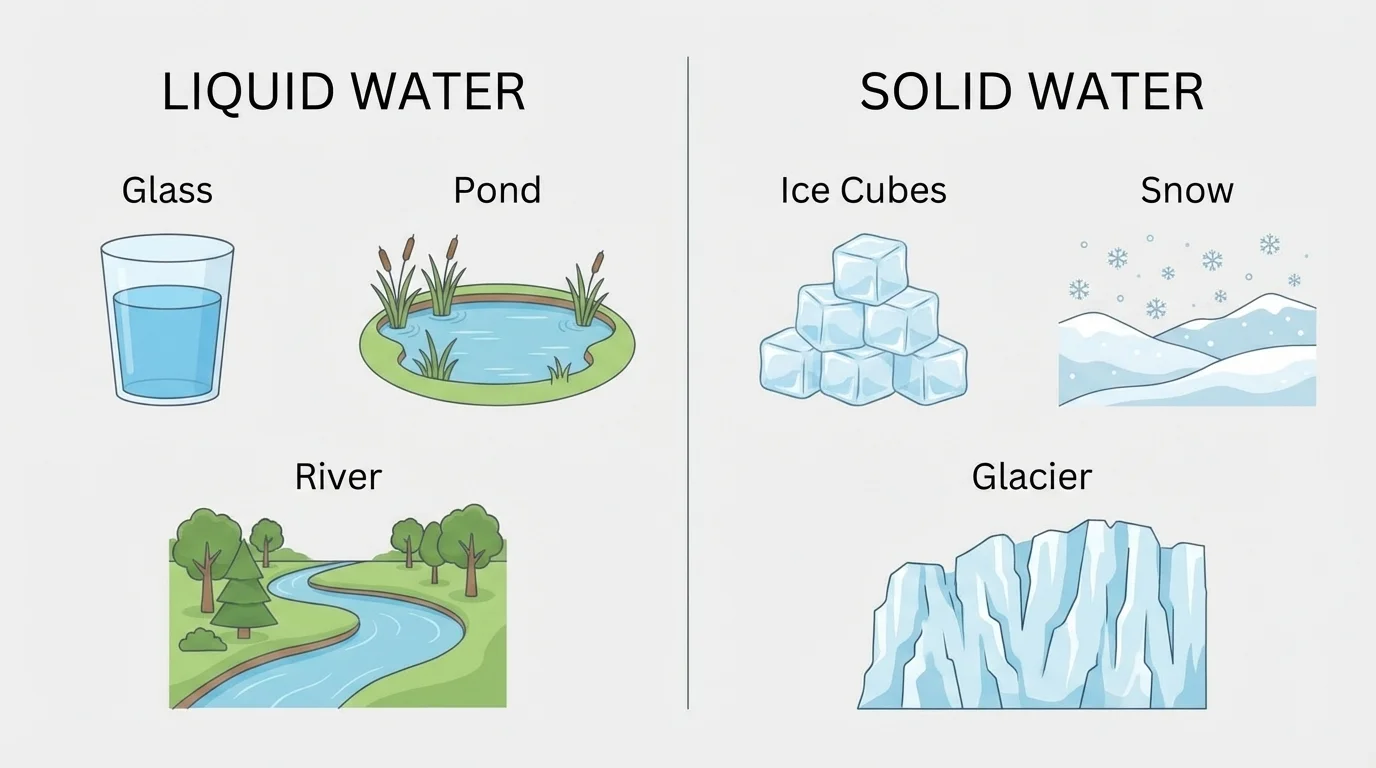
Examples of solid water include ice cubes, snow, hail, frost, and glaciers. Snow on the ground is water in a solid form. Ice on a winter puddle is also solid water. A glacier is a huge body of solid ice on land that moves very slowly over time.
If you leave an ice cube on a plate, it changes from solid to liquid as it warms. If you put liquid water into a freezer, it changes from liquid to solid. The water is still the same substance, H2O, but its form changes when temperature changes.
How water changes form
When water gets cold enough, it freezes into solid ice. When ice gets warmer, it melts into liquid water. These changes happen in nature all the time. Snow can melt into streams, and puddles can freeze on cold nights.
This matters on Earth because water does not stay in one form everywhere. A mountain may have snow and ice at the top, while a river of liquid water flows below. As we saw in [Figure 2], the same water can look very different depending on where it is and how warm or cold it is.
Water does more than just sit in one place. It can change the shape of land, as [Figure 3] shows. Rain can wash soil downhill. Rivers can wear away land as they flow. Ocean waves can move sand and shape beaches. Ice can also change land when it pushes on rock or when water freezes in cracks.
Think about a muddy playground after rain. Water may carry tiny bits of soil from one place to another. Over time, moving water can make small channels in dirt. In bigger places, rivers can carve deeper paths through the land.
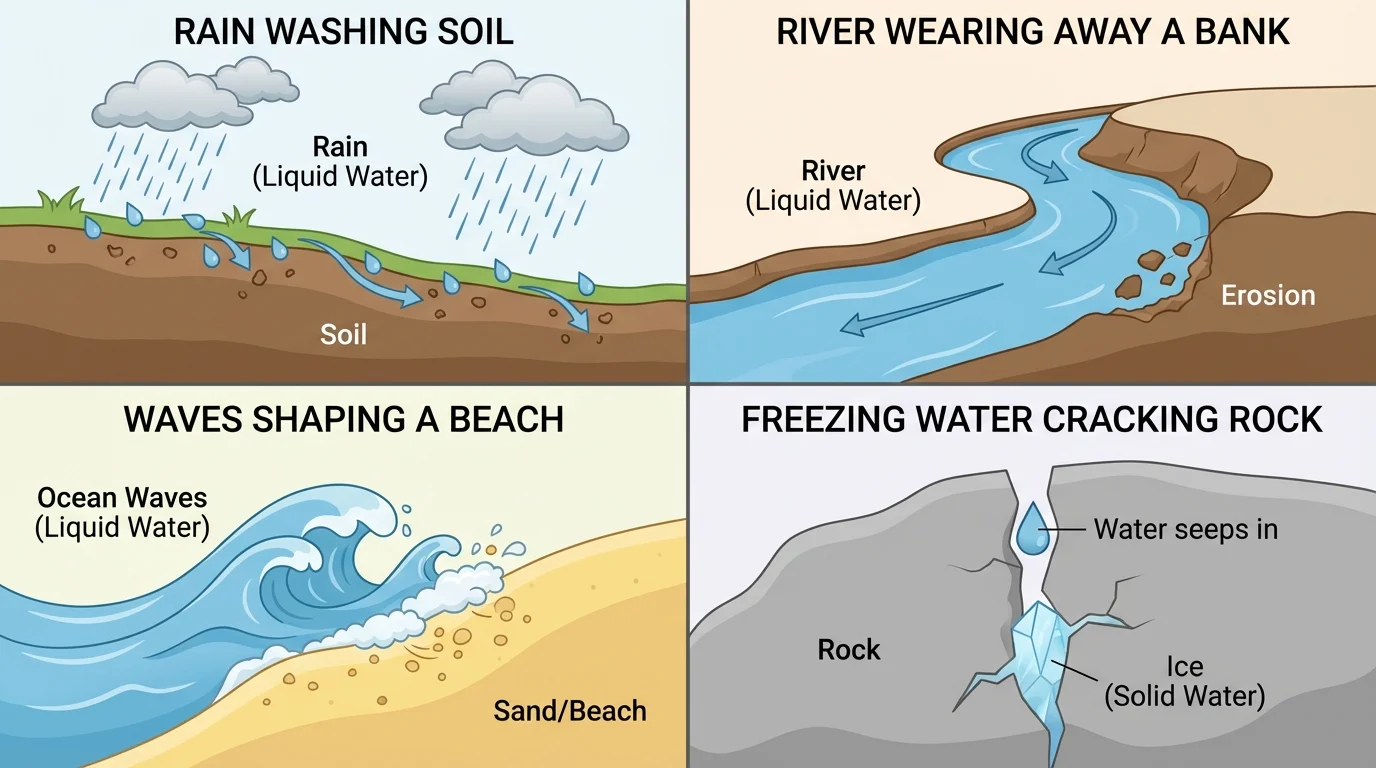
Solid water can change land too. When water gets into a crack in a rock and freezes, it becomes solid ice. Ice takes up more space than the liquid water did. That can push on the rock and make the crack bigger. Later, pieces of rock may break off.
Glaciers are another powerful example. They are made of solid ice, but they move very slowly. As they move, they can scrape and push rock and soil. This can change the land over a long time.
Some valleys and smooth rock surfaces were shaped long ago by moving glaciers. Even though glaciers move slowly, they can be strong enough to change large pieces of land.
Flowing water and solid ice both help explain why Earth's surface changes. The ocean you see at a beach, the stream near a park, and the winter ice on a sidewalk are all part of a bigger story about how water shapes our world. The land-changing examples in [Figure 3] connect water's forms to real changes on Earth.
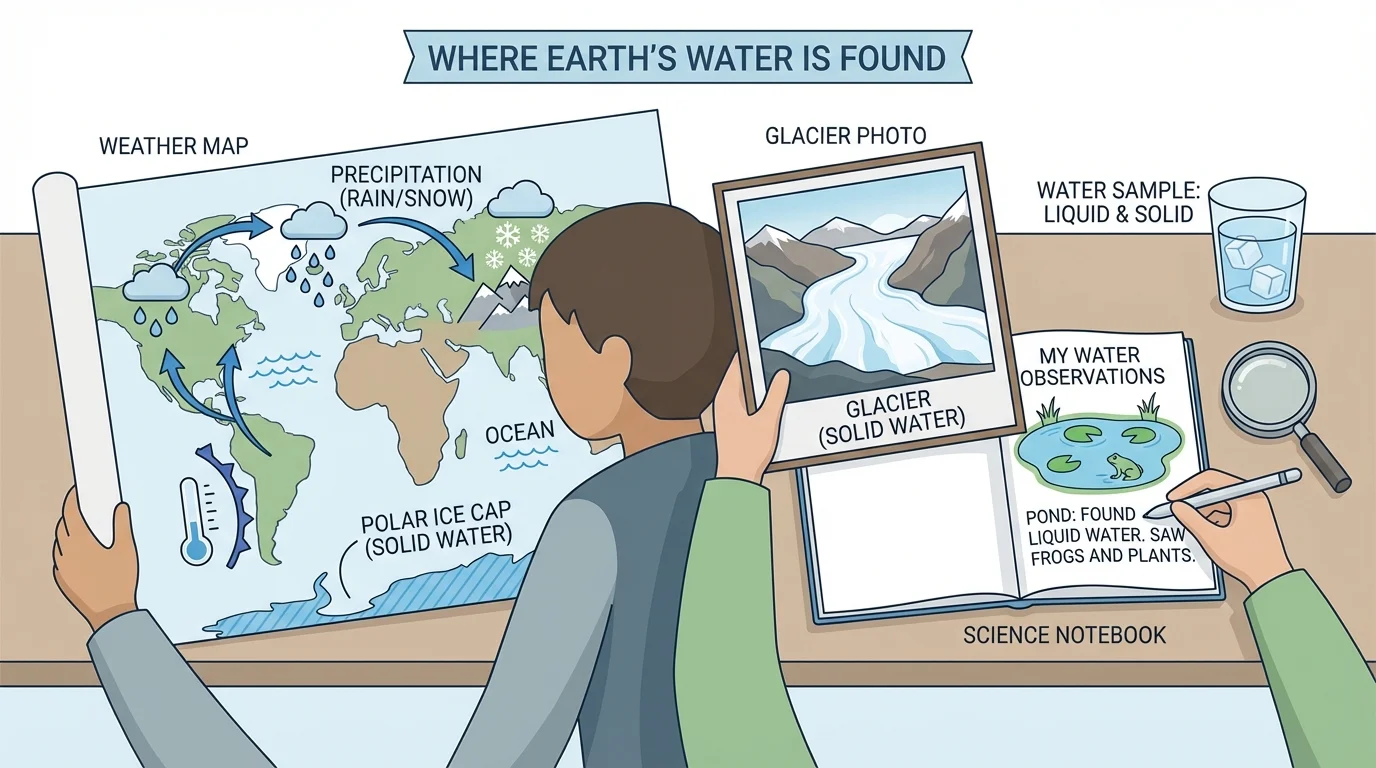
Scientists do not have to guess where water is found. They obtain information from observations, photographs, maps, weather reports, and field notes, as [Figure 4] shows. Students can do this too by looking carefully and asking, "What evidence shows water is here?"
For example, a class photo of a snow-covered mountain gives evidence of solid water. A weather report that says rain is coming gives information about liquid water in clouds and falling to the ground. A map with a blue river on it shows where water flows across land. A picture of waves crashing on a shore shows water at the edge of land.
You can also find evidence close to home. Wet soil after rain, a puddle in the parking lot, frost on a car window, or ice in a freezer are all observations that help identify where water is found and what form it is in. Looking at the sky, the ground, and nearby land helps you gather information like a scientist.
| Place or clue | What it tells us | Form of water |
|---|---|---|
| River | Water is moving across land | Liquid |
| Lake | Water is collected in one place | Liquid |
| Snow on a mountain | Water is frozen in a cold place | Solid |
| Ice cubes in a freezer | Water can freeze and keep shape | Solid |
| Puddle after rain | Water fell from clouds and collected on land | Liquid |
| Glacier | Large mass of ice on land | Solid |
Table 1. Examples of evidence that help identify where water is found and whether it is solid or liquid.
Good scientists compare different sources of information. A photograph, a map, and a direct observation can all work together. As shown in [Figure 4], obtaining information is not only about reading. It is also about seeing, noticing, and recording what is happening in the world.
Water is important for living things. People need liquid water to drink. Plants need water to grow. Animals drink water from puddles, ponds, streams, or other places. Water in clouds can fall as rain and help fill rivers and lakes.
Solid water matters too. Snow can cover the ground in winter. Ice can make roads slippery. Ice in a cooler can keep food cold. Snow on mountains can later melt and feed streams and rivers. This is one reason it is helpful to know whether water is solid or liquid.
You may already know that weather can be sunny, rainy, windy, or snowy. Water is part of weather too. Rain is liquid water, while snow and hail are forms of solid water.
Water can be peaceful, but it can also be powerful. Heavy rain can move soil. Fast rivers can carry rocks. Ocean waves can reshape beaches. Frozen water can make surfaces hard and slippery. Knowing where water is found helps people stay safe and understand nature better.
When you think back to the places in [Figure 1], you can see that water connects sky, land, living things, and even underground spaces. It is not found in just one kind of place. It is part of Earth almost everywhere.
You can learn about water by making a careful observation. Put one ice cube in a bowl and watch it for a little while. At first, the ice cube is solid water. After some time, you will see liquid water in the bowl. This gives evidence that water can change from solid to liquid.
Another observation is to look outside after a rainstorm. You may notice puddles, wet sidewalks, dripping leaves, and water moving along the ground. These observations help identify where liquid water is found. On a cold morning, you might instead find frost or ice, which is evidence of solid water.
Observation example: ice changing form
Step 1: Look at the ice cube.
It has its own shape, so it is solid water.
Step 2: Wait and observe.
The outside becomes wet as some ice melts.
Step 3: Check the bowl again.
Now there is liquid water collecting in the bottom.
This observation shows that water can be found in different forms and can change form when conditions change.
As you study Earth, keep asking two important questions: Where is the water? and What form is it in? Those questions help you notice oceans, lakes, rivers, snow, ice, clouds, and underground water. They also help you understand how water can slowly and powerfully change the shape of the land.
