The ground under your feet may feel still, but Earth is a very busy planet. It spins, moves around the Sun, shakes, cracks, erupts, and slowly changes shape over time periods much longer than a human life. Some changes happen again and again, like morning turning into night. Other changes begin and end, like a volcano erupting. Some changes happen so fast that people feel them right away. Others are so slow that they are hard to notice unless we look at rocks, landforms, and clues from long ago.
Planet Earth is about 4.6 billion years old. That is such a huge number of years that no person can watch all of Earth's history. But we can still learn about it. Scientists study land, water, air, rocks, and fossils to understand what happened long before any people were here.
When we talk about Earth's history, it helps to sort changes into groups. Some changes are repeating patterns. Some are events with a clear start and stop. Some happen very quickly. Some happen very slowly. Learning these groups helps us make sense of our changing world.
Cycle means something that repeats in the same order again and again. Eruption means melted rock, ash, and gas come out of a volcano. Earthquake means the ground shakes because parts of Earth move suddenly. Erosion means rock and soil are worn away and carried to a new place by water, wind, ice, or gravity.
Earth is made of systems that work together. The land, oceans, air, and living things all affect one another. Changes in one part of Earth can lead to changes in another part. That is why Earth's history is really the story of many parts working together over time.
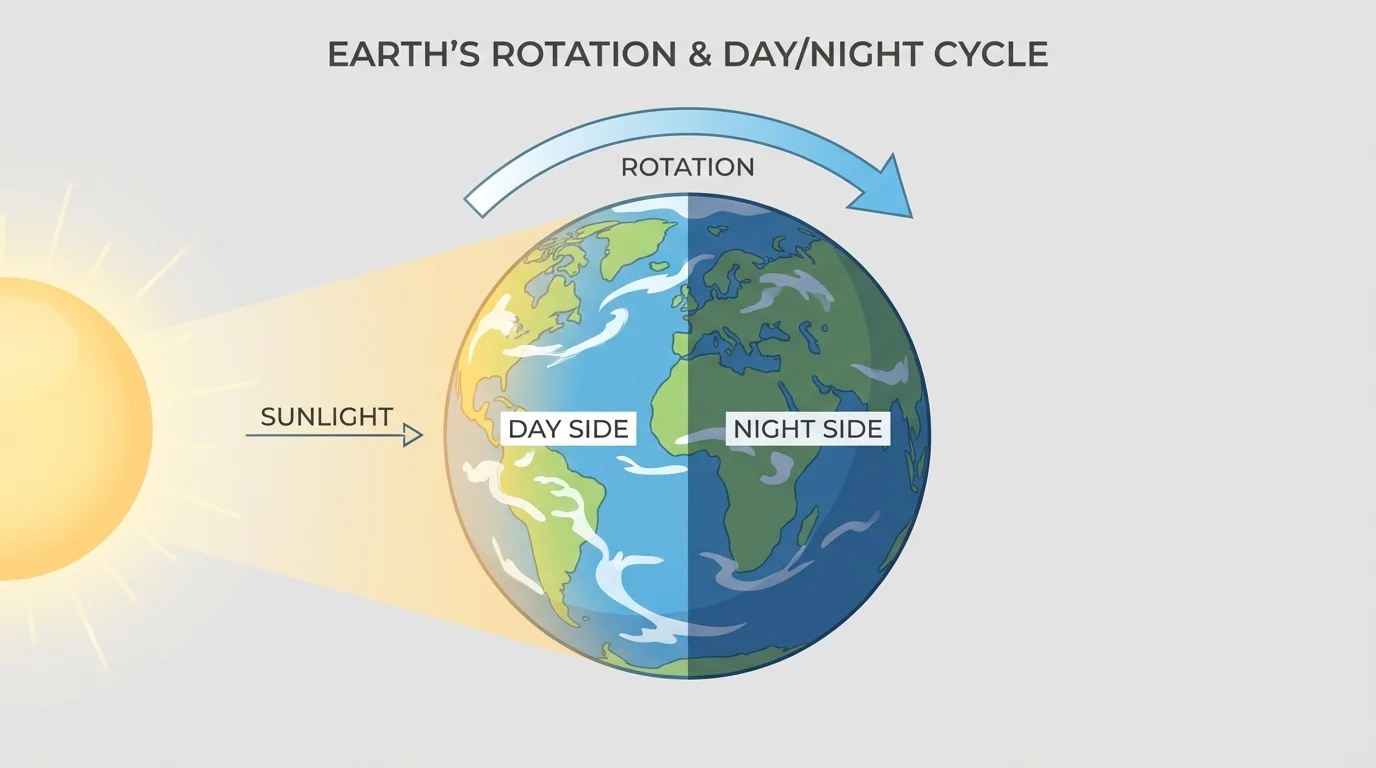
Some Earth events happen in a pattern we can count on. Day and night are a great example. Earth spins like a top, and as [Figure 1] shows, the side facing the Sun has daytime while the side turned away has nighttime. This cycle repeats every day.
Because Earth keeps rotating, the Sun seems to rise, move across the sky, and set. It looks like the Sun is moving around us, but really Earth is turning. This repeating motion helps us tell time and plan our days.
Another cycle is the seasons. As Earth moves around the Sun during the year, different parts of Earth get different amounts of sunlight. This causes a repeating pattern of spring, summer, autumn, and winter in many places.
The Moon also follows a cycle. Its shape seems to change in the sky from night to night, but the Moon is not really changing shape. We are seeing different amounts of the lit part of the Moon. This is another repeating pattern we can observe.
Cycles are important because they are regular. They help plants grow, animals migrate, and people know when to sleep, wake up, plant crops, or celebrate seasons. Long ago, people watched the sky carefully because these repeating patterns helped them understand time.
Not every Earth event repeats in a simple pattern. Some events start, happen, and then stop. A volcano eruption is one example. A volcano may be quiet for a long time, then erupt, and later become quiet again. The eruption has a beginning and an end.
During an eruption, hot melted rock called lava can reach the surface. Ash and gases may also burst out. These changes can happen over hours, days, or longer, but they do not go on forever. The event stops, even though the volcano may erupt again at another time.
Events and cycles are different
A cycle repeats in a regular pattern, like day and night. An event has a start and a stop, like a volcanic eruption. Some events may happen more than once, but each one still has its own beginning and end.
Big storms can also be thought of as events with a start and finish. A storm forms, moves, and then weakens. Floods often work this way too. Earth's history includes both repeating patterns and special events.
Some Earth changes happen so quickly that people can feel or see them right away. An earthquake, as [Figure 2] illustrates, is a sudden shaking of the ground. It happens when large pieces of Earth's crust move.
Earth's outer layer is broken into huge pieces called plates. When these pieces push, pull, or slide, they can get stuck. Then they suddenly move. That sudden movement sends energy through the ground, and the ground shakes.
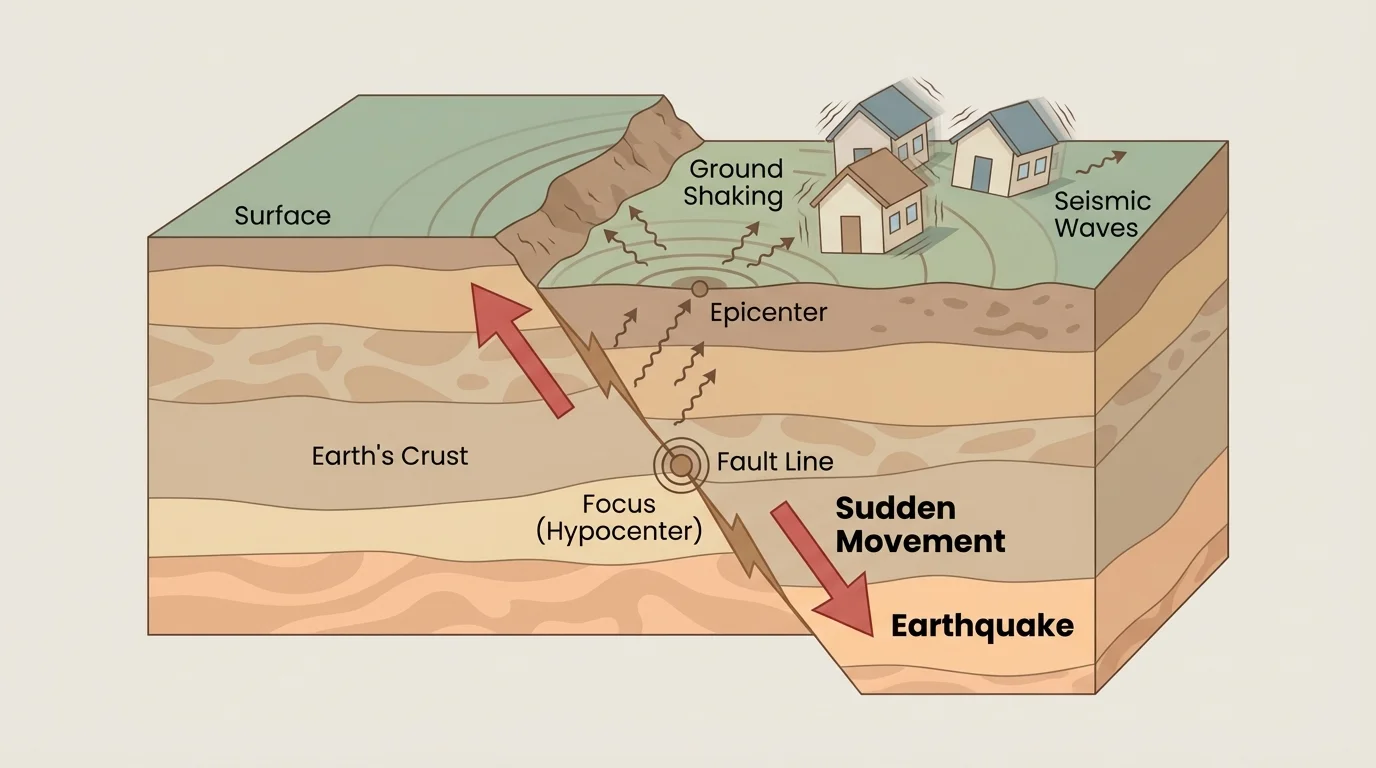
Earthquakes can crack roads, shake buildings, and change the shape of land in a very short time. A landslide is another fast change. Rock and soil can suddenly rush down a hill after heavy rain or an earthquake.
Fast changes can feel dramatic because they happen in seconds, minutes, or days. People cannot stop them, but learning about them helps communities build safer buildings and make emergency plans.
Some earthquakes are so small that people do not feel them at all, but special tools can detect them. Other earthquakes are strong enough to change the ground in just a few moments.
When we compare fast changes with cycles, we notice something important. Day and night happen over and over in a steady pattern, but an earthquake is sudden and does not follow a simple daily schedule. Earth includes both kinds of change.
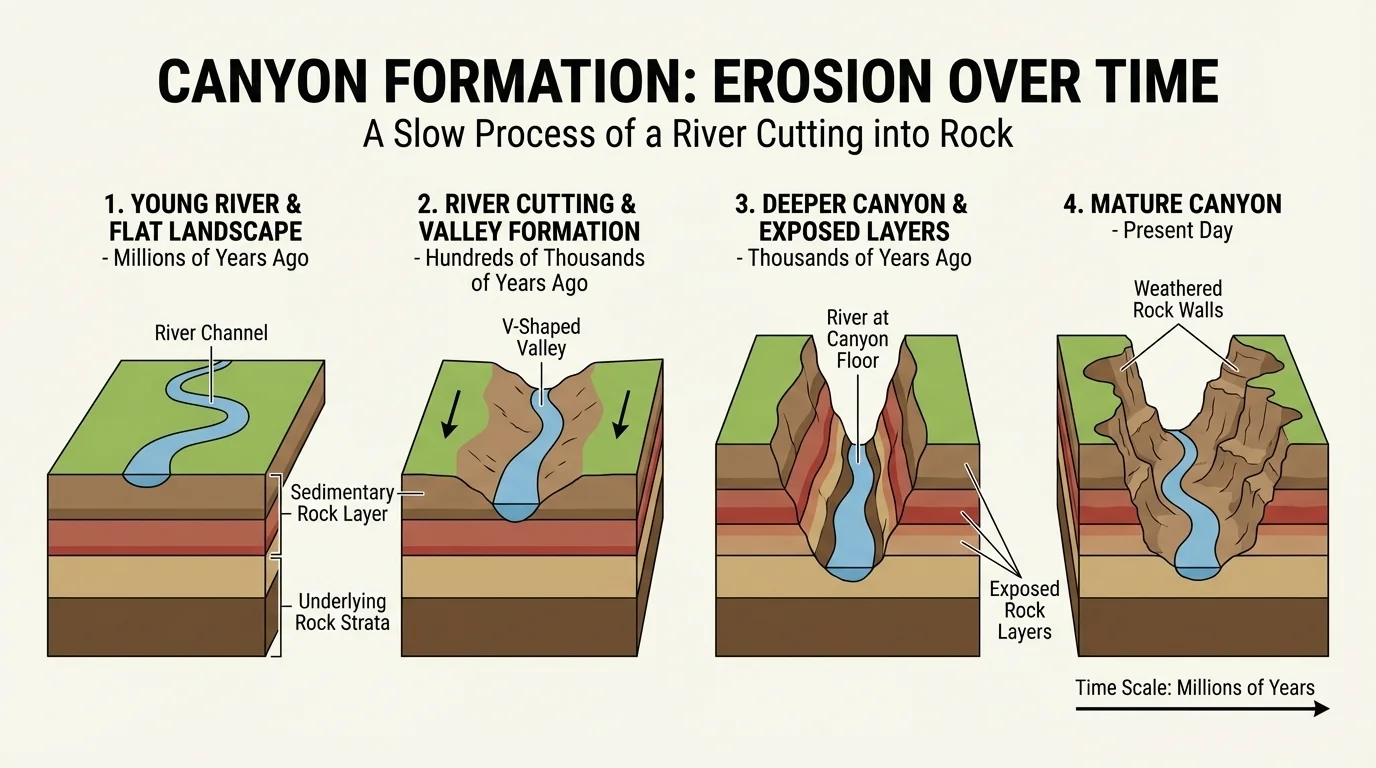
Other changes are much slower. A canyon, beach, or mountain may take a very long time to form. Slow change can be hard to notice in one day or even one year, but over thousands or millions of years it can reshape huge areas. The long-term cutting of rock by moving water, shown in [Figure 3], is one important example.
Weathering breaks rock into smaller pieces. Then erosion moves those pieces away. Rain, rivers, wind, ice, and waves all help wear Earth's surface down and carry sediment from place to place.
The Grand Canyon in the United States is a famous example of slow change. The Colorado River helped carve deeper and deeper into rock over a very long time. No person can stand there and watch the whole canyon form, but the canyon itself is evidence that slow change really happens.
Mountains can also change slowly. Some mountains rise when parts of Earth push together. Later, wind, ice, and water wear them down. This means Earth's surface is always being built up and worn down, even when the changes are too slow to notice day by day.
Beaches also show slow change. Waves move sand again and again. Over time, the shoreline can look different. A small change each day can become a big change after many years.
Real-world example: How a river changes land
Step 1: Rain falls and water flows downhill.
Step 2: The moving water carries tiny pieces of rock and soil.
Step 3: The water keeps rubbing against the land and cuts a little deeper.
Step 4: After a very long time, the land can become a valley or canyon.
This is slow change: each small action seems tiny, but the total effect becomes huge over time.
The same idea helps us understand why older landscapes often look very different from newer ones. Looking back at [Figure 3], we can see that a river does not make a canyon all at once. Repeated movement of water over long periods changes the land bit by bit.
People were not here for most of Earth's history, so scientists look for clues. Rocks and fossils, as [Figure 4] shows, are like pages in a history book. They help us learn what Earth was like long ago.
A fossil is the preserved remains or trace of a living thing from long ago. A shell in rock, a leaf print, or a dinosaur bone can tell us about plants and animals that once lived on Earth.
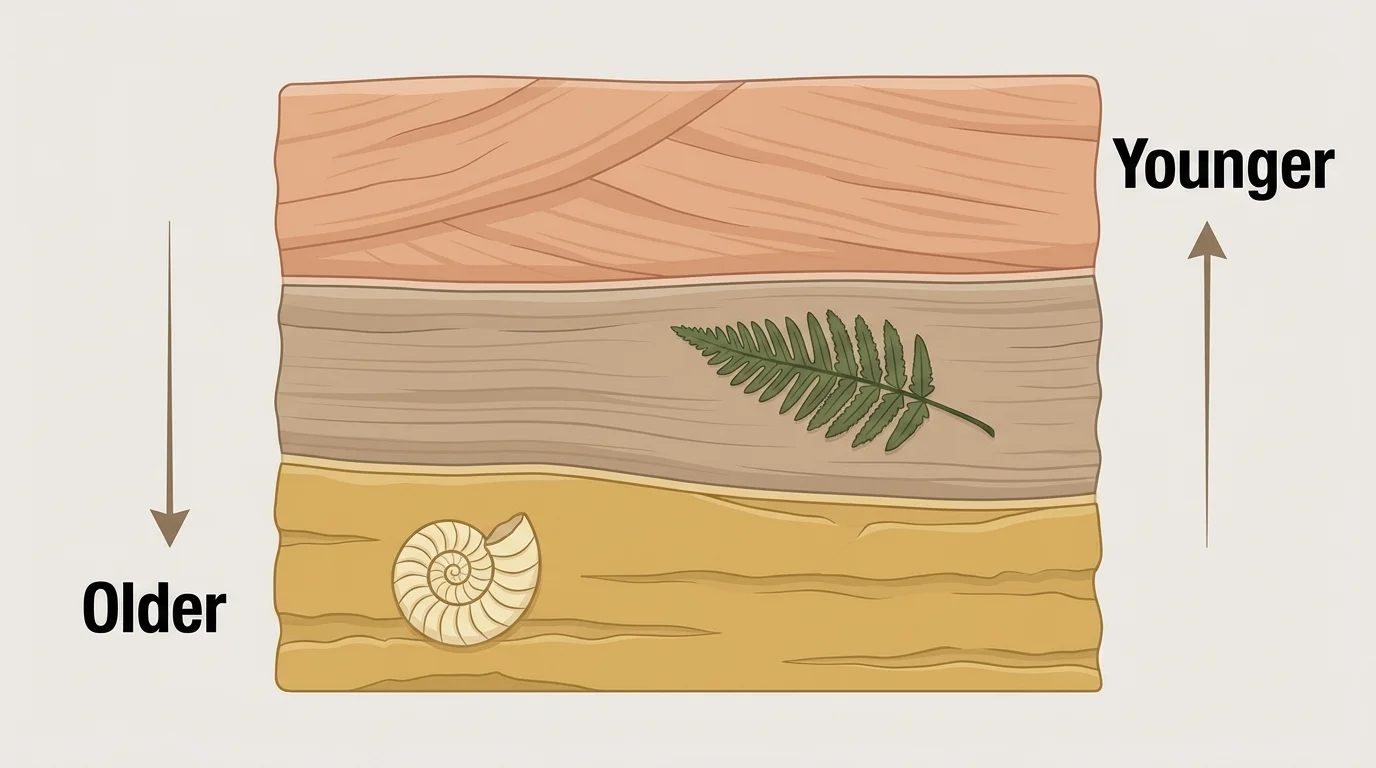
Rock layers are helpful too. In many places, lower layers formed before upper layers. That means lower layers are often older. Scientists compare layers and fossils to figure out what happened first and what happened later.
These clues help scientists learn about ancient oceans, deserts, forests, volcanoes, and changing climates. They also show that Earth has not always looked the way it does today.
| Clue | What it can tell us |
|---|---|
| Rock layers | Which parts are older or younger |
| Fossils | What living things were around long ago |
| Canyons and valleys | How water and erosion changed land |
| Volcanic rocks | Where eruptions happened in the past |
Table 1. Different clues scientists use to learn about Earth's history.
When students see a canyon, a mountain, or a shell in rock, they are seeing evidence. Evidence helps us answer questions about the past. That is how Earth science works: scientists observe carefully and use clues to explain change over time.
Earth's place in space helps explain some of its repeating patterns. Earth rotates to make day and night, and it travels around the Sun to help create the yearly pattern of seasons. The sky's patterns and Earth's motions are part of Earth's story.
At the same time, Earth itself has a long history. Volcanoes, earthquakes, moving water, wind, and ice have all helped shape the planet for far longer than a human lifetime. This means Earth's history includes both regular cycles and long, changing stories.
Looking again at [Figure 1], we can connect the daily cycle of light and darkness to Earth's motion in space. Looking back at [Figure 4], we can connect rock layers and fossils to Earth's deep past. Space and Earth history fit together.
The Sun is a star, Earth is a planet, and the Moon moves around Earth. Earth's motion in space helps create patterns we can observe from the ground.
Even though Earth feels steady, it is always moving in more than one way. It spins, travels through space, and changes on the surface. Some of these changes are easy to see every day, and others take huge amounts of time.
Learning about Earth's history is useful in everyday life. It helps people know where earthquakes may happen, where volcanoes may erupt, and how rivers may shape land. This helps communities stay safer.
Farmers care about seasons. Builders care about land and rock. Scientists care about fossils and layers. Families care about weather, water, and safe places to live. Earth's history is not just about the distant past. It also helps people make smart choices today.
Earth teaches us patience. A sudden earthquake reminds us that some changes are fast. A canyon reminds us that tiny actions over a long time can make something enormous. Both kinds of change are part of our planet's amazing story.
