Why does a basketball always come back down after a shot, even when it flies high into the air? Why does rain fall from clouds instead of drifting off into space? Why do your feet stay on the ground instead of floating away? The answer to all of these questions is the same powerful force: Earth's gravity. Gravity is always working, every second of every day, even when we do not notice it.
Gravity may seem ordinary because we experience it all the time, but it is actually amazing. Earth is so large that it pulls on everything near it: people, pets, pencils, puddles, playground balls, and even the air around us. When you drop a spoon, hop off a step, or watch leaves fall from a tree, you are seeing gravity in action.
Even when an object seems still, gravity is often acting on it. A book resting on a table is being pulled downward by gravity. The table pushes upward and holds the book up, so the book does not move. This helps us understand an important idea: gravity acts on objects whether they are moving or not.
Gravity is a force that pulls objects toward each other. Near Earth's surface, gravity pulls objects toward the center of Earth.
Force is a push or a pull that can change an object's motion.
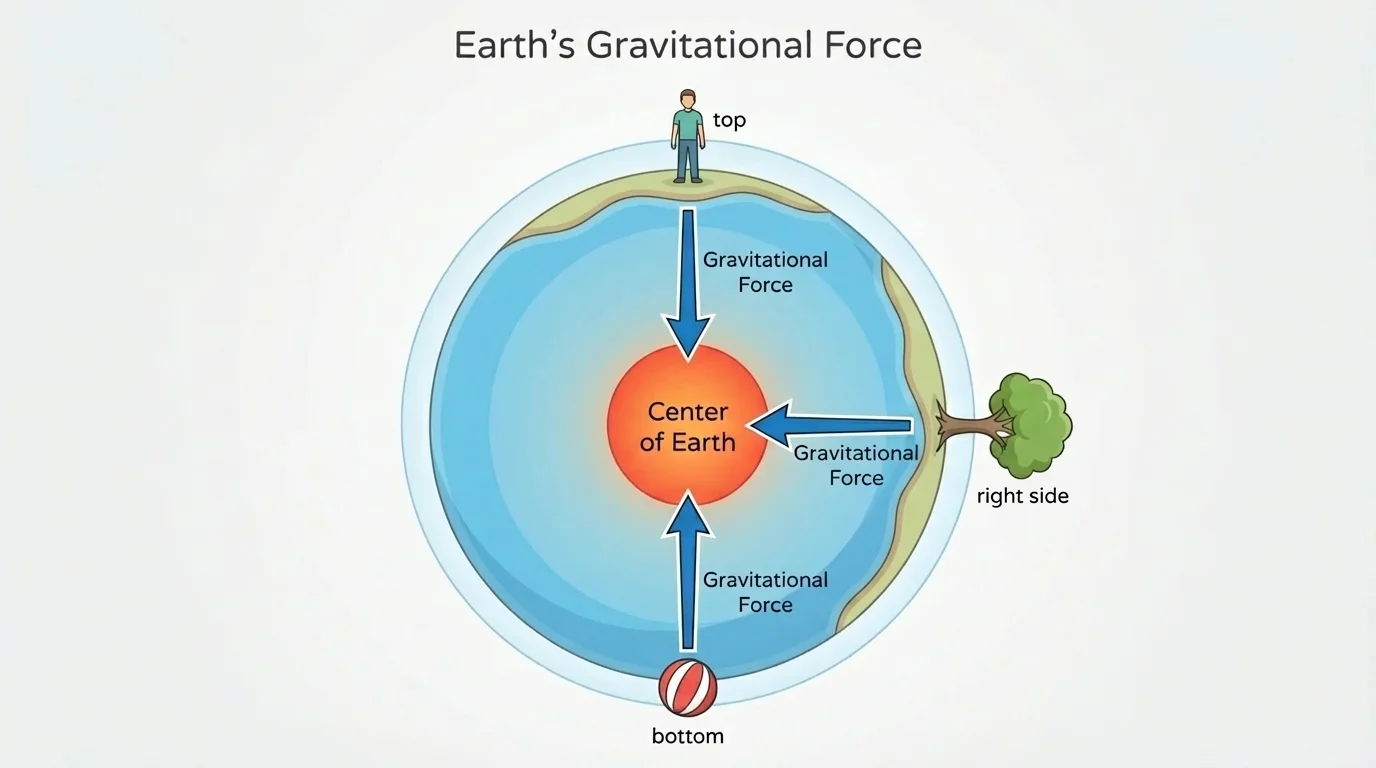
Center of Earth means the middle of the planet. When we say gravity pulls things "down," we really mean it pulls them toward Earth's center.
Earth's gravitational force acts on every object near the ground. That includes tiny things, like grains of sand, and huge things, like buses. As [Figure 1] shows, the pull is always directed inward, toward the middle of the planet, not simply straight "down."
If you stand in a different part of the world, your "down" direction is different from someone else's, but both of you are pulled toward the same place: Earth's center. That is why people in different countries do not fall off Earth. Gravity pulls each person toward the planet.
Gravity is easy to notice once you start looking for it. Drop a pencil, and it falls. Toss a ball upward, and it slows down, stops for a moment, and then falls back. Jump, and you return to the ground. Water poured from a cup moves downward. Snowflakes drift down from the sky. All of these happen because Earth pulls objects toward itself.
Gravity also gives things weight. Weight is the pull of gravity on an object. When you lift a heavy backpack, you feel how strongly Earth pulls on it. A backpack with more items in it has more matter, so gravity pulls on more matter and it usually feels heavier.
When you sit in a chair, gravity pulls you down onto the seat. When you walk, gravity helps keep your feet on the ground. When a slide goes downward, gravity helps pull you along. On a playground, gravity affects swings, seesaws, monkey bars, and every jump from a platform.
A raindrop can fall from a cloud high in the sky because gravity pulls it downward the whole time. Without gravity, rain would not fall to the ground to water plants, fill rivers, and help living things survive.
Gravity does not need to touch an object to pull it. A magnet has to be near some metals to affect them, but gravity acts at a distance. Earth pulls on the Moon, and the Moon also pulls on Earth. We do not feel the Moon's pull strongly in daily life, but it helps cause ocean tides.
People often say that gravity pulls things "down," and that is useful in daily life. But in science, "down" near Earth means toward the planet’s center. This idea matters because Earth is round. No matter where you are on Earth, gravity still pulls you inward toward Earth's center, just as we saw earlier in [Figure 1].
Think about a globe. Every place on the surface has a different direction for straight outward and straight inward. Gravity pulls inward. That is why a dropped apple falls toward the ground where it is, not sideways across the planet.
This also explains why "up" means away from Earth's center. When you throw a ball up, you are pushing it away from Earth for a moment. After it leaves your hand, gravity continues pulling it back inward, so the ball eventually comes down.
Why falling happens
An object falls when gravity pulls it downward and there is not enough support to hold it up. If you let go of a toy, your hand no longer supports it, so gravity makes it move toward Earth's center.
It may seem like the ground is what stops falling objects, but the ground is not what causes them to fall. The cause is gravity. The ground only stops the motion when the object reaches it.
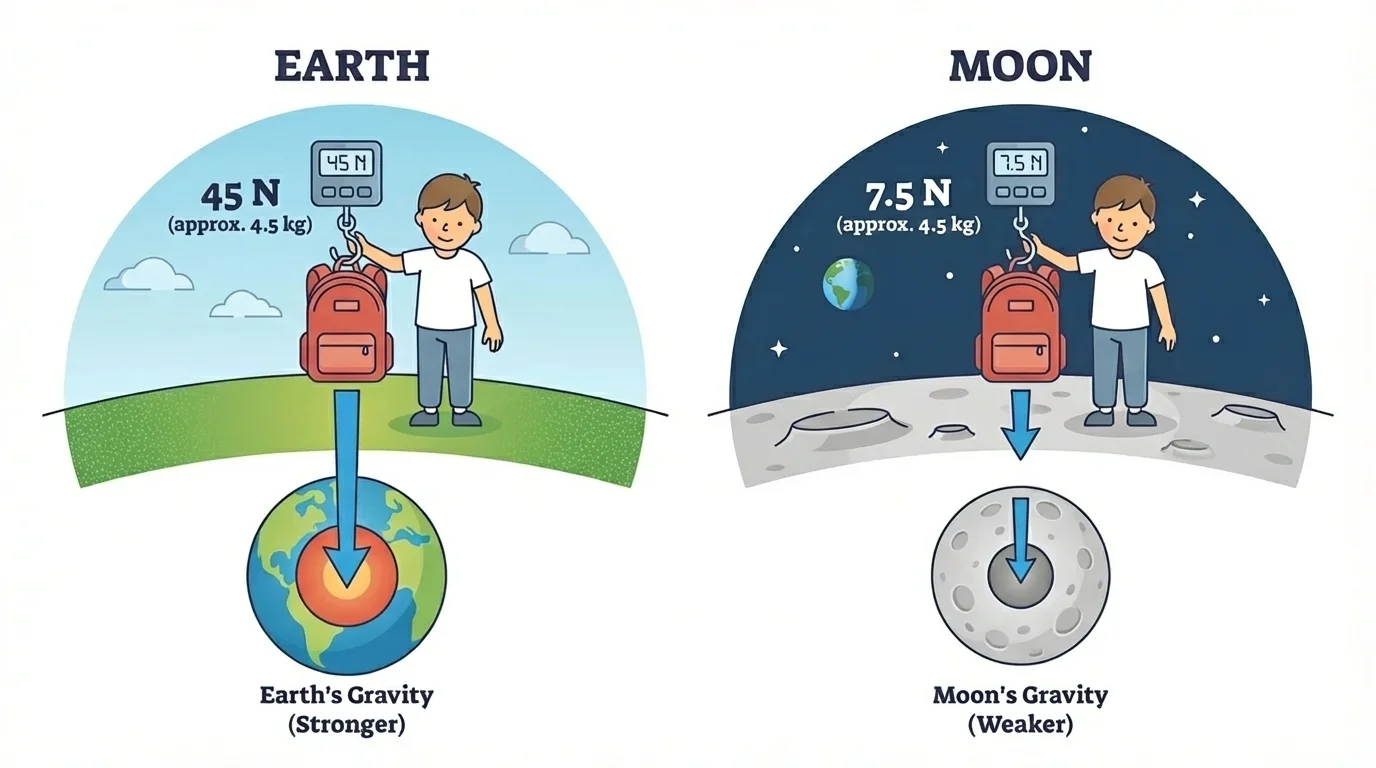
Students sometimes mix up mass and weight. Mass is the amount of matter in an object. Weight is the pull of gravity on that mass. Figure 2 helps compare these ideas because the same backpack has the same mass in both places, but its weight changes when gravity changes.
On Earth, gravity gives objects their usual weight. On the Moon, gravity is weaker, so the same object would weigh less. But the object would still have the same mass because the amount of matter in it has not changed.
Scientists often write weight with a simple formula:
\[W = m \times g\]
In this formula, \(W\) is weight, \(m\) is mass, and \(g\) is the strength of gravity. Near Earth's surface, \(g\) is about \(9.8 \textrm{ N/kg}\), but for younger students it is enough to know that Earth gives objects a strong downward pull.
Numeric example: finding weight on Earth
A toy has a mass of \(2 \textrm{ kg}\). What is its weight near Earth's surface?
Step 1: Use the formula
\(W = m \times g\)
Step 2: Substitute the numbers
\(W = 2 \times 9.8\)
Step 3: Multiply
\[W = 19.6 \textrm{ N}\]
The toy's weight is \(19.6 \textrm{ N}\) on Earth.
If that same toy were on the Moon, its mass would still be \(2 \textrm{ kg}\), but its weight would be smaller because the Moon's gravity is weaker. This is why astronauts can bounce more easily on the Moon than on Earth.
Gravity does not just hold things to Earth. It also changes how objects move. If you roll a ball off a table, the ball moves forward at first, but gravity pulls it downward at the same time. The path curves down instead of staying straight.
When you toss a ball upward, gravity slows it as it rises. At the top of its path, the ball is still under gravity's pull. Then it starts moving downward faster and faster until something stops it. This is why catching a fast ball can hurt your hands.
A waterfall is another example. Water at the top moves over the edge, then gravity pulls it downward. Rivers flow downhill because gravity pulls water from higher places to lower places.
Even the Moon is affected by gravity. Earth's gravity pulls on the Moon, and that pull helps keep the Moon moving around Earth. Objects in space can keep moving while gravity changes their direction. That idea is more advanced, but it shows that gravity is important far beyond the ground under our feet.
Motion means a change in position. A force can start motion, stop motion, speed it up, slow it down, or change its direction. Gravity is one of the most important forces that changes motion near Earth's surface.
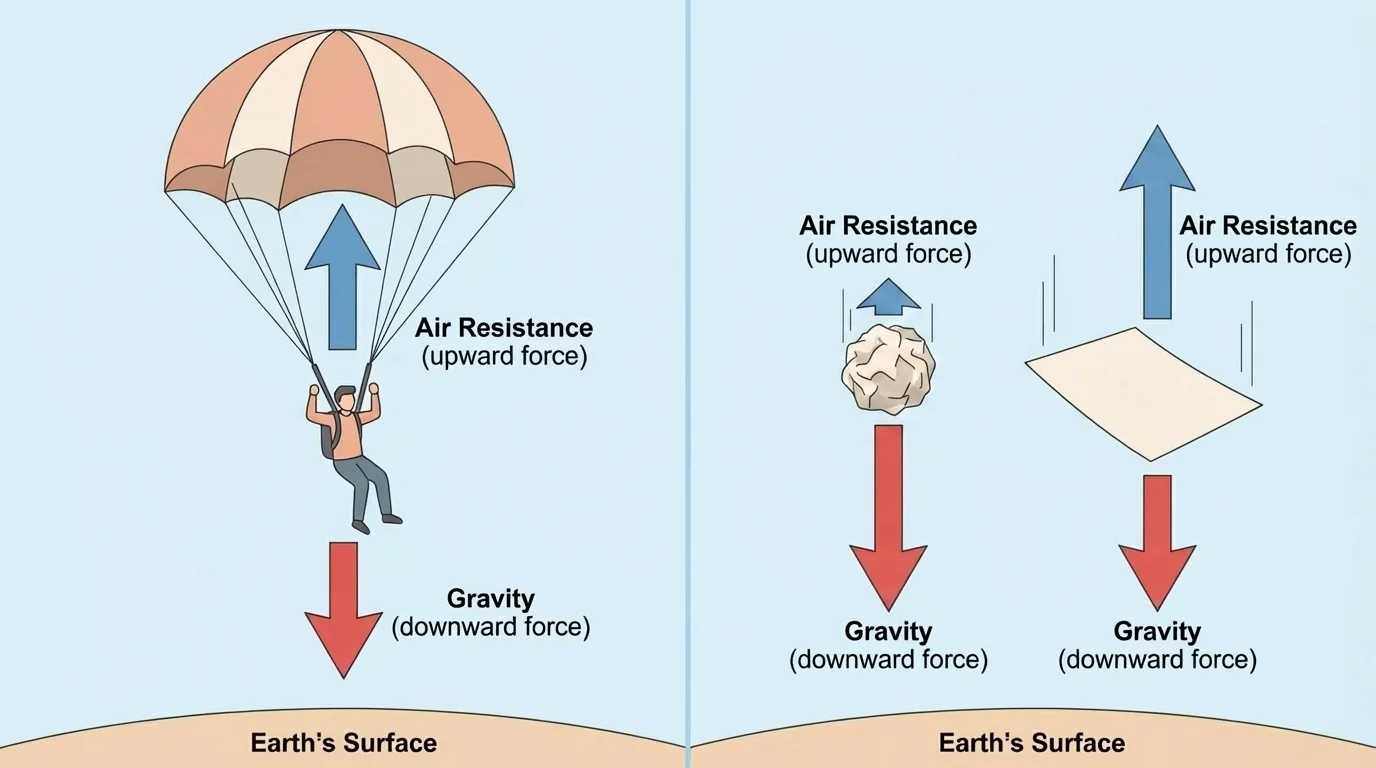
Gravity is powerful, but it is not the only force acting on objects. Many times, gravity works together with other forces. As [Figure 3] shows, two good examples are air resistance pushing upward on falling objects and a parachute using that force to slow a person's fall.
When a book rests on a desk, gravity pulls it down, while the desk pushes it up. Because the pushes and pulls balance, the book stays still. When you hold a grocery bag, gravity pulls the bag down, and your hand pulls up on it.
Air resistance is a force from the air that pushes against moving objects. A flat sheet of paper usually falls more slowly than a crumpled paper ball. The shapes are different, so the air pushes on them differently. Gravity pulls both downward, but air resistance can slow one object more than the other.
A parachute works because it spreads out wide and catches a lot of air. Gravity still pulls the parachute and person downward, but the upward push from the air helps slow the fall, making landing safer.
Later, when you watch leaves drift down or see a kite sink when the wind fades, you can think back to these examples. Gravity keeps pulling downward, while the air can change how fast something falls.
Gravity matters in sports. In basketball, players must aim high enough because gravity pulls the ball down during its flight. In soccer, a kicked ball rises and then comes back down. In diving, gymnasts and swimmers plan their motions knowing they will be pulled back toward Earth.
Gravity matters in engineering too. Builders design stairs, ramps, bridges, and tall buildings so they can safely support weight. Amusement park rides are carefully designed because gravity affects speed and direction. Water towers work because gravity helps water flow downward through pipes to homes and schools.
Gravity also helps life on Earth. Rain reaches the ground, rivers move toward oceans, and roots grow down into soil partly because of Earth's pull. Our bodies have grown and changed over millions of years while living under gravity all the time.
Astronauts in orbit may look like they are floating without gravity, but Earth's gravity is still pulling on them. They seem weightless because they are falling around Earth while moving forward very fast.
You can learn a lot about gravity by observing common objects. Drop a rubber ball and watch it fall, hit the floor, and bounce. Gravity pulls it down. The floor pushes it back up for a moment, which makes it bounce.
You can also compare a flat paper sheet and a crumpled paper ball. If both are dropped from the same height, the crumpled one often lands first. This does not mean gravity ignores the flat paper. It means air resistance affects the flat paper more strongly, which connects back to the ideas shown in [Figure 3].
If you toss a ball upward gently and then more strongly, both balls come back down. The stronger toss makes the ball rise higher first, but gravity still wins in the end by pulling it back toward Earth.
Numeric example: comparing two tosses
Suppose one ball is tossed to a height of \(2 \textrm{ m}\) and another to \(5 \textrm{ m}\). How much higher does the second ball go?
Step 1: Write the subtraction
\(5 - 2\)
Step 2: Find the difference
\[3 \textrm{ m}\]
The second ball goes \(3 \textrm{ m}\) higher, but both eventually fall because gravity pulls both downward.
A common misunderstanding is that heavier objects always fall much faster than lighter ones. In everyday life, that may sometimes seem true, but often air resistance is the reason. If air resistance is small, objects can fall at nearly the same rate. Gravity pulls on both.
Another misunderstanding is that gravity only works when something is falling. That is not true. Gravity also acts on a sleeping cat, a parked bicycle, a glass on a shelf, and a child standing still. Those objects do not move downward because something supports them.
Some people think there is no gravity in space. In fact, gravity acts over great distances. Planets stay in orbit around the Sun because of gravity, and moons stay near planets because of gravity too.
Gravity near Earth's surface
Near Earth's surface, the main idea is simple and powerful: Earth pulls objects toward its center. This pull affects motion, creates weight, and works together with other forces such as support forces and air resistance.
When you watch a dropped coin, a bouncing ball, falling rain, or a person landing after a jump, you are seeing the same rule again and again. Earth's gravitational force acts on the object and pulls it inward, toward the center of the planet.
