Have you ever sat in a chair and thought you were feeling no forces at all? It feels calm and still, but something surprising is happening: forces are acting on you every second. The Earth pulls you downward, and the chair pushes upward on you at the same time. Because these forces balance, you stay still instead of falling through the floor or shooting into the air. That simple idea helps explain why objects rest, move, stop, speed up, and turn.
A force is a push or a pull. When you open a door, kick a ball, pull a wagon, or squeeze clay, you are using forces. Forces are not things you can see directly, but you can see what they do. They can make objects start moving, stop moving, speed up, slow down, or change direction.
Each force acts on one particular object. If you push a toy car, the force acts on the car. If a magnet pulls a paper clip, the force acts on the paper clip. If gravity pulls on an apple, the force acts on the apple. It is important to ask, Which object is the force acting on?
Forces also have two important features: strength and direction. A gentle push and a strong shove are not the same strength. A pull to the left and a pull to the right are not the same direction. To understand motion, we need to think about both.
Force is a push or a pull on an object.
Direction tells which way the force acts, such as up, down, left, right, forward, or backward.
Net force is the overall force on an object after all the forces acting on it are considered together.
Sometimes one force acts on an object, but very often several forces act on the same object at once. That is why scientists do not just ask, "Is there a force?" They ask, "What forces are acting, and how do they work together?"
A single object can have more than one force acting on it at the same time. Think about a backpack sitting on the floor. As [Figure 1] helps us visualize, gravity pulls it downward, while the floor pushes upward on it. Both forces act on the same backpack.
This is an important idea because many students think that if an object is not moving, then no forces are acting on it. But that is not true. An object at rest often has multiple forces acting on it. The key is that those forces balance each other.
You can think of it like a tug-of-war where both teams pull equally hard in opposite directions. The rope does not move because the pulls balance. In the same way, a resting object can stay still when the forces on it work against each other in just the right way.
Objects can move in different ways: they can speed up, slow down, stop, start, or turn. Motion changes when the forces on an object do not balance.
A lamp hanging from the ceiling is another example. Gravity pulls the lamp downward, while the chain or cord pulls upward. Even though the lamp is not moving, forces are still acting on it.
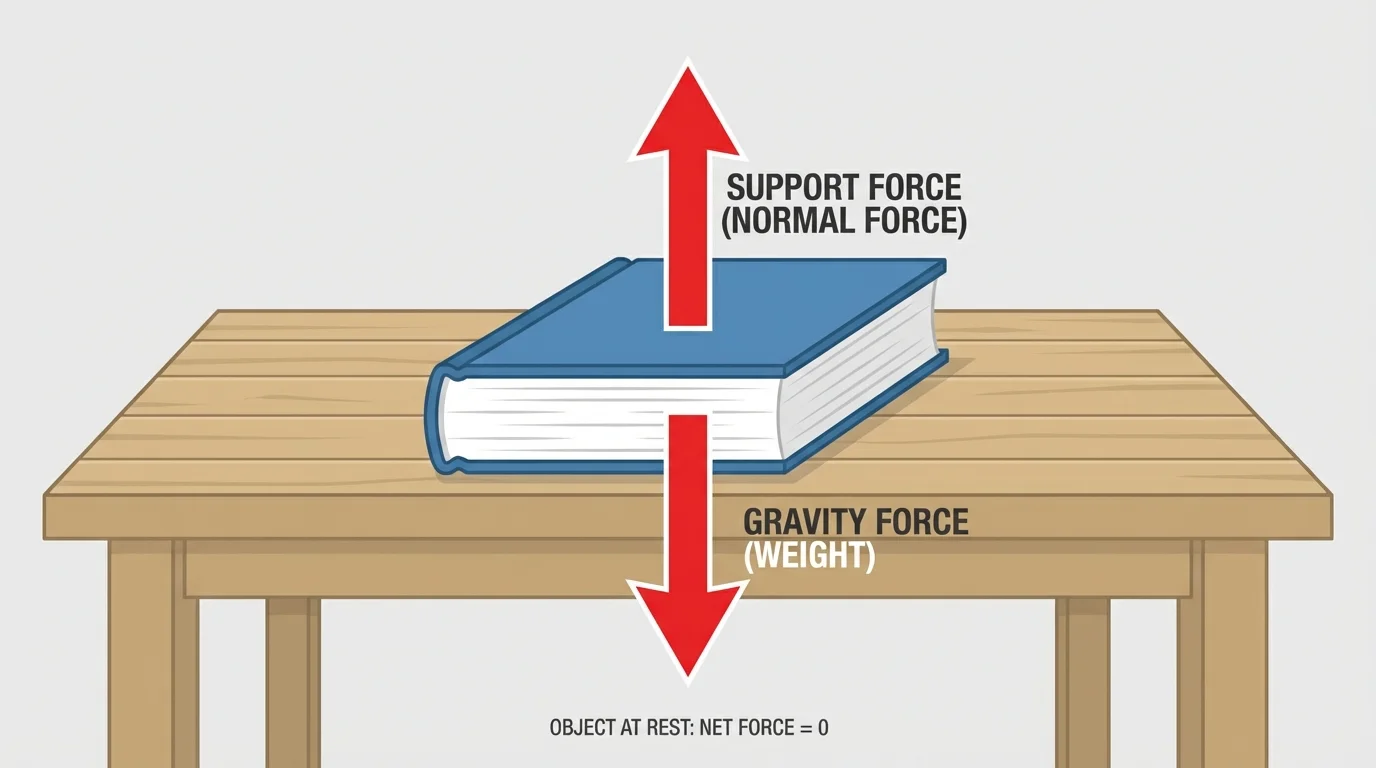
When forces on an object combine so that the overall result is zero, they are called balanced forces. In that case, the net force is zero. A book resting on a table has gravity pulling it down and the table pushing it up. Because these forces balance, the book stays at rest.
The table does not "turn off" gravity. Gravity is still pulling downward. The table simply pushes upward with an equal strength in the opposite direction. The book does not move because the forces add to zero overall.
Balanced forces do not always mean an object is standing still. Balanced forces can also happen when an object is already moving in a steady way. For example, if a hockey puck glides across very smooth ice and its motion is not changing, the overall force on it is zero. At this level, the most important idea is that balanced forces do not change motion.
If an object is at rest and stays at rest, its net force is zero. If an object is moving straight ahead at a steady speed and keeps doing that, its net force is also zero. In both cases, the motion is not changing.
Why zero net force matters
Zero net force does not mean zero forces. It means the forces acting on an object cancel each other overall. An object can have two, three, or even more forces acting on it and still have zero net force if they balance in strength and direction.
You can return to the book and table example from [Figure 1] whenever you want to test this idea. The book is not floating because there is no gravity. It is resting because gravity downward and the table's upward push balance.
As [Figure 2] illustrates with a soccer ball, when the forces on an object do not add to zero, the object has a nonzero net force acting on it. That can change how fast something moves or which direction it moves.
If you kick a still ball, the ball starts moving. If you kick a moving ball in the same direction, it may speed up. If you kick it from the side, it changes direction. If you stop a rolling ball with your foot, the force from your foot changes the ball's motion again.
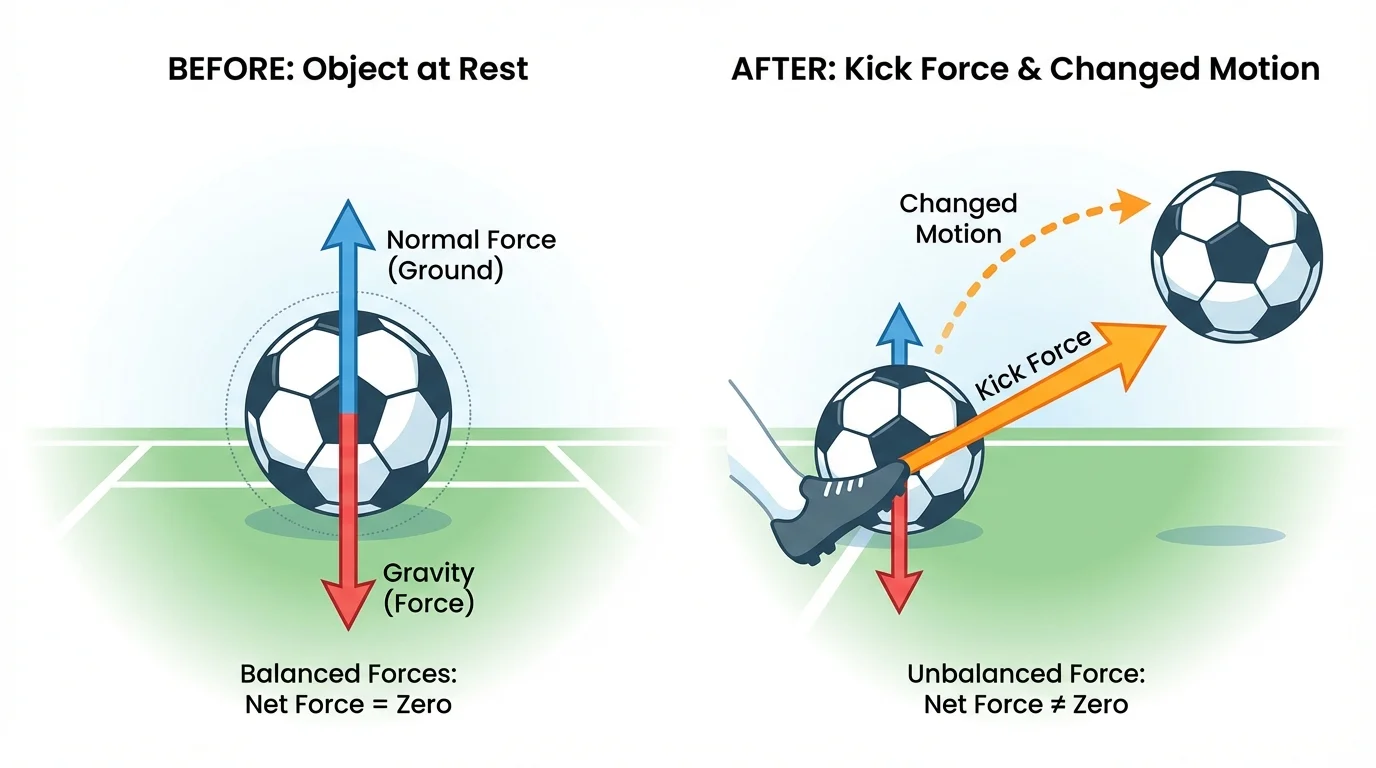
Changes in motion can happen in several ways. An object can start moving, stop moving, speed up, slow down, or turn. All of these are signs that the forces are not balanced.
A playground swing is a good example. When the swing is hanging still, the forces are balanced. When someone pushes it, that push creates an overall force, and the swing starts moving. Later, air resistance and friction work against the swing's motion, so it slows down if nobody keeps pushing.
The soccer ball example in [Figure 2] helps us notice something important: the same object can have different forces acting on it at different times. A ball can be still, then kicked, then rolling, then slowed by grass, then stopped by a shoe. Forces explain each change.
As [Figure 3] shows with a bicycle, many everyday situations involve gravity, the normal force, friction, and air resistance. Several different forces can act on one object at once.
Gravity pulls objects toward Earth. It acts on you, your desk, raindrops, balls, and cars. Gravity pulls downward near Earth's surface, which is why dropped objects fall.
Normal force is the push from a surface that supports an object. A table pushes up on a book. The floor pushes up on your shoes. A chair pushes up on you when you sit.
Friction is a force that resists motion when two surfaces touch. Friction can help or hinder motion. It helps your shoes grip the ground so you do not slip, but it also slows a toy car rolling across carpet.
Air resistance is a kind of friction caused by air. It pushes against moving objects. A bicyclist feels air resistance when riding fast. A parachute works by increasing air resistance so a person falls more slowly.
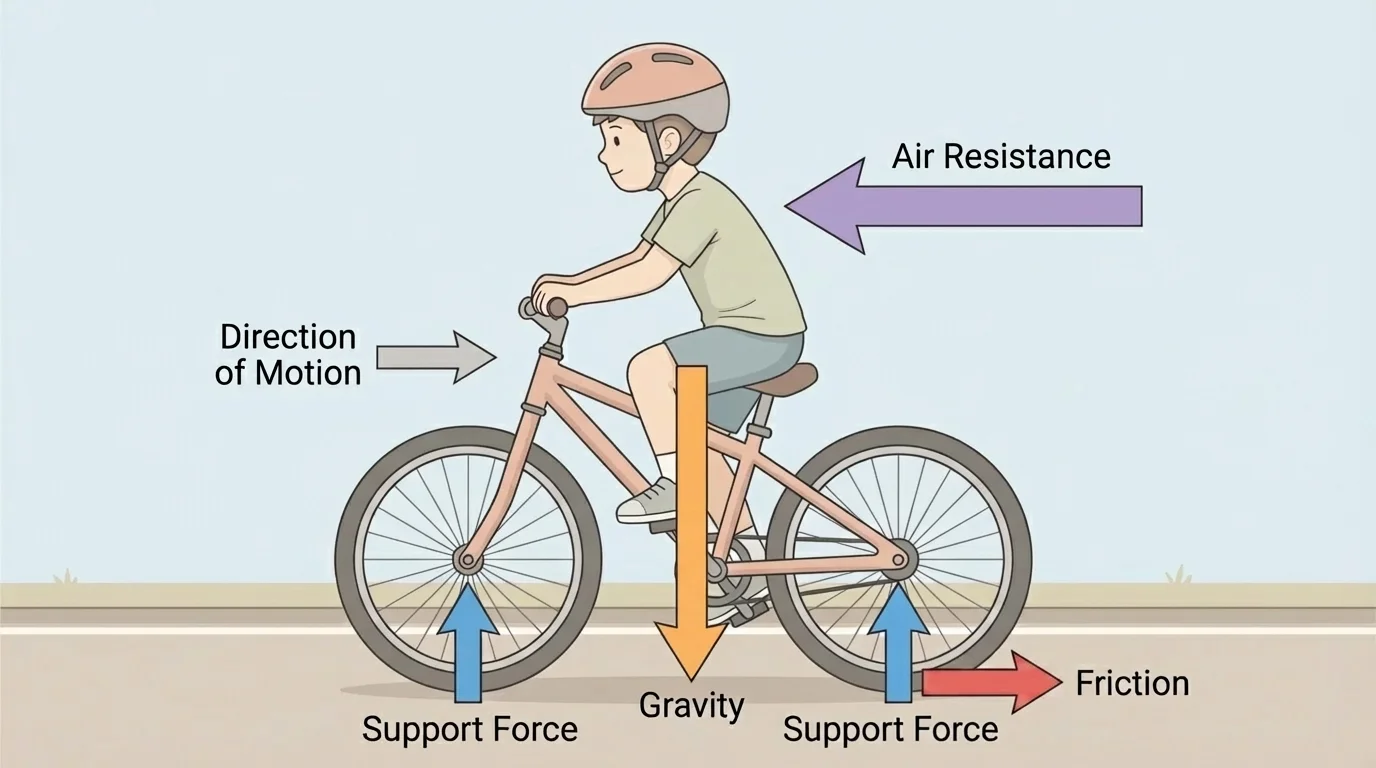
Look again at the bicycle in [Figure 3]. Gravity pulls the rider and bicycle downward. The ground pushes upward through the tires. The tires interact with the road, and air pushes backward against the moving rider. Motion depends on how these forces work together.
A skydiver does not keep speeding up forever. As the diver falls faster, air resistance grows stronger, and eventually it can balance the pull of gravity for a time.
Scientists talk about these forces separately so they can understand the whole situation clearly. In real life, several forces often act together at once.
Sports are full of forces. In basketball, a player pushes the ball upward and forward. Gravity then pulls the ball downward. In baseball, the bat exerts a force on the ball, changing its speed and direction. In swimming, a swimmer pushes water backward, and the water pushes the swimmer forward.
Transportation also depends on forces. A car moves forward because the tires push against the road. Brakes create forces that slow the wheels. Seat belts apply force to stop a person from continuing forward suddenly when the car stops.
At home, you can see balanced and unbalanced forces in simple ways. A refrigerator magnet stays in place because forces balance. A drawer opens when you pull with enough force to overcome friction. A rolling toy slows on a rug because friction is stronger there than on a smooth floor.
Everyday force situations
Step 1: A mug sits on a table.
Gravity pulls the mug downward, and the table pushes upward. The forces balance, so the mug stays still.
Step 2: Someone slides the mug gently across the table.
The push changes the mug's motion, so there is an unbalanced force while it starts moving.
Step 3: The mug is no longer being pushed.
Friction from the table slows it down and stops it. That means the net force is not zero during the slowing.
These examples matter because force ideas help engineers design bikes, cars, helmets, bridges, and playground equipment. Understanding forces helps people make things safer and more useful.
It helps to compare three situations: an object at rest, an object moving steadily, and an object changing motion. These situations may look different, but the force idea connects them all.
| Situation | What is happening with forces? | What happens to motion? |
|---|---|---|
| Book resting on a desk | Forces balance | It stays still |
| Skater gliding steadily | Forces balance overall | It keeps moving steadily |
| Scooter starting to move | Forces do not balance | It speeds up |
| Bike turning a corner | Forces do not balance | Its direction changes |
| Ball rolling to a stop | Forces do not balance | It slows down |
Table 1. Comparison of balanced and unbalanced forces in common situations.
Notice that "not moving" and "moving" are not the only ideas that matter. The most important question is whether the motion is changing. If the motion is changing, the forces are not balanced. If the motion is not changing, the net force is zero.
The bicycle scene from [Figure 3] connects well to this comparison. A rider moving steadily has forces balanced overall, but a rider who brakes, speeds up, or turns has unbalanced forces causing those changes.
You do not need a fancy lab to notice forces. A toy car, a ball, a book, and a few surfaces are enough to make good observations.
Roll a toy car across tile and then across carpet. On tile, the car usually rolls farther. On carpet, it slows more quickly. That tells you friction is stronger on the carpet.
Push a box lightly and then more strongly. The stronger push changes the motion more. This helps show that force strength matters, not just force direction.
Drop a crumpled paper ball and a flat sheet of paper. The flat paper falls differently because air resistance has a bigger effect on it. If you crumple the paper, it falls more easily through the air.
Observing balanced and unbalanced forces with a toy car
Step 1: Place a toy car on the floor without touching it.
Gravity pulls down, and the floor pushes up. The car stays at rest because the forces balance.
Step 2: Push the car forward.
Your push creates an unbalanced force, so the car starts moving.
Step 3: Stop pushing and watch.
Friction and a little air resistance slow the car, so its motion changes again.
These observations are simple, but they match the same ideas scientists use in larger systems such as airplanes, rockets, and trains.
One common mistake is thinking that a resting object has no forces acting on it. In many cases, it has several. They just balance so the net force is zero.
Another mistake is thinking that motion always needs a force in the direction of motion. A moving object does not need a force to keep moving steadily. A force is needed to change the motion.
A third mistake is forgetting that direction matters. Two forces can be strong, but if they act in different directions, they may balance or may cause turning. Strength alone does not tell the whole story.
"To understand motion, ask two questions: What forces are acting, and do they balance?"
That pair of questions works for a book on a desk, a sled on snow, a bird landing on a branch, or a car stopping at a light. Forces tell the story of why objects stay as they are or why they change.
