Why don't you fall right through the floor? It may feel like the floor is just sitting there, doing nothing. But it is actually pushing up on you every second you stand, walk, jump, or dance. That surprising idea helps us understand an important rule in science: when objects touch, they can push or pull on each other.
A force is a push or a pull. Forces can make things start moving, stop moving, speed up, slow down, or change direction. If you kick a soccer ball, your foot pushes the ball. If you pull a wagon, your hand pulls the handle and the wagon moves.
Some forces happen when objects touch. These are called contact forces. Other forces can act even when objects are not touching, such as gravity. This lesson focuses on forces that happen through contact.
Force means a push or a pull. Contact means two objects are touching. A contact force is a push or pull that happens because objects touch.
Forces are important because motion changes when forces act. A toy car rolls when you push it. A swing moves when someone gives it a push. A basketball bounces because the floor pushes back on it after the ball hits the ground.
When two objects are in contact, they touch each other. Your shoes touch the ground. A pencil touches your hand. A chair touches the floor. Touching lets objects exert forces on each other.
The word exert means "to apply" or "to put forth." So when we say an object exerts a force, we mean it applies a push or pull. If you squeeze a sponge, your hand exerts a force on the sponge. At the same time, the sponge pushes back on your hand.
This may sound strange at first. We often notice only the force we are making. But in contact situations, the other object is also involved. Touch always goes both ways.
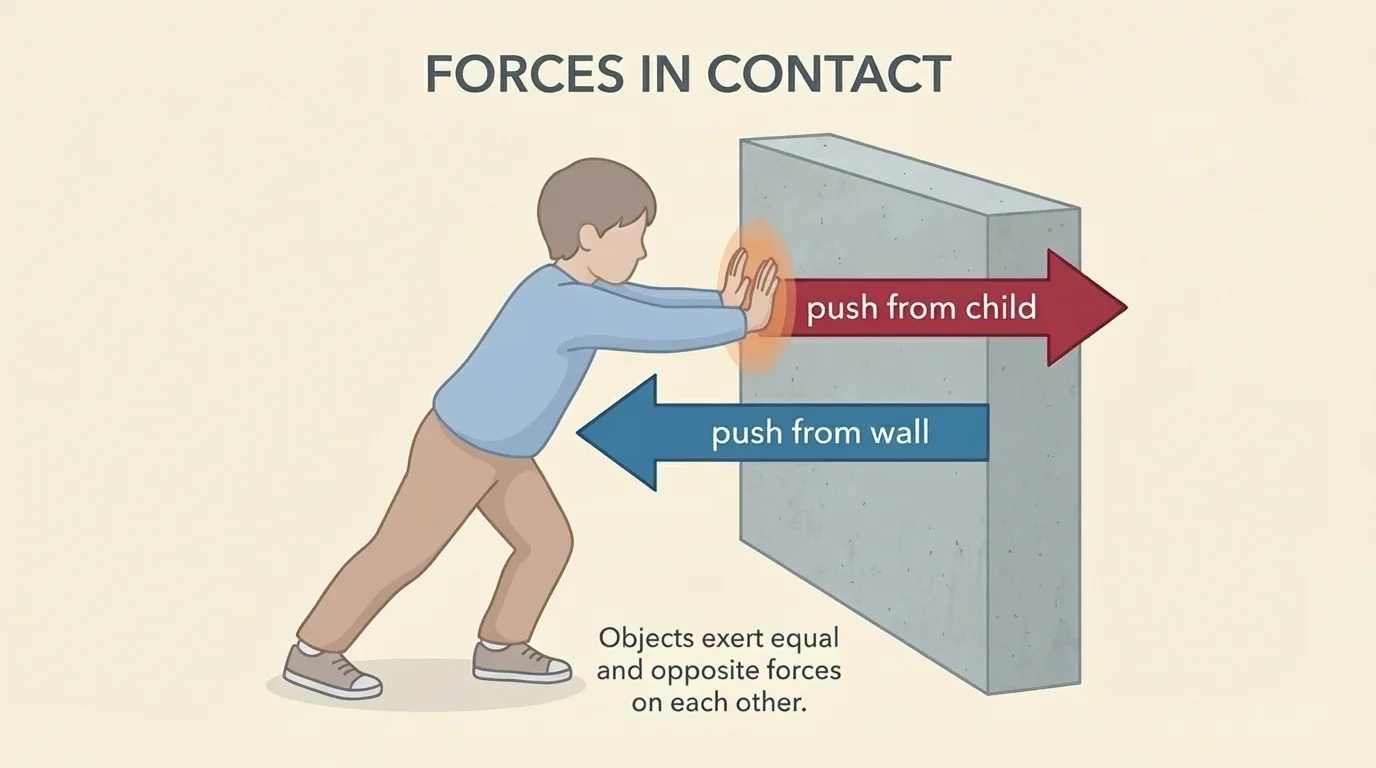
When one touching object pushes or pulls another, the second object also pushes or pulls back. This is a big idea in science, and [Figure 1] illustrates it with a child and a wall. If a child pushes on a wall, the wall pushes back on the child.
You can test this with your own hands. Press your palms together. Each hand pushes on the other. If you push harder with one hand, you feel the push in both hands because the hands are in contact and each exerts a force.
Another example happens when a ball hits the floor. The ball pushes down on the floor. The floor pushes up on the ball. That upward push helps the ball bounce.
These paired forces act on different objects. One force acts on the wall, and the other force acts on the child. One force acts on the floor, and the other force acts on the ball. This matters because the two forces do not "cancel out" each other on one single object.
Why paired forces matter
When two objects touch, they interact. The force is not one-way. The interaction always includes both objects. If object A pushes object B, then object B pushes object A. If object A pulls object B, then object B pulls object A.
You may feel this when you jump. Your feet push down on the ground. The ground pushes up on your feet, helping send you upward. That push from the ground is one reason jumping works at all.
We can describe the size of some forces with numbers. For example, if one object pushes another with a force of \(5\) units, the second object pushes back with \(5\) units in the opposite direction. The directions are opposite, but the forces are part of the same interaction.
Not all contact forces look the same. Some are easy to see, like a hand pushing a box. Some are harder to notice, like the table pushing up on a book.
One common kind of contact force is a push. Another is a pull. If you push a shopping cart, your hands push the cart. If you pull a sled with a rope, the rope pulls the sled.
Another important contact force is friction. Friction happens when two surfaces rub against each other. Friction can slow things down or keep them from sliding. When you slide a heavy box across the floor, friction between the box and the floor makes the motion harder.
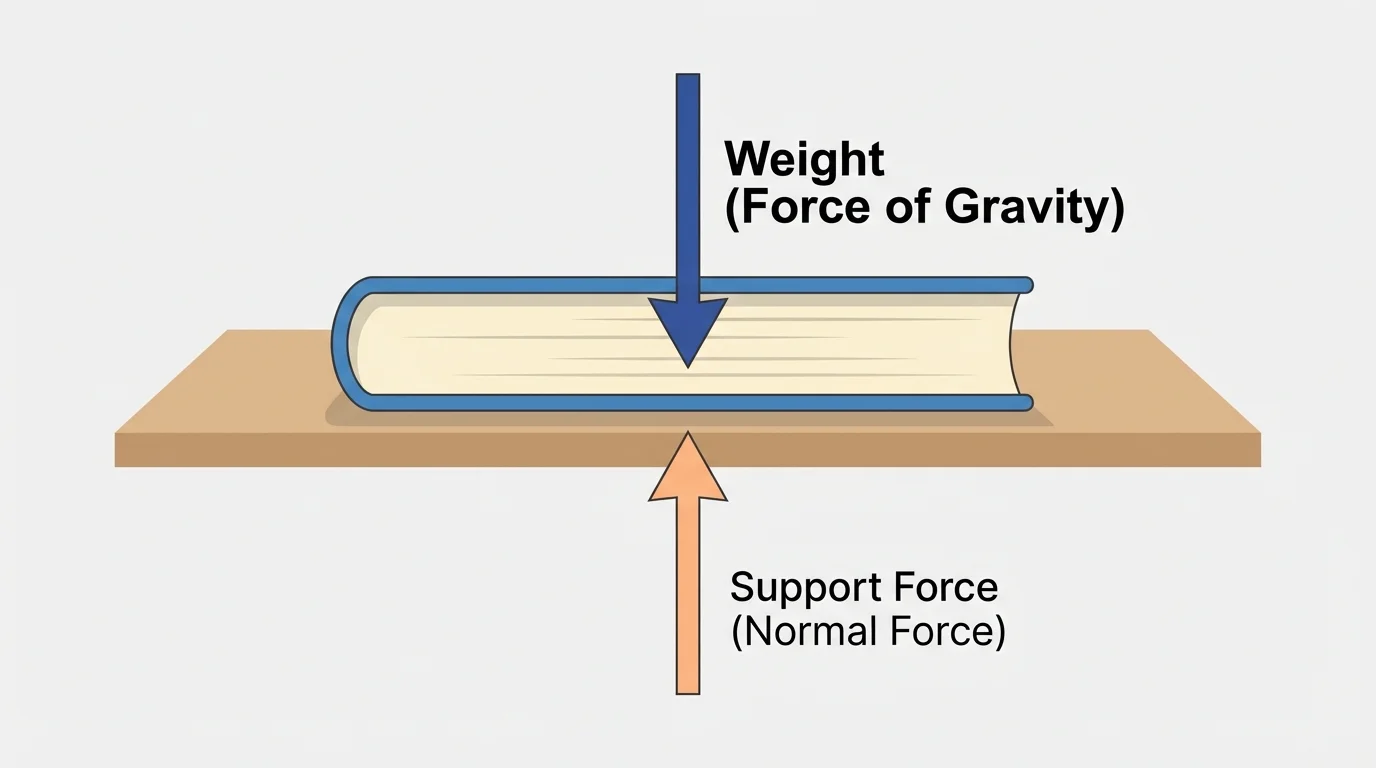
A different contact force is the support force, sometimes called the normal force. A table pushes up on a book resting on it, as shown in [Figure 2]. Even though the table does not move, it still exerts a force.
If the table did not push up, the book would fall. The support force helps hold objects up when they are resting on a surface.
Tension is a contact force carried by a rope, string, or cable when it is pulled tight. When you pull a wagon with a rope, the rope exerts a pulling force on the wagon.
Air can also exert a contact force. This is called air resistance. Air resistance pushes against moving objects. When you ride a bike fast, you can feel the air pushing against your face. A parachute works because air pushes upward on the open parachute and slows the falling person.
Water does this too. If you try to run in a swimming pool, the water pushes against your legs and slows you down. Water and air are made of matter, so when they touch moving objects, they can exert forces.
| Contact force | What it does | Example |
|---|---|---|
| Push | Moves an object away | Hand pushing a door |
| Pull | Draws an object closer | Pulling a wagon |
| Friction | Resists sliding | Shoes gripping the ground |
| Support force | Pushes up from a surface | Table holding a book |
| Tension | Pulls through a rope or string | Kite string pulling on a kite |
| Air resistance | Pushes against motion through air | Parachute slowing a fall |
Table 1. Common contact forces and everyday examples.
Sometimes contact forces are balanced. This means the forces on an object match in a way that does not change its motion. A book resting on a table is a good example. Gravity pulls the book downward, and the table's support force pushes upward. The book stays still because these forces balance.
If the downward force is \(10\) units and the upward force is also \(10\) units, the forces are balanced. The book does not start moving up or down.
Sometimes forces are unbalanced. Then motion changes. If you push a toy car across the floor and your push is stronger than friction, the car speeds up. If friction becomes stronger after you stop pushing, the car slows down and stops.
Example: balanced and unbalanced forces
Suppose a box is pushed to the right with \(8\) units of force, and friction pushes to the left with \(3\) units.
Step 1: Compare the forces.
The push is \(8\) units to the right, and friction is \(3\) units to the left.
Step 2: Find which side is stronger.
Because \(8 > 3\), the force to the right is stronger.
Step 3: Find the difference.
\(8 - 3 = 5\)
The forces are unbalanced, so the box changes motion to the right with a net force of \(5\) units.
Balanced forces do not always mean an object is not moving. If you slide a hockey puck at a steady speed on a nearly smooth surface and the forces stay balanced, its motion does not change. Unbalanced forces are what change motion.
Forces have both strength and direction. A gentle push and a strong push are not the same. A push to the left and a push to the right are also different.
If two friends push the same box from opposite sides with equal forces, the box may stay still. For example, if one pushes right with \(6\) units and the other pushes left with \(6\) units, the forces balance.
If one friend pushes right with \(9\) units and the other pushes left with \(4\) units, then the stronger push wins. The box has an unbalanced force of \(9 - 4 = 5\) units to the right.
Direction matters in paired forces too. When your hand pushes a desk downward, the desk pushes your hand upward. The forces are opposite in direction, but each acts on a different object.
A rocket can move even in space because gases push out of the rocket, and the rocket is pushed the other way. The same force-pair idea works even when there is no air around the rocket.
This shows that force pairs are a rule about interactions between objects, not just about things we can easily see on Earth.
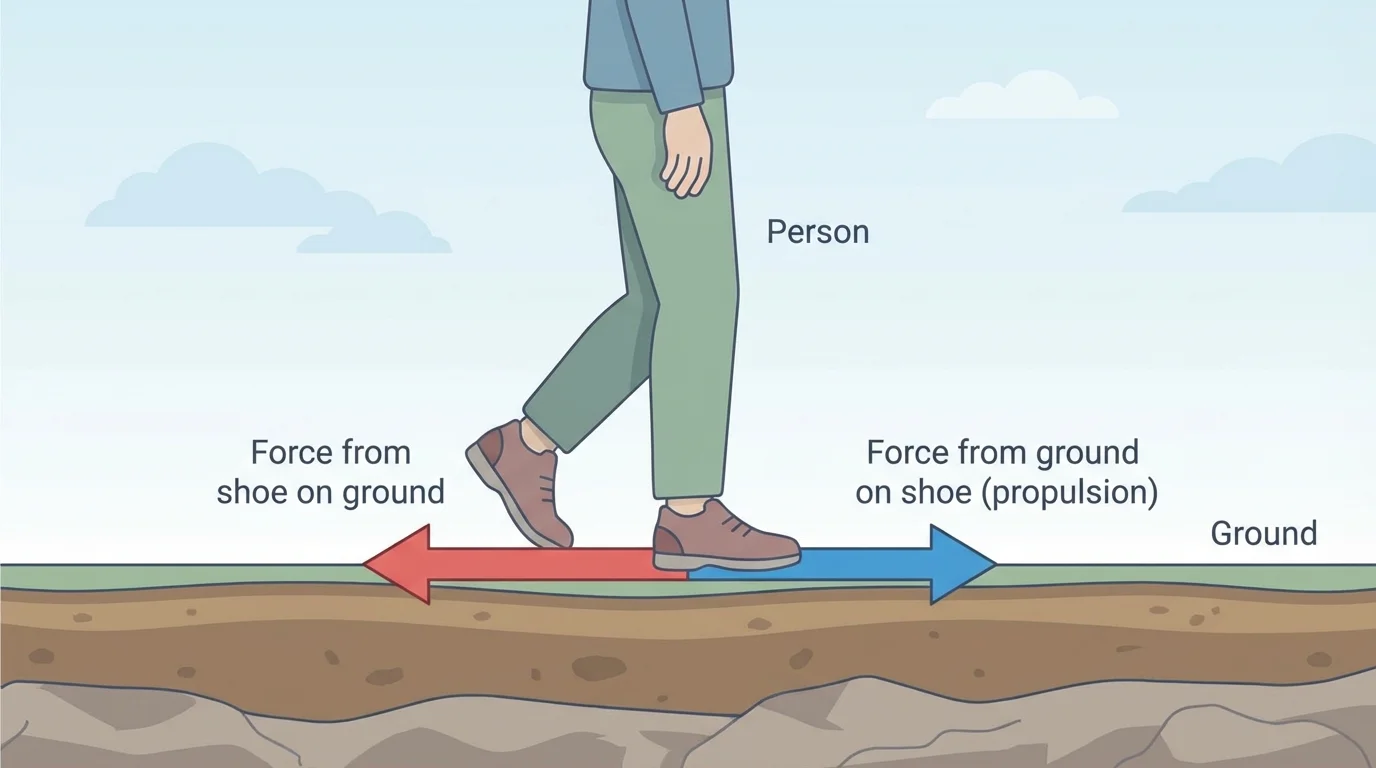
[Figure 3] shows a key contact-force interaction in walking. Your foot pushes backward on the ground. The ground pushes forward on your foot. That forward push helps move you ahead.
If the ground is icy, there is less friction. Then your shoe cannot push backward effectively, and the ground cannot push you forward as well. That is why people slip on ice.
When you ride a bike, your tires push backward on the road. The road pushes forward on the tires. Friction between the tires and the road helps the bike move.
When a baseball bat hits a ball, the bat exerts a force on the ball. At the same time, the ball exerts a force on the bat. Players can feel that push back in their hands. This is similar to the wall example we saw in [Figure 1], where both touching objects exert forces on each other.
When you sit in a chair, your body pushes down on the chair. The chair pushes up on your body. That support force keeps you from falling to the floor. This is the same kind of upward push shown by the book and table in [Figure 2].
Cars stop because of contact forces too. Brakes create friction. Tires also use friction with the road. Without enough friction, a car would have trouble stopping or turning safely.
Example: why a rolling ball stops
A ball rolling across grass slows down even when nobody is touching it by hand.
Step 1: Identify the contact forces.
The grass rubs against the ball, creating friction. The air also exerts air resistance on the ball.
Step 2: Decide what those forces do.
Both friction and air resistance act against the motion.
Step 3: Predict the result.
Because the forces are unbalanced against the direction of motion, the ball slows down and eventually stops.
Objects often stop moving because contact forces resist their motion.
Even playground equipment depends on contact forces. A swing moves when a person pushes it. A slide works because gravity pulls a child down, while friction between clothes and the slide affects how fast the child moves.
You can observe contact forces with simple materials. Press a sponge and notice that it pushes back. Roll a toy car across carpet and then across a smooth floor. The car travels different distances because friction changes. Hold a book in your hand and feel the book pushing down while your hand pushes up.
If you gently push a chair, it moves. If you push a wall, it usually does not move. But the wall still pushes back on you. Your muscles feel that push, even though the wall stays in place.
A sheet of paper and a crumpled paper ball also show air resistance. Drop them at the same time. The flat paper usually falls more slowly because the air exerts more resistance on its larger open surface.
You already know that objects can move in different ways: they can start, stop, speed up, slow down, or turn. Forces are the reason those changes happen.
Careful observation helps scientists learn about forces. We cannot always see a force directly, but we can see what it does.
One common misunderstanding is thinking that only the moving object exerts a force. Actually, both objects in contact exert forces. A hammer hits a nail, but the nail also pushes back on the hammer.
Another misunderstanding is thinking that paired forces cancel because they are equal and opposite. They do not cancel on one object because they act on different objects. In the wall example from [Figure 1], the child's force acts on the wall, and the wall's force acts on the child.
Some students also think objects need a constant push to keep moving. In everyday life, many moving things slow down because of friction and air resistance. If those contact forces were very small, an object could keep moving for much longer.
Understanding contact forces helps explain many ordinary events. Floors support us, shoes grip the ground, balls bounce, ropes pull, and air slows fast-moving objects. Touching objects are constantly exerting forces on each other, even when nothing dramatic seems to be happening.
