Have you ever seen a paper clip jump onto a magnet, or watched your hair stand up after rubbing a balloon on it? Those things can look like magic, but they are really caused by forces. Some forces need a push or a pull by touch. Other forces can act across empty space. That means two objects do not have to be in contact for one to affect the other.
A force is a push or a pull. Many forces happen when objects touch. If you kick a soccer ball, your foot touches the ball. If you push open a door, your hand touches the door. But some forces are different. As [Figure 1] shows, a magnet can pull a paper clip without touching it, and a charged balloon can pull on hair or tiny bits of paper without touching them first.
These are called non-contact forces. They work across a space between objects. Electric forces and magnetic forces are both non-contact forces. Gravity is also a non-contact force, but here we will focus on electricity and magnetism.
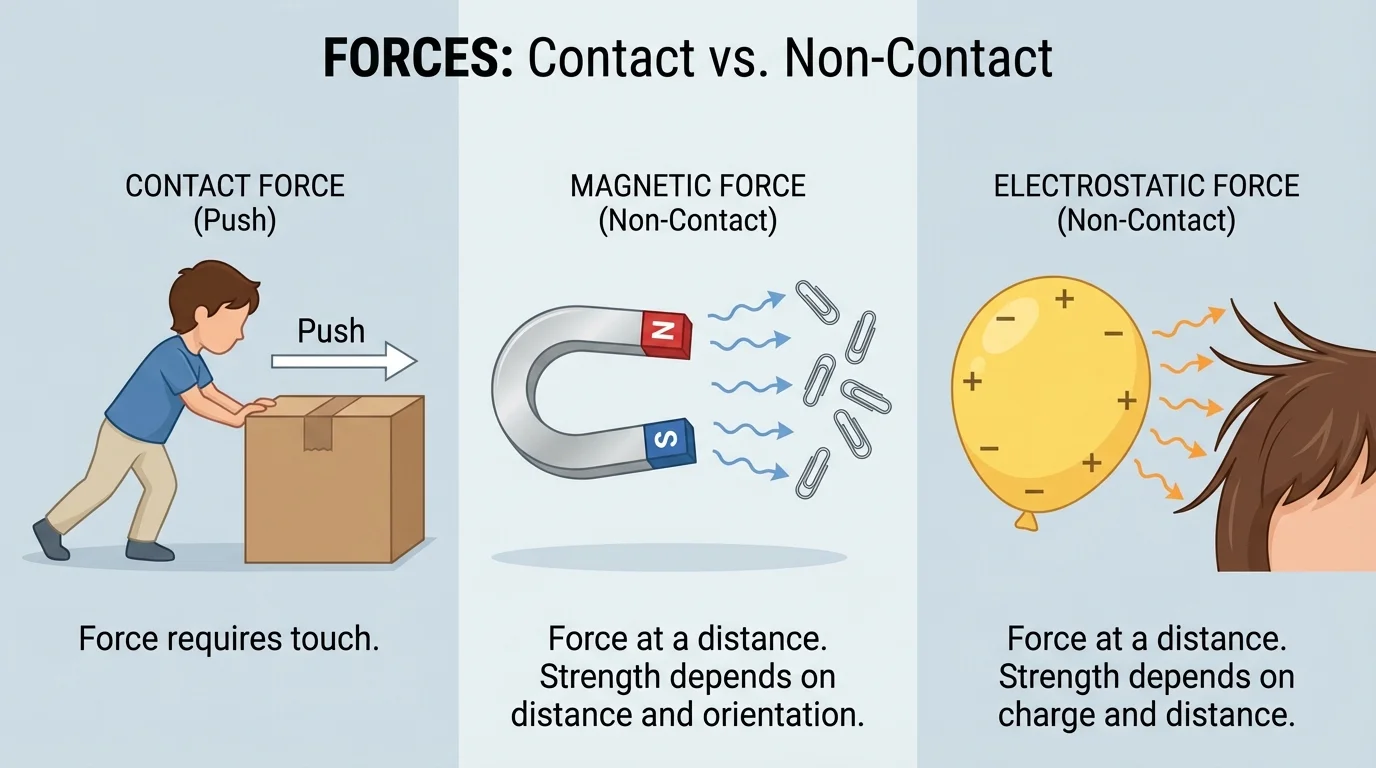
Even though these forces act without contact, they are still real forces. They can make objects move, stop, speed up, slow down, or change direction. If a magnet pulls a paper clip, the paper clip moves. If two magnets push away from each other, they can slide apart.
Electric force is the push or pull between charged objects.
Magnetic force is the push or pull between magnets or between a magnet and certain metals such as iron.
One big idea in science is that the size of a force can change. A force can be stronger or weaker depending on the objects involved and how far apart they are. With magnets, there is one more important idea: the way the magnets are turned matters too.
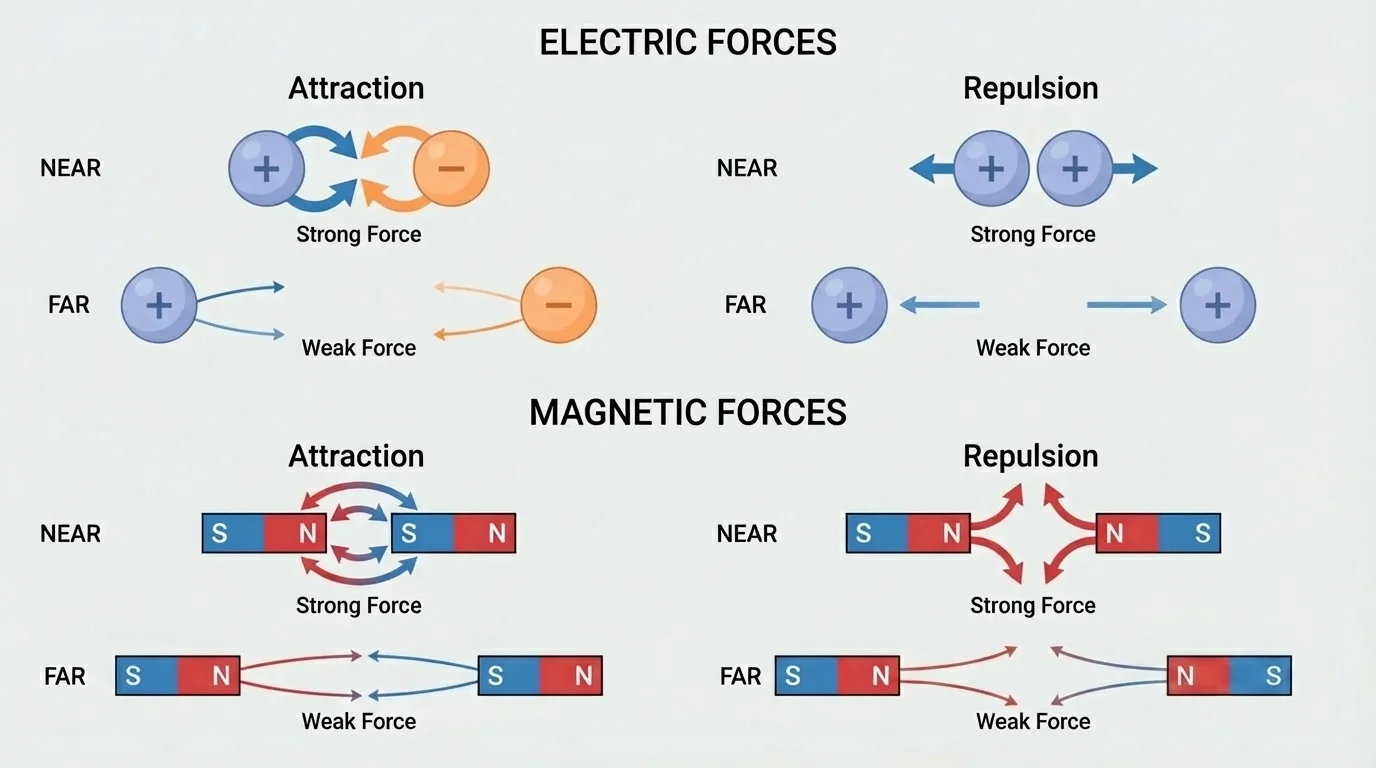
Electric force happens because of electric charge. Objects can have positive charge, negative charge, or be balanced so that charges cancel out overall. At this level, the most useful idea is this: charges can make objects pull together or push apart, as shown in [Figure 2].
If two objects have the same kind of charge, they repel, which means they push away from each other. If two objects have different kinds of charge, they attract, which means they pull toward each other.
A common example is static electricity. When you rub a balloon on your hair, tiny electric charges build up. Then the balloon may stick to a wall, or your hair may rise toward the balloon. The balloon and hair do not need to stay in contact for the electric force to act.
The electric force usually gets stronger when the charged objects are closer together. If they move farther apart, the force becomes weaker. We do not need a difficult formula to understand this. Think of it like this: when the distance changes from a near space of about \(1 \textrm{ cm}\) to a farther space of about \(10 \textrm{ cm}\), the electric pull becomes much harder to notice.
The amount of charge matters too. If an object has more charge, it can create a stronger electric force. A balloon that has picked up a lot of charge may attract more bits of paper than a balloon with only a little charge.
Electric force can also act on very tiny things. Inside matter are particles with charge, but students at this level mainly need to know that charge helps explain why some objects can pull or push without touching. Later, you will learn more about how charges are arranged inside atoms.
Example: A charged balloon and paper bits
Step 1: Rub a balloon on a sweater.
Rubbing can move charge, so the balloon becomes charged.
Step 2: Hold the balloon close to tiny paper pieces.
If the balloon is very close, such as about \(2 \textrm{ cm}\) away, the electric force may be strong enough to lift or move the paper.
Step 3: Move the balloon farther away.
At a larger distance, such as about \(20 \textrm{ cm}\), the force becomes weaker and the paper may no longer move.
This shows that electric forces can act without touching and that distance matters.
The idea from [Figure 2] also explains why some objects snap toward each other quickly when they get close enough. The force becomes easier to notice when the objects are near.
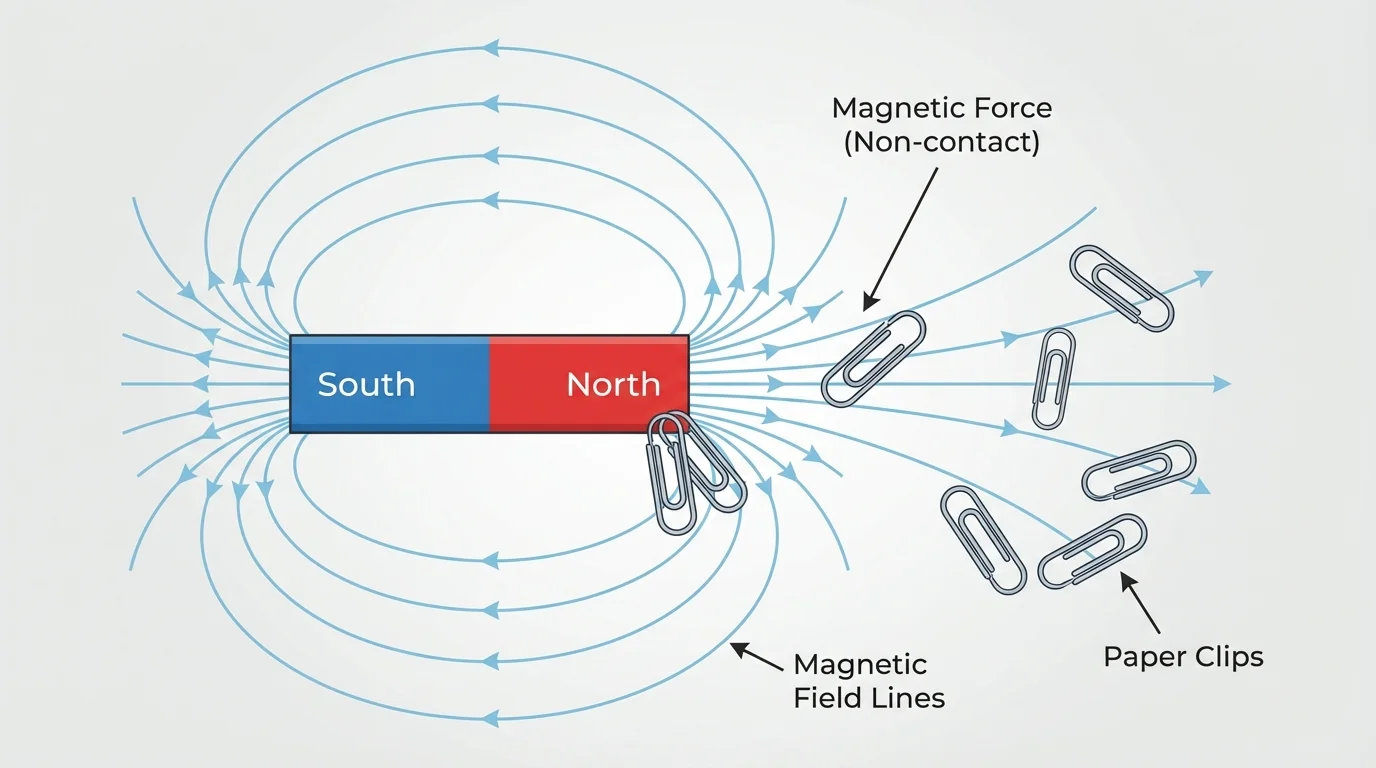
A magnet is an object that creates a magnetic force. Every magnet has two ends called poles. These poles are called north and south. A magnet can pull on certain metals, especially iron. As [Figure 3] illustrates, a bar magnet can attract paper clips even when a small gap of air is between them.
Magnetic force can work between two magnets, or between a magnet and a magnetic material such as iron or steel. This is why a refrigerator magnet sticks to a steel refrigerator door.
Like electric force, magnetic force can attract or repel. If opposite poles face each other, the magnets attract. If the same poles face each other, the magnets repel.
Magnets do not pull on every material. A magnet will not strongly attract wood, plastic, rubber, or paper by themselves. It works best with certain metals. That is why a paper clip can be picked up with a magnet, but a plastic straw cannot.
The magnetic force is stronger when the magnet is closer to the object. If a paper clip is \(1 \textrm{ cm}\) from a magnet, it may jump toward it. If the paper clip is \(15 \textrm{ cm}\) away, it may not move at all. This does not mean the force has completely vanished everywhere. It means the force at that distance is too weak to notice in that situation.
The strength of a magnet matters too. A strong magnet can pull from farther away than a weak magnet. So the size of the force depends on a property of the object itself: how magnetic it is.
Some birds, sea turtles, and other animals can sense Earth's magnetic field. This helps them travel long distances and find their way.
The poles and field pattern around a magnet help explain why the paper clips line up in chains and why iron filings form curved patterns around a magnet. The curves seen around the magnet in [Figure 3] help us picture where the magnetic force acts.
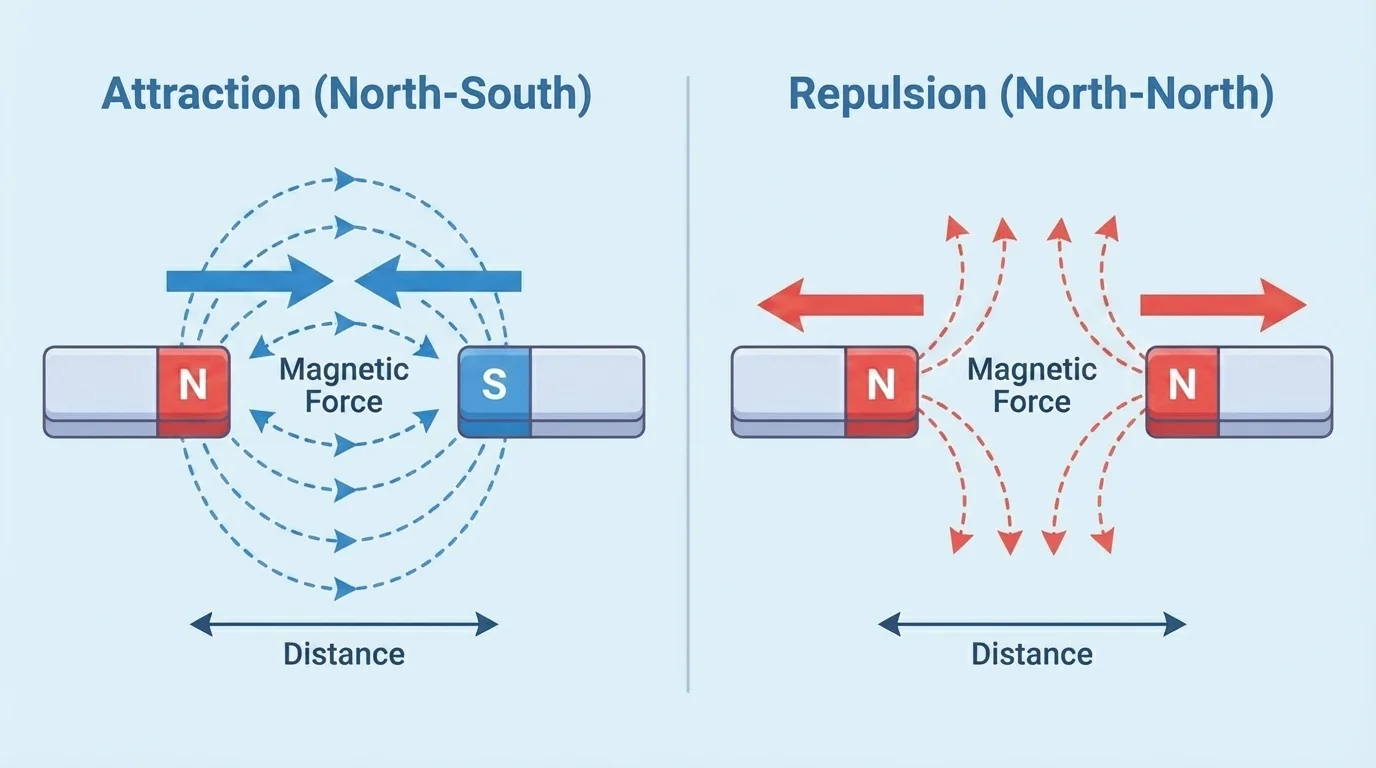
With two magnets, distance and magnet strength matter, but there is another important factor: orientation. Orientation means the way an object is turned or lined up. [Figure 4] shows that when one magnet is turned, the force can change from pulling together to pushing apart.
If the north pole of one magnet faces the south pole of another magnet, the magnets attract. If the north pole faces another north pole, the magnets repel. The same is true for south facing south. So the same two magnets can behave differently just by turning one of them around.
This is different from many everyday pushes and pulls. If you push a toy car with your hand, the result depends mostly on how hard you push. But with magnets, the direction of the poles matters a lot. Turn the magnet, and the force can change.
That is why magnets can feel tricky and surprising. A student may bring two magnets together and feel them snap together in one position, but in another position the magnets seem to refuse to touch. The magnets are not being stubborn. Their orientation has changed the force.
Why orientation matters for magnets
Each magnet has a north pole and a south pole. Opposite poles pull together, and matching poles push apart. Because of this, changing the direction of a magnet changes which poles face each other, and that changes the force.
When you use a compass, this idea matters too. The magnetized needle turns until it lines up in a certain direction. It does not point randomly. It turns because magnetic orientation changes the forces on it.
Scientists often ask, "What changes the size of the force?" For electric and magnetic forces, there are two big answers. First, the properties of the objects matter. Second, the distance apart matters. For magnets, the orientation matters too.
Properties are features of the objects. For electric forces, one important property is how much charge an object has. For magnetic forces, important properties include how strong the magnet is and whether the other object is made of a magnetic material such as iron.
Distance is the space between the objects. Usually, when the distance gets smaller, the force gets bigger. When the distance gets larger, the force gets smaller. If object A is \(2 \textrm{ cm}\) from object B and then moves to \(8 \textrm{ cm}\) away, the force becomes weaker.
| Situation | What can change the force? | What usually happens? |
|---|---|---|
| Charged balloon and paper | Amount of charge, distance | More charge or less distance makes a stronger pull |
| Magnet and paper clip | Magnet strength, distance | Stronger magnet or less distance makes a stronger pull |
| Two magnets | Magnet strength, distance, orientation | Closer magnets interact more strongly; turning them can change attraction to repulsion |
Table 1. Factors that affect the size and direction of electric and magnetic forces.
You can think of this with a simple comparison. Suppose one magnet can pull a paper clip from \(3 \textrm{ cm}\) away, but another weaker magnet must be only \(1 \textrm{ cm}\) away to do the same thing. That tells us the stronger magnet creates a larger magnetic force.
Example: Comparing distances
Step 1: A magnet is held \(2 \textrm{ cm}\) from a paper clip.
The magnetic force is strong enough to move the paper clip.
Step 2: The same magnet is moved to \(6 \textrm{ cm}\) away.
The force is weaker because the distance is greater.
Step 3: The magnet is turned so a different pole faces another magnet.
The force may change from attraction to repulsion because orientation changed.
This example shows three ideas at once: distance matters, object properties matter, and orientation matters for magnets.
The turning behavior shown earlier in [Figure 4] is the reason we must include orientation when we talk about the force between two magnets. Two identical magnets can act differently depending on how they are lined up.
Electric and magnetic forces are not just classroom ideas. They are part of many tools and machines people use every day.
Refrigerator magnets work because magnetic force pulls the magnet to the steel door. The magnet and the door do not need glue to stay attached. The force acts across a tiny gap.
Compasses work because a magnetized needle lines up with Earth's magnetic field. The needle turns until it faces a certain direction.
Scrapyard cranes can lift heavy metal objects using powerful electromagnets. An electromagnet is a magnet made using electricity. This lets workers pick up and move piles of scrap metal.
Speakers and headphones use electric currents and magnets to make parts vibrate and create sound. Music from a phone or computer depends on these forces.
Static cling in clothes and tiny shocks after walking on carpet are examples of electric force. Charges build up and then attract, repel, or suddenly move.
You already know that a force can change an object's motion. Electric and magnetic forces follow that same rule. Even without contact, they can start motion, stop motion, or change direction.
The contact and non-contact comparison from [Figure 1] helps connect these examples. A hand push, a magnetic pull, and an electric pull are all forces, but only some need touching.
You can observe these forces with simple materials. Rub a balloon on hair or wool and hold it near tiny paper pieces. Bring a magnet near paper clips. Try two bar magnets and turn one around slowly. Watch when they pull together and when they push apart.
Be careful with magnets around electronics, bank cards, and devices that can be affected by magnetic fields. Also be careful not to put small magnets in your mouth or nose, and keep them away from younger children who might swallow them.
When you investigate, change one thing at a time. For example, keep the same magnet and change only the distance: \(1 \textrm{ cm}\), \(3 \textrm{ cm}\), and \(5 \textrm{ cm}\). Or keep the distance the same and turn one magnet. This makes it easier to notice which property changes the force.
Scientists do this all the time. They compare situations carefully so they can figure out what causes a force to become stronger, weaker, attractive, or repulsive.
