A giant oak tree begins as a tiny acorn, and a buzzing butterfly starts life as a small egg. That may sound almost unbelievable, but it shows one of the most important ideas in life science: living things do not stay the same forever. They grow, change, and make new living things like themselves. Without that process, every kind of plant and animal would disappear over time.
Every organism has a lifespan. It is born, it lives, and eventually it dies. If no new organisms were made, that kind of organism would no longer exist. Reproduction is the process by which living things make new living things of the same kind. A maple tree makes more maple trees. A frog makes more frogs. A cat makes more cats.
New living things are called offspring. Offspring are not always exactly the same as their parents, but they are the same kind of organism. A puppy may not look exactly like its mother, and one sunflower may grow taller than another, yet both still belong to the same kind.
Why species continue
Reproduction does not happen only so one individual can produce offspring. It matters because it keeps a whole group of organisms going from one generation to the next. When many individuals reproduce over time, the species continues to exist on Earth.
Living things also follow patterns of growth and change. These patterns are called life cycles. A life cycle is the series of stages an organism goes through during its life. The stages may look simple in some organisms and more dramatic in others, but all organisms have a life cycle.
Some organisms begin life from an egg. Some begin inside the body of a parent. Most plants begin as seeds, while some begin from spores or from parts of another plant. Even though the starting points are different, the big idea stays the same: a new organism begins, grows, becomes an adult, and can then reproduce.
Reproduction is how living things make new organisms of the same kind.
Life cycle is the sequence of stages in an organism's life, from its beginning to its adult stage and reproduction.
Offspring are the young organisms produced by parents.
Plants and animals do not all reproduce in the same way. Some animals care for just a few babies, while others produce hundreds or even thousands of eggs. Some plants make flowers and fruits. Others make cones. Some plants can even grow a new plant from a stem or underground part. Nature uses many different ways to keep life going.
A common plant life cycle goes from seed to seed, as [Figure 1] shows. A seed contains a tiny young plant and stored food. When the seed gets the right amount of water, air, and warmth, it can begin to grow. This first stage of growth is called germination.
During germination, the seed coat opens. A root begins to grow downward into the soil, and a shoot begins to grow upward toward the light. Soon the young plant develops leaves and starts making its own food using sunlight, water, and carbon dioxide from the air.
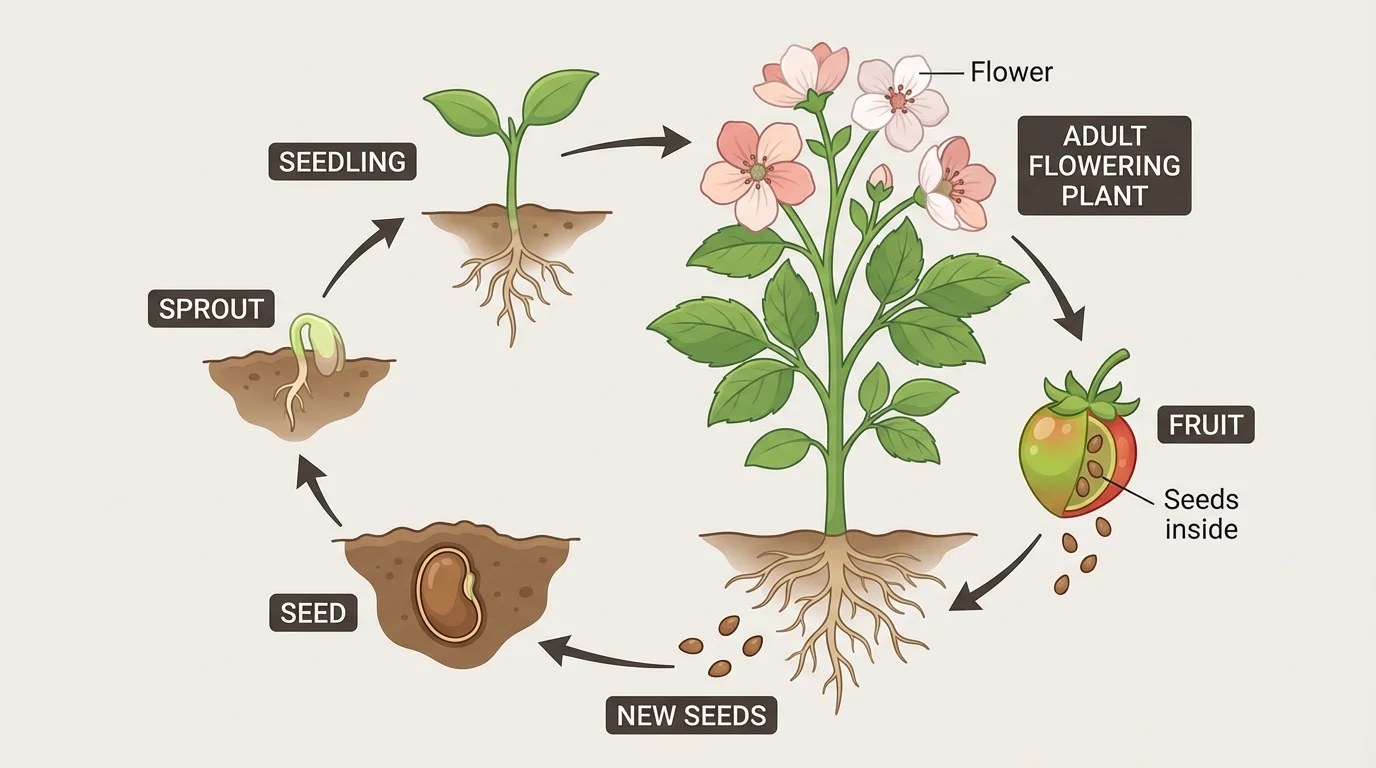
As the plant grows larger, it becomes an adult plant. In many plants, the adult stage includes flowers. Flowers are important because they help the plant reproduce. A flower can contain male parts that make pollen and female parts that contain ovules.
Pollination happens when pollen moves from one flower part to another. This can happen by wind, water, or animals such as bees, butterflies, bats, and birds. When a bee visits a flower to collect nectar, pollen may stick to its body and be carried to the next flower. That helps the plant reproduce.
After pollination, fertilization can happen. This is when the pollen joins with an ovule. Then seeds begin to form. In many flowering plants, the flower changes into a fruit that protects the seeds. Apples, tomatoes, peas, and pumpkins are all examples of fruits that hold seeds.
Those seeds need to spread out, or disperse, so new plants can grow in new places. Some seeds are carried by wind, like dandelion seeds. Some float on water, like coconut seeds. Some stick to animal fur. Others are eaten by animals and later dropped in a different place. The full cycle then begins again, just as we saw earlier in [Figure 1].
Some seeds can wait a very long time before growing. If they do not have enough water, warmth, and air, they may stay inactive until conditions improve.
Not all plants make flowers. Pine trees and other cone-bearing plants reproduce using cones. Male cones release pollen, and female cones contain the ovules that can develop into seeds. These plants still reproduce and still have life cycles, but the structures are different from flowers and fruits.
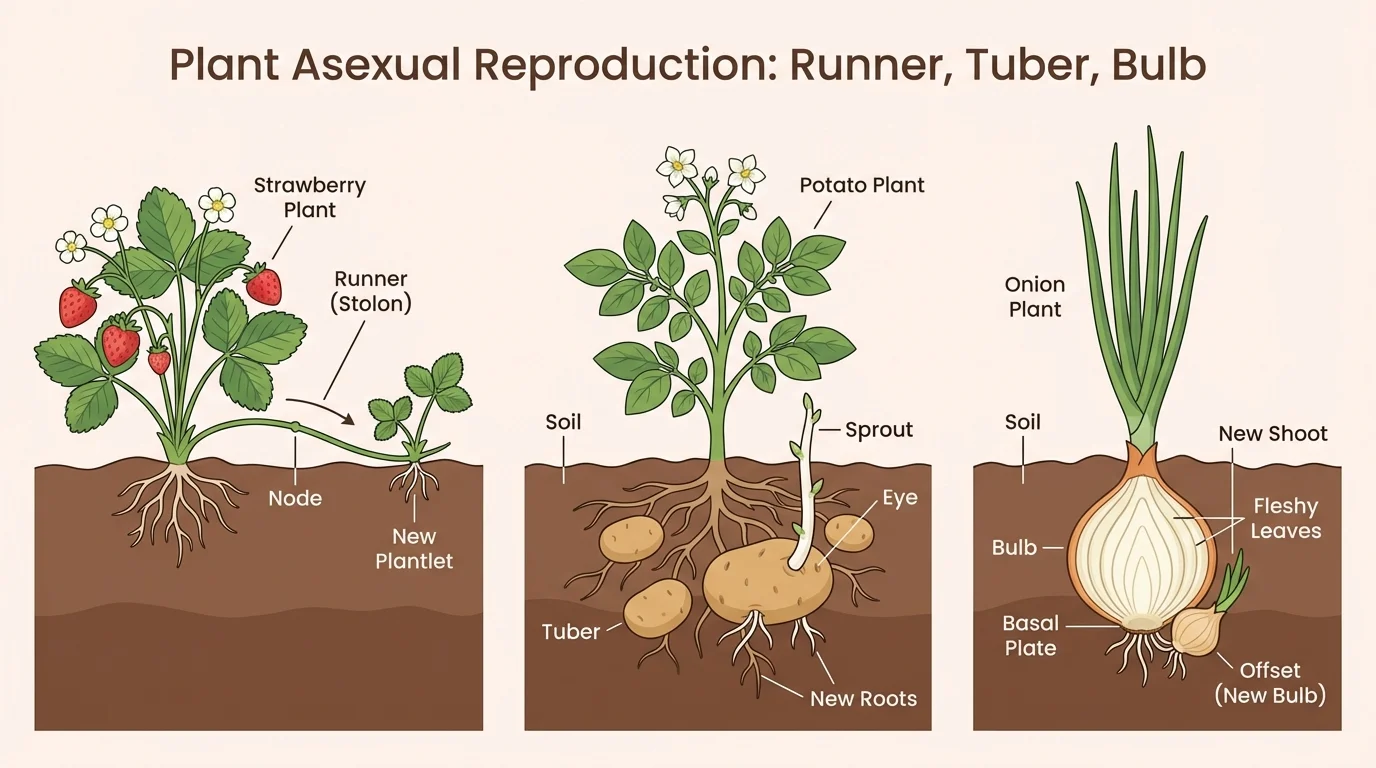
Plants do not always need seeds to make more plants. In [Figure 2], several plants reproduce by growing new plants from their own parts. This kind of reproduction creates a new plant without forming a new seed first.
Strawberry plants can send out thin stems called runners. A runner grows across the ground, and where it touches the soil, a new plant can grow. Potatoes grow from underground stems called tubers. The "eyes" on a potato can sprout into new plants. Onions grow from bulbs, which store food underground and can grow into new onion plants.
Ferns and mosses reproduce in another way. They make spores, which are tiny structures that can grow into new organisms. Spores are much smaller than seeds and do not contain stored food in the same way seeds do. Ferns often release spores from the underside of their leaves.
These different methods show that plants have diverse life cycles. A flowering bean plant, a pine tree, a fern, and a strawberry plant all reproduce, but not in exactly the same way. Their structures and stages differ, yet each life cycle leads to new plants.
Real-world example: a school garden
Step 1: Gardeners plant bean seeds in soil.
Step 2: The seeds germinate and grow into bean plants with leaves and flowers.
Step 3: Pollinators such as bees move pollen between flowers.
Step 4: Bean pods form, and the pods contain new seeds.
This is why gardens can produce more seeds for the next planting season.
People use plant reproduction every day in farming, orchards, parks, and home gardens. Farmers save seeds, plant cuttings, and care for pollinators because these living processes help grow food such as corn, apples, pumpkins, and berries.
Animals also go through life cycles, and [Figure 3] compares a few examples. Even though animals may look very different from one another, their life cycles usually include a beginning, a period of growth, an adult stage, and reproduction.
Some animals begin life in eggs. Birds, fish, most reptiles, amphibians, and insects often hatch from eggs. Other animals, such as most mammals, begin life inside the mother's body and are born alive. After birth or hatching, young animals grow and develop. They need food, water, and protection.
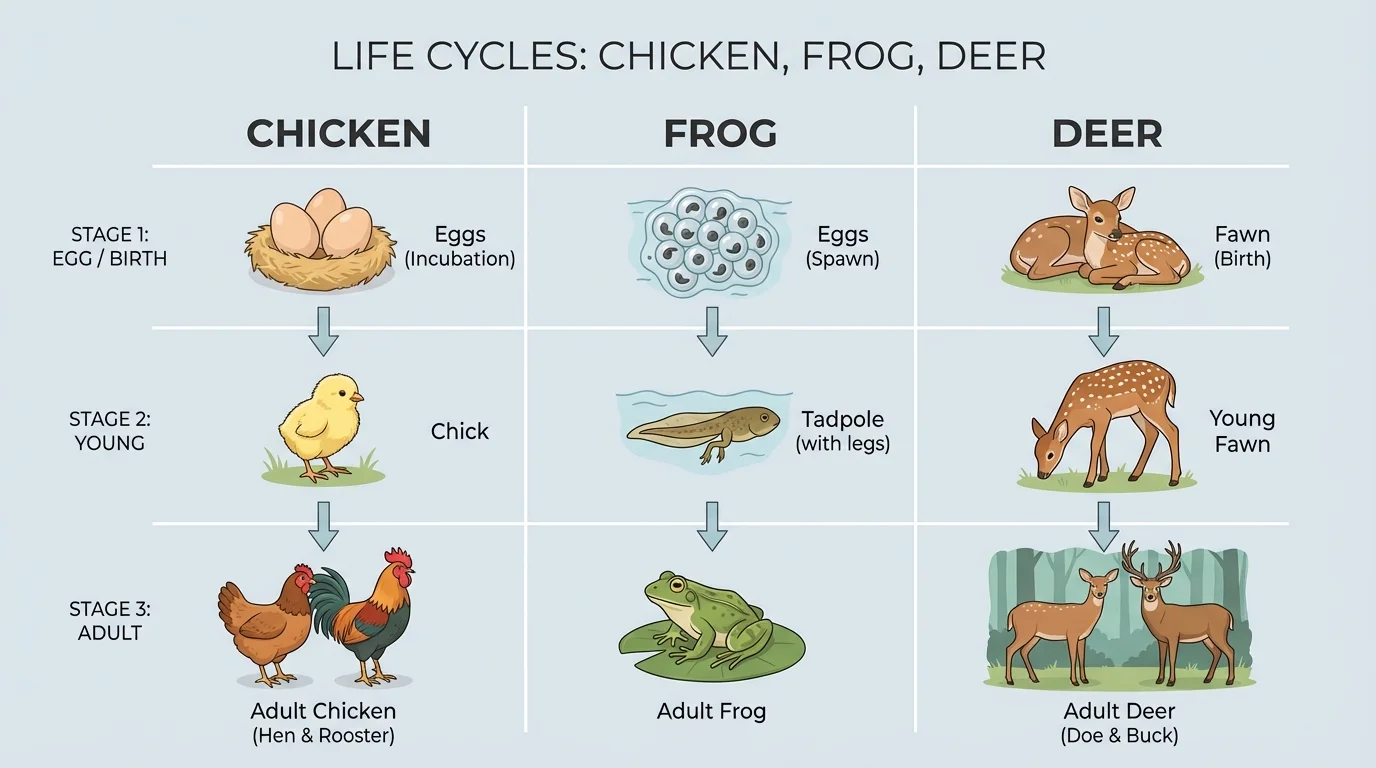
As animals grow, they may change a little or a lot. A young deer looks somewhat like a smaller adult deer. A chick hatches from an egg and grows feathers as it matures. A tadpole, however, looks very different from the adult frog it will become. No matter the pattern, the animal eventually reaches adulthood and can reproduce.
Some animal parents care for their young for a long time. Birds may build nests, sit on eggs, and bring food to chicks. Mammals often feed milk to their babies and protect them. Other animals provide little or no care after laying eggs. For example, many fish lay eggs in water and do not stay to raise the young.
Mammals such as dogs, whales, elephants, and humans are animals that usually give birth to live young. The babies drink milk from their mothers. Mammal young often spend a long time growing and learning.
Amphibians such as frogs usually begin life in water as eggs. Their young often look very different from the adults. Reptiles such as turtles and snakes usually hatch from eggs laid on land. Birds hatch from eggs and are covered with downy feathers when young. Fish hatch from eggs in water and breathe with gills.
Insects have some of the most varied life cycles of all. A grasshopper hatches from an egg and looks like a small wingless adult. A butterfly, on the other hand, changes completely as it grows.
| Animal group | How life often begins | Young form | Special note |
|---|---|---|---|
| Mammals | Born alive | Looks somewhat like adult | Young drink milk |
| Birds | Egg | Chick | Parents often care for young |
| Fish | Egg | Larva or young fish | Usually live in water |
| Amphibians | Egg | Tadpole or larva | Major body changes may happen |
| Insects | Egg | Nymph or larva | Some go through metamorphosis |
Table 1. Comparison of common animal life cycle patterns in several groups.
These patterns show that a life cycle is not one single path for all animals. Instead, the same basic purpose appears in many forms: begin life, grow, become adult, and reproduce.
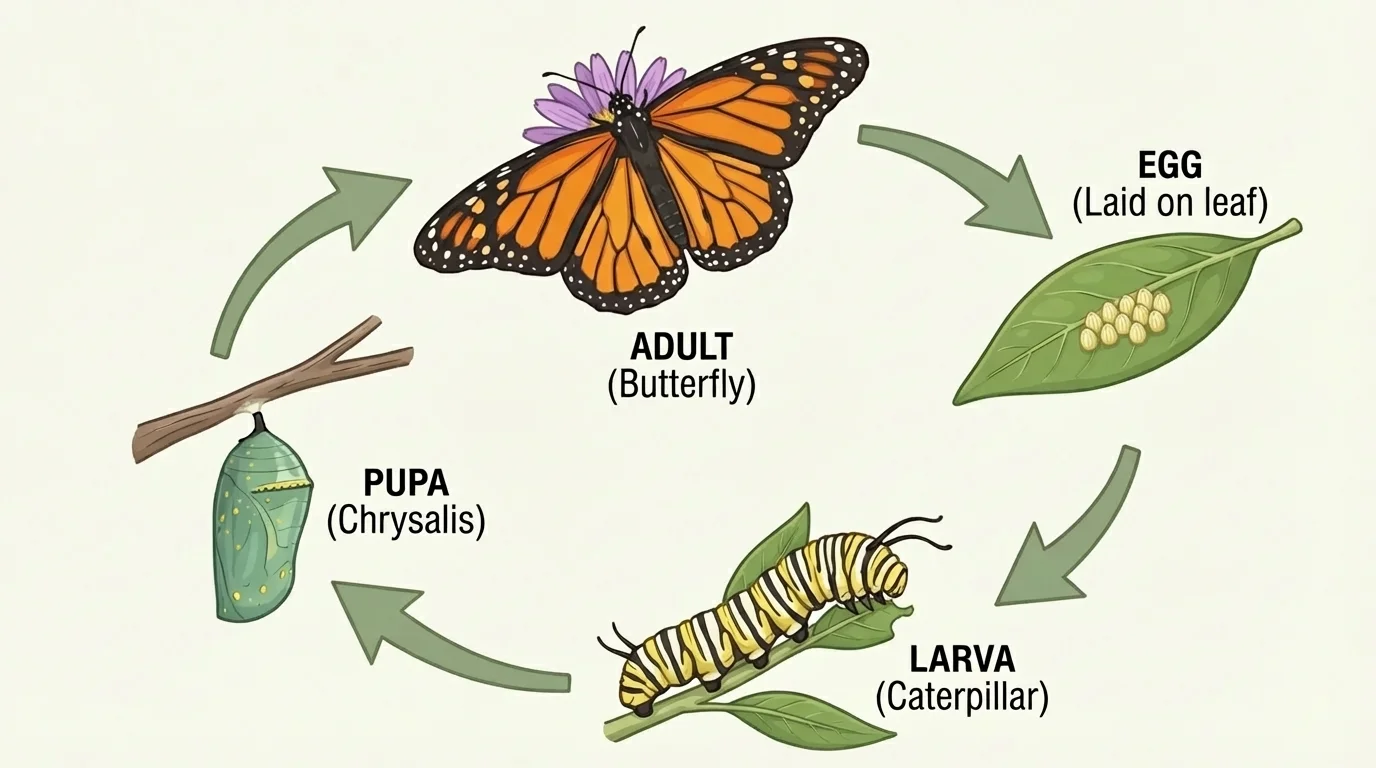
Some animals go through metamorphosis, a major change in body form during the life cycle. [Figure 4] shows a butterfly life cycle, which is one of the best-known examples.
A butterfly begins as an egg. It hatches into a larva called a caterpillar. The caterpillar eats and grows quickly. Next it forms a chrysalis, also called a pupa. Inside, its body changes greatly. Finally, an adult butterfly emerges. The adult can reproduce and lay eggs, starting the cycle again.
Frogs also go through major changes. A frog begins as an egg in water. It hatches into a tadpole with a tail and gills. Later, it grows legs, develops lungs, loses its tail, and becomes an adult frog. The young and adult live in different ways and often eat different foods.
Metamorphosis can help reduce competition between young and adults. For example, caterpillars eat leaves, while adult butterflies sip nectar from flowers. Tadpoles and adult frogs also use different body structures. This means that different stages of the same organism may survive by using the environment in different ways.
The dramatic changes in butterfly development remain a helpful example later when we compare simple and complex life cycles, as [Figure 4] makes clear.
All living things need energy and materials to grow. During every life cycle stage, organisms need resources from their environment such as food, water, air, space, and often sunlight.
Even when life cycles look very different, they all involve growth and development. A seedling becoming a flowering plant and a caterpillar becoming a butterfly are both examples of living things changing over time.
Different reproduction strategies help organisms survive in different environments. Some plants make huge numbers of seeds because many seeds will not grow. Some animals lay hundreds of eggs because only a few may survive to adulthood. Other organisms make fewer offspring but spend more time protecting them.
A dandelion uses wind to carry many seeds far away. An oak tree makes acorns with stored food for the young plant. A bird may lay only a few eggs but guard them in a nest. A sea turtle lays many eggs on a beach and then leaves them. These are different strategies, but each can help continue the species.
Structure and function in reproduction
The parts of plants and animals are shaped for the jobs they do. Flowers attract pollinators, fruits protect seeds, eggs protect developing young, and body changes during growth help organisms live in their habitats. Reproduction depends on these structures working well.
Life cycles are closely tied to seasons and habitats. Many flowers bloom in spring when pollinators are active. Frogs lay eggs when ponds are available. Birds often nest when food is plentiful. These patterns show how living things interact with their environment while reproducing.
People depend on plant reproduction for much of the food they eat. Farmers grow crops from seeds, fruit trees make new fruit after pollination, and gardeners often use bulbs, cuttings, or tubers to grow plants. Bees and other pollinators are especially important because they help many crop plants reproduce.
Understanding animal life cycles also matters. Fish populations can shrink if too many adults are caught before they reproduce. Frog eggs can be harmed if wetlands are polluted. Protecting habitats helps animals complete their life cycles and produce offspring of their own.
Some bamboo plants grow for many years before flowering, and then they produce seeds all at once. Life cycles can be short, long, simple, or very unusual.
Scientists, farmers, veterinarians, park rangers, and conservation workers all use knowledge of reproduction and life cycles. They study when seeds sprout, when insects hatch, when birds nest, and how animals raise young. This helps people grow food, care for ecosystems, and protect living things.
When you look at a fruit, a seed, an egg, a nest, or a tiny sprout in the soil, you are seeing part of a life cycle. That small stage is connected to what came before and what comes next. Reproduction keeps the story of life moving forward, generation after generation.
