A baseball flies off a bat, a drum makes the air shake, and a lamp brightens a dark room. These may seem like very different events, but they are connected by one big idea: energy. Energy is all around us. We know it is present whenever something moves, makes sound, gives off light, or feels warm.
Energy is the ability to make things happen or change. We cannot usually see energy by itself, but we can see what it does. A toy car rolls across the floor. A flashlight shines. Soup on the stove gets hotter. In each case, energy is causing a change.
Scientists talk about energy in different forms of energy. For students your age, some important forms are energy in moving objects, energy in sound, energy in light, and energy in heat. These forms can move from one object to another, and they can change from one form into another.
Energy is the ability to cause change.
Motion means movement from one place to another.
Collision is an event in which two objects hit each other.
One important thing to remember is that when energy is transferred, something changes. An object may speed up, slow down, stop, change direction, get warmer, or make a sound. Watching these changes helps us understand where the energy is going.
A moving object has kinetic energy, which is energy due to motion. A rolling marble, a running dog, a falling apple, and a bicycle going down a hill all have kinetic energy. When a moving object hits another object, it can pass some of that energy along, as [Figure 1] shows with one moving ball causing another ball to move.
The amount of kinetic energy depends on how fast an object is moving and how much matter it has. You do not need a complicated formula to understand the idea: a faster object usually has more kinetic energy than the same object moving slowly, and a heavier object usually has more kinetic energy than a lighter one moving at the same speed. That is why a fast soccer ball can push a ball farther than a slow tap can.
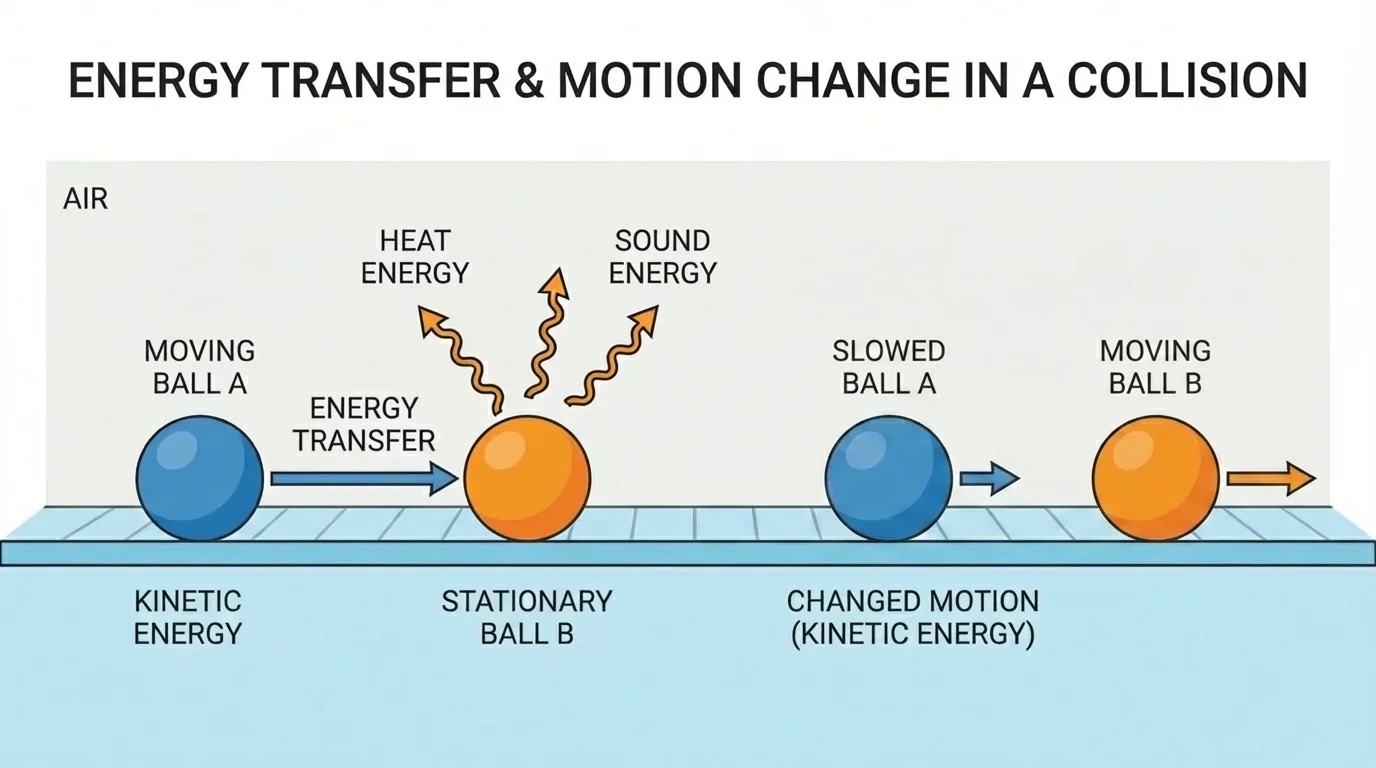
Think about bowling. A bowling ball rolls down the lane and crashes into the pins. The ball has kinetic energy because it is moving. When it collides with the pins, some of its energy is transferred to them. The pins begin to move, tip over, and slide. Their motion changes because energy moved from the ball to the pins.
The same thing happens in smaller ways too. If you gently push one toy car into another, the second car starts moving. The first car may slow down, and the second car speeds up. That change in motion tells you that energy was transferred during the collision.
Energy is not only in moving objects. It is also present in sound energy, light energy, and thermal energy. A lamp gives off light energy and often heat too. A drum makes sound energy when its surface vibrates. A campfire gives off light and lots of heat. These familiar examples help show, as [Figure 2] illustrates, that energy can appear in several forms at once.
Sound energy travels through materials such as air because something vibrates. When you clap your hands, your hands strike each other and make the air vibrate. Those vibrations travel to your ears, and you hear a clap. Light energy helps us see. The Sun, light bulbs, and glowing screens all give off light energy. Heat, or thermal energy, is related to how warm something is. A mug of hot cocoa has more thermal energy than a mug of cooler cocoa.
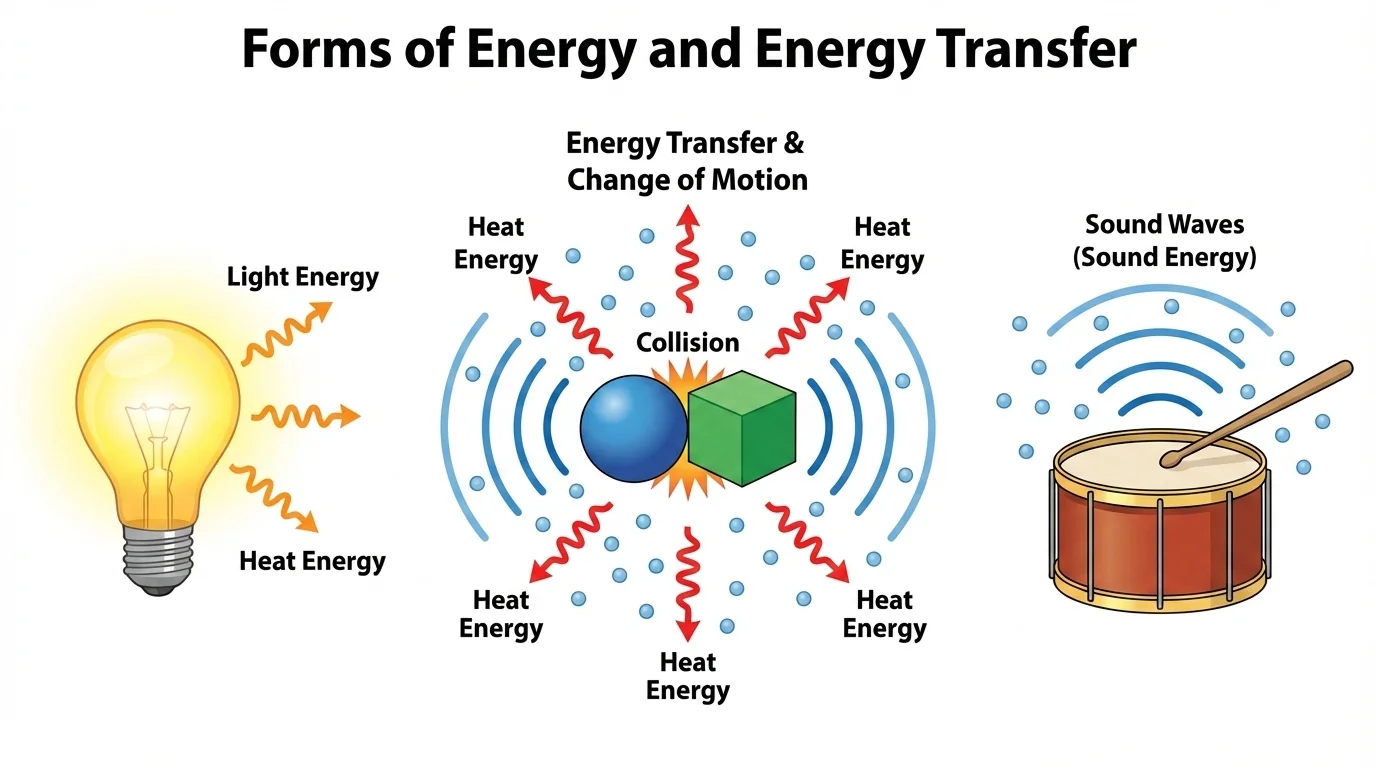
Sometimes one source gives more than one kind of energy. A candle gives off light and heat. A toaster uses electrical energy to make heat. Fireworks produce light, sound, heat, and moving pieces. Looking for more than one form of energy is a smart way to understand what is happening in the world around you.
Lightning and thunder happen from the same event. Lightning is energy we notice as light, and thunder is energy we notice as sound.
Even when you cannot see motion clearly, tiny motions may still be happening. For example, sound comes from vibrations, which are back-and-forth motions. Heat also involves tiny particles moving and bumping into one another faster when something gets warmer.
A energy transfer happens when energy moves from one object or place to another. In a collision, one object can transfer energy to another object, and this often changes how both objects move. A bat hits a baseball, and the ball shoots away. A skateboard strikes a curb and stops. A bumper car bangs into another bumper car, and both cars change speed or direction. Some of the energy also spreads into the surroundings, as [Figure 3] shows.
When objects collide, several things may happen. One object may start moving. Another may stop moving. Both may move apart in new directions. One may bounce. One may bend or change shape a little. These changes all tell us that energy has been transferred.
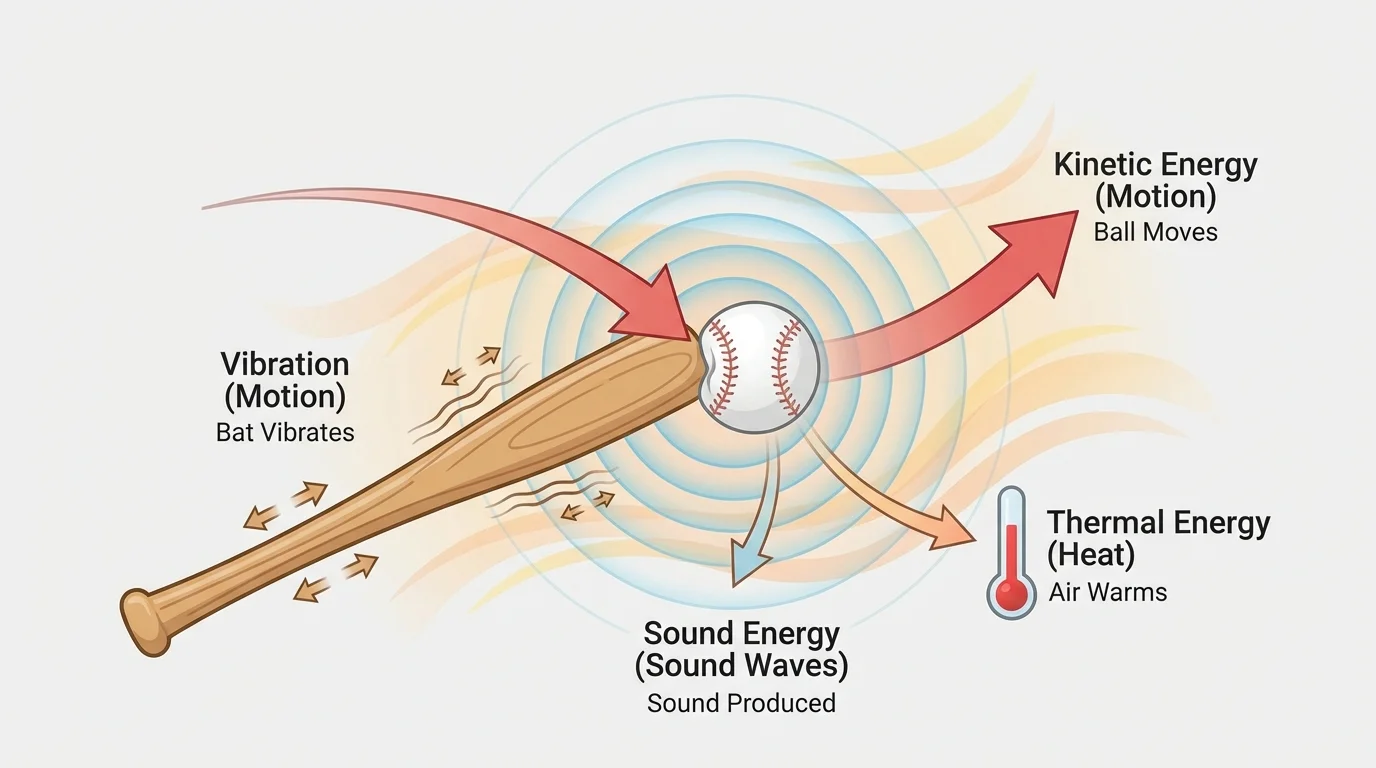
Imagine a rolling playground ball hitting a wall. Before the collision, the ball is moving and has kinetic energy. When it hits the wall, the ball changes motion. It may stop, bounce back, or slow down. The wall may not seem to move, but the collision still causes changes. Some energy goes into the wall, some stays with the ball, some goes into the air as sound, and some becomes heat.
Not every collision is exactly the same. A soft foam ball and a hard rubber ball behave differently. A hard surface and a soft surface behave differently too. If you drop a rubber ball on concrete, it may bounce high. If you drop it on thick carpet, it may not bounce as much. The energy is still being transferred, but the path it takes is different.
This is one of the most interesting parts of collisions: not all of the energy stays in the moving objects. Some energy is usually transferred to the surrounding air. When that happens, the air gets warmed a little, and sound is produced. That is why collisions often make noise.
When two objects hit, they can vibrate. Those vibrations shake the air nearby. The shaking travels outward as sound waves. Your ears detect those waves, and you hear the crash, thump, clap, or bang. The louder the sound, the more energy is usually transferred into vibrations in the air.
Why sound and warming happen together
During a collision, energy can spread into several places at once. Some changes the motion of objects. Some makes the objects and nearby air vibrate, producing sound. Some turns into thermal energy, so the air or the objects become slightly warmer. Even if the warming is too small to feel, it is still part of the energy transfer.
Rubbing your hands together is a good clue for understanding this idea. Your hands move, then friction between them changes some of that energy into heat. If you rub quickly, your hands feel warmer. A collision is not exactly the same as rubbing, but both can change motion energy into heat and sound.
Even a tiny tap on a desk transfers energy to the air. You hear the tap because the desk and the air vibrate. If the tap is stronger, the sound is louder. That means more energy is being transferred into those vibrations.
Sports are full of energy transfers. In soccer, a foot collides with a ball. Energy moves from the player's moving leg to the ball, and the ball speeds away. In baseball, the bat collides with the ball. In hockey, the stick collides with the puck. In each case, the moving object transfers energy and changes the motion of another object.
Music also depends on energy transfer. A drummer hits a drum. The drum surface begins to vibrate, and the air carries sound to the audience. A guitarist plucks a string. The string vibrates, the guitar body vibrates, and the air vibrates too. What you hear is sound energy moving through the air.
Example: Rolling marbles
Suppose one marble is rolling and hits a marble that is standing still.
Step 1: Start with the moving marble.
The rolling marble has kinetic energy because it is moving.
Step 2: Watch the collision.
When the first marble hits the second, energy is transferred.
Step 3: Notice the changes.
The second marble may begin to move, and the first marble may slow down or stop.
Step 4: Look for other energy transfers.
You may hear a clicking sound. That means some energy also moved into the air as sound.
The collision changes motion because energy moves from one marble to another and also into the surroundings.
Clapping hands is another great example. Your hands move toward each other, so they have kinetic energy. When they collide, your hands stop or slow. At the same time, the collision makes a sound because the air vibrates. Your hands may also feel a tiny bit warmer after many claps because some energy turns into heat.
Long after we first saw the rolling-ball idea in [Figure 1], the same pattern still helps us: a moving object transfers energy, and another object's motion changes. This idea works for marbles, toy cars, bowling balls, and many collisions involving sports equipment.
Sometimes students wonder, "If energy goes into moving the second object, why is there also sound and heat?" The answer is that energy can be split into different paths. One part changes motion. Another part makes vibrations. Another part warms objects and nearby air.
Think of a bouncing basketball. You hear it hit the floor, so some energy has gone into sound. The ball and floor also press on each other and change shape slightly for a moment. That tiny squish and rebound can also lead to warming. Because some energy goes into sound and heat, the ball usually does not bounce back to exactly the same height each time.
The lamp and drum example in [Figure 2] reminds us that more than one form of energy can appear together. In collisions, motion, sound, and heat are often linked in the same event.
You already know that warmer objects feel different from cooler ones and that loud sounds come from strong vibrations. Those earlier ideas help explain what collisions do with energy.
Scientists often use the word vibration for the quick back-and-forth motion that produces sound. If you pluck a ruler sticking off the edge of a desk, it vibrates. If you tap a metal pan, it vibrates. In many collisions, objects vibrate for a short time, and that vibration pushes on the air around them.
You can notice energy transfer in simple, safe ways. Roll a ball gently into another ball and watch how the second ball starts moving. Tap a spoon lightly on a cup and listen to the sound. Rub your hands together and feel them warm up. These observations help connect big science ideas to small everyday events.
If you compare a soft object and a hard object, you may notice different sounds and different motions. For example, dropping a tennis ball and a beanbag from the same height gives different results. The tennis ball bounces more. The beanbag usually does not bounce much. Different materials transfer energy in different ways.
Example: Dropping a rubber ball
A rubber ball is dropped onto the floor.
Step 1: Before the collision.
The ball is moving downward, so it has kinetic energy.
Step 2: During the collision.
The floor pushes on the ball, and the ball pushes on the floor.
Step 3: After the collision.
The ball may bounce upward, showing that some energy changed its motion again.
Step 4: Notice other effects.
You hear a bounce sound, and a tiny amount of energy warms the ball, floor, and nearby air.
The energy does not disappear. It is transferred in several ways.
The bat-and-ball collision in [Figure 3] shows this clearly: one event can send energy into motion, sound, vibrations, and a little heating all at once.
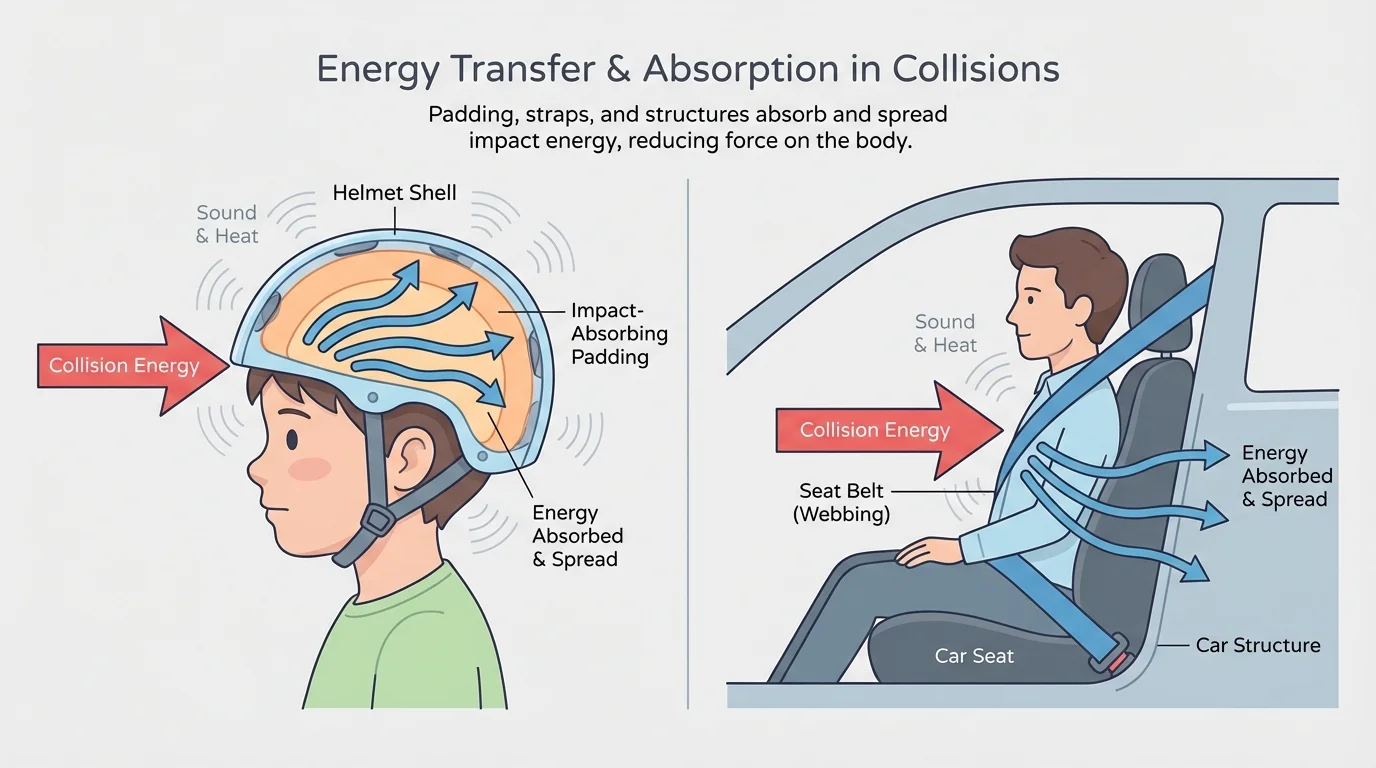
Understanding energy transfer helps explain why safety equipment is so important. Helmets, knee pads, car seat belts, and airbags all help manage what happens during collisions. They spread out the energy transfer so the body is better protected, as [Figure 4] illustrates.
A helmet does not stop energy from being involved. Instead, it helps absorb and spread the energy so your head is less likely to be hurt. A seat belt helps your body slow down more safely during a car stop. Soft landing mats in gyms do something similar. They reduce how strong the collision feels by changing how energy is transferred.
Engineers think about these ideas when designing playground surfaces, sports gear, and vehicles. Musicians think about them when choosing materials for instruments that create the right sounds. Athletes use them when deciding how hard to kick, throw, or hit a ball.
Protective gear in [Figure 4] also connects back to the earlier collision examples. The goal is not to get rid of energy, but to control where it goes and how it affects motion, sound, and heating.
Energy is one of the biggest ideas in science because it connects so many things. When objects move, collide, make sound, shine light, or become warmer, energy is involved. Watching how things change helps us trace where the energy goes.
