A soccer ball flies across a field, hits a player's foot, and suddenly moves in a new direction. A skateboard bumps a curb and stops. A bowling ball crashes into pins and sends them sliding. These moments seem fast, but something important is happening each time: when objects touch, they push on each other, transfer energy, and change motion.
A collision happens when two objects touch and interact. A collision can be a crash, a bump, a kick, a hit, or even a gentle tap. Some collisions are loud and dramatic, like two bumper cars meeting. Others are quiet, like a marble rolling into another marble.
During a collision, each object exerts a contact force on the other. A contact force is a push or pull that happens only when objects are touching. That force can make an object start moving, stop moving, speed up, slow down, or change direction.
Not every collision breaks things. Sometimes objects bounce apart. Sometimes they stick together. Sometimes one object barely changes while the other changes a lot. What they all have in common is that touching objects can transfer energy and change motion.
Collision means two objects touch and push on each other.
Contact force is a push or pull that happens only when objects are touching.
Energy transfer means energy moves from one object to another or changes form.
To understand collisions, it helps to remember that moving objects carry energy. The faster an object moves, the more energy of motion it usually has. A rolling bowling ball can do more to move pins than a slowly rolling ping-pong ball because it has more energy to transfer.
Motion means a change in position over time. If a toy car moves from one place to another, it is in motion. If it is sitting still, it is not in motion at that moment.
When a force acts on an object, it can change the object's motion. A kick can start a ball moving. A glove can stop a baseball. A wall can send a bouncing ball back the other way. In each case, the force acts during contact.
Scientists use the word energy for the ability to cause change. Energy can be stored, transferred, and changed from one form into another. The energy of motion is called kinetic energy. For this lesson, the big idea is simple: when objects collide, contact forces transfer energy so the objects' motions change.
Remember that a push and a pull are both forces. Also remember that an object does not always keep doing the same thing if a force acts on it. A force can change speed, direction, or both.
You do not need a complicated formula to understand the main idea, but it is useful to know that kinetic energy depends on how much mass an object has and how fast it moves:
\[KE = \frac{1}{2}mv^2\]
Here, mass tells how much matter is in the object, and speed tells how fast it moves. For example, if a toy car has mass \(m = 2\) units and speed \(v = 3\) units, then its kinetic energy is \(KE = \dfrac{1}{2} \cdot 2 \cdot 3^2 = 9\) units. You do not need to memorize this formula, but it helps show why faster-moving objects can cause bigger motion changes in collisions.
One collision can cause many kinds of changes, as [Figure 1] illustrates with two balls meeting and then moving differently. An object may speed up, slow down, stop, start moving, or turn in a new direction. Sometimes both objects change. Sometimes one changes more than the other.
Suppose a rolling marble hits a marble that is standing still. After the collision, the first marble may slow down while the second starts moving. Energy has been transferred from the first marble to the second through contact forces.
A collision can also change direction. When a basketball hits the floor, the floor pushes back on the ball. That push changes the ball's downward motion into upward motion, so the ball bounces.
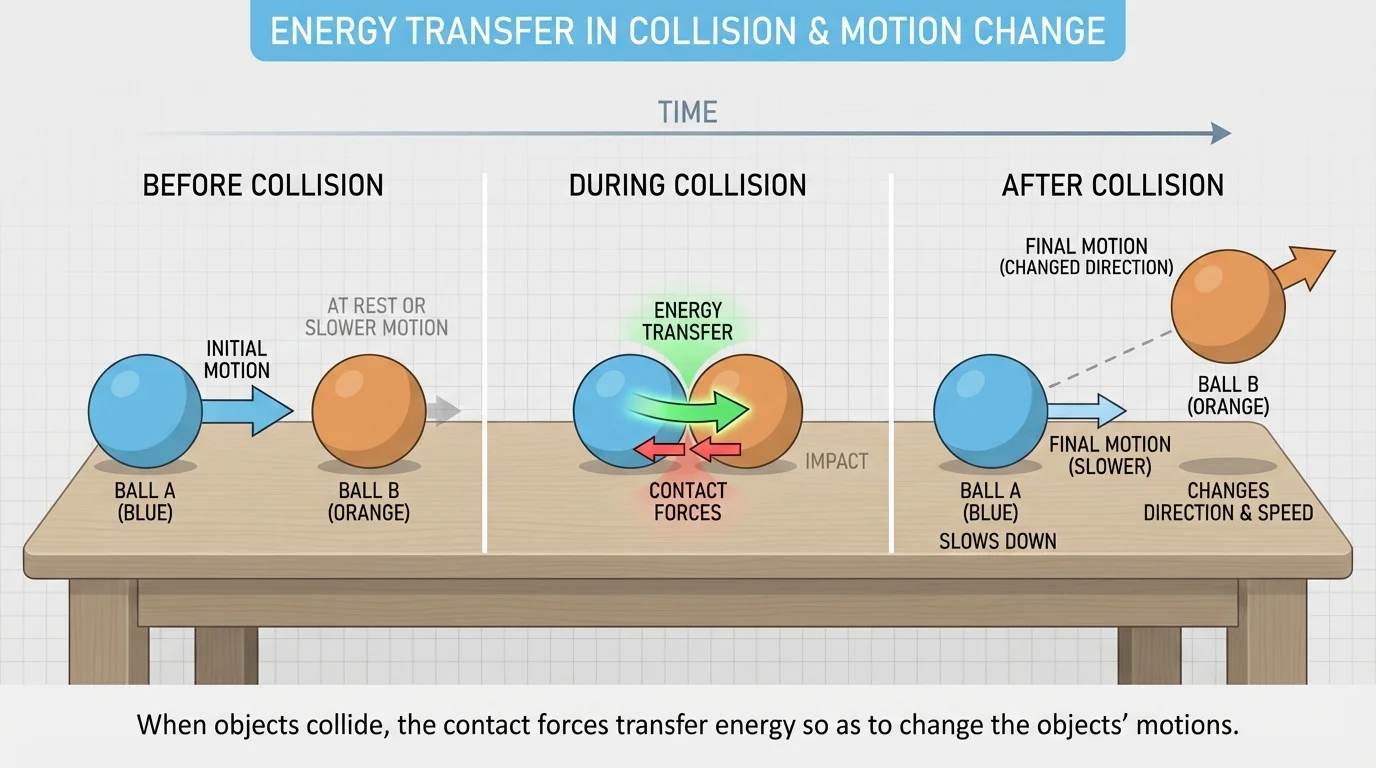
Sometimes a collision stops motion. If you catch a tossed beanbag, your hands exert a force on the beanbag and bring it to rest. The beanbag's energy of motion does not simply vanish. Some of it is transferred to your hands and arms, some becomes a tiny bit of heat, and some may become sound.
At other times, a collision starts motion. A cue stick hits a pool ball. Before contact, the ball is still. During contact, the stick pushes on the ball and transfers energy to it. After contact, the ball rolls away.
Changes in motion can be compared in a simple table.
| Collision example | What contact force does | Change in motion |
|---|---|---|
| Foot kicks soccer ball | Pushes the ball | Ball speeds up and changes direction |
| Glove catches baseball | Stops the ball | Ball slows to zero |
| Ball hits wall | Pushes ball backward | Ball changes direction |
| Moving cart hits still cart | Transfers energy to second cart | First cart slows, second cart moves |
Table 1. Examples of how contact forces during collisions change motion.
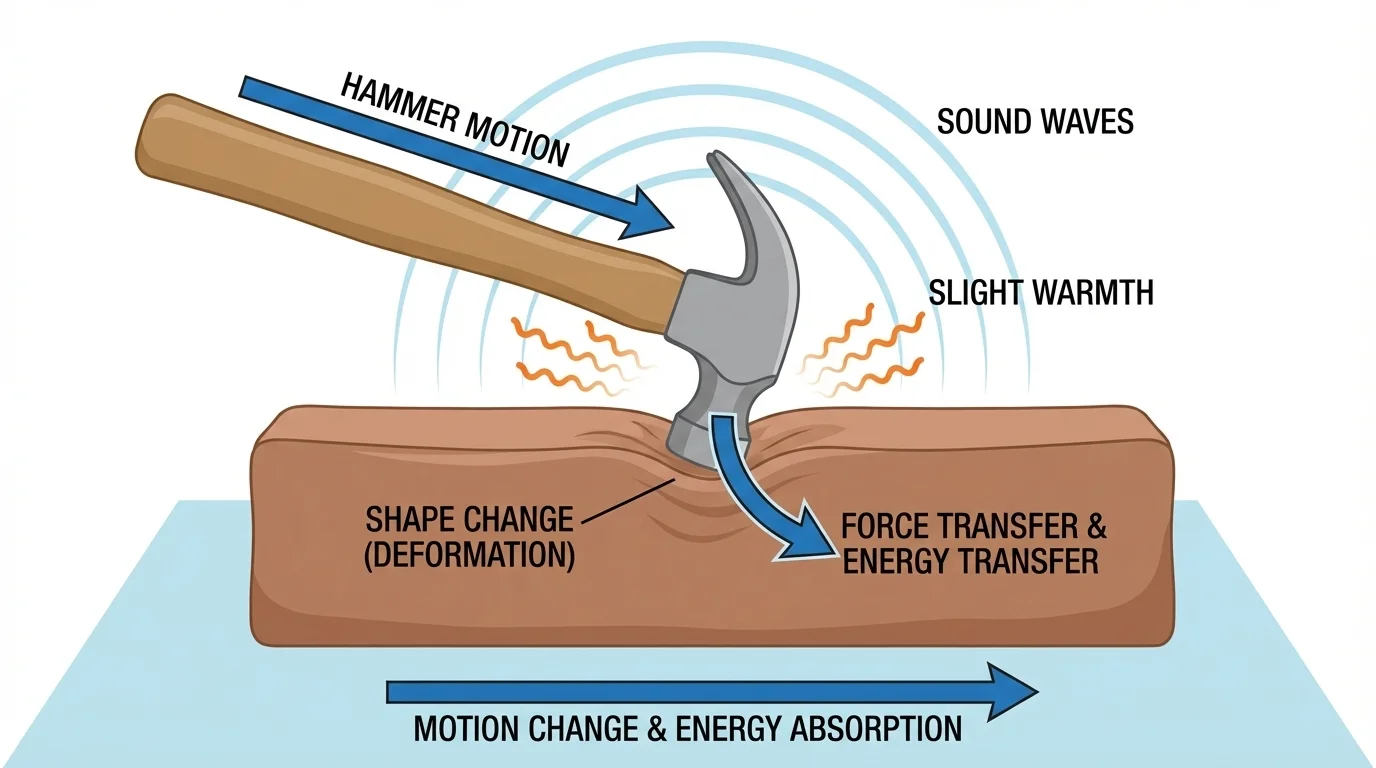
Energy transferred in a collision does not always stay only as motion. As [Figure 2] shows with a hammer striking soft clay, transferred energy can spread into several results at once: motion, sound, heat, and changes in shape.
Think about clapping your hands. Your moving hands collide. After the collision, your hands stop, but you hear a sound. Some energy has been transferred into sound. Your hands may also feel a little warmer, which means some energy has become heat.
Now think about dropping a lump of clay on the floor. The clay may not bounce much, but it changes shape. During the collision, energy is transferred into bending and flattening the clay. That is why not all collisions look bouncy.
A rubber ball and a lump of clay can hit the same floor in very different ways. The rubber ball stores some energy during the squish and then gives much of it back as motion, so it bounces. The clay does not give much of that energy back as motion, so it stays squashed.
Energy does not disappear in a collision. It moves from one object to another and can also change form. A moving object may transfer energy into another object's motion, into sound you hear, into heat you feel, or into changes in shape you can see.
This idea matters when we look again at the beanbag and the basketball. The beanbag does not bounce much because more of its energy goes into sound, heat, and shape changes. The basketball bounces because more of its energy returns to motion after the brief squish.
We can describe energy transfer in a simple way. If a ball starts with \(10\) energy units and after the collision \(6\) units are still in motion, then \(10 - 6 = 4\) units have gone into other forms such as sound, heat, or shape change. This is not a unit you need to measure in class every time, but it shows how scientists keep track of energy.
[Figure 3] Safety gear works because changing how a collision happens can change how harmful it is. Helmets, knee pads, airbags, and playground surfaces do not stop collisions from happening. Instead, they help spread out the force and increase the stopping time so the collision is less damaging.
Drop an egg onto a hard floor and it cracks easily. Drop a similar egg onto a thick pillow from the same height, and it is more likely to stay whole. In both cases, the egg collides, but the pillow squishes and gives the egg more time and distance to stop.
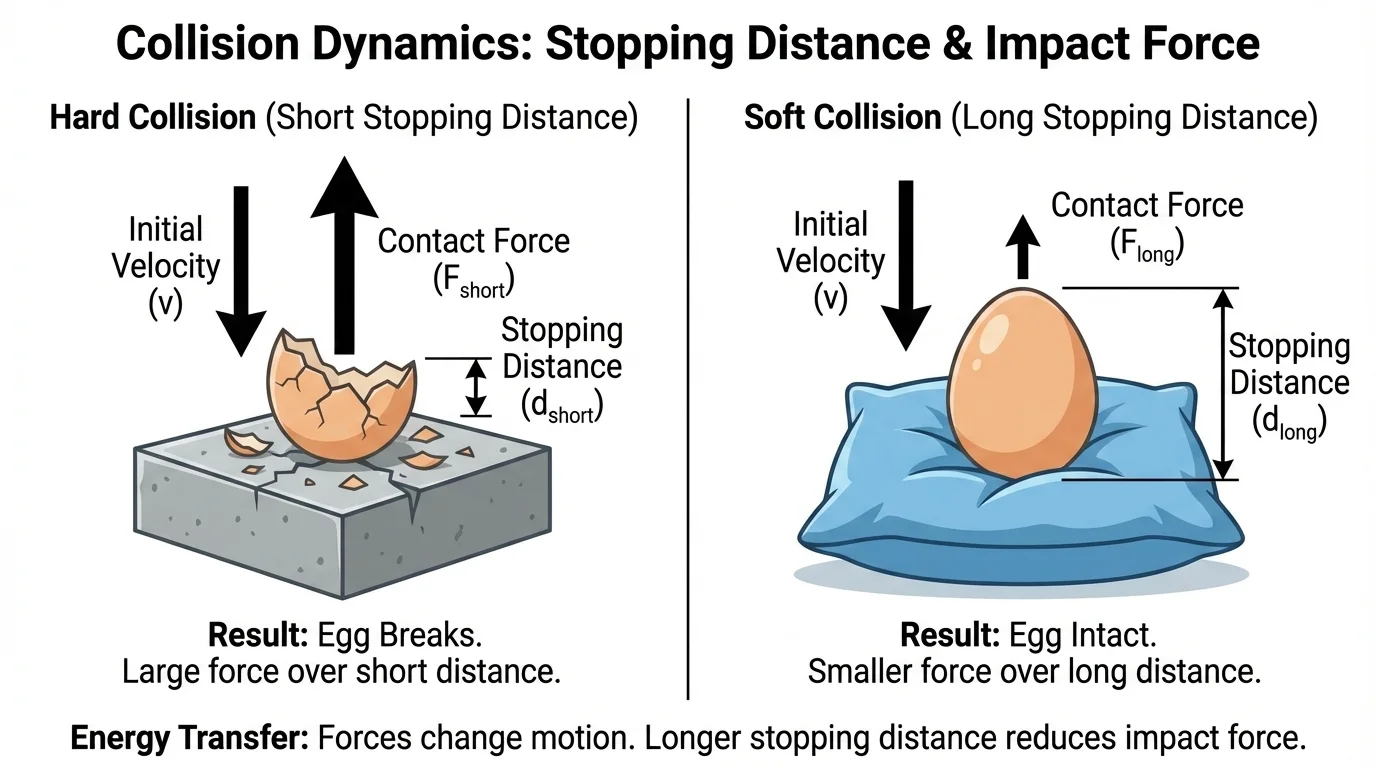
This is why catching a ball by moving your hands backward feels easier than holding your hands stiff. Your hands still stop the ball, but the stopping happens more gently. The same idea helps gym mats protect athletes and helps car seats protect passengers.
When engineers design cars, bikes, helmets, and sports gear, they think carefully about collisions. They choose materials that bend, squash, or cushion in useful ways. Those materials transfer energy while helping reduce injury.
Woodpeckers peck trees again and again without getting hurt the way a human would. Their skulls and neck structures help manage the forces from those repeated collisions.
The lesson from safety design is powerful: collisions are not only about motion changing. They are also about where energy goes and how forces are spread out over time.
[Figure 4] Not all collisions have the same ending. Objects may bounce apart, stick together, or one may push the other away while both continue moving.
When two marbles collide, they often bounce apart. When two lumps of wet clay collide, they may stick together. When a moving toy car hits a still toy car, the first may slow down and the second may roll away.
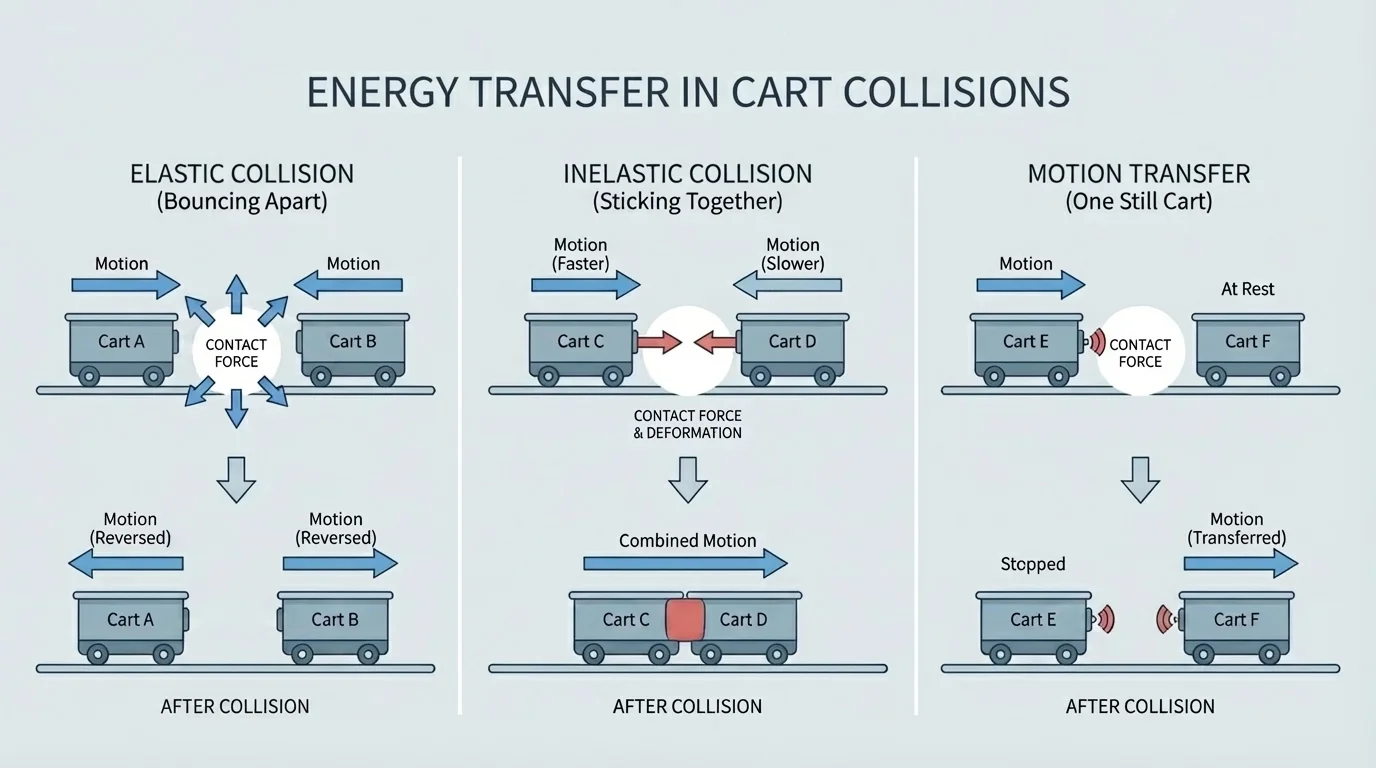
These different results depend on things like the materials, the speeds, the masses, and the shapes of the objects. Smooth, springy materials often bounce better. Soft, sticky materials often do not.
A bowling ball and a bowling pin show a strong motion transfer. The ball hits the pin, and the pin moves quickly. As we saw earlier in [Figure 1], one object can lose some motion while another gains motion during contact.
Even rolling objects are part of this story. If a rolling can bumps another can, the contact forces between them transfer energy. One can may slow while the other starts rolling. The touch lasts only a short time, but the change can be easy to see.
Sports are full of collisions. A bat hits a baseball. A tennis racket hits a tennis ball. A foot kicks a soccer ball. In each case, the player wants the contact force to transfer energy in a useful way. The angle, speed, and part of the equipment used all affect the result.
On a playground, swings, slides, and jumping all involve collisions. Shoes meet the ground. A ball meets a wall. A child lands on mulch or rubber mats. Safer playground surfaces work because they help manage energy transfer and reduce harmful forces, just like the soft landing in [Figure 3].
Cars are designed with seat belts and airbags because sudden collisions can quickly change a passenger's motion. A seat belt prevents a person from continuing forward when the car stops suddenly. The belt and airbag spread out the force over more time and area.
Tools also use collisions. A hammer drives a nail because the moving hammer transfers energy to the nail. The nail then moves into the wood. As shown earlier in [Figure 2], not all transferred energy stays as motion; some becomes sound and a little heat.
Real-world example: Kicking a soccer ball
A player kicks a still soccer ball.
Step 1: Before contact
The foot is moving, so it has kinetic energy. The ball is not moving.
Step 2: During contact
The foot pushes on the ball, and the ball pushes back on the foot. Contact forces act on both objects.
Step 3: After contact
The ball moves away. Energy has been transferred from the foot to the ball, changing the ball's motion.
Some energy also becomes sound and a little heat.
Animals use collision ideas too. A fish pushes water backward and moves forward. A kangaroo lands and pushes on the ground. A bird lands on a branch and slows down safely by bending its legs. In each case, contact forces and energy transfer are involved.
You can observe collision effects with toy cars, marbles, or balls. Roll one toy car into another that is standing still. Watch what happens to the first car and the second car after they touch. Then try again with a faster roll. The faster-moving car usually causes a bigger change in motion.
Try comparing surfaces too. Bounce a ball on tile, carpet, and grass. The ball often bounces highest on the hardest surface because less energy goes into bending the ground. On softer surfaces, more energy goes into shape changes and less returns to the ball's upward motion.
If you compare these results with the collision types in [Figure 4], you can notice that materials matter a lot. Springy materials tend to bounce. Soft materials tend to absorb more energy into shape changes.
Simple number example: Tracking energy in a bounce
A ball has \(12\) energy units before hitting the ground. After the bounce, \(7\) energy units are still in the ball's motion.
Step 1: Start with the energy before the collision
The ball begins with \(12\) units.
Step 2: Look at the motion energy after the collision
After bouncing, the ball has \(7\) units in motion.
Step 3: Find the difference
\(12 - 7 = 5\)
The other \(5\) energy units went into sound, heat, and shape changes.
Scientists make careful observations like these to explain what they cannot always see directly. Even when energy changes form, the results can often be noticed by looking for movement, sound, warmth, or changes in shape.
One common mistake is thinking that only moving objects exert forces in a collision. Actually, both objects push on each other. When a ball hits a wall, the ball pushes on the wall, and the wall pushes on the ball.
Another mistake is thinking energy disappears when an object stops. It does not. If motion stops, the energy has been transferred somewhere else, perhaps into another object's motion, or into sound, heat, or shape change.
A third mistake is thinking that harder objects always make bigger changes. Hardness matters, but speed, mass, and how long the collision lasts matter too. That is why a padded catcher's mitt can stop a baseball safely, and why a helmet can protect your head during a fall.
"When objects touch, they push on each other, transfer energy, and change motion."
Understanding collisions helps explain everyday events that happen in just a blink. Whether a ball bounces, a car stops, a hammer drives a nail, or a pillow protects an egg, the same big idea is at work: contact forces transfer energy and change motion.
