Have you ever watched a line of waves roll across a lake or the ocean and wondered, "Is all that water traveling across the whole surface?" It looks as if the water is racing forward, but something surprising is happening. In deep water, the wave travels much farther than the water itself. The pattern moves, the energy moves, but most of the water only bobs up and down and shifts a little back and forth.
A wave is a regular pattern of motion that carries energy from one place to another. A wave can move through water, air, a rope, or even space. Water waves are easy to see because the surface rises and falls in a repeating pattern.
When we say a wave is a "pattern," we mean that the same shape repeats again and again. If you drop a pebble into a pond, rings spread outward. If wind blows across a lake, many waves form in rows. These are all examples of moving patterns.
Wave means a repeating disturbance that transfers energy. In water waves, the surface moves up and down in a pattern that travels across the water.
Disturbance means something that starts the motion, such as wind, a splash, a boat, or a dropped object.
One of the most important ideas about waves is that they usually transfer energy much more than they transfer matter. Matter is the "stuff" things are made of. In this lesson, the matter is water. A wave can move energy across the surface without carrying all the water across the lake or ocean.
Water waves begin when the surface is disturbed. A pebble dropped into water pushes the water down. A hand splashing in a tub does the same. Wind blowing over the ocean rubs against the surface and gives it energy. Boats can also create waves as they move.
Once the water is disturbed, the water surface does not stay flat. It begins to move in a repeating way. The motion spreads outward because nearby water pushes and pulls on more nearby water. That is why one splash can send ripples across a whole puddle.
Think about a row of dominoes. One domino tips the next, and then the next one tips after that. The dominoes do not fly across the table. Instead, the motion moves through them. Water waves are not exactly the same as dominoes, but this comparison helps us understand that a pattern can travel even when the material itself does not travel very far.
Ocean waves can travel for great distances after a storm far away. A beach may have waves even when the local weather seems calm because the energy came from somewhere else.
Small ripples and huge ocean waves both start with a disturbance. The difference is how much energy was added and how the water responds. A tiny pebble gives a little energy. Strong wind blowing for a long time across a wide area gives much more energy, so larger waves can form.
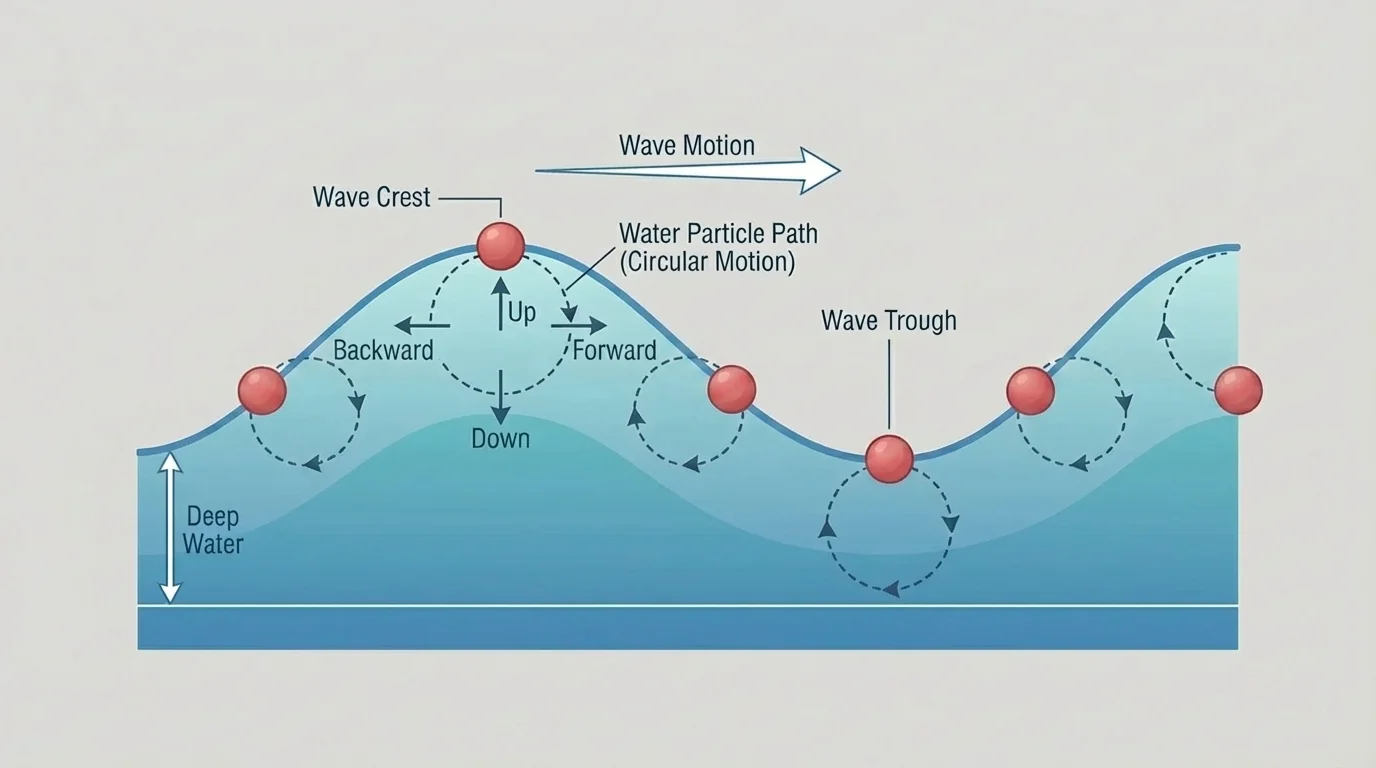
In deep water, the moving surface pattern and the water itself are not doing exactly the same thing. As [Figure 1] shows, the wave shape travels across the surface, but a small floating bit of water mostly stays in the same general area. It rises as a crest passes, then falls as a trough passes.
If you watched a leaf floating on deep water, you might see it bob up and down. It may also move a little forward and a little backward, but it does not travel across the ocean with the wave. This is why we say there is only a very small amount of net motion in deep water. "Net motion" means the overall movement after the back-and-forth motion is finished. In deep water, the net motion forward is almost zero.
Scientists often describe the motion of water in deep waves as small circular paths. The water near the surface moves in tiny loops. For grade-level understanding, the most important idea is this: the water goes mostly up and down in place, while the wave itself moves across the surface.
This idea can feel tricky because our eyes notice the moving wave shape. But the shape is not a chunk of water sliding forward like a toy car. It is more like a moving signal. Energy passes from one place to the next, and the pattern keeps going.
A fun real-life clue comes from buoys in the ocean. A buoy is a floating object used to measure waves and weather. During many waves, the buoy mostly bobs up and down. It does not race forward with each wave. That matches the deep-water motion shown earlier in [Figure 1].
Energy moves, water mostly stays
This is the big idea behind surface waves in deep water. The wave carries energy across the water, but the individual water particles mostly move up and down and a little back and forth. That is why a floating object can bob for a long time without drifting very far from the waves alone.
This same big idea appears in many kinds of waves. Sound waves move energy through air. Light waves move energy through space. Water waves move energy across water. The material in the wave responds, but the pattern itself is what travels.
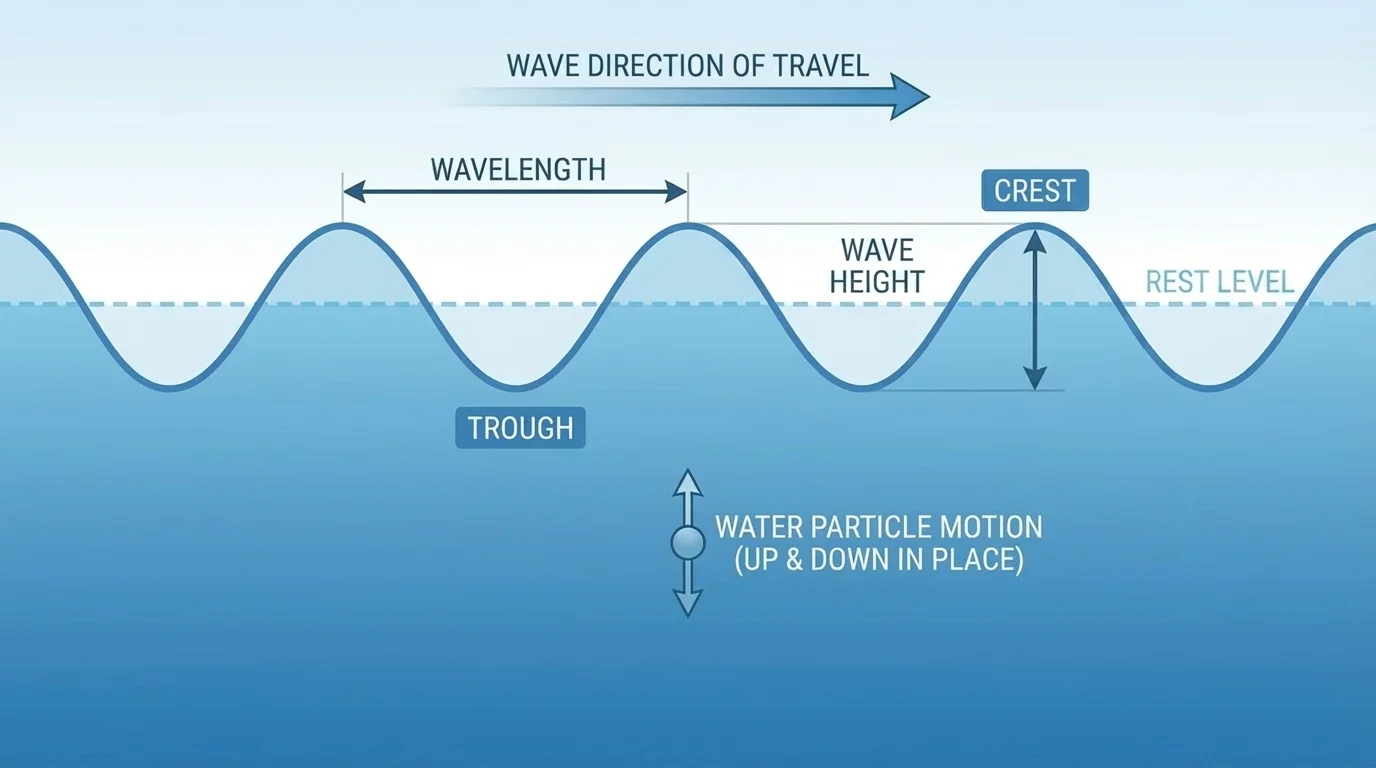
To describe waves clearly, scientists use special words. These words help us compare small ripples and giant ocean swells. The labeled picture in [Figure 2] helps show the main parts.
The highest part of a wave is the crest. The lowest part is the trough. The distance from one crest to the next crest is called wavelength. The distance from the rest level to the crest is called the amplitude, and the full distance from trough to crest is the wave height.
If a wave has taller crests and deeper troughs, it usually has more energy. If the crests are close together, the wavelength is shorter. If they are farther apart, the wavelength is longer. These features help people describe the kind of waves they are seeing.
| Wave part | What it means | What you notice |
|---|---|---|
| Crest | The highest point of the wave | The top of the bump |
| Trough | The lowest point of the wave | The dip between bumps |
| Wavelength | Distance from one crest to the next | How spread out the waves are |
| Wave height | How tall the wave is compared with its rest level | How big the up-and-down motion looks |
Table 1. Main parts of a water wave and what each part describes.
Knowing these parts also helps when people talk about storms, boats, and beach safety. For example, bigger wave height often means rougher water. Longer wavelength can mean waves are more spread out and may feel smoother to a large ship.
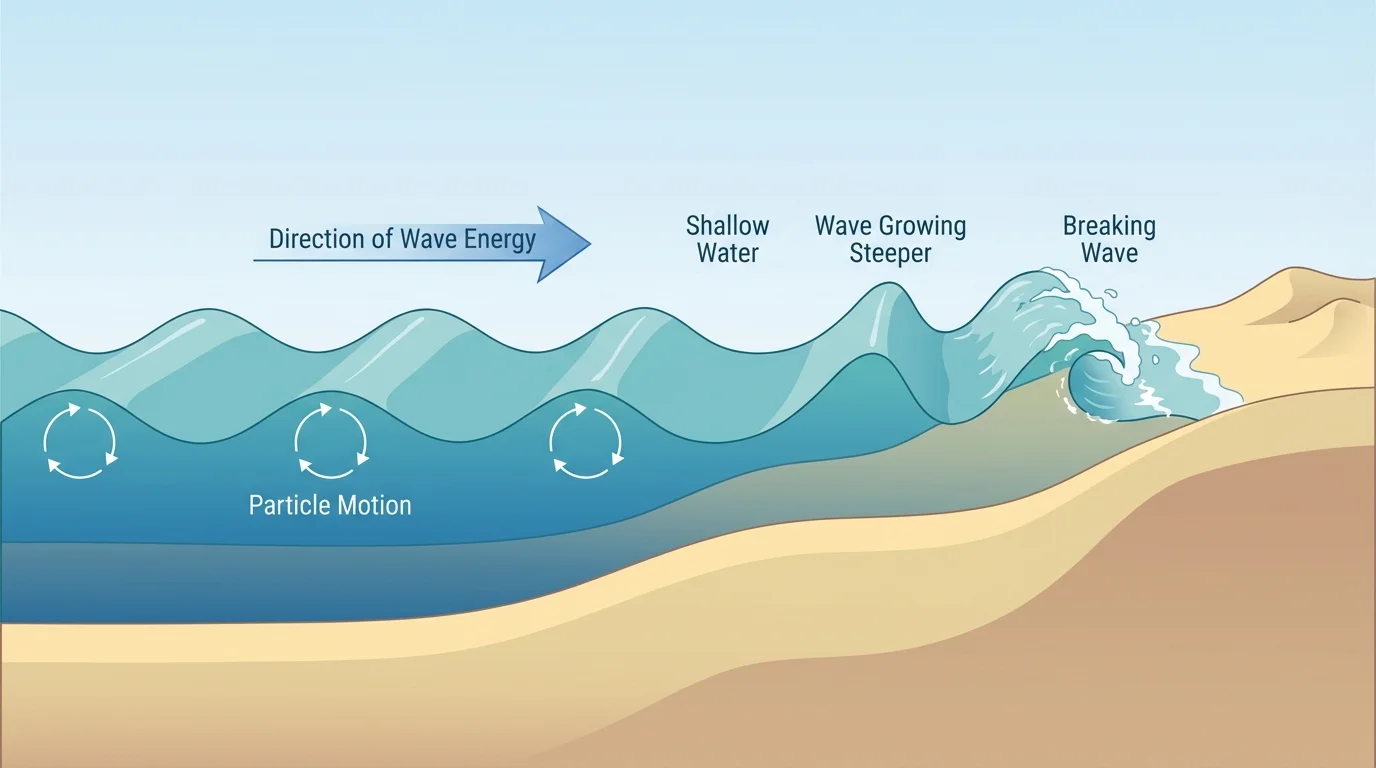
Waves behave differently when they are far from shore and when they approach land. In deep water, the water motion mostly stays in place, as explained earlier. Near shore, the bottom of the water begins to affect the wave. [Figure 3] shows this change from deep ocean to beach.
As a wave moves into shallow water, the lower part of the wave begins to interact with the bottom. The wave slows down, the wavelength often becomes shorter, and the wave grows steeper. That means the crest becomes sharper and taller compared with the water under it.
Eventually, the wave can become so steep that it breaks. When this happens near a beach, water really does rush forward. This is the important exception: in deep water there is no net motion in the direction of the wave, but when the water meets a beach and the wave breaks, water can surge onto the shore.
This is why standing in the ocean near the beach feels different from floating farther out. Near the beach, breaking waves can push sand, shells, and even your feet. The motion there is no longer just gentle bobbing in place.
Surfers use this change on purpose. They wait for waves that begin in deeper water and then steepen near shore. The shape of the ocean floor helps decide where the best breaking waves happen. Beaches, reefs, and sandbars can all affect wave behavior, just as we saw in [Figure 3].
Real-world example: a floating toy and a beach ball
Suppose a toy boat floats in deep water while waves pass under it.
Step 1: Watch the motion of the toy boat.
The boat rises as a crest arrives and falls as a trough arrives.
Step 2: Notice its place on the water.
It may drift a little because of wind or currents, but the passing waves alone mostly make it bob rather than travel far forward.
Step 3: Compare that with a beach ball in shallow, breaking waves.
Near shore, the breaking water can push the ball strongly toward the beach.
This comparison helps show the difference between deep-water wave motion and breaking waves at the shore.
Currents are different from waves. A current is water actually flowing from one place to another. If you see something drifting steadily in one direction for a long distance, a current may be carrying it. A wave, by itself in deep water, usually does not do that.
Understanding water waves helps people stay safe and understand nature. Meteorologists study waves during storms. Boat captains pay attention to wave size and direction. Lifeguards watch how waves break near shore because breaking waves affect swimmers.
Waves also fit into a bigger science idea: many kinds of waves transfer energy and can even transfer information. Water waves show the basic pattern clearly, but sound waves carry voices through air, and electromagnetic waves such as radio waves and light waves can carry information in communication systems. Water waves are not used in the same way as radio waves, but they help us understand what all waves have in common.
You may already know that energy is the ability to make things happen or change. Waves are one way energy moves from place to place.
Scientists and engineers study ocean waves for practical reasons too. They design boats that can handle rough water. They build harbors to protect ships. They also use instruments to measure wave height and timing so people can prepare for storms.
Even animals respond to waves. Seabirds, fish, and shore animals live in places where waves constantly shape the environment. Waves move sand, wear down rocks, and help change the coastline over time.
Some beaches gain sand in one season and lose sand in another because waves keep moving sediment along the shore. Waves help shape the land as well as the water.
You can observe basic wave behavior with a shallow pan or bowl of water. Tap one side gently and watch ripples move across the surface. Drop in a small floating piece of cork or a tiny paper dot. The marker helps you see that the water mostly bobs as the ripple passes.
If the container is very shallow, you may notice the motion changes more quickly near the edges. That happens because the bottom and sides affect the wave. This is a small version of what happens when ocean waves approach shore.
Watching carefully is an important science skill. Instead of only asking, "Where did the wave go?" scientists also ask, "What did the water itself do?" That question leads to the key idea of this topic.
Here are two ideas that are easy to mix up. First, the wave pattern moves across the water. Second, the water particles in deep water mostly move up and down in place. These are connected, but they are not the same thing.
Another important idea is that waves can change when conditions change. Deep water and shallow water are not the same. A wave that is smooth and rolling offshore can become steep and breaking close to land. That is why the same wave system can seem gentle in one place and powerful in another.
When you watch the ocean next time, look for these clues. Are the waves smooth and rounded far from shore? Do floating objects bob? Do the waves become steeper as they near the beach? Those observations help show how waves move energy through water.
