Have you ever walked into a dark room and suddenly noticed that your favorite toy seems to vanish, even though it is still right where you left it? That strange moment gives us a big clue about sight: seeing is not just about having eyes and having objects nearby. To see something, light has to reach your eyes. For most objects around you, that happens because light hits the object, bounces off it, and then enters your eyes.
An object can be seen when light reflected from its surface enters the eyes. That sentence is the heart of this topic. If no light enters your eyes from an object, you cannot see it. This is why things are easy to see in sunlight or under a lamp, but hard to see in the dark.
Your eyes do not stretch out and touch objects. Instead, light travels from place to place. When some of that light gets into your eyes, your brain uses the information to tell what you are looking at. You might be seeing a red apple, a blue backpack, or a brown dog, but in each case light from that object is reaching your eyes.
Reflect means to bounce back. When light reflects from a surface, it bounces off that surface. Surface means the outside part of an object. Light source means something that makes its own light, such as the Sun, a candle flame, or a flashlight.
Most of the things around you do not make their own light. A book, a desk, a tree, and your shoes are usually seen only because light from another source shines on them first.
Some things are light sources. They give off light by themselves. The Sun is the main light source in our everyday lives. Light bulbs, flashlights, stars, and fireflies are also examples. If a lamp is turned on, it sends out light in many directions.
Other things are not light sources. They do not glow on their own. A soccer ball sitting on the grass does not create light. During the day, sunlight hits the ball and reflects into your eyes, so you can see it. At night, if there is no lamp, flashlight, or moonlight, much less light reaches the ball, and very little or no reflected light reaches your eyes.
This is why the Moon looks bright in the night sky. The Moon is not a star and does not make its own visible light. It looks bright because sunlight reflects off the Moon and travels to Earth.
The Moon can look as if it is glowing, but what you see is sunlight reflected from its dusty surface. In a way, the Moon acts like a giant space reflector.
Even in a classroom, many objects are visible only because light from windows or ceiling lamps bounces off them. If the lights go out and the curtains are closed, objects seem to disappear from view, even though they have not moved at all.
Light usually travels in straight paths. In a simple way of thinking, a ray of light moves from a source, reaches an object, and then may bounce off that object. As [Figure 1] shows, you see a toy, ball, or book when light first reaches it and then reflected light travels from the object into your eyes.
Suppose sunlight shines on a yellow raincoat. Some light hits the raincoat and bounces off. Part of that reflected light enters your eyes, and you see the raincoat. If the raincoat is behind a wall, the light from it cannot travel straight into your eyes, so you cannot see it.
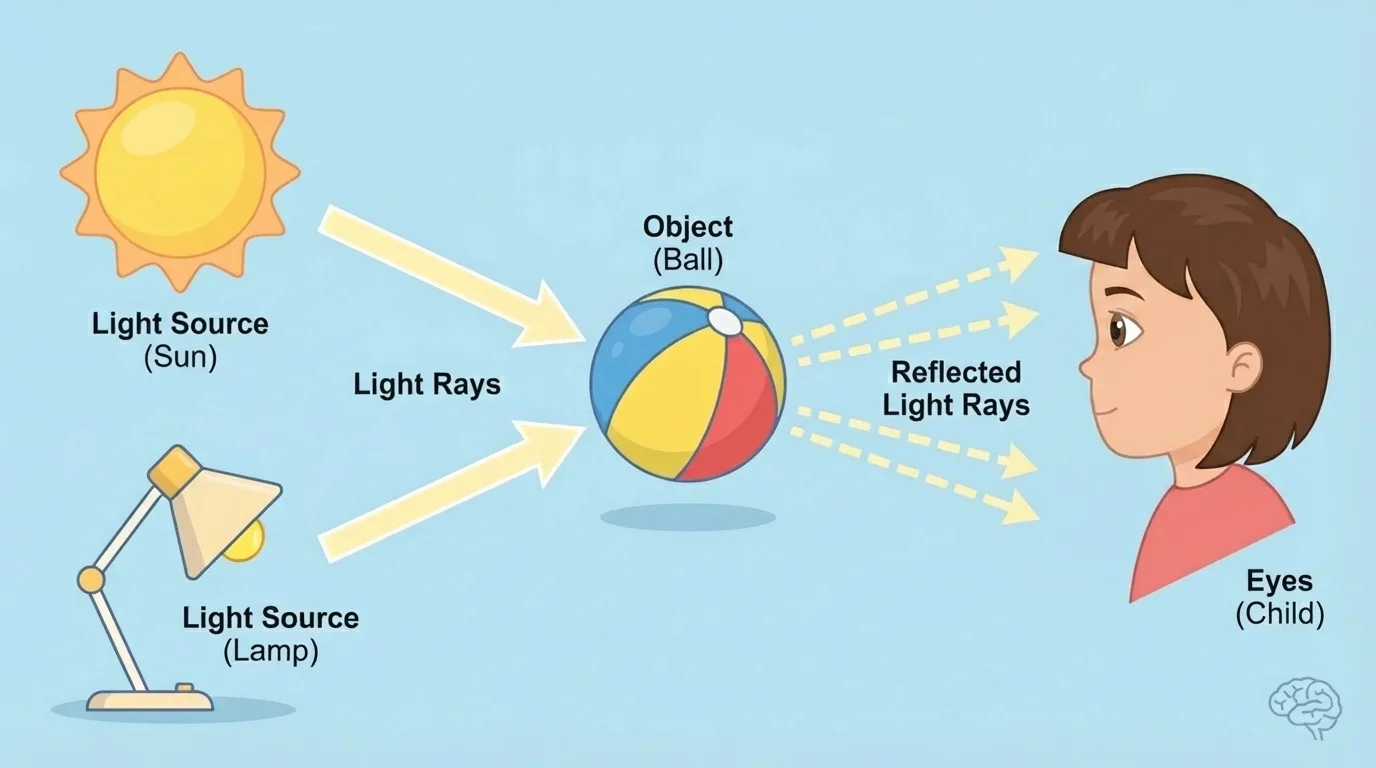
Reflection happens everywhere. It happens on floors, sidewalks, water, mirrors, windows, leaves, skin, and paper. Some reflections are easy to notice, like your face in a mirror. Others are more spread out and less obvious, like the reflection from a notebook page.
If you point a flashlight at a backpack in a dark room, the backpack becomes visible because the flashlight provides the light that the backpack reflects. If you cover the flashlight, the backpack becomes difficult to see again. The object is still there, but the reflected light is gone or greatly reduced.
Seeing needs a path for light
To see an object, there must be a path for light: from a light source to the object, and then from the object to your eyes. If either part of the path is blocked, seeing becomes difficult or impossible. A closed box blocks light from reaching the toy inside. A wall blocks reflected light from reaching your eyes.
Later, when you think about shadows, mirrors, or even why a shiny spoon sparkles, remember the same idea from [Figure 1]: light has to reach an object and then reach your eyes.
Not all surfaces reflect light in the same way. As [Figure 2] illustrates, a very smooth surface such as a mirror reflects light in an organized way, while a rougher surface such as paper, cloth, or wood reflects light in many directions.
A smooth surface can form a clear image. That is why you can see your face in a mirror. Many light rays bounce off in a regular pattern, so your eyes receive a picture-like reflection. This is often called regular reflection from a smooth surface.
A rough surface still reflects light, but the rays scatter in different directions. This is why you can see a wall or a sheet of paper from many angles, even though you do not see a sharp picture of yourself in it. The wall sends reflected light in many directions, and some of it reaches your eyes wherever you are standing.
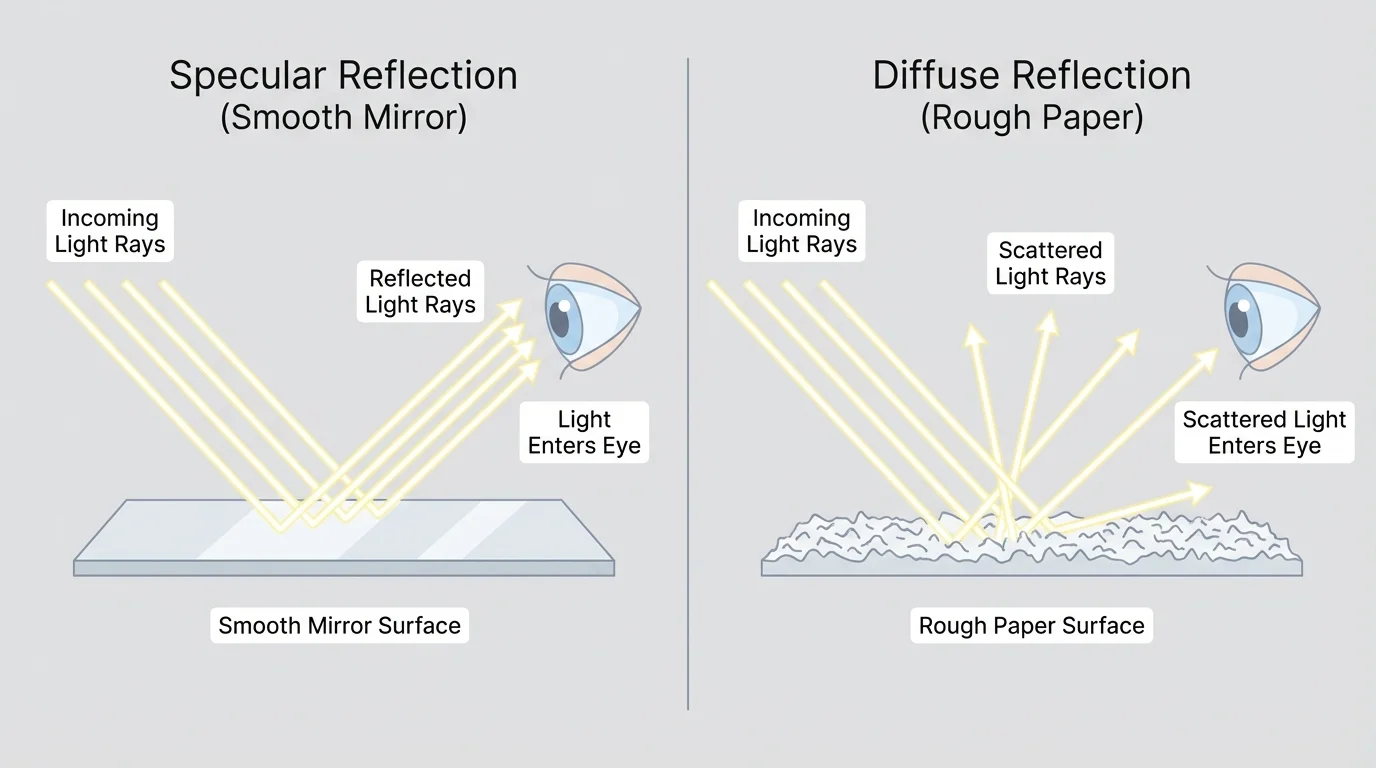
This is one reason shiny objects can create bright glare. A polished car, a calm pond, or a tablet screen can reflect light strongly into your eyes. A rough sweater or a sidewalk also reflects light, but usually in a more spread-out way.
When artists draw highlights on a shiny apple or when photographers move lights to avoid glare, they are working with the same idea. Surface texture changes how reflected light travels.
Real-world example: Why can you read paper but not use it like a mirror?
Step 1: Light from a lamp shines on the page.
Step 2: The paper reflects the light in many directions because its surface is not perfectly smooth.
Step 3: Some of that reflected light enters your eyes, so you can see the words.
You see the page clearly, but you do not see a sharp reflection of your face because the light is scattered instead of forming a neat image.
The difference between smooth and rough surfaces helps explain many everyday experiences, from seeing yourself in a bathroom mirror to noticing that chalkboard dust makes a board look less shiny.
Your eyes are the body parts that receive light. When reflected light enters your eyes, it is focused and detected so your brain can figure out what you are seeing. You do not need to memorize all the parts of the eye to understand the main idea: no incoming light means no sight.
The front parts of the eye let light in. Inside the eye, special cells respond to light. Then messages travel to the brain, which helps you recognize shapes, colors, brightness, and motion. This all happens very quickly.
That is why two students can look at the same basketball and both see it, as long as reflected light from the ball enters both of their eyes. The ball does not jump into their eyes; light from the ball does.
Earlier learning about senses can help here: the eyes are sense organs for sight, but they need information from the environment. For sight, that information comes in as light.
Color is connected to light too. A red apple looks red because it reflects red light to your eyes more strongly than many other colors of light. A blue shirt reflects blue light strongly. If the lighting changes, the colors can look different because the light reaching the objects has changed.
Sometimes objects are present, but seeing them is difficult because not enough light reaches your eyes. Darkness is the clearest example. In a dark cave or a windowless room with the lights off, there may be many objects around you, but you cannot see them well because there is very little light to reflect from their surfaces.
Shadows also affect seeing. A shadow forms when light is blocked. If a tree blocks sunlight from reaching the ground, the ground in the shadow receives less light, so it reflects less light into your eyes and appears darker.
Fog, smoke, and dusty air can make seeing harder too. Light is scattered by tiny particles in the air, so less clear reflected light from distant objects reaches your eyes. That is why a car looks fuzzier in thick fog than on a clear day.
Camouflage works partly because it reduces how much an object stands out from its surroundings. If an animal's colors and patterns are similar to leaves, bark, or sand, the reflected light from the animal may look very similar to the reflected light from the background, making the animal harder to notice.
Many animals are harder to spot at dawn or dusk because the amount and direction of light are changing. The same animal can be easy to see at noon and much harder to see later in the day.
Safety tools often help by making reflected light easier to notice. Bright-colored clothing stands out because it reflects light in a way that catches attention. Reflective strips on jackets or backpacks are designed to send light from car headlights back strongly, making people easier to see at night.
Materials affect how light travels. As [Figure 3] shows, some materials let most light pass through, some let only some light through, and some block light. These differences help explain why you can see through a window, see blurry light through frosted plastic, and not see through a wooden door.
Transparent materials let most light pass through in an organized way. Clear window glass and clean water are common examples. Because the light keeps traveling through, you can often see objects on the other side clearly.
Translucent materials let some light pass through, but they scatter it. Wax paper, frosted glass, and some shower curtains are examples. You can tell that light is coming through, but objects behind the material look blurry.
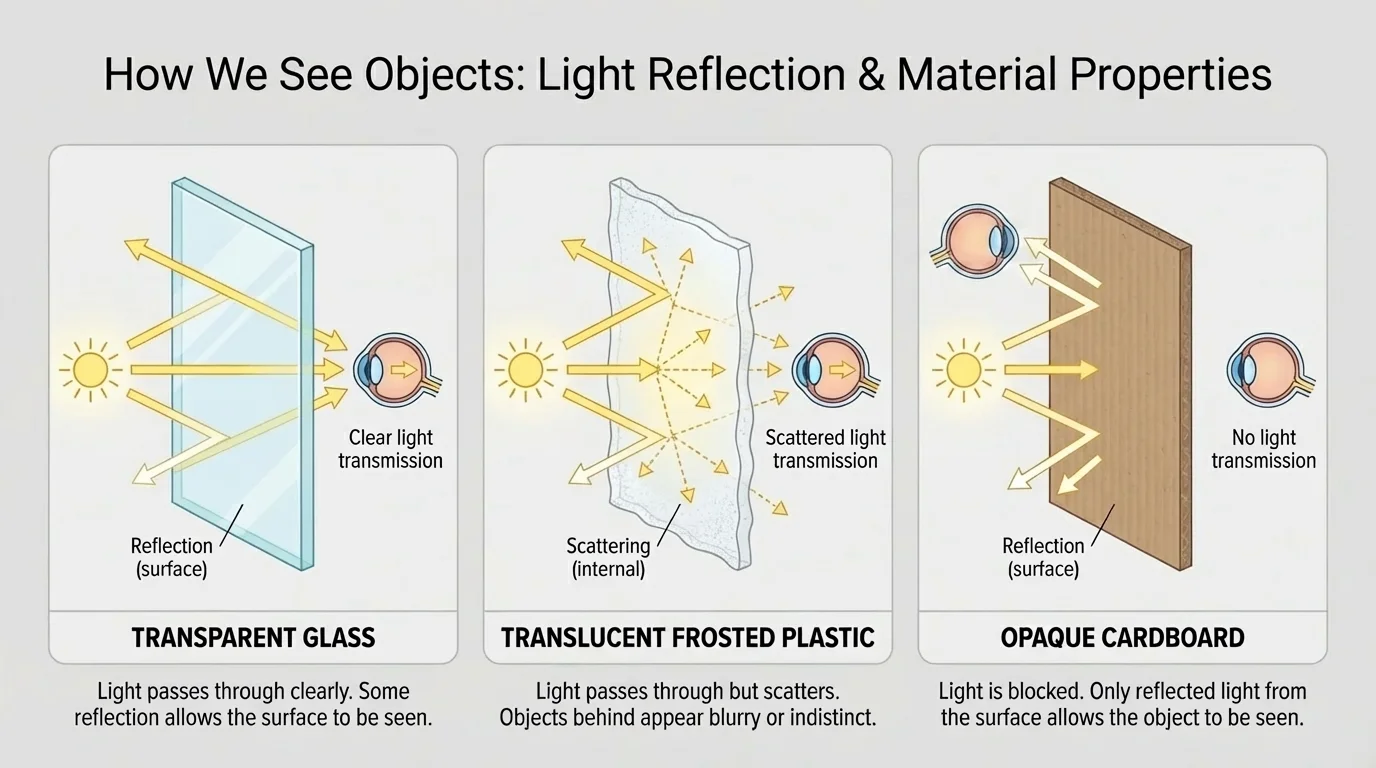
Opaque materials block light from passing through. Cardboard, brick, and most metal doors are opaque. Light may reflect from their surfaces, so you can see the material itself, but you cannot see through it.
These material types matter in everyday life. Windows are useful because they are transparent. A lampshade may be translucent so it softens light. Curtains and walls are often more opaque so they block light and give privacy.
| Material type | What light does | Example | What you see |
|---|---|---|---|
| Transparent | Most light passes through | Clear glass | Objects look clear |
| Translucent | Some light passes through and scatters | Frosted glass | Objects look blurry |
| Opaque | Light does not pass through | Wood | You cannot see through it |
Table 1. Comparison of transparent, translucent, and opaque materials and how they affect seeing.
Thinking about these materials also helps with reflection. Even an opaque object that blocks light can still be seen because light reflects from its surface into your eyes.
Mirrors are designed to have very smooth surfaces, so they reflect light in a regular way. This lets them form clear images. Bathroom mirrors, car side mirrors, and mirrors in stores all work because reflected light from objects enters your eyes in an organized pattern.
Periscopes use mirrors to change the path of light so a person can see over or around obstacles. Some telescopes use mirrors too, because mirrors can collect and direct light from faraway objects in space.
Road signs, bicycle reflectors, and safety vests are made to reflect light strongly so drivers can notice them at night. A sign is much easier to see when headlights shine on it because the sign sends a lot of that light back toward the driver.
Real-world example: Why do reflectors on bikes help?
Step 1: A car's headlights shine light toward the bicycle.
Step 2: The reflector sends light back very strongly.
Step 3: That reflected light enters the driver's eyes.
The bicycle becomes much easier to see, especially in dim light.
Screen glare on tablets and laptops is another reflection effect. If a lamp behind you reflects off the screen into your eyes, the screen can become harder to see. Changing the angle of the screen changes the path of reflected light.
Even photographers and movie makers think carefully about reflection. They move lights, use shiny or dull surfaces, and choose backgrounds so that the right amount of reflected light reaches the camera.
You can notice this science almost anywhere. In the morning, dew on grass sparkles because tiny drops of water reflect sunlight. A spoon may look bright under a kitchen light because its smooth metal surface reflects strongly. A black T-shirt and a white T-shirt can both be seen because both reflect some light, but they may reflect different amounts and colors of light.
Here is a simple investigation you can try with an adult: place a book on a table in a room with the lights on, then dim the lights or shine a flashlight on the book from different angles. Watch how the book becomes easier or harder to see depending on how much light reaches it and where the reflected light travels. You are not changing the book itself; you are changing the light path.
If you try this with a mirror and a sheet of paper, you will notice a difference. The mirror gives a sharper reflection, while the paper is easier to see from many directions. That matches what we learned earlier from [Figure 2], where smooth surfaces reflect more regularly and rough surfaces scatter light more.
You can also compare a clear plastic cup, a frosted container lid, and a cereal box. Their different appearances match the three material types shown in [Figure 3]. The clear cup lets light pass through more clearly, the frosted lid scatters some passing light, and the cereal box blocks light from passing through.
Once you start noticing reflected light, the world looks different. Every visible leaf, shoe, pencil, cloud, and face is part of a constant journey of light from a source to an object and then into someone's eyes.
"We do not see objects by sending sight out to them. We see them because light comes to us from them."
