A person can speak in one city, and just moments later another person far away can hear the same words on a phone. This is remarkable when you think about it. The voice does not ride through the air all the way across mountains, oceans, and streets. Instead, the sound is changed into a code that devices can send, receive, and turn back into sound again.
Your voice begins as sound waves. When you talk, your vocal cords vibrate. Those vibrations push the air around them. The pushes move outward as waves. A microphone, as shown in [Figure 1], senses those vibrations and changes them into an electrical signal that a device can work with.
A microphone is a part of many devices, including phones, tablets, computers, and headsets. It listens to changes in air pressure. When the air vibrates because of your voice, tiny parts inside the microphone move too. That movement becomes an electrical signal.
Waves carry energy and information. You may already know that light waves help us see and sound waves help us hear. Technology can use waves to carry messages too.
At this stage, the signal still matches the changing shape of your voice very closely. It is not yet in the digital format that computers and phones process most efficiently. To make it easier to store, send, and copy, the device changes that signal into numbers.
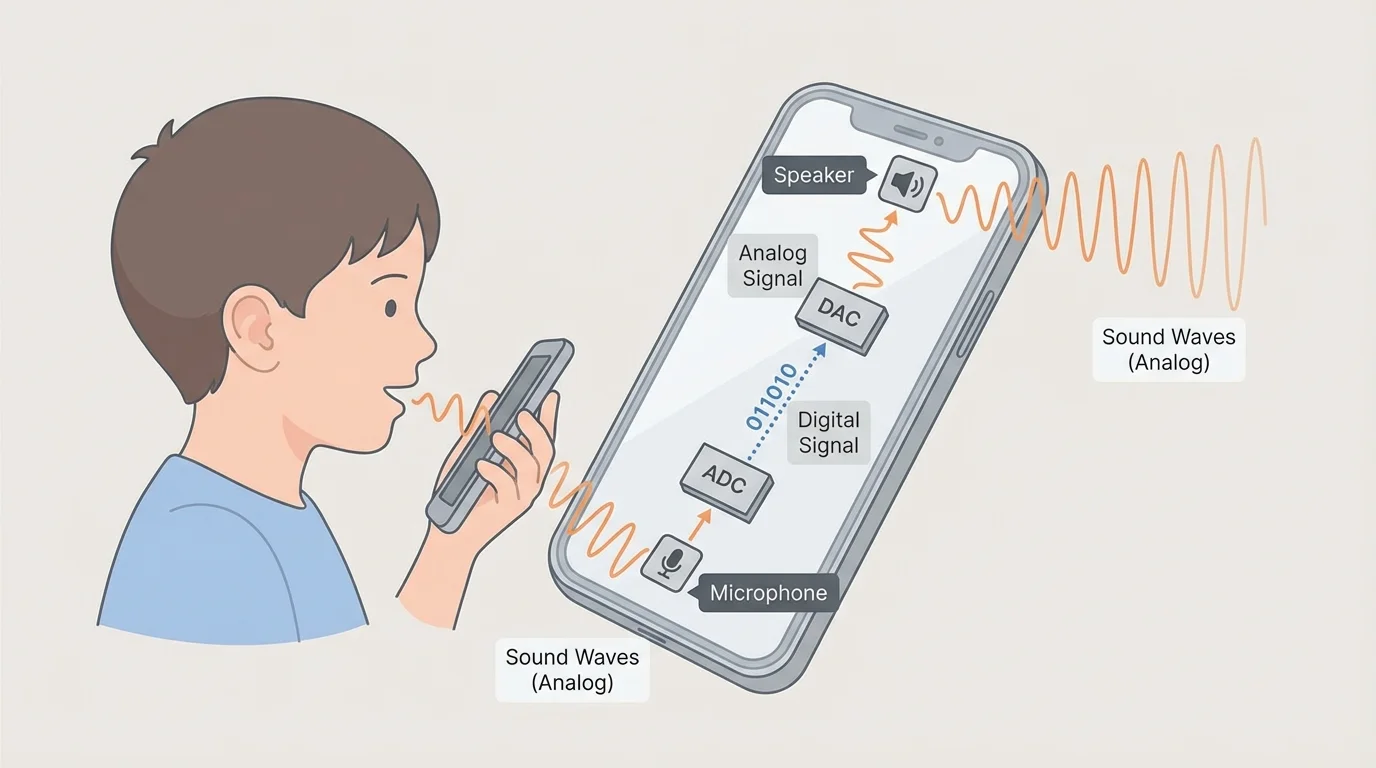
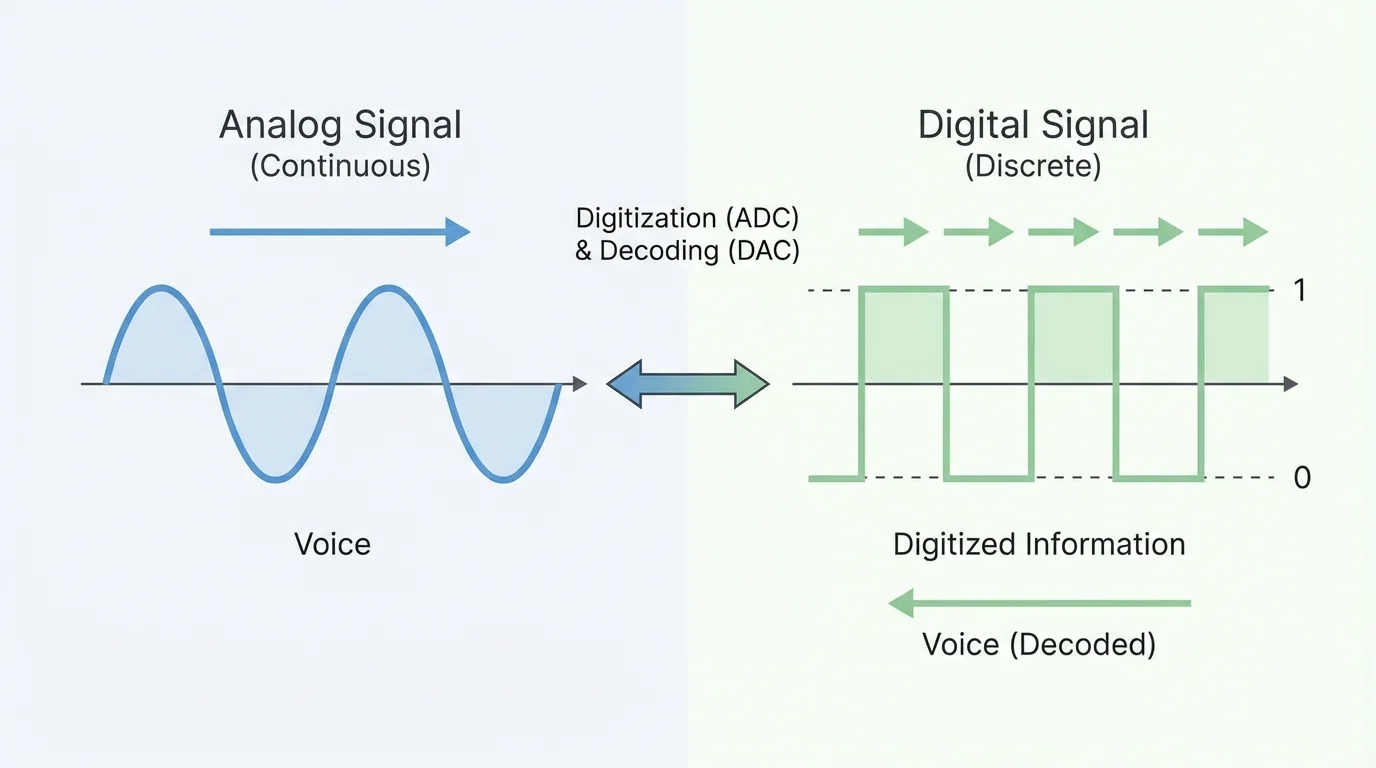
Digital information means information written as numbers or codes that a device can read. In many electronic systems, that code uses only two choices: bits called 0 and 1. As [Figure 2] shows, a smooth sound signal can be changed into a pattern that digital devices can store and send.
A smooth, continuously changing signal is often called analog. A digital system takes many quick measurements of that changing sound. Then it records the measurements as numbers. If a device checks the sound many times in a short amount of time, it can capture the shape of the sound well enough for us to understand words and enjoy music.
Analog information changes smoothly, like a dimmer switch moving from low light to high light. Digital information is stored as separate values, often using patterns of 0s and 1s. A bit is one small piece of digital information.
Think about building a picture with blocks. A smooth painted line and a line made of tiny square blocks are not exactly the same, but if the blocks are small enough and there are enough of them, the shape can look very close. Digital sound works in a similar way.
This is one reason digital systems are so useful. A pattern such as 1 0 1 1 0 can be copied again and again. If each bit is read correctly, the copy stays the same. That is very different from making copy after copy of an old paper picture, which usually gets blurrier over time.
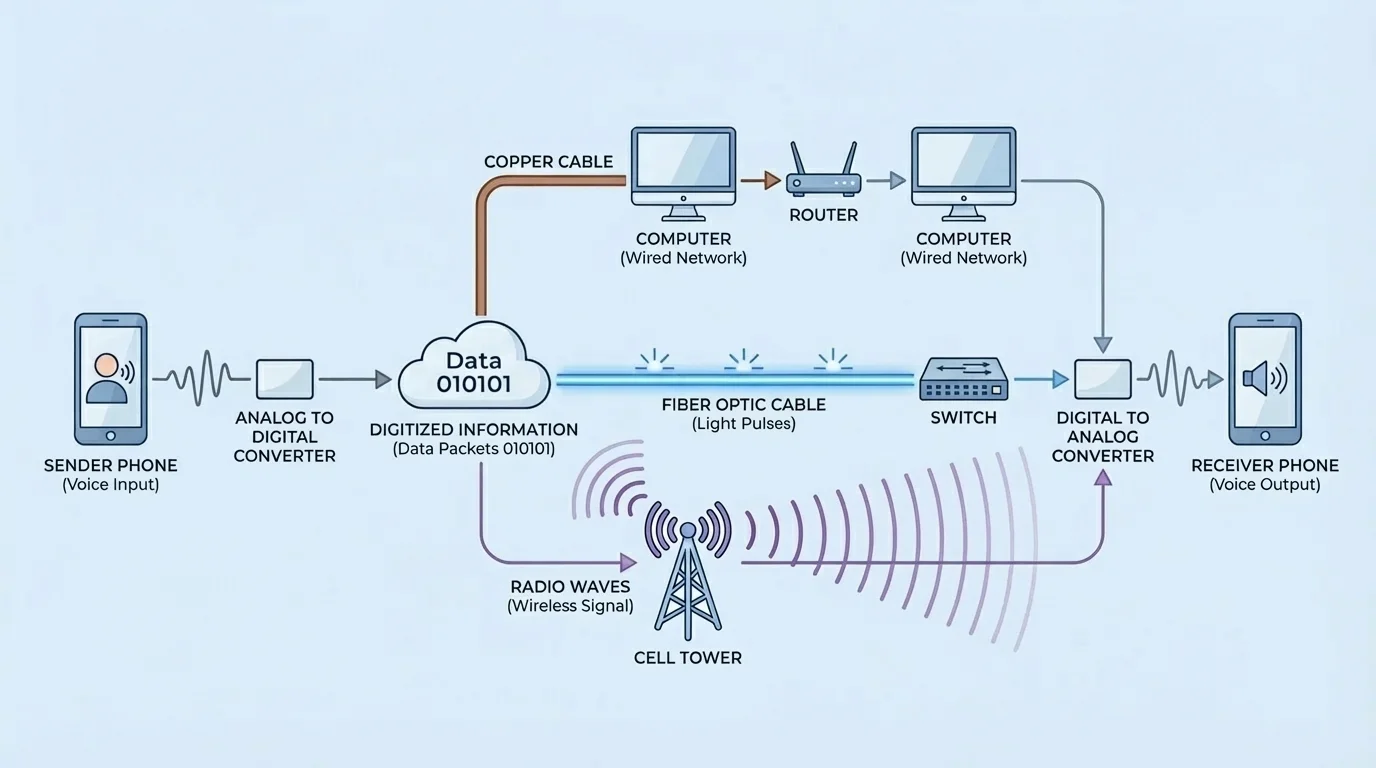
Once sound has been turned into code, the message can travel in several ways, as [Figure 3] illustrates. The information might move through metal wires as electrical signals, through fiber-optic cables as pulses of light, or through the air as radio waves.
Fiber-optic cables are amazing because they use light to carry information. Inside these cables, light pulses race along thin strands. Since light can move very fast, fiber systems can send huge amounts of data over long distances. That helps people make video calls, watch shows online, and use the internet.
Cell phones often use radio waves. Your phone sends coded information to a nearby tower. The tower passes the information into a network. Then the network sends it toward the other person. If that person is far away, the message may move through many parts of the system before reaching the correct phone.
One message, many pathways
The same digital message can travel by different routes. Part of a phone call may go from your phone to a tower by radio wave, then move through cables underground, and later travel back through radio waves to another phone. The message stays in digital form through most of the trip.
Computers can also send information through Wi-Fi, which is another use of radio waves. Even though we cannot see these waves, they carry messages all around us every day.
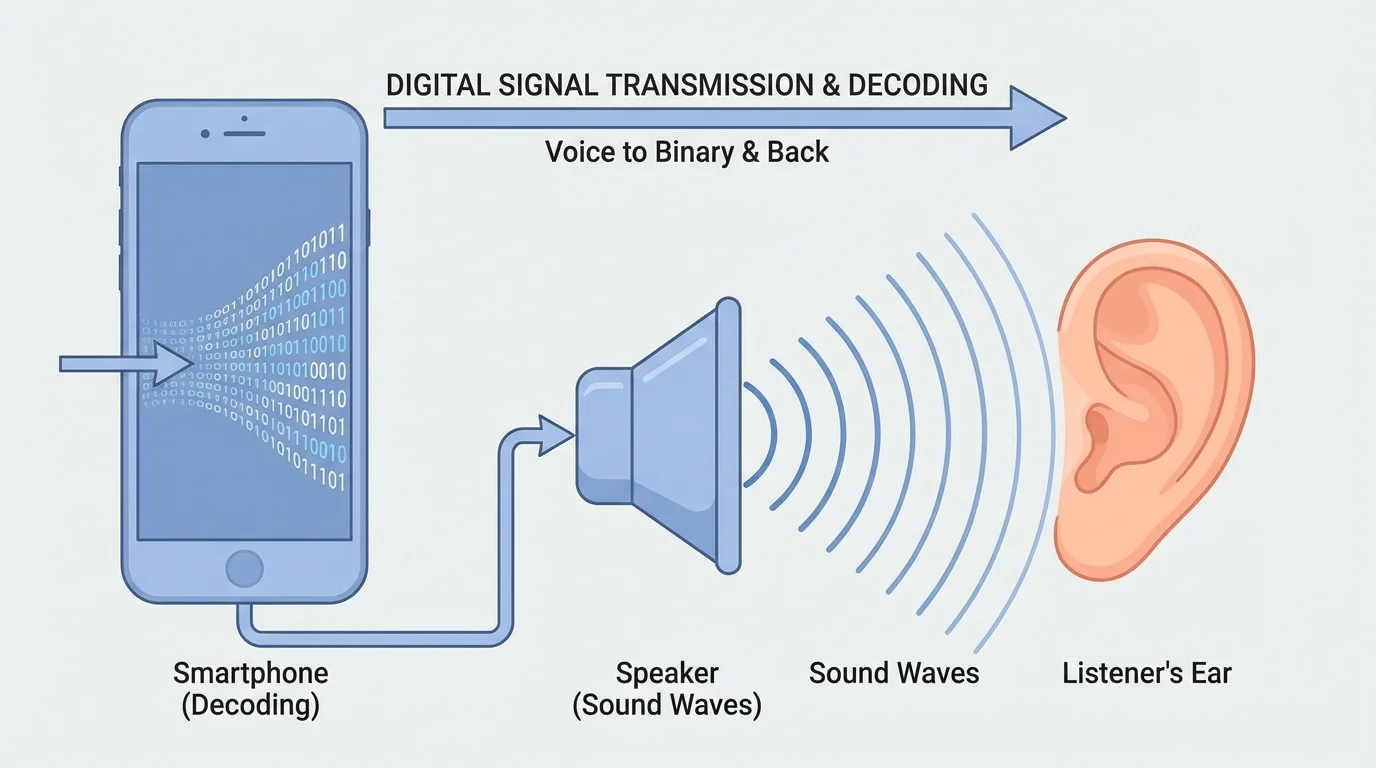
A receiving device does not simply "hear" the original voice in the air. It detects a coded signal and then reads it. In this process, called decoding, the device follows rules to turn the pattern of bits back into useful information.
[Figure 4] After the device decodes the digital message, it sends the information to a speaker. A speaker does the opposite job of a microphone. It changes electrical signals into vibrations. Those vibrations make sound waves in the air, and your ears hear them as words, music, or other sounds.
This back-and-forth process happens very quickly. When you speak into a phone, the phone changes your voice into digital information. The network sends it. Another phone receives it, decodes it, and changes it back to sound. All of that can happen in less than a second.
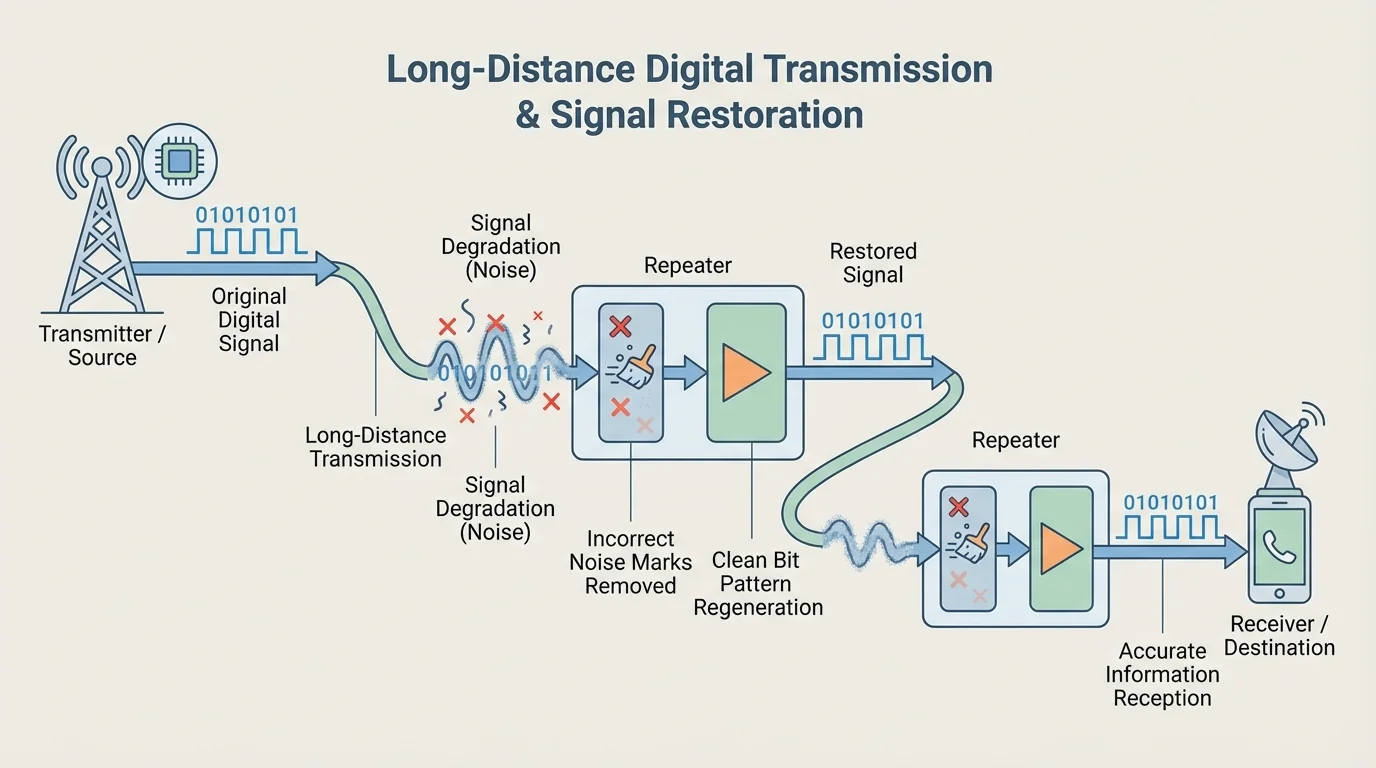
One of the most important ideas in modern communication is that digital information can travel long distances without much loss of quality. [Figure 5] shows why. Even if a signal gets a little messy during travel, the system often only needs to decide whether each bit is a 0 or a 1. If it can tell correctly, it can rebuild a clean version of the message.
This is different from older analog systems. In an analog recording or signal, little errors can pile up. A little hiss, crackle, or fuzz may be added. Then more may be added later. The quality can slowly get worse. This wearing down of a signal is called degradation.
Digital systems can use devices along the route that check and resend the information clearly. These devices are sometimes called repeaters or regenerators. Instead of passing along every tiny wiggle of a weak signal, they can send a fresh, clean pattern.
Some messages cross oceans through cables on the seafloor. Even there, digital information can stay accurate because the system boosts and rebuilds the signals along the way.
That does not mean digital systems are perfect. If too much information is lost, the receiver may not know whether a bit was a 0 or a 1. Then you might hear a glitch, a pause, or a dropped call. But as long as the bits are read correctly, the message can remain very clear.
Every time you send a voice message, join a video call, or watch a live stream, digital information transfer is at work. The camera and microphone collect light and sound. The device changes them into data. The network carries the data. Another device changes the data back into pictures and sounds.
Emergency systems also depend on this idea. Police, firefighters, doctors, pilots, and rescue teams need fast and clear communication. When the information arrives accurately, people can make better decisions and help others more quickly.
Music streaming is another example. A song can be stored as digital information on a server far away. When you press play, the file is sent over networks to your device. Your device decodes the data and your speaker creates the sound. The same basic idea from [Figure 4] is happening again, even though the sound began far away and may have been recorded long ago.
Suppose a device measures a sound several times in a very short time. For a very simple model, imagine it records the amplitude values as a short list of numbers during one part of a word. Not every device uses the same values, but the main idea is that sound can be stored as a list of numbers.
Encoding and decoding example
Think of a class game where one student taps a pattern and another student repeats it.
Step 1: A sound is observed.
A student hears three short taps and one long tap.
Step 2: The pattern is encoded.
The class agrees that a short tap is 0 and a long tap is 1. The pattern becomes 0 0 0 1.
Step 3: The pattern is sent.
The coded pattern can be passed to another student across the room or written down.
Step 4: The pattern is decoded.
The receiving student uses the same rule and turns 0 0 0 1 back into three short taps and one long tap.
This is a model of what technology does with much more speed and detail.
Real devices do this incredibly fast. If a system takes many measurements each second, then even a short sentence contains a very large amount of data. Yet computers and phones are designed to handle that job.
You can also think about how a weak signal might still work. If the original bit pattern is 1 0 1 0 and the receiver still reads those bits correctly, the message stays the same. That is why digital communication can remain strong over distance, much like the clean pattern in [Figure 5].
If you have ever heard a robotic sound on a call or seen a video freeze, you have seen the limits of information transfer. Sometimes the network is crowded. Sometimes the signal is weak. Sometimes obstacles like thick walls or long distances make transmission harder.
There can also be a short delay. Even though signals move very fast, they are not truly instant. The information still has to be measured, encoded, sent, received, decoded, and played. For most everyday uses, this happens so quickly that it feels immediate.
Engineers work to improve speed, accuracy, and reliability. They build better cables, stronger networks, smarter error-checking systems, and better devices. Their goal is to help information arrive clearly and safely.
Digital information transfer is one of the great ideas behind modern life. It helps connect people across towns, countries, and even space. Satellites, computers, smart watches, game systems, and robots all depend on sending and receiving coded information.
When you speak into a phone and someone far away hears your voice, many scientific ideas are working together: waves, energy, signals, coding, and decoding. Your voice becomes data, the data travels, and another device turns that data back into sound. That is how digitized information can go long distances without significant degradation and still sound like you when it arrives.
