A dog can smell food from a long distance, a bat can fly in the dark without bumping into things, and you can pull your hand back almost instantly if you touch something hot. These amazing actions all begin with one important idea: animals collect information from the world, and their bodies are built to notice different kinds of clues. Then the brain helps make sense of those clues and decides what to do next.
Animals do not simply move around at random. They use information from their surroundings and from inside their bodies. They also use what they have learned before. That means animals depend on both sensing and remembering. Together, these help an animal find food, avoid danger, care for young, and survive in its environment.
Many students learn about five senses: sight, hearing, smell, taste, and touch. These are very important, but animals often sense even more than that. They may detect temperature, body position, movement, pressure, and pain. Some animals can even sense things that humans cannot sense well, such as tiny vibrations, heat from another animal's body, or changes in Earth's magnetic field.
All of this information comes from special body parts or cells that notice changes. A change in the environment that can be detected is called a stimulus. A flash of light, the smell of smoke, a rough surface, and the sound of thunder are all stimuli. Inside the body, hunger, thirst, and a fast heartbeat can also provide important information.
Receptors, stimuli, and perception are central ideas in animal sensing. A receptor is a special cell or body part that detects a certain kind of stimulus. A stimulus is a change that can be noticed, such as light, sound, pressure, or smell. Perception is the brain's understanding of what the sensory information means.
Animals must notice stimuli quickly and accurately. If a rabbit hears a sudden rustle in the grass, it needs to decide whether the sound means wind or a fox. If you smell something burning in the kitchen, your brain must figure out what that smell means so you can act. Sensing is the first step, but understanding the meaning is just as important.
Animals have receptors that are specialized, which means each kind is built for a certain job. As [Figure 1] shows, the body has different receptors in different places, and each type is best at detecting a particular kind of information. Eyes detect light, ears detect sound vibrations, noses detect odor molecules, tongues detect chemicals in food, and skin detects touch, pressure, pain, and temperature.
Your eyes do not hear music, and your ears do not taste ice cream. That is because each receptor responds to only certain stimuli. Light receptors in the eyes respond to light. Sound receptors in the ears respond to vibrations in the air. Receptors in the nose and tongue respond to chemicals. This specialization helps animals gather clear and useful information.
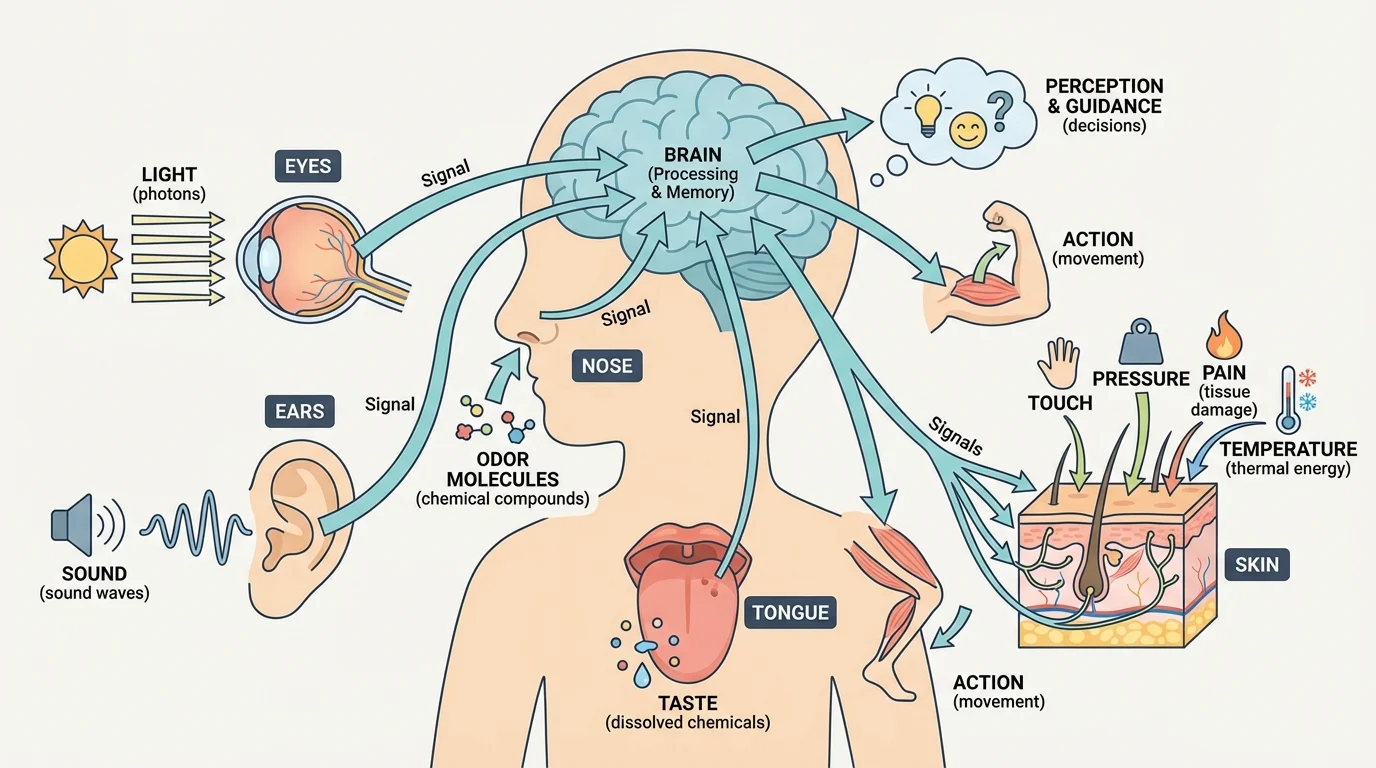
Skin has several kinds of receptors. Some notice a soft touch. Others respond to pressure, warmth, cold, or pain. This is why you can tell the difference between petting a kitten, holding an ice cube, and stepping on a sharp toy. Your skin is not doing just one job. It is collecting many kinds of sensory information at once.
Inside the ear, special parts help detect both sound and balance. Sound helps animals communicate and notice what is happening around them. Balance helps them keep from falling over. That is why spinning in circles can make a person feel dizzy. The inner ear sends information that helps the brain understand body movement and position.
The nose and tongue also work together. When you eat soup, your tongue notices basic tastes such as sweet, salty, sour, and bitter, while your nose detects many odor molecules rising from the food. Together these help create the full flavor. When you have a stuffy nose, foods often seem to taste weaker because some of that sensory information is missing.
Some snakes have heat-sensing receptors that help them detect warm animals nearby, even in dim light. This gives them extra information beyond the senses humans usually think about.
Plants do not have brains, but animals do, and that changes what happens next. Receptors gather information, but the brain helps turn that information into useful understanding and action. This is what allows an animal to respond in adaptive ways rather than just receiving signals.
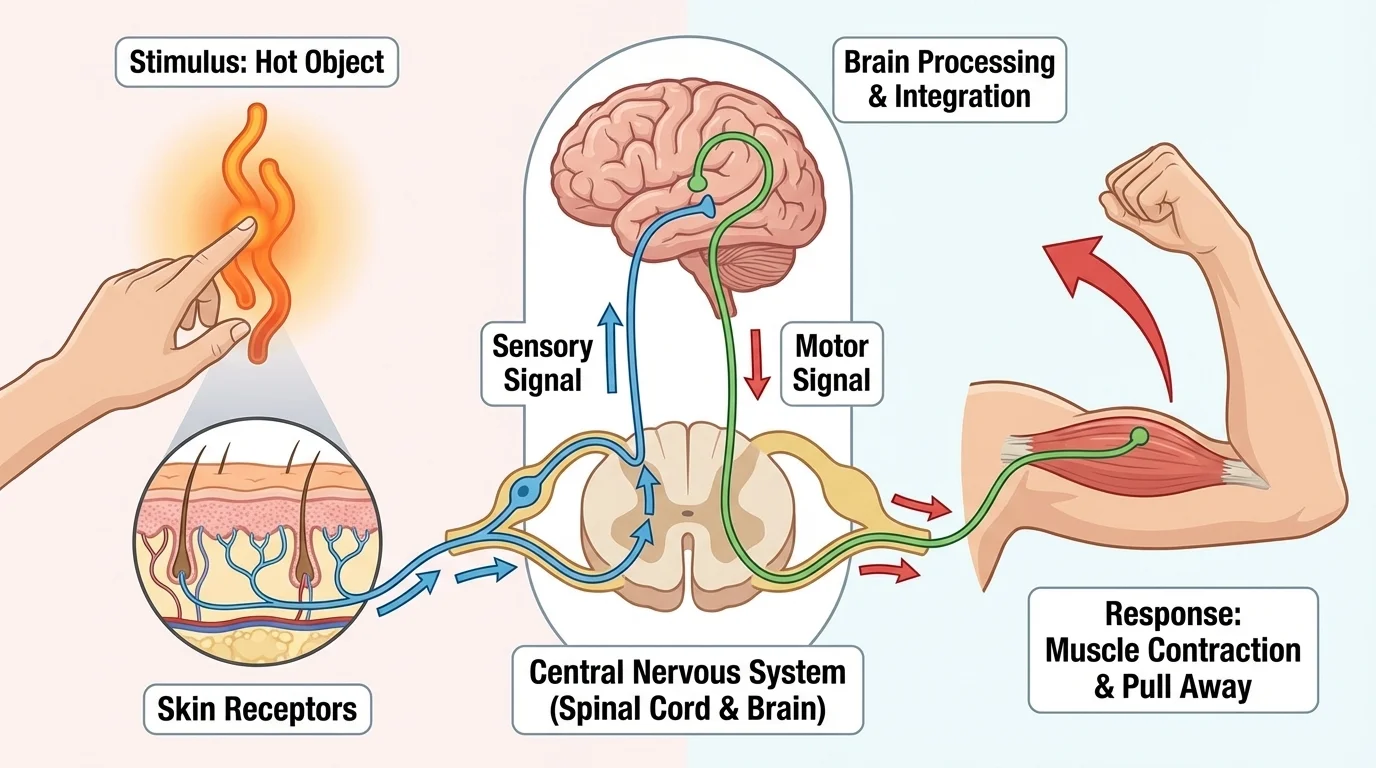
Once a receptor detects a stimulus, the information must be sent to the brain. As [Figure 2] illustrates, the path usually goes from receptor to nerve to brain, and then the brain may send instructions to muscles. This communication happens very quickly, which is why animals can respond fast when something important happens.
Nerves are like the body's message pathways. They carry signals from receptors to the brain and from the brain back to the body. If you hear your name called, sound receptors in your ears detect the vibrations, nerves carry the message, and your brain helps you turn your head toward the sound.
The brain does not receive all sensory messages as one mixed-up bundle. Different areas help process different kinds of information. Some parts are especially involved in vision, some in hearing, and others in movement, memory, and emotion. The brain works as a busy control center, organizing messages and helping the animal decide what matters most.
Sometimes the body reacts with amazing speed. If you touch a hot pan, receptors in your skin detect the heat and pain. Your body can begin to pull your hand away very fast to protect you. Then your brain becomes fully aware of what happened. Quick warning responses like this help keep animals safe from injury.
From detection to response
Sensory systems work as a chain. First, receptors detect a stimulus. Next, nerves carry the information. Then the brain processes the message. Finally, the body responds, often by moving muscles or changing behavior. If any part of this chain does not work properly, the response may be slow, weak, or missing.
This fast communication is important in everyday life. Catching a ball, riding a bike, crossing a street, and listening for a timer in the kitchen all depend on the body sending and processing sensory information quickly.
Getting a signal is not the same as understanding it. The brain must figure out what the signal means. This understanding is called perception. For example, your eyes may detect a shape and color, but your brain helps you recognize that the object is a red apple and not a toy ball.
The brain often combines information from several senses at once. If you see a dog barking, hear the bark, and feel the ground shake a little as it runs past, your brain blends those signals into one experience. This helps animals understand their surroundings more clearly than they could by using only one sense at a time.
Perception can depend on context. A sound in the daytime at a playground may seem normal, but the same sound outside your window late at night might seem surprising or scary. The brain does not just collect signals. It compares them with what is already known and with what is happening around the animal at that moment.
The same idea explains why camouflage can fool animals. A predator may have eyes that work well, but if the prey blends into the background, the brain may not notice it right away. Sensing depends on both the receptors and the brain's ability to separate important details from the rest of the scene.
A powerful part of animal behavior comes from memory. Memory is stored information from past experiences. Animals use memory to recognize places, learn what foods are safe, remember where danger was found, and know how to return to shelter or a nest.
A squirrel hiding nuts for winter must remember where many of them are buried. A pet dog may remember the sound of the treat bag opening. A bird may remember the location of a safe nesting area. These memories help animals make choices that improve their chances of survival.
Real-world case: a deer at the edge of a forest
A deer hears a snapping twig and must decide what to do.
Step 1: Receptors detect information.
Sound receptors in the ears notice the noise, and the eyes may look for movement.
Step 2: The brain processes the signals.
The deer's brain compares the sound and movement with past experiences.
Step 3: Memory guides action.
If similar sounds once came from a predator, the deer is more likely to run.
This shows that animals do not rely only on the moment. They use the past to choose an action in the present.
Learning is closely connected to memory. Young animals often improve by trying, failing, and trying again. A young fox may become better at hunting after repeated attempts. A child learns to balance on a scooter by using information from the eyes, ears, skin, muscles, and inner ear again and again. With practice, the brain becomes better at using sensory information.
Some actions become almost automatic after lots of practice. When you tie your shoes, write your name, or dribble a basketball, you are using memory along with current sensory information. The same is true for many animals. Practice helps make responses faster and more accurate.
Earlier learning about body systems helps here: the brain, nerves, sense organs, and muscles do not work alone. They cooperate as one connected system.
Memory can also help animals avoid danger. If a bird once tasted a brightly colored insect that made it sick, the bird may avoid insects with similar colors later. This protects the bird and also affects how animals interact with one another in ecosystems.
Not all animals sense the world in the same way. As [Figure 3] shows, different species have sensory systems that fit their lives. Animals that hunt, hide, migrate, dig, swim, or fly may have very different receptor systems because they need different kinds of information.
Bats use sound in a special way called echolocation. They make high sounds and listen for the echoes bouncing back from objects. This helps them find insects and avoid obstacles in darkness. Their ears and brains are specially adapted to process these echo signals.
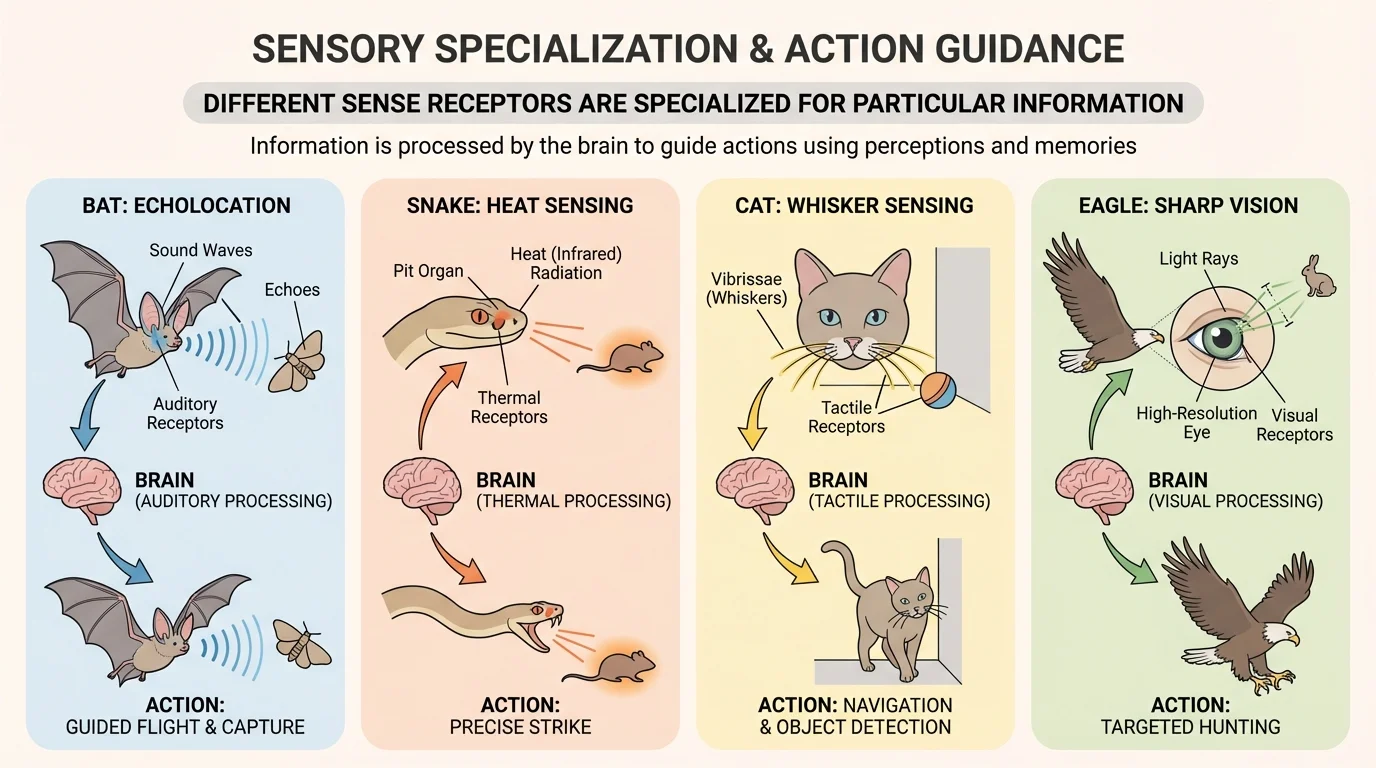
Cats and many other mammals use whiskers to detect nearby objects and air movements. Whiskers are connected to sensitive receptors, so they can help an animal judge spaces and movement, especially in dim light. An eagle, on the other hand, depends greatly on sharp vision to spot prey from high in the sky.
Some fish sense vibrations in the water. Some birds use the sun, stars, landmarks, and possibly Earth's magnetic field when migrating. Some insects detect chemical signals from very far away. Returning to [Figure 3], we can see that each sensing tool matches an animal's way of life. A bat needs different sensory strengths than an eagle because they live and hunt in different conditions.
These differences do not mean one animal is better than another in every way. They mean each animal is adapted for certain tasks. A mole that spends time underground benefits from strong touch and smell, while a hawk benefits from excellent vision.
At home, in school, and outdoors, you can notice sensory systems in action. A dog hears a familiar car and runs to the door before you even see the person arrive. A basketball player watches the ball, hears teammates, feels the floor under their shoes, and remembers where the hoop is. A bee uses sight and smell to find flowers.
Humans also use sensory information and memory together constantly. When you read, your eyes detect symbols and your brain matches them to meanings you learned before. When you walk into a dark room, your hands may feel around for a light switch based on your memory of where it usually is.
Simple observation example
Think about catching a tossed beanbag or soft ball.
Step 1: Your eyes track the moving object.
Light receptors in the eyes detect where it is and how fast it is moving.
Step 2: Your brain predicts where it will go.
The brain uses current information and past practice to estimate the path.
Step 3: Your body responds.
Muscles in your arms and hands move into position to catch it.
The better you know the task, the more smoothly your body responds.
Service animals give another clear example. A guide dog senses changes in the environment, pays attention to training, remembers commands, and chooses safe actions. Its behavior depends on receptors, brain processing, learning, and memory all working together.
Sensory systems are also important for protection. Pain receptors warn the body about damage or possible damage. Heat receptors help prevent burns. Sound can warn of storms, alarms, or approaching animals. Smell can warn of spoiled food or smoke.
When the body receives danger signals, actions may happen quickly. Muscles may tense, the heart may beat faster, and attention may sharpen. These responses help an animal prepare to escape, hide, or defend itself. The body and brain work together to improve safety.
We also learn from warning experiences. If touching a cactus hurts, memory helps you avoid grabbing one again. If a loud crash startles a flock of birds, they may fly away and become more alert for similar sounds. Sensing and remembering together support survival.
By now, it is clear that sensing is not just about one body part. It is a whole system. Receptors collect information. Nerves carry messages. The brain processes the signals. Memory adds meaning from past experience. Muscles and other body parts then carry out actions.
Earlier we saw in [Figure 1] that different body parts gather different kinds of information. We also saw in [Figure 2] that the information travels through the body in a pathway from detection to response. And [Figure 3] reminds us that animals have sensory systems that fit their environments and needs.
This system helps animals do many things: finding food, recognizing family members, escaping predators, building shelters, moving through space, and caring for offspring. Even simple actions often depend on several kinds of sensory input plus memory.
"Animals do not just receive information from the world. They use that information to decide how to live in it."
Whether it is a child catching a ball, a wolf tracking prey, or a bird returning to its nest, the same big idea is at work: special receptors gather information, the brain processes it, and memory helps guide action. This is one of the most important ways animals interact with their environment every day.
