If you sliced into a cliff the way you slice into a layered cake, you would see something amazing: Earth keeps a record of its own history underground. Each layer of rock can hold clues about ancient rivers, oceans, deserts, volcanoes, and even animals that lived long ago. Scientists read these clues the way detectives read footprints.
The ground under our feet may look still, but Earth is always changing. Rain wears rocks down. Rivers carry tiny pieces away. Mud and sand settle. Deep inside Earth, powerful forces push and pull the crust. Over long periods of time, these changes can build mountains, crack the ground during earthquakes, and bend rock layers that were once flat.
When scientists study rocks, they look for rock formations, which are groups of rocks arranged in patterns. These patterns can be studied in one small place, across a large region, or even around the world. The patterns help scientists understand what happened long before people were here to watch.
Rocks are natural solid materials that make up Earth's crust. Some rocks form from cooled melted rock, some from pressed sediments, and some from older rocks changed by heat and pressure. In this lesson, the biggest focus is on layered rocks and the clues they contain.
Earth's story is not written with words. It is written with layers, cracks, folds, and fossils. By reading those clues carefully, scientists can tell which rocks formed first, which formed later, and what forces changed them afterward.
Many rock layers begin as sediment such as sand, mud, tiny shells, or bits of rock. Water and wind move these materials from place to place. When the sediment settles in lakes, rivers, beaches, or oceans, it builds up in flat layers. Over a very long time, the weight of more sediment presses down on the lower layers, and those layers can harden into rock.
[Figure 1] A basic rule scientists use is called superposition. In undisturbed rock layers, the oldest layer is usually at the bottom, and the youngest layer is usually at the top. If a bottom layer formed first, then the layer above it formed later, and so on.
This does not mean every place on Earth has neat, perfect layers. Some layers wear away. Some are tilted. Some are broken. But when layers are still in order, they act like pages in a very old book.
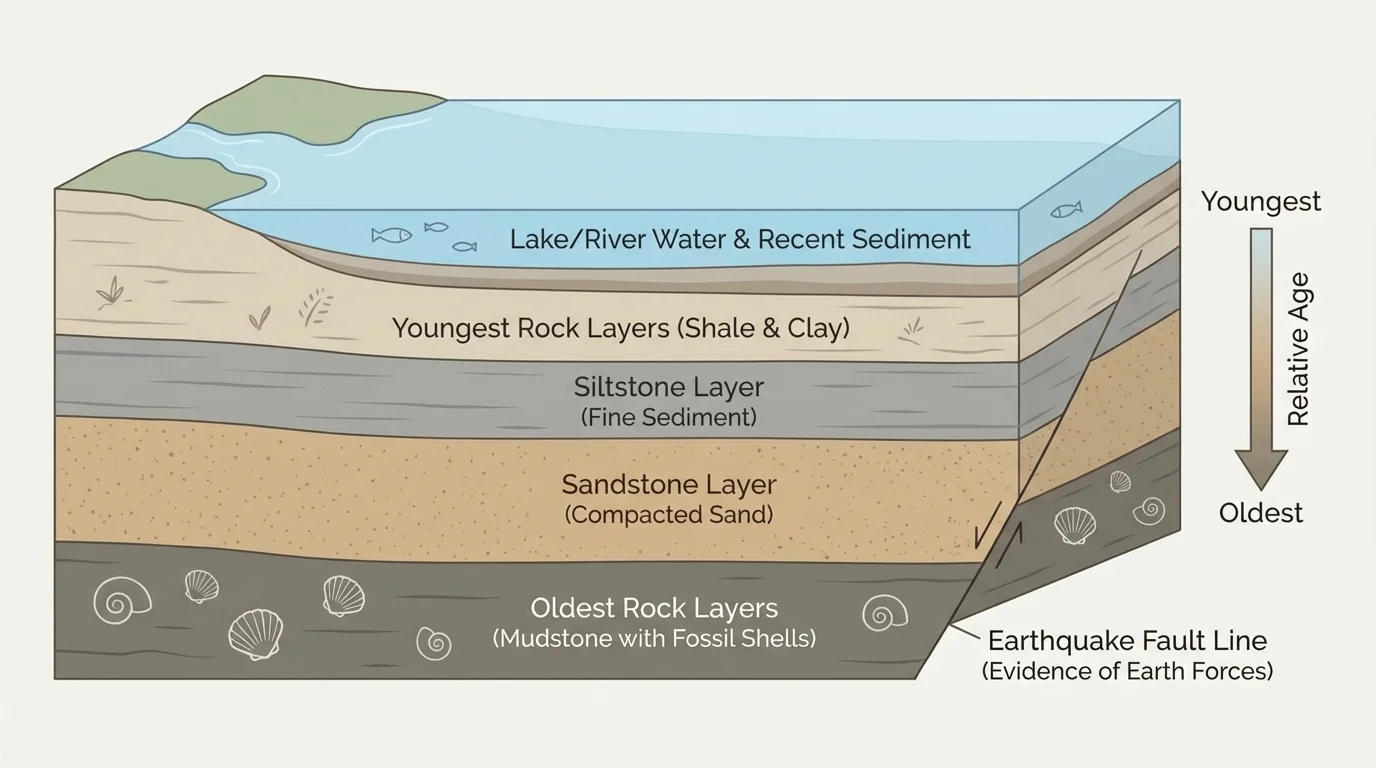
Scientists also study the color, thickness, and material in each layer. A dark layer with shell pieces may show that the area was once under shallow ocean water. A red sandy layer may suggest a dry desert long ago. A layer full of rounded stones may mean a strong river once flowed there.
Rock layer means a sheet of rock that formed during a certain time. Relative age means whether something is older or younger than something else, even when we do not know its exact age in years.
When students look at a road cut or canyon wall, they are often seeing many different times in Earth's past stacked one on top of another. The deeper layers usually formed earlier, while the upper layers formed later.
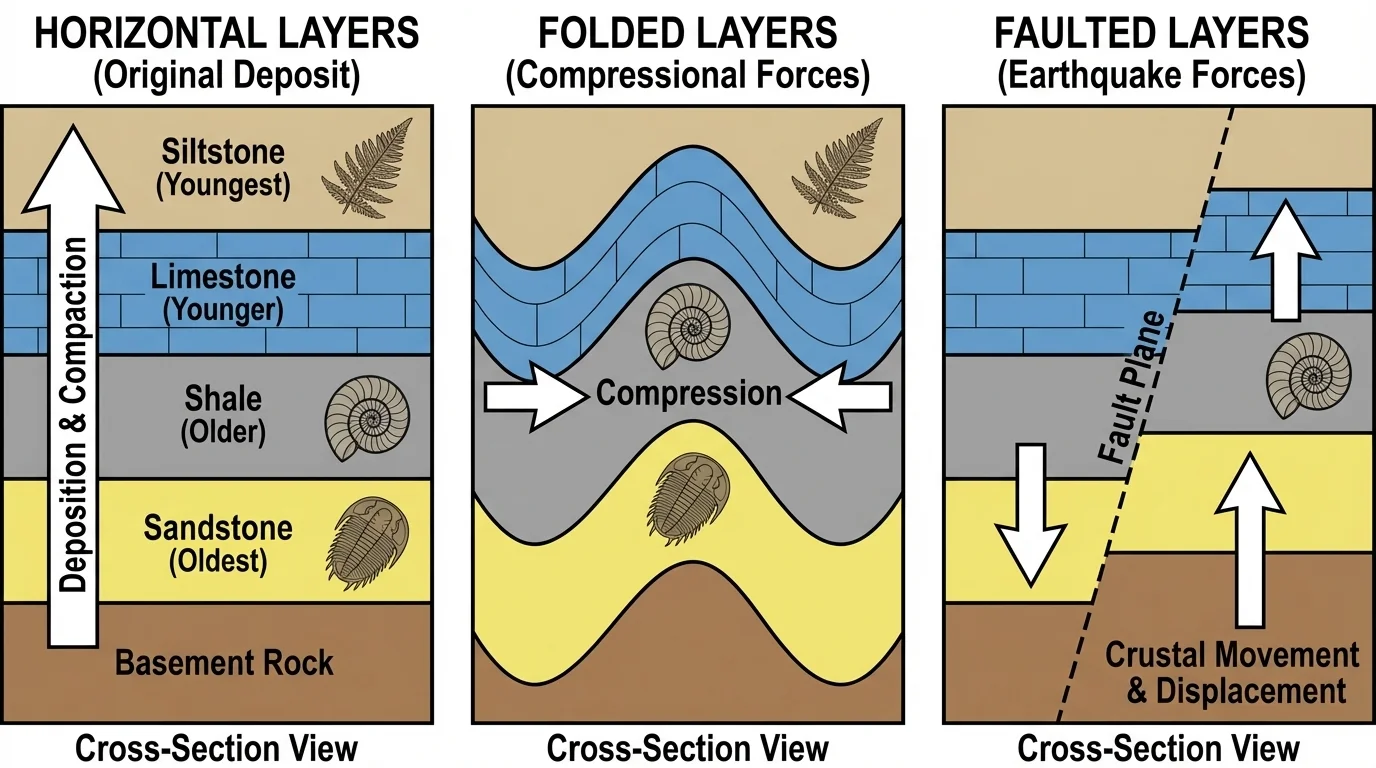
[Figure 2] Rock layers do not always stay flat forever. Earth's crust can move, and the movement can bend, break, or lift rocks. Layers that formed in flat sheets can later become folded like a bent carpet or broken along a crack called a fault. These changes happen because of strong Earth forces.
An earthquake happens when energy is released as rocks suddenly move along a fault. Earthquakes can shake the ground, but they also tell us something important: Earth's crust is active. If rocks move today, then rocks also moved in the past. That past movement changed many rock formations we see now.
Folding happens when rock layers are squeezed and bend without completely breaking. A layer that was once flat may curve into arches or dips. Fault movement happens when rocks break and one side moves up, down, or sideways compared with the other side.
Another force is uplift, when parts of Earth's crust are pushed upward. Uplift can raise old seafloor rocks into mountains. That is one reason scientists sometimes find marine fossils high above sea level. Those fossils did not grow on mountaintops. The rocks were lifted there over time.
After uplift, weathering and erosion often begin to wear the raised land down. Wind, water, and ice can cut into the rock and reveal older layers beneath. This is why cliffs, canyons, and mountain slopes are such useful places for geologists to study Earth's history.
Some rocks now found high in the Himalayas contain fossils from ancient sea creatures. This tells scientists that land that is now part of a giant mountain range was once under an ocean.
Later, when scientists compare bent and broken layers in different places, they can often connect those patterns to the same kinds of crust movement we still observe today. The folded and faulted layers we saw earlier in [Figure 2] help explain why rock patterns are not always flat and simple.
A local pattern is a pattern in one small place, such as a quarry, stream bank, or canyon wall. A scientist might notice that one cliff has three layers: sandstone on the bottom, shale in the middle, and limestone on top. That local pattern tells a story about what happened in that area.
[Figure 3] A regional pattern covers a larger area, such as a state, a mountain range, or a large river valley. In one region, the same rock layer might appear again and again in many places. That helps scientists match rocks across long distances. The map illustrates how matching rock and fossil patterns can be traced across separated areas.
A global pattern is even larger. Scientists have found rock types, mountain belts, and fossil evidence on different continents that fit together in surprising ways. These patterns help scientists understand how Earth's surface has changed over huge spans of time.
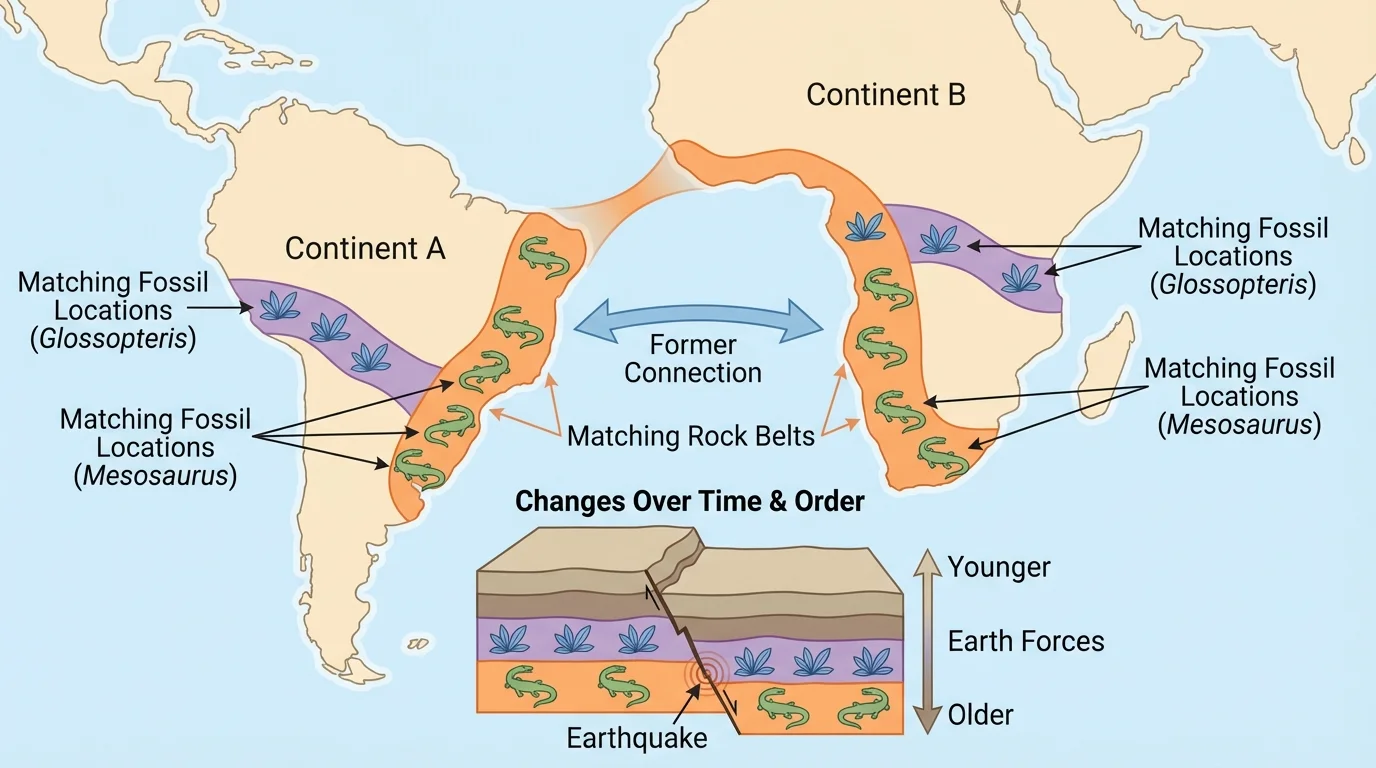
For example, if the same kind of fossil and the same kind of rock layer appear on two continents now far apart, that is an important clue. It suggests that those places may once have been connected or had very similar environments long ago.
Studying patterns at more than one scale is important. A single cliff tells part of the story, but many cliffs across a region can tell a bigger story. When scientists compare regions around the world, they can understand even larger changes in Earth's history.
| Scale | What scientists study | Example |
|---|---|---|
| Local | One place or small area | A road cut with visible layers |
| Regional | Many places across a large area | The same rock layer across a state |
| Global | Patterns across continents or oceans | Matching fossils on different continents |
Table 1. Rock-pattern scales from small local areas to the entire world.
Scientists do not rely on only one clue. They compare rock layers, rock types, fossils, and the way layers are bent or broken. The bigger the pattern they can confirm, the stronger their explanation becomes.
[Figure 4] A fossil is the preserved remains or trace of a living thing from the past. Fossils can be bones, shells, teeth, footprints, leaf prints, or other marks left in sediment that later turned to rock. Some fossils appear only in certain layers, and that makes them powerful clues.
Different kinds of living things lived during different times in Earth's history. That means some fossil types are older than others. If a certain fossil is found only in lower layers, and another fossil is found in higher layers, scientists can use that pattern to tell which layer formed first and which formed later.
This idea is called fossil succession. It means fossil types appear in a certain order in rock layers. If the same kind of fossil is found in two faraway places, those layers may have formed at about the same time, even if the rocks look a little different.
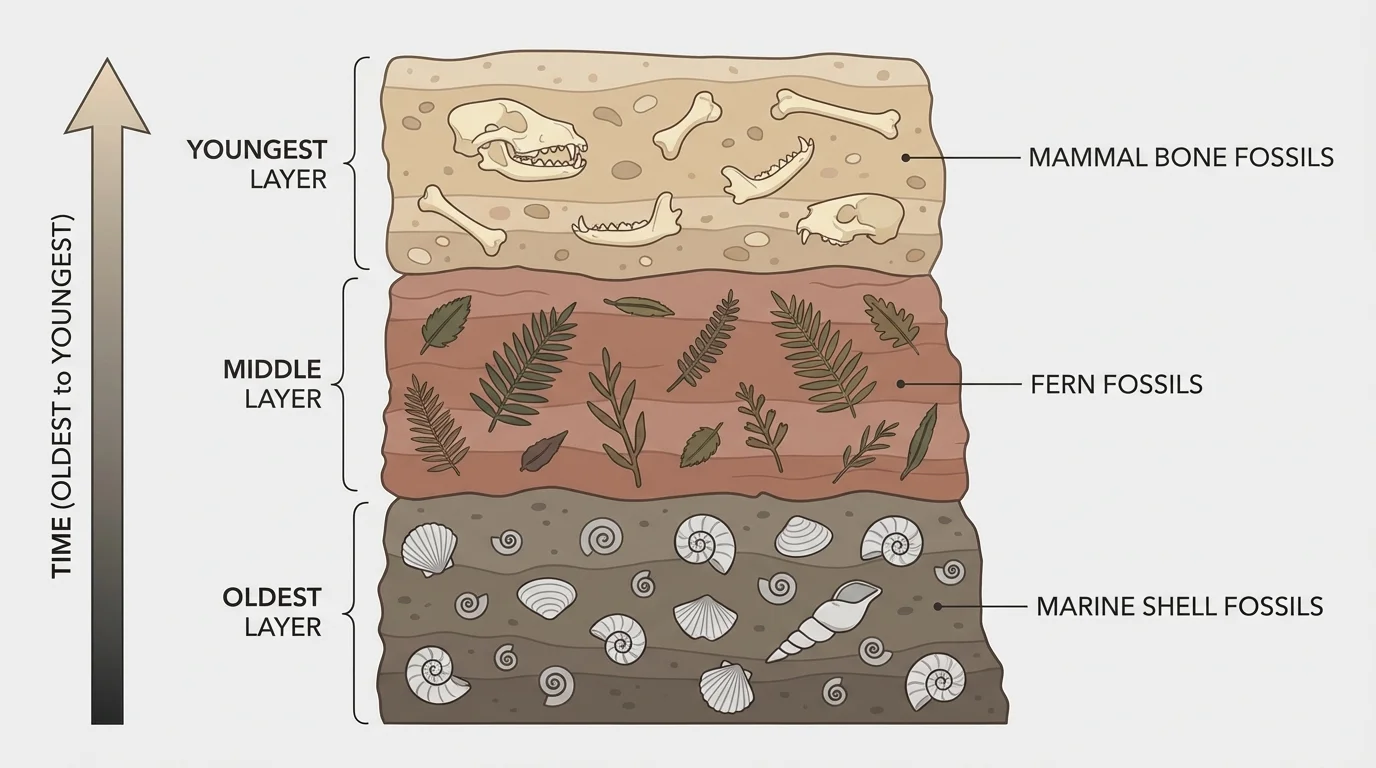
Suppose scientists find shell fossils in a low layer, fern fossils above that, and mammal bones in a higher layer. They infer that the shell layer formed before the fern layer, and the fern layer formed before the mammal-bone layer. The order of fossils helps reveal the order of the rock layers.
Using fossils to compare two places
Two cliffs are far apart. One cliff has a layer with a certain shell fossil. The other cliff also has a layer with the same shell fossil.
Step 1: Compare the fossils.
If the fossil type is the same and known to belong to a certain time, the layers may be the same relative age.
Step 2: Compare the layer positions.
If one fossil layer is below a fern layer in both places, then the shell layer is older than the fern layer in both cliffs.
Step 3: Build the history.
Scientists conclude that the shell-bearing layer formed first, then the fern-bearing layer formed later, even if the cliffs are many miles apart.
Fossils help connect separate rock records into one larger story.
Not every rock contains fossils. Rocks formed from melted rock usually do not preserve them well because the heat destroys remains. But many layered sedimentary rocks are excellent places to find fossil clues.
Scientists also think carefully about the environment each fossil suggests. Fish fossils may point to water. Plant fossils may point to land. Coral fossils suggest warm, shallow seas. In that way, fossils tell both when and where certain conditions existed.
Earth scientists are like puzzle solvers. A rock layer by itself gives one clue. A fossil by itself gives another. But when the clues are combined, the picture becomes much clearer.
For example, imagine a low rock layer with sea-shell fossils, a middle layer with ripple marks from shallow water, and an upper layer with plant fossils from land. Scientists may infer that the area was once covered by shallow ocean water and later became dry land. The order of the layers matters.
If those layers are now tilted or broken, scientists know something happened after the layers formed. Earth forces changed the rocks later. That is why scientists ask two different questions: What was this place like when the layer formed? and What happened to the layer afterward?
How scientists tell a sequence of events
First, scientists determine the relative ages of layers, often using superposition and fossil succession. Next, they look for signs that layers were bent, faulted, or lifted. This helps them build a timeline: layer formation first, then later Earth movements, then erosion that reveals the rocks today.
The fossil order in [Figure 4] becomes even more useful when combined with broken or folded rock layers. Even if a region has been changed by earthquakes and uplift, fossil clues can still help scientists match layers and rebuild the story.
Learning from rocks and fossils is not only about the distant past. It also helps people today. Geologists study faults and past earthquakes to understand where future earthquakes may happen. They map rock layers to learn where the ground may be stable or unstable for roads, bridges, tunnels, and buildings.
Rock layers can also help people find important resources. Groundwater often moves through certain rock layers. Oil and natural gas may collect in trapped layers. Useful minerals may be found in special kinds of rock formations. To locate these, scientists need to understand how layers were formed and changed.
Fossils are important too. They help scientists identify the age of rocks in places where drilling or construction reveals underground layers. If engineers know which layers they are working with, they can plan more safely.
Workers cutting through hills for highways sometimes expose rock layers that were hidden underground for millions of years. These fresh rock faces can give scientists valuable new information.
Understanding Earth's history also helps us understand climate and environmental change. Layers with coal suggest swampy forests long ago. Layers with desert sand suggest dry climates. Glacial scratches on rock show where ice once moved. Rocks are records of changing worlds.
Earth is part of a larger universe filled with rocky objects such as the Moon, Mars, and many asteroids. Scientists study craters, mountains, canyons, and layered surfaces on other worlds too. Those features show that planets and moons also change over time.
Earth is special because it has abundant liquid water, active plate movement, and fossils from ancient life. Other worlds may have layered surfaces, but on Earth, the combination of rock layers and fossils gives especially rich evidence about the past. By studying our planet carefully, scientists also learn how planetary surfaces can change across the universe.
Looking closely at Earth teaches an important idea: the planet we live on has a long history. Local cliffs, regional mountain belts, and global rock patterns are all parts of that history. When we read rocks and fossils together, we can discover how Earth has changed through time.
