A forest is not just a place where trees grow. A forest can actually change the ground under your feet, the water in nearby streams, and even the air above it. That is one of the amazing ideas in Earth science: living things do not simply live in a region. They also help shape it.
Earth has different regions, such as mountains, deserts, wetlands, grasslands, forests, rivers, and coasts. Each region has physical characteristics. These are the features you can observe, such as the kind of soil, the shape of the land, how much water is present, and what the surface looks like. Over time, living things can change many of these features.
Physical characteristics are the visible and measurable features of a place, such as its landforms, soil, water, and air conditions. Region means an area that has certain features in common. Erosion is the wearing away and movement of soil or rock by water, wind, ice, or gravity.
Some changes happen slowly, over many years. Tree roots can crack rock little by little. Worms can mix soil again and again. Coral animals can build giant reefs over a very long time. Other changes happen faster. A beaver can block a stream in a short time and turn part of it into a pond.
Earth's systems include land, water, air, and living things. These systems interact all the time. Rain falls on soil. Plants grow in that soil. Animals depend on the plants. Water flows through the area, and all of these things affect one another. This means a region is always changing.
Living things are part of those changes. A place with thick grass looks and behaves differently from a place with bare dirt. A riverbank with many roots can stay in place better than one without plants. A coastline with coral reefs or marsh grasses can be shaped differently from a coastline without them.
When scientists study a region, they ask questions such as: What lives here? How do those organisms affect the land? How do they affect the water? How do they affect the air? These questions help explain why one place looks different from another.
Remember that Earth's surface is changed by water, wind, ice, and gravity. Living things do not replace these forces. Instead, they often work with them or slow them down. For example, rain can wash soil away, but plant roots can help hold that soil in place.
The physical characteristics of a region include its landforms, its soil, its amount of water, and its surface features. A landform is a natural shape of Earth's surface, such as a hill, valley, plain, dune, or reef. Physical characteristics also include whether the ground is rocky or muddy, dry or wet, flat or steep.
For example, think about a stream. Its physical characteristics include the shape of its banks, the speed of the water, the size of the rocks, and the kind of plants growing beside it. If beavers build a dam, if roots hold the banks together, or if algae grow in the water, the stream's physical characteristics can change.
That is why this topic matters: when living things change a place, they are helping shape the region itself.
Plants are some of the most important Earth shapers in nature. Their roots reach into the ground and act like a net on a hillside. Roots hold soil together, making it harder for rain or wind to carry the soil away. This helps reduce erosion.
Plants can also break rock. When roots grow into tiny cracks in rock, they push outward. Over time, the rock can split apart. The broken rock becomes smaller pieces, and eventually some of it becomes part of the soil. This is one way plants help change the surface of Earth.
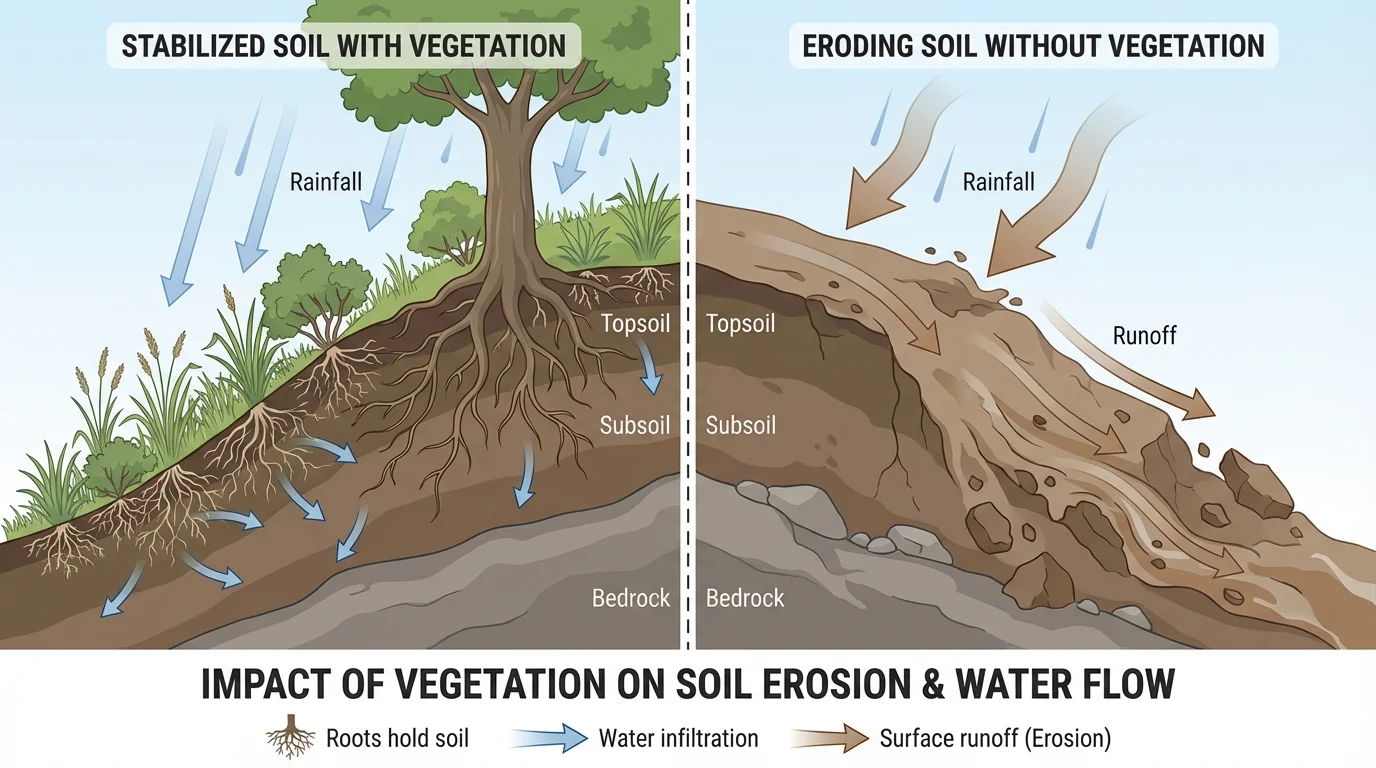
Leaves, stems, and grasses also slow down moving water. When rain falls on a bare slope, water can rush downhill and carry away dirt. When plants cover the slope, the water moves more slowly. Slower water usually carries less soil away.
Forests change more than the ground. Trees create shade, which can keep soil cooler and wetter. Fallen leaves form a layer on the ground that helps hold moisture. As those leaves break down, they add nutrients to the soil. This can make the area more supportive of other plants and animals.
Grasslands are another great example. The long roots of grasses can reach deep underground. These roots help keep the soil in place during heavy rain and strong wind. In some places, grass roots have helped form thick, dark soil over many years.
Later, when we compare different regions, [Figure 1] remains useful because it shows an important idea: plants do not just sit on the ground. They help shape what the ground becomes.
Some tree roots are strong enough to lift sidewalks or crack pavement. If roots can change human-made surfaces, they can also slowly change natural rock and soil.
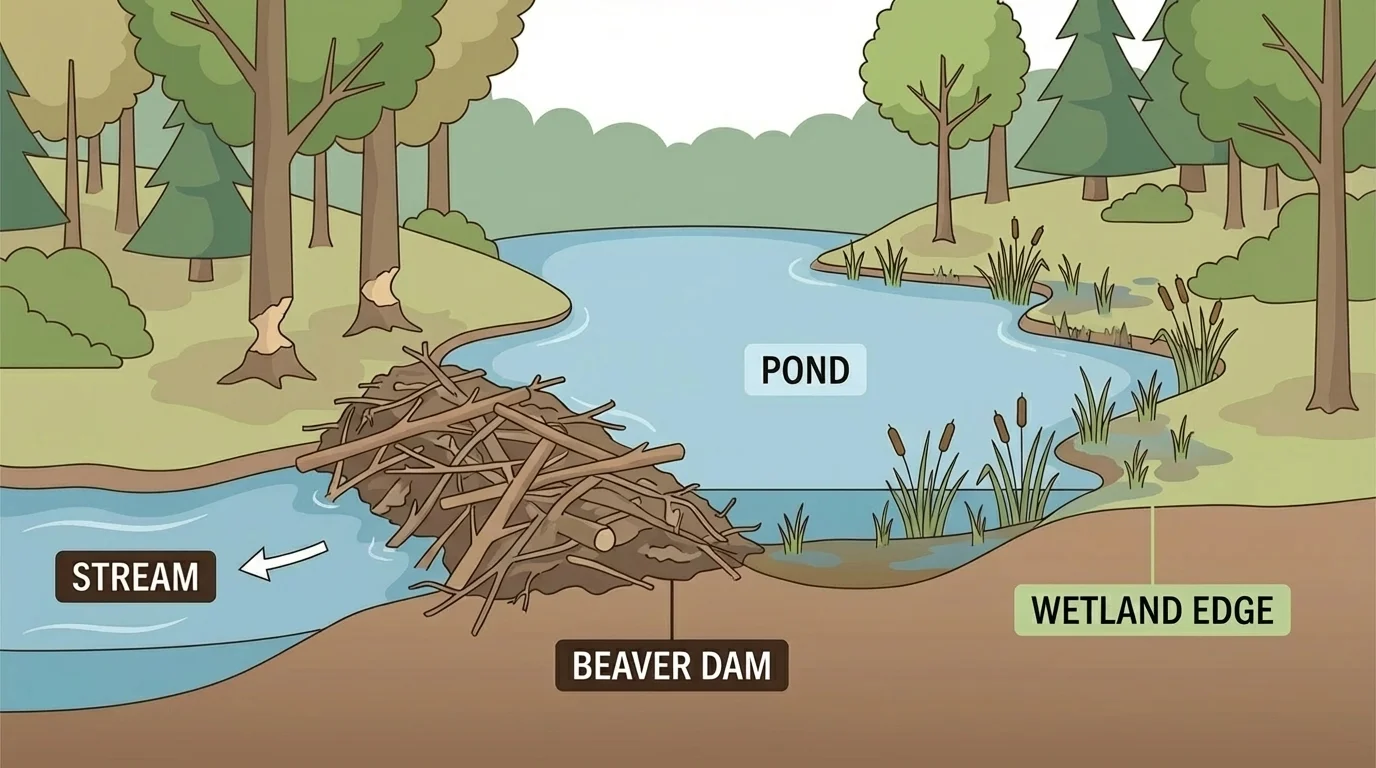
Animals can shape regions in powerful ways too. Some animals dig, some build, and some stir up soil or water. A famous example is the beaver dam, which can transform a flowing stream into a pond.
When beavers cut branches and build a dam across a stream, water slows down behind it. As the water collects, a pond forms. This changes the physical characteristics of the region. The water becomes deeper in one area, the shape of the stream changes, and wet soil spreads nearby. A new wetland habitat may begin to form.
These changes affect many other living things. Fish, frogs, insects, birds, and plants may move into the new pond or wetland. Mud and small pieces of soil settle in the slower water. Over time, the whole area may look very different from the stream that was there before.
Other animals also reshape land. Earthworms tunnel through the ground and mix soil. This makes the soil looser, which can help air and water move through it. Prairie dogs, ants, moles, and rabbits dig burrows. Their digging can change the surface and move soil from underground to aboveground.
Along coasts and in oceans, tiny corals build hard structures made mostly of calcium carbonate, written as \(\textrm{CaCO}_3\). Over very long periods, these structures can form large coral reefs. Reefs are physical features of a region. They can break waves, protect shorelines, and create places for many sea creatures to live.
Far from rivers and oceans, herds of grazing animals can also change a region. If too many animals eat too much grass, less plant cover remains. Then wind and rain may remove more soil. This shows that living things can make a region more stable or less stable, depending on the situation.
The beaver example helps us notice a big pattern: one species can change water flow, soil, land shape, and habitats all at once.
Living things can create habitats while changing land. When an organism changes soil, water, or landforms, it often makes new living spaces for other organisms. A beaver pond, a worm-mixed garden soil, and a coral reef are all examples of physical changes that also create habitats.
Some of the most important region-shaping living things are so small that we often do not notice them. Decomposers, such as fungi and many bacteria, break down dead plants and animals. As they do this, materials return to the soil.
This process helps create rich soil. When leaves, dead insects, and fallen branches break down, the soil becomes darker and more crumbly. It can hold more water and support more plant growth. In this way, tiny organisms help change the physical characteristics of forests, gardens, and fields.
In ponds, lakes, and oceans, tiny living things such as algae and plankton can affect water too. If large amounts grow, they may change the color or clarity of the water. In some cases, too much algae can reduce oxygen in the water, making it hard for fish and other animals to survive.
Even though these organisms are small, the changes they cause can affect an entire region. Soil quality, water quality, and even the appearance of a place can depend partly on tiny life forms.
Living things do not only shape the ground and water. They also affect the air, or atmosphere. Green plants use photosynthesis to make food. In this process, plants take in carbon dioxide, written as \(\textrm{CO}_2\), and release oxygen, written as \(\textrm{O}_2\).
A simple way to show this change is with the chemical equation for photosynthesis:
\[6\textrm{CO}_2 + 6\textrm{H}_2\textrm{O} \rightarrow \textrm{C}_6\textrm{H}_{12}\textrm{O}_6 + 6\textrm{O}_2\]
This equation means plants use carbon dioxide and water to make sugar and oxygen. Sunlight provides the energy for the process. For example, if a plant uses \(6\) molecules of \(\textrm{CO}_2\) and \(6\) molecules of \(\textrm{H}_2\textrm{O}\), it can produce \(1\) sugar molecule, written as \(\textrm{C}_6\textrm{H}_{12}\textrm{O}_6\), and \(6\) molecules of \(\textrm{O}_2\).
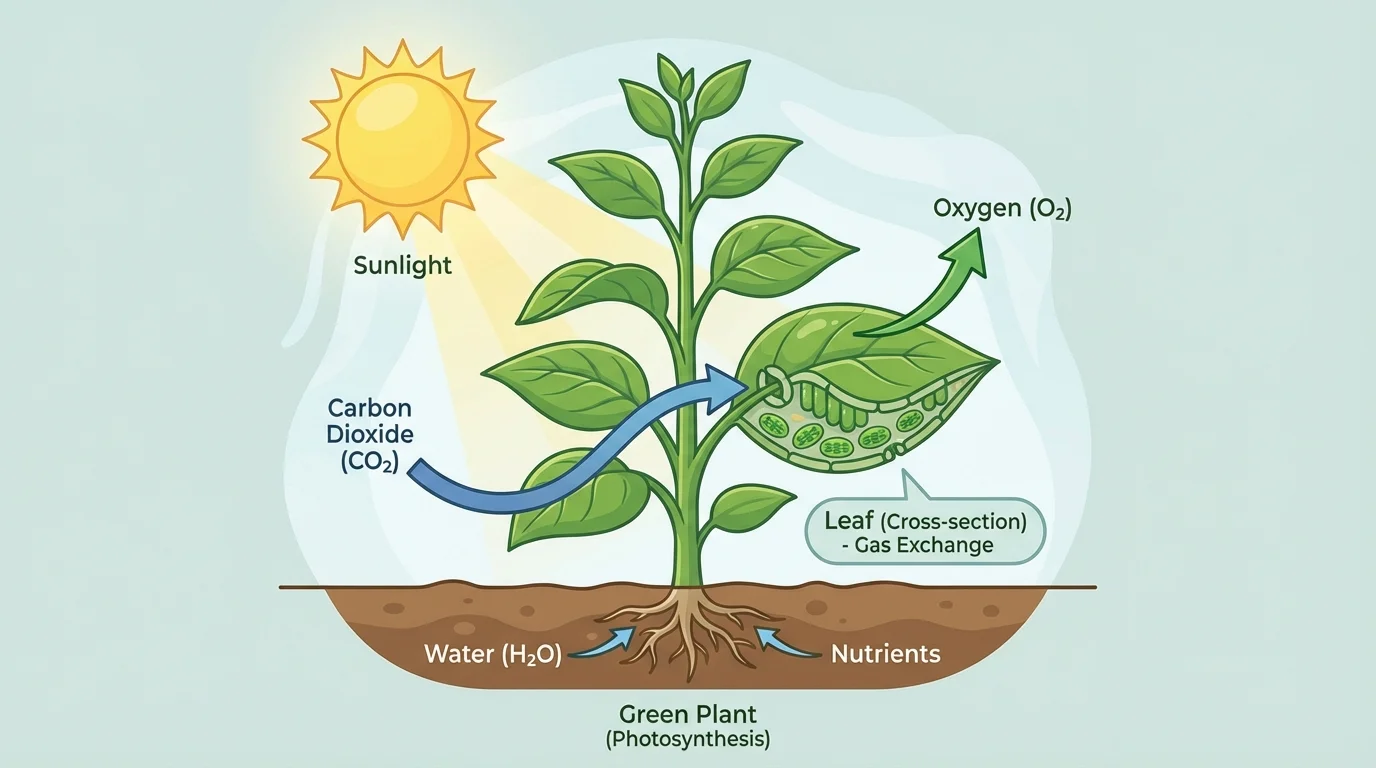
Because plants affect the amounts of gases in the air, they can influence the conditions of a region. Forests release water vapor into the air from their leaves. This can affect humidity and sometimes even local rainfall patterns. Large areas of plants can help keep a region cooler than areas with bare ground or pavement.
Oceans are part of this story too. Tiny marine plants called phytoplankton also perform photosynthesis. Even though they are small, huge numbers of them live in the ocean and help affect the gases in Earth's atmosphere.
When forests are cut down, some of these effects change. There may be less shade, less moisture held in the ground, and less carbon dioxide taken from the air. The idea in [Figure 3] helps explain why plants matter not only to a single backyard, but to whole regions.
Real-world example: A tree-covered park and a bare lot
Two nearby places can feel very different because living things affect the region.
Step 1: Compare the surfaces
The park has trees, grass, and soil. The lot has mostly bare ground or pavement.
Step 2: Compare what happens after rain
In the park, roots help hold soil, and plants slow down water. In the lot, water may run off quickly.
Step 3: Compare the air
The park is often cooler and shadier because plants release water vapor and block sunlight.
Living things have changed the land, water movement, and air conditions of the park region.
The same idea appears in different ways in different places. A living thing that shapes a forest may not be the same as one that shapes a desert or a coast. But in each case, life affects the physical characteristics of the region.
In forests, trees and other plants help build soil, hold slopes together, and affect moisture. In wetlands, reeds, grasses, and other water-loving plants slow water and trap mud. In deserts, plants are fewer, but the ones that survive can still help hold sand and soil in place. Along warm coasts, coral reefs create hard structures in shallow water.
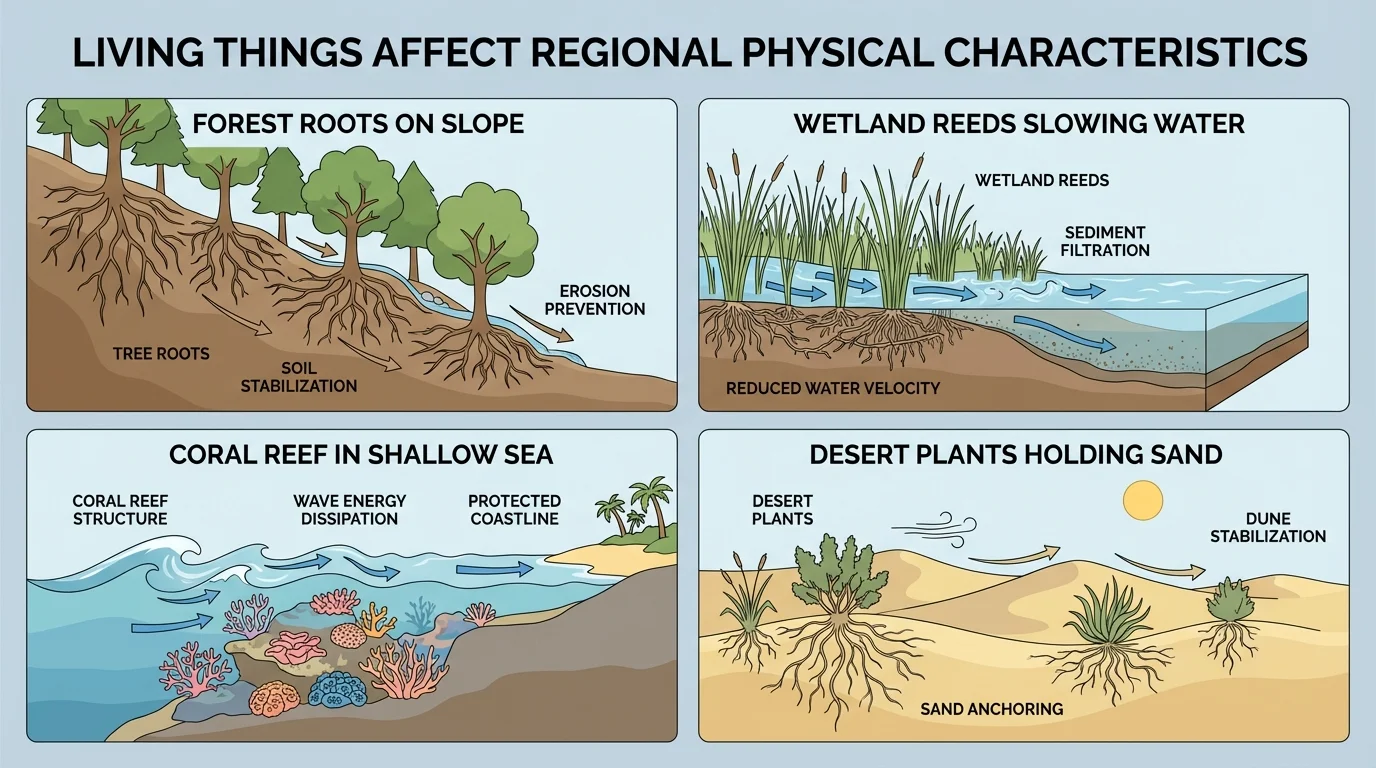
In grasslands, the main effect often comes from deep plant roots and from grazing animals. In tundra regions, where the ground stays cold for much of the year, mosses and lichens can help cover and protect the surface. In river valleys, plants and animals together may affect flooding, soil movement, and the shape of stream banks.
Wetlands are especially important. Their plants slow water down and trap sediment, which is tiny rock and soil material carried by water. This can help reduce flooding and make the water clearer. Wetlands can also protect shorelines and riverbanks.
Coral reef regions are another strong example. Reefs create underwater ridges and barriers. These physical structures can reduce the force of waves before they reach the shore. That means living coral animals help shape both the seafloor and the nearby coastline.
The comparison in [Figure 4] reminds us not to look for just one kind of Earth-shaping life. Different organisms do similar jobs in different regions.
| Region | Living thing | How it changes the region |
|---|---|---|
| Forest | Trees and other plants | Hold soil, break rock, add leaf litter, keep ground moist |
| Grassland | Grasses and grazing animals | Build and protect soil, but heavy grazing can increase erosion |
| Wetland | Marsh plants | Slow water, trap sediment, reduce flooding |
| Stream | Beavers | Build dams, form ponds, change water flow |
| Ocean coast | Corals | Build reefs, shape seafloor, reduce wave energy |
Table: Examples of how living things change the physical characteristics of different regions.
Many changes made by living things help keep a region healthy. Plant roots reduce erosion. Wetland plants trap sediment. Corals and the reefs they build protect coasts. Decomposers enrich soil. Beavers can create valuable wetland habitats.
But not every change is helpful in every situation. If too many grazing animals remove too much plant cover, soil may erode. If invasive plants spread quickly, they may crowd out local plants and change water use in the region. If harmful algae grow too much in a lake, water quality can drop.
Humans are living things too, and our actions strongly affect regions. When people plant trees, protect wetlands, or restore damaged streams, they help life support Earth's systems. When forests are removed carelessly or land is overused, regions may become less stable.
"A place is shaped not only by rock, water, and wind, but also by the living things that call it home."
These ideas matter in everyday life. Farmers often plant cover crops so roots hold soil in place between growing seasons. Communities protect wetlands because wetlands can reduce flooding. People restore dunes and beaches by planting grasses that help hold sand together.
Scientists and engineers also study how living things can help solve problems. For example, planting trees on hillsides can reduce landslides and soil loss. Protecting coral reefs can help reduce coastal damage from waves. Restoring riverbank plants can make streams healthier and clearer.
Even in cities, living things affect physical characteristics. Tree roots change soil, city trees cool neighborhoods, and rain gardens filled with plants can soak up water that might otherwise flood streets. A region does not have to be wild or far away for life to shape it.
Case study: Restoring a stream bank
A town notices that part of a stream bank is washing away after storms.
Step 1: Observe the problem
The bank has little plant cover, so fast water removes soil easily.
Step 2: Add living things
The town plants native grasses, shrubs, and trees along the bank.
Step 3: Watch for change over time
Roots begin to hold the soil, plants slow runoff, and the bank becomes more stable.
This is a real-world way people use living things to change the physical characteristics of a region in a helpful way.
When you look at a place carefully, you can often find clues that living things have shaped it. Exposed roots on a hillside, muddy water trapped in a wetland, a beaver pond, rich dark forest soil, or a coral reef near shore all tell part of the story.
A useful way to think is by cause and effect. Ask: What lives here? What does it do? How does that action affect the land, water, or air? These questions help explain why regions change over time.
Life is one of Earth's most powerful change-makers. Plants, animals, and tiny organisms can hold soil, break rock, slow water, build reefs, dig tunnels, and change the atmosphere. Because of them, the physical characteristics of a region are never just the result of rock and weather alone.
