Here is a surprising idea: when you run, jump, laugh, or even blink, you are using energy that may have started in the sun long ago. A slice of bread, an apple, a glass of milk, or a piece of chicken all connect back to sunlight. Food is not just something that fills your stomach. Food stores energy, and that energy has a story.
The energy your body gets from food was once sunlight. Plants capture light energy from the sun and use it to make their own food. Then animals eat plants, or they eat animals that ate plants. That means the energy in almost all food chains begins with the sun.
Food contains chemical energy. This is energy stored in matter. In food, that energy is stored in tiny parts called chemical bonds. When your body breaks food apart during digestion and other body processes, it can use that stored energy for living.
Energy is the ability to make things happen, such as movement, heating, light, or sound. Energy can change from one form to another, but it does not just appear from nowhere.
So where did the food's chemical energy come from in the first place? It came from sunlight that was captured by plants and turned into plant matter.
Plants are amazing because they can make their own food, as [Figure 1] shows. They take in water through their roots and a gas called carbon dioxide from the air. With energy from sunlight, they build sugar and other plant materials.
This process is called photosynthesis. During photosynthesis, plants use sunlight to change water, \(\textrm{H}_2\textrm{O}\), and carbon dioxide, \(\textrm{CO}_2\), into sugar, often written as \(\textrm{C}_6\textrm{H}_{12}\textrm{O}_6\), and oxygen, \(\textrm{O}_2\). A simple way to show it is:
\[6\textrm{CO}_2 + 6\textrm{H}_2\textrm{O} + \textrm{light energy} \rightarrow \textrm{C}_6\textrm{H}_{12}\textrm{O}_6 + 6\textrm{O}_2\]
This equation looks big, but the idea is simple: air and water are changed into plant food with help from sunlight.
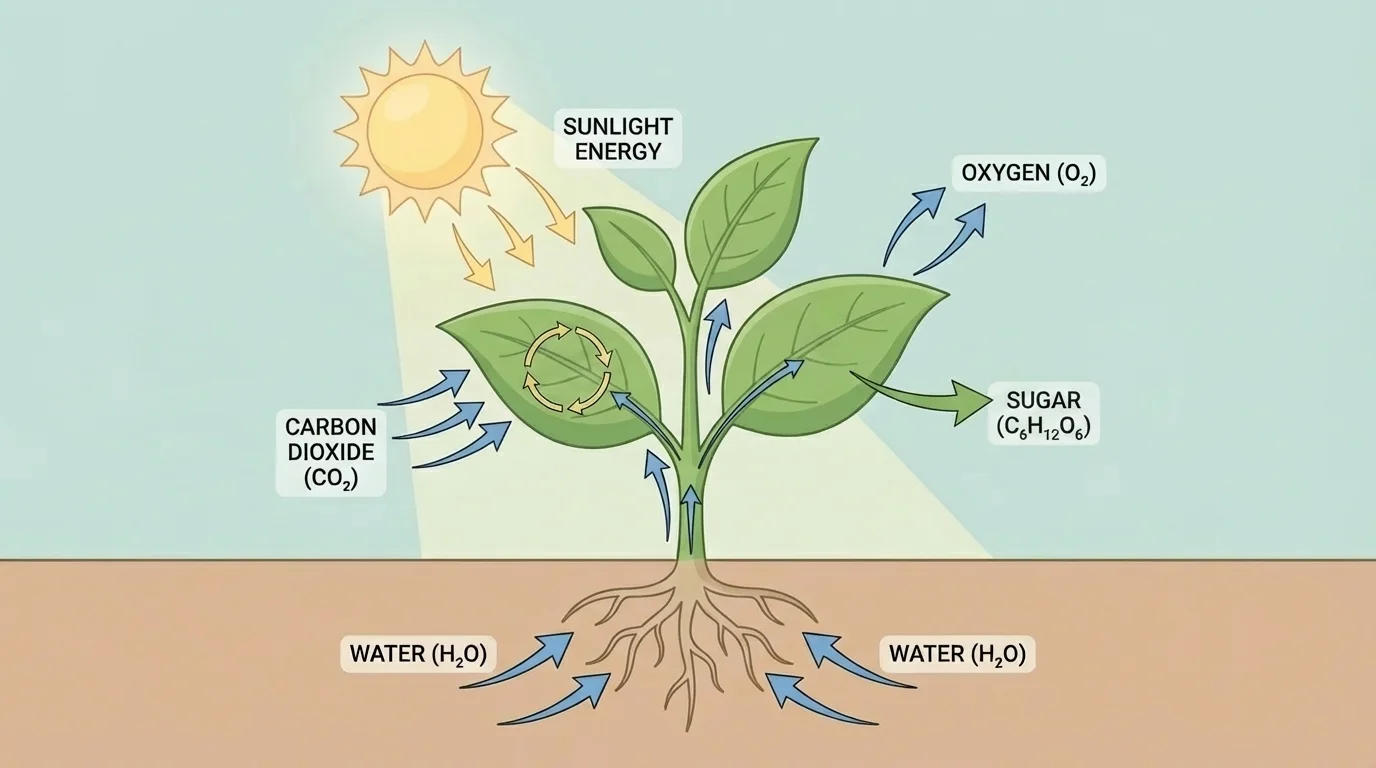
Plants do not pull most of their mass from soil. That surprises many students. A lot of plant matter is made from carbon dioxide in the air and water. When a tree grows taller and thicker, much of that new wood came from the air, not just from the ground.
How sunlight becomes stored food
Sunlight is a form of energy. During photosynthesis, a plant captures some of that light energy and stores it as chemical energy in sugar molecules. The sugar can be used right away or changed into other kinds of plant matter, such as wood, leaves, fruits, and seeds.
Plants also need minerals from the soil to stay healthy, but the main building materials for much of the plant come from air and water. This is one of the most amazing ideas in science: a plant can use invisible gas from the air, liquid water, and sunlight to build a solid leaf or a crunchy carrot.
When plants make sugar, they can use it in different ways. Some sugar is used right away for the plant's own needs. Some is stored for later. Some is turned into other substances that help build the plant body, such as stems, roots, bark, fruit, and seeds.
This built-up material is called plant matter. Plant matter includes all the stuff that makes up a plant's body. A juicy apple, a hard seed, a soft leaf, and a tall wooden trunk are all made from matter the plant built using photosynthesis.
For example, a bean plant starts as a small seed. With sunlight, air, and water, it grows leaves, stems, flowers, and beans. The beans hold stored food energy. When people or animals eat those beans, they get some of the energy the plant captured from the sun.
A huge tree can weigh hundreds or even thousands of kilograms, yet much of that mass was built from carbon dioxide in the air. The air around us helps build forests.
Fruits are another good example. A strawberry plant uses photosynthesis to build sweet fruit. The sweetness comes from sugars made by the plant. Those sugars store chemical energy that began as sunlight.
Animals cannot make their own food from sunlight the way plants do. Instead, animals get energy by eating plants or other animals, as [Figure 2] illustrates. This is why plants are so important in food chains.
A food chain shows how energy moves from one living thing to another. In a simple chain, the sun shines on grass, the grass grows, a rabbit eats the grass, and a fox eats the rabbit. The fox's energy depends on the rabbit, and the rabbit's energy depends on the grass. The grass depends on sunlight.
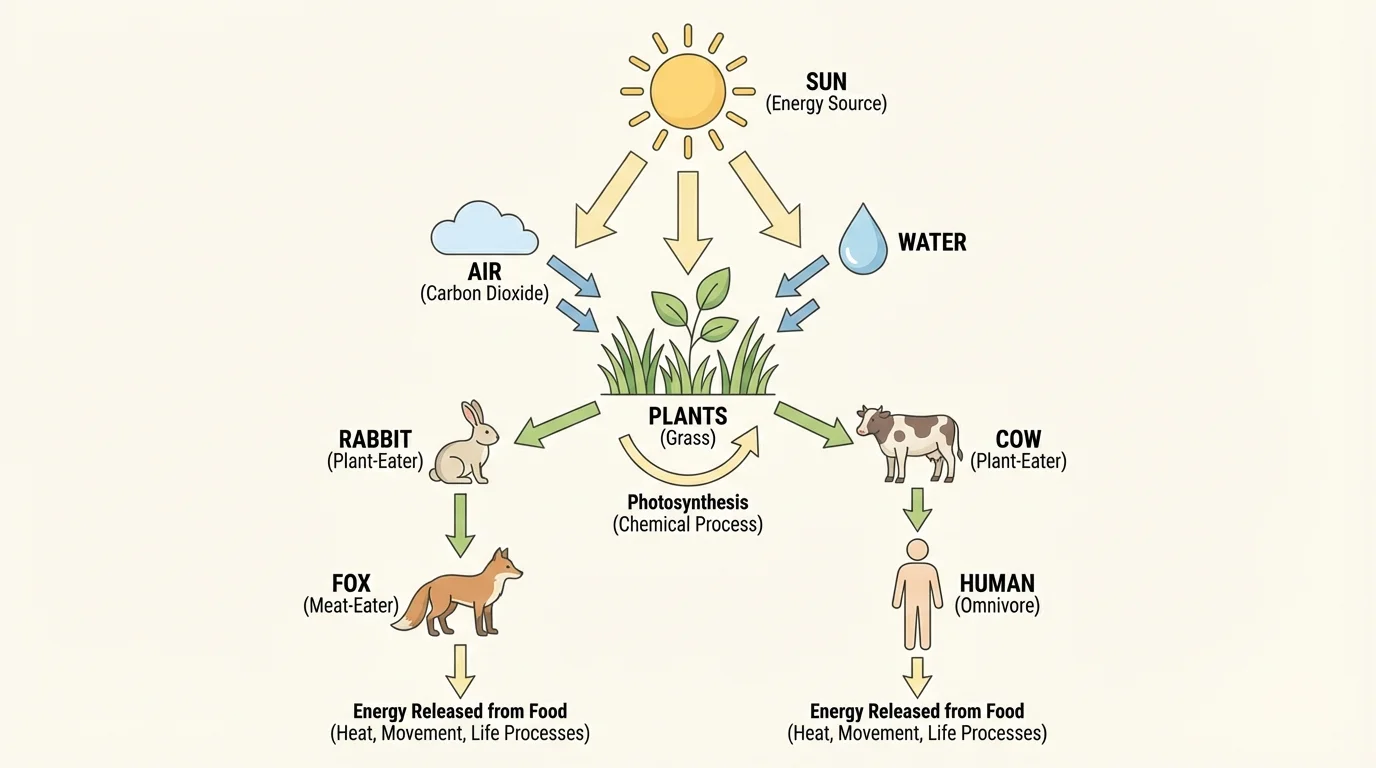
People fit into food chains too. If you eat a salad, you are getting energy directly from plants. If you drink milk or eat cheese, the energy came from a cow that ate plants. If you eat chicken, that chicken got its energy from plants or from feed made from plants such as corn.
This means that even foods that do not look like plants still connect back to plants. And because plants get their energy from the sun, many of the foods we eat are really carrying sunshine energy in stored form.
Tracing the energy in a sandwich
Step 1: Think about the bread.
The bread came from wheat plants. Wheat used sunlight, water, and carbon dioxide to grow.
Step 2: Think about the cheese.
The cheese came from milk. The cow that made the milk ate grass or feed from plants.
Step 3: Think about the person eating the sandwich.
The person gets chemical energy from both the bread and the cheese.
The sandwich energy traces back to plants, and the plants trace back to the sun.
We can see that animals do not start the energy flow. They pass energy along by eating other living things.
When you eat, your body begins a process called digestion. Digestion breaks food into smaller parts that your body can absorb and use. Your cells use these food molecules to release some of the stored chemical energy.
Your body uses this energy in many ways. Muscles use it to move your arms and legs. Your body uses it to keep warm. Your brain uses energy when you think, read, and solve problems. Your body also uses energy to grow and repair itself.
Even when you are sleeping, your body is still using energy. Your heart beats, your lungs move air, and your body keeps a steady temperature. This is why you need food every day.
Producer is a living thing, such as a plant, that can make its own food using sunlight.
Consumer is a living thing, such as an animal, that gets energy by eating plants or other animals.
Your body does not create energy from nothing. It changes the chemical energy in food into other forms of energy your body can use.
Energy is always changing form, and [Figure 3] shows this chain clearly. Sunlight becomes chemical energy in plants. Then, when animals or people eat the plants, that chemical energy can become movement, body heat, and energy for growth.
Suppose you eat a banana before a soccer game. The banana plant captured sunlight by photosynthesis. The banana stored chemical energy in sugars and other food molecules. When you eat the banana, your body can use some of that chemical energy to run, kick, and stay warm.
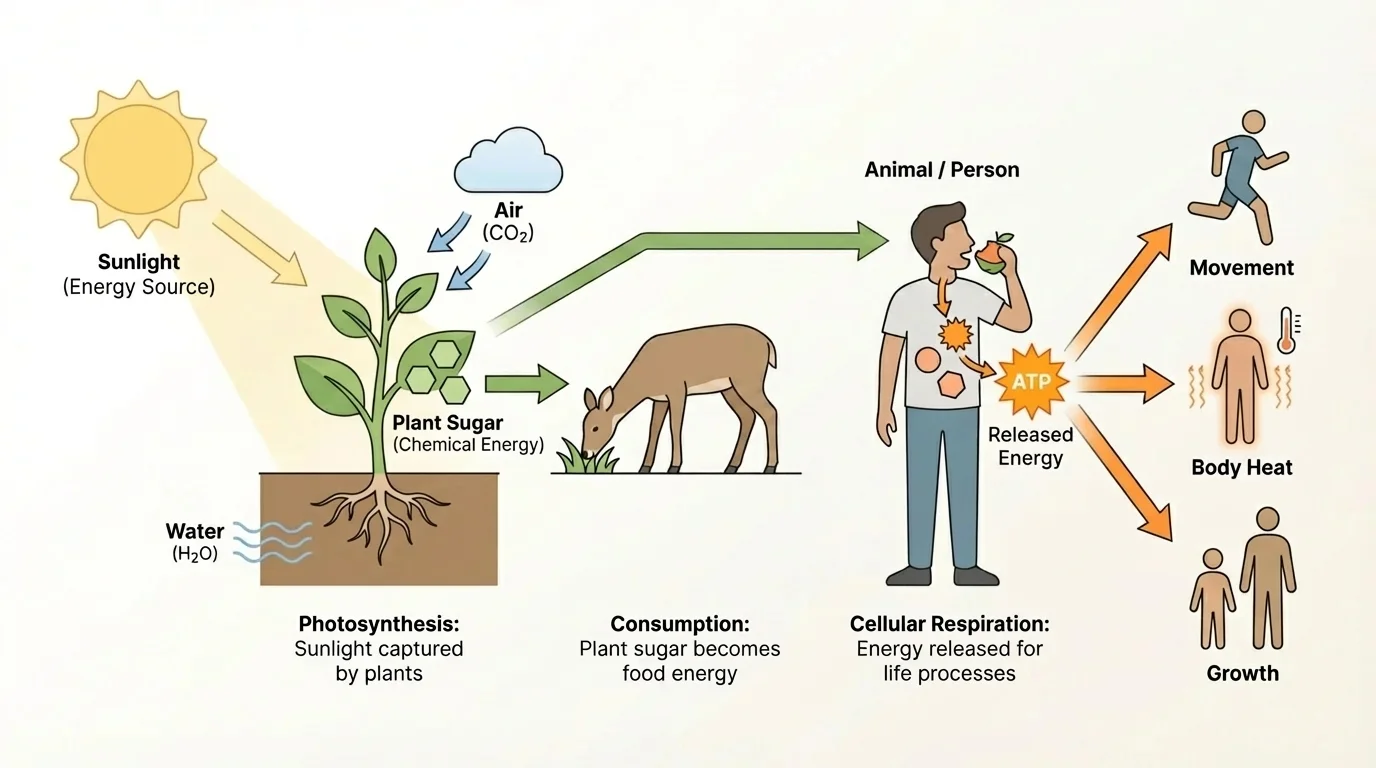
We can describe one simple path like this: \(\textrm{sunlight} \rightarrow \textrm{plant food} \rightarrow \textrm{your food} \rightarrow \textrm{motion and heat}\). The energy changes form, but it is still energy moving through a system.
If you rub your hands together quickly, they get warm. The food energy your muscles use for rubbing came from chemical energy in your body, and that chemical energy came from food. Looking back farther, that food energy traces to plants and sunlight.
"Almost every bite of food is a piece of stored sunlight."
This idea helps explain why the sun is so important for life on Earth. Without sunlight, plants could not capture energy to make food. Without plants, most animals, including people, would not have food energy to live.
Let us trace a few foods you may know well.
An apple grows on a tree. The apple tree uses photosynthesis to make sugars. When you eat the apple, you get energy that started as sunlight. Bread works in a similar way because it comes from grains such as wheat.
Milk may seem different because it comes from an animal. But cows eat grass or feed made from plants. So the energy in milk also traces back to sunlight captured by plants.
Chicken nuggets also connect to the sun. Chickens eat seeds, grains, and other foods that often come from plants. So even when people eat meat, the energy usually traveled from the sun to plants and then to the animal.
Everyday food and where its energy began
| Food | Direct source | Energy path |
|---|---|---|
| Apple | Apple tree | \(\textrm{Sun} \rightarrow \textrm{tree} \rightarrow \textrm{apple} \rightarrow \textrm{person}\) |
| Bread | Wheat plant | \(\textrm{Sun} \rightarrow \textrm{wheat} \rightarrow \textrm{bread} \rightarrow \textrm{person}\) |
| Milk | Cow | \(\textrm{Sun} \rightarrow \textrm{grass} \rightarrow \textrm{cow} \rightarrow \textrm{milk} \rightarrow \textrm{person}\) |
| Chicken | Chicken | \(\textrm{Sun} \rightarrow \textrm{grain} \rightarrow \textrm{chicken} \rightarrow \textrm{person}\) |
Table 1. Examples of common foods and how their energy traces back to the sun through plants.
These examples show that foods can have different paths, but the beginning is usually the same: sunlight captured by plants.
Understanding energy from food helps us understand ecosystems, farming, and our own bodies. Farmers depend on healthy plants because plants are the starting point for many food systems. Wild animals depend on plants too, either directly or indirectly.
It also reminds us that air, water, sunlight, and living things are connected. Plants use matter from the air and water to build food and body parts. Then that matter and energy move through food chains.
When you eat lunch, you are not just eating food. You are taking part in a huge Earth system that includes the sun, the atmosphere, water, plants, animals, and people.
So the next time you bite into an orange, chew a carrot, or drink a glass of milk, remember the hidden story inside it: sunlight was captured by plants, stored as chemical energy, and passed along until it reached you.
