A hawk flying over a field, a rabbit nibbling grass, mushrooms growing on a fallen log, and tiny bacteria in the soil may seem like completely different parts of nature. But they are all connected. In fact, if you trace where almost any animal gets its food, the path usually leads back to plants. That idea helps us understand one of the most amazing things about life on Earth: living things survive by depending on one another in a big, connected system called an ecosystem.
Every ecosystem is made of living things and the nonliving parts around them, such as sunlight, water, air, and soil. Some living things make their own food, some eat other organisms, and some break down what has died. Together, these relationships form a web of life. When the web is strong and balanced, many kinds of organisms can survive. When the web is disturbed, problems can spread through the whole system.
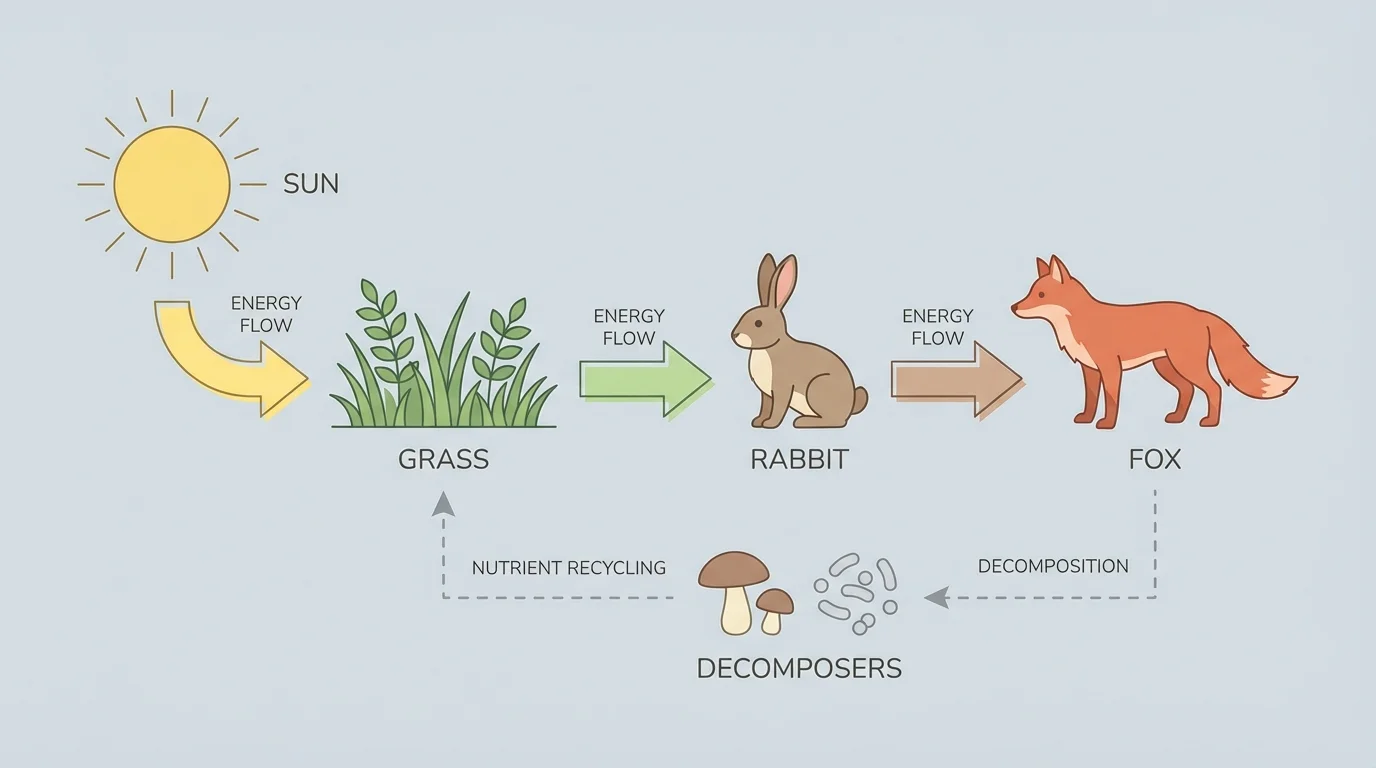
Plants are often called producers because they make their own food using sunlight, water, and air. This is why so many feeding paths begin with plants, as [Figure 1] shows. Grass, trees, bushes, pond plants, and even tiny water plants called algae capture energy from the Sun and store it in food.
Animals cannot make their own food the way plants do. A deer eats leaves. A caterpillar eats plant leaves. A mouse may eat seeds. Even an animal that never eats plants directly, such as a hawk, depends on plants in an indirect way because it might eat a mouse that ate seeds or a snake that ate a mouse.
This means the food of almost any animal can be traced back to plants. Without plants, there would be no plant-eaters, and without plant-eaters, many meat-eaters would not survive either. Plants are the starting point for energy moving through an ecosystem.
Think about breakfast. If a person eats toast, the wheat plant is part of that food path. If a person eats eggs, the chicken may have eaten grains from plants. If a person drinks milk, the cow likely ate grass or feed made from plants. Again and again, the path leads back to plants.
Producer means an organism that makes its own food, usually a plant.
Consumer means an organism that gets energy by eating plants or other animals.
Ecosystem is a community of living things interacting with one another and with nonliving parts of the environment.
Some places have huge plants, like rainforest trees. Other places have tiny producers, like algae floating in a pond. No matter the size, producers are essential because they bring energy into the living system.
A food chain is a simple model that shows who eats whom. It follows one path of energy. For example, grass is eaten by a rabbit, and the rabbit is eaten by a fox. That chain is useful, but real ecosystems are usually more connected than just one line, as [Figure 2] illustrates.
Most organisms eat more than one kind of food, and many animals are food for more than one predator. A robin may eat worms, insects, and berries. A frog may eat insects but also become food for a snake or a bird. Because of these many connections, scientists often use a food web, which shows several food chains linked together.
In a pond, small water plants may be eaten by insects or tiny fish. Those insects may be eaten by frogs. The fish may be eaten by larger fish, turtles, or herons. One organism can connect to many others. That is why food webs give a better picture of how ecosystems really work.
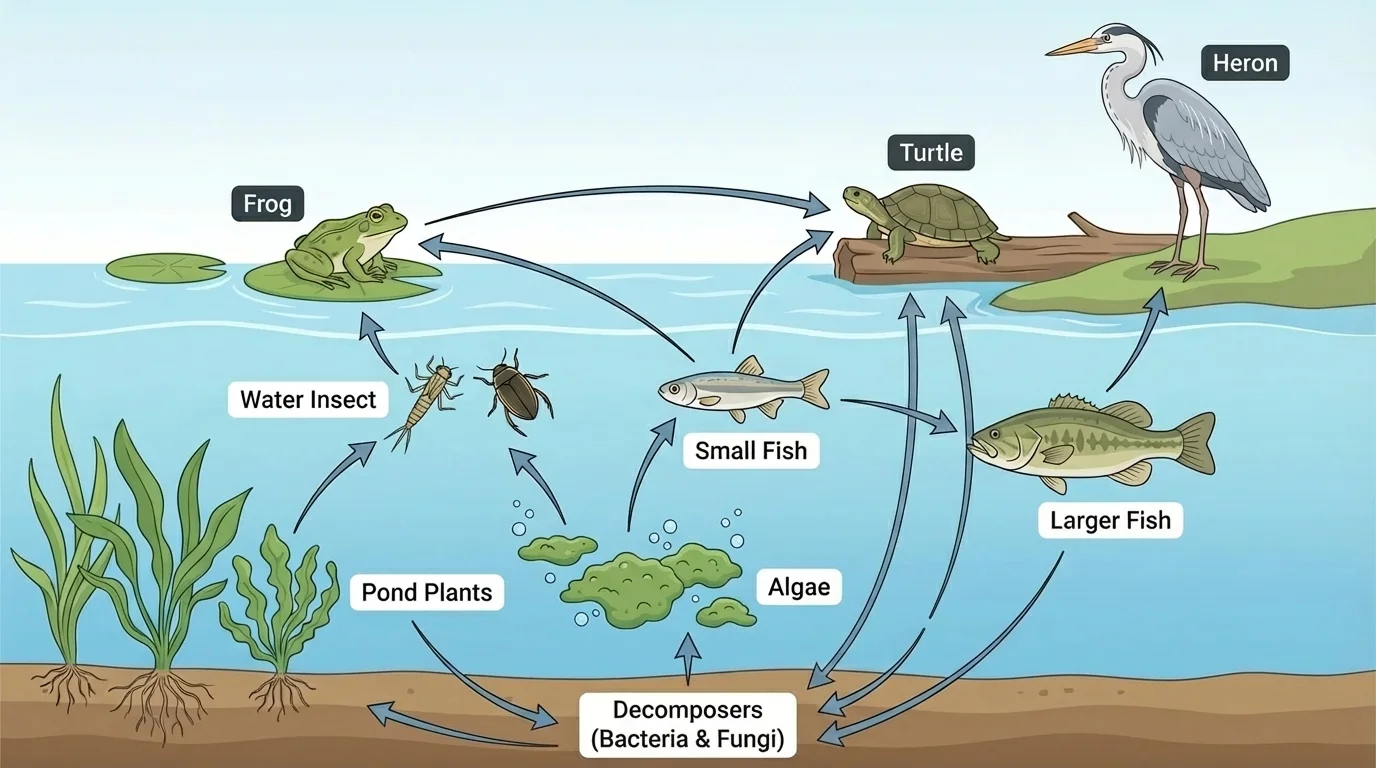
A food web is important because it helps explain what happens when one part changes. If a disease kills many pond plants, plant-eating insects may decrease because they have less food. Then frogs that eat the insects may also decrease. A change in one part of the web can affect many other organisms.
Sometimes one animal fits into more than one role. A bear might eat berries, fish, and insects. That means it connects to plants and animals in the same ecosystem. Looking back at [Figure 2], we can see that one missing connection can affect several paths at once.
Energy moves through a web of life
Energy enters most ecosystems from sunlight. Plants capture that energy and store it in food. When animals eat plants, they get some of that energy. When other animals eat those animals, energy moves again. At each step, living things use energy to move, grow, stay warm, and survive.
Food chains and food webs do not just tell us who eats whom. They also show that life is connected, and that no organism lives completely alone.
What happens when a plant dies, or when an animal dies? Nature does not simply leave that material forever. Decomposers, such as fungi and bacteria, break down dead plants, dead animals, and animal waste. As [Figure 3] shows, this process returns materials to the soil where plants can use them again.
Mushrooms growing on a log are a familiar sign of decomposition. Under the ground and on dead material, tiny bacteria are also at work, even though we cannot easily see them. They break complex materials into simpler substances. Over time, dead leaves, fallen branches, and dead organisms become part of the soil.
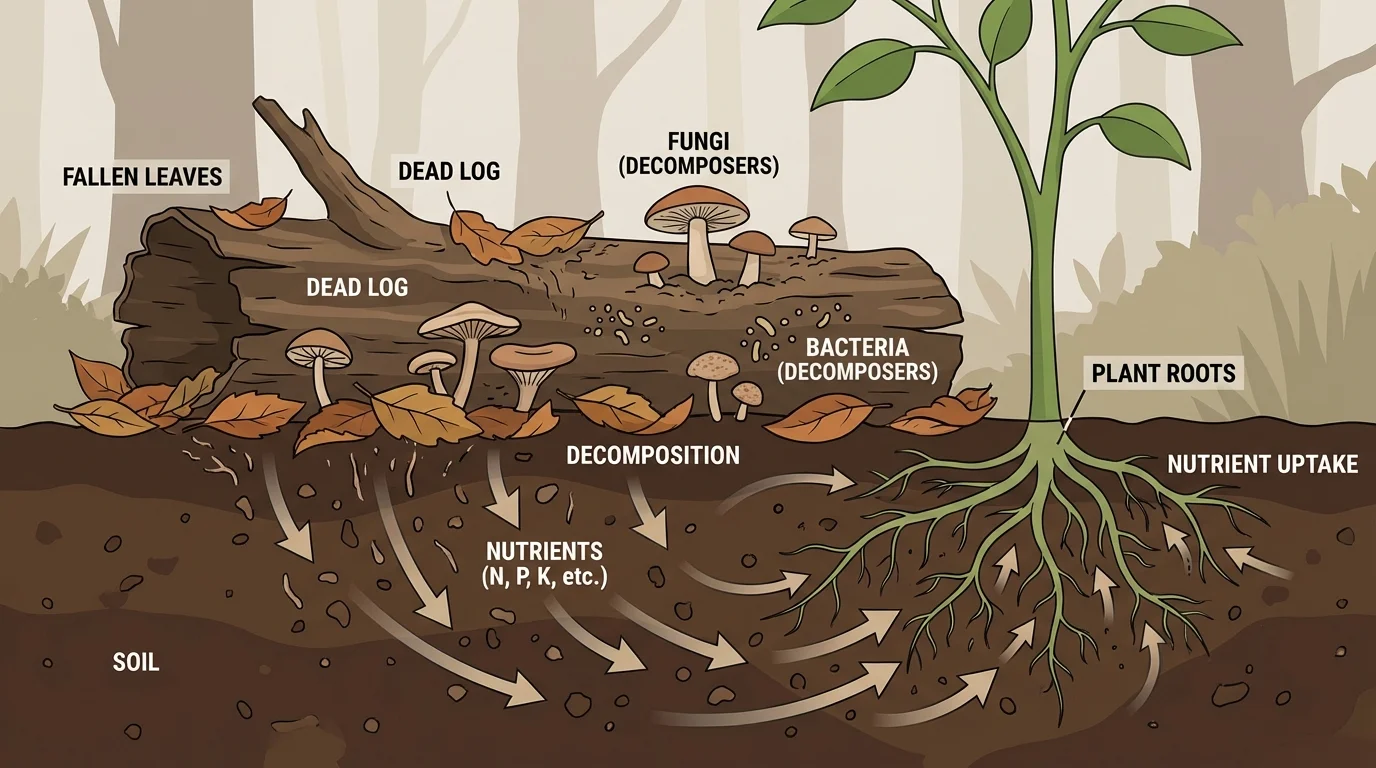
This recycling is extremely important. If decomposers did not exist, dead matter would pile up, and the soil would not be refilled with useful materials. Plants depend on these recycled materials to grow. Then animals depend on the plants. So decomposers are a key part of the ecosystem, even though they may be small or hidden.
When autumn leaves fall to the ground, they may seem finished. But they are really entering a new part of the cycle. Months later, some of their materials are back in the soil, helping new plants grow. That is one reason forests can keep renewing themselves year after year.
A single handful of healthy soil can contain huge numbers of tiny living things, including bacteria and fungi that help break down dead material and support plant growth.
Looking again at [Figure 3], the cycle becomes clearer: living things grow, die, decompose, and return useful materials to the environment. Ecosystems are not only about eating; they are also about recycling.
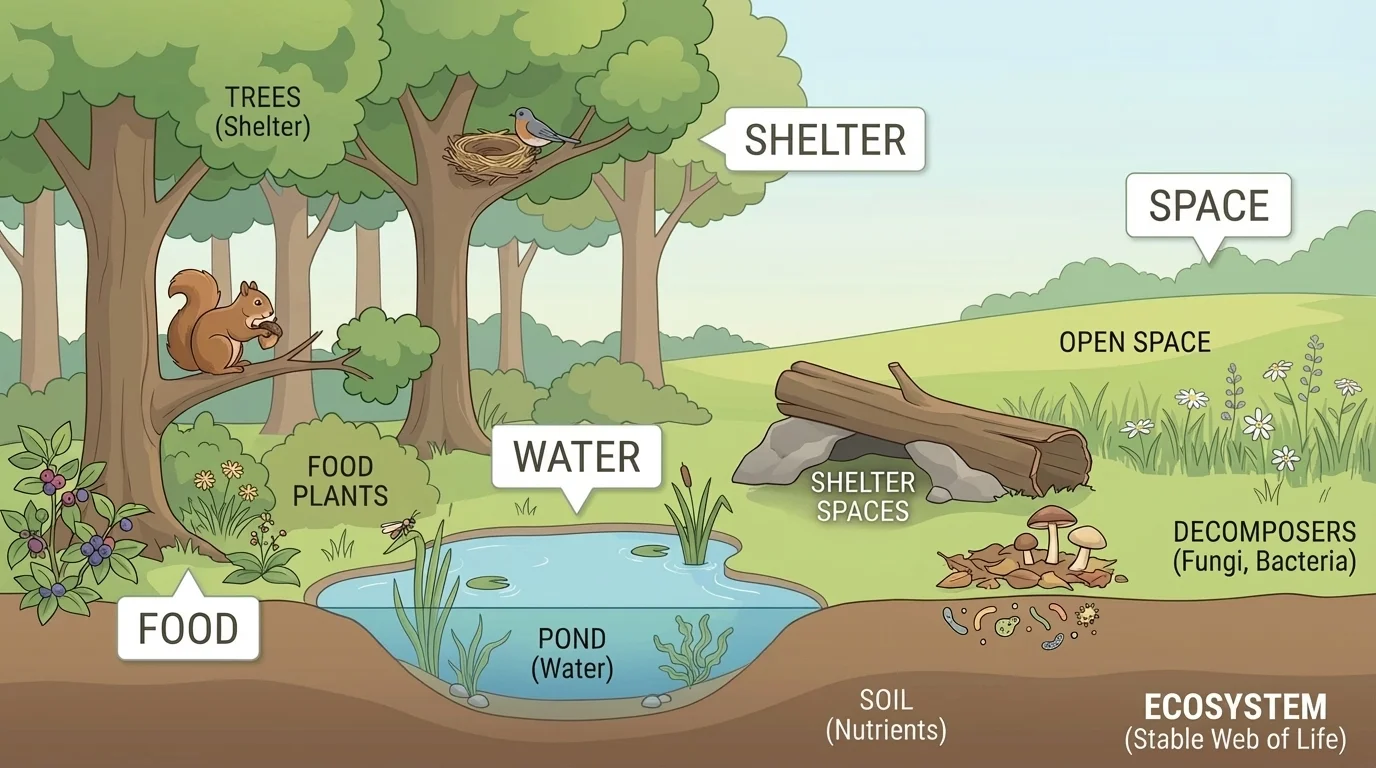
Each living thing needs the right place to live. A habitat is the environment where an organism gets what it needs to survive. As [Figure 4] shows, those needs may include food, water, air, shelter, space, and the right temperature.
A cactus can survive in a hot, dry desert because it is suited to low water conditions. A frog usually needs water or a damp environment. A polar bear is adapted to cold regions. A fish needs water with enough oxygen in it. If the environment does not meet an organism's needs, that organism cannot survive well there.
Needs can differ even between animals living in the same place. In a forest, a woodpecker may need trees with bark insects and places to nest. A deer may need plants to eat and enough open space to move. A fox may need prey, shelter, and room to hunt. The forest supports many species because it offers many kinds of resources.
When humans change habitats, organisms can be affected. Cutting down too many trees can remove shelter and nesting places. Polluting a stream can make the water unsafe for fish and insects. Draining a wetland can remove the damp home needed by frogs, turtles, and many birds.
[Figure 4] helps show that survival is not just about one need. An organism may find food in a place, but if it lacks water or shelter, it still may not survive. Organisms need a full set of conditions that work together.
Living things need basic resources to survive. Earlier science learning about plants and animals helps here: plants need sunlight, water, air, and space, while animals need food, water, air, and shelter.
That is why not every organism can live everywhere. The right environment matters just as much as the organism itself.
A healthy ecosystem is one in which many different species are able to meet their needs in a fairly stable web of life. Species means a kind of living thing, such as oak tree, rabbit, frog, or hawk. When there are multiple species of plants, animals, fungi, and microorganisms, the ecosystem is often stronger and more flexible.
Why does variety help? Suppose one type of plant has a bad year because of drought. If an ecosystem has only that one plant, many animals may suffer. But if there are several kinds of plants, some may still grow well, giving food and shelter to animals. More variety often means more ways for the system to keep working.
A healthy ecosystem also depends on balance. This does not mean every population stays exactly the same. Numbers naturally rise and fall. One year there may be more insects, and the next year fewer. Balance means the changes do not completely break the web of life.
| Part of the ecosystem | Main job | Example |
|---|---|---|
| Producers | Make food from sunlight | Grass, trees, algae |
| Consumers | Eat plants or animals | Rabbit, frog, hawk |
| Decomposers | Break down dead matter and recycle materials | Fungi, bacteria |
Table 1. Main roles of producers, consumers, and decomposers in an ecosystem.
If too many parts are removed, the ecosystem may struggle. For example, if pollinators such as bees disappear from an area, many flowering plants may make fewer seeds. Then animals that depend on those plants may also be affected. A healthy ecosystem needs many organisms doing many jobs.
Real-world example: A school garden ecosystem
A school garden can be a small but complete ecosystem.
Step 1: Producers grow.
Vegetables, flowers, and grasses use sunlight to make food.
Step 2: Consumers feed.
Caterpillars may eat leaves, birds may eat insects, and worms may eat decaying plant matter.
Step 3: Decomposers recycle.
Fungi and bacteria in compost and soil break down dead leaves and return materials to the garden soil.
Step 4: Habitat matters.
If the garden has water, shelter, flowers, and healthy soil, more organisms can survive there.
This small example works the same way as a larger forest or pond, just on a smaller scale.
Healthy ecosystems support life not by accident, but through many connected relationships happening at the same time.
Sometimes a species is moved, by people or by accident, into a place where it did not live before. A introduced species is a species that enters a new ecosystem. As [Figure 5] illustrates, newly introduced species can damage the balance of that ecosystem.
This can happen for several reasons. The introduced species may eat native organisms, take over their habitat, use up food resources, or reproduce very quickly. Sometimes it has no natural predators in the new place, so its population grows fast.
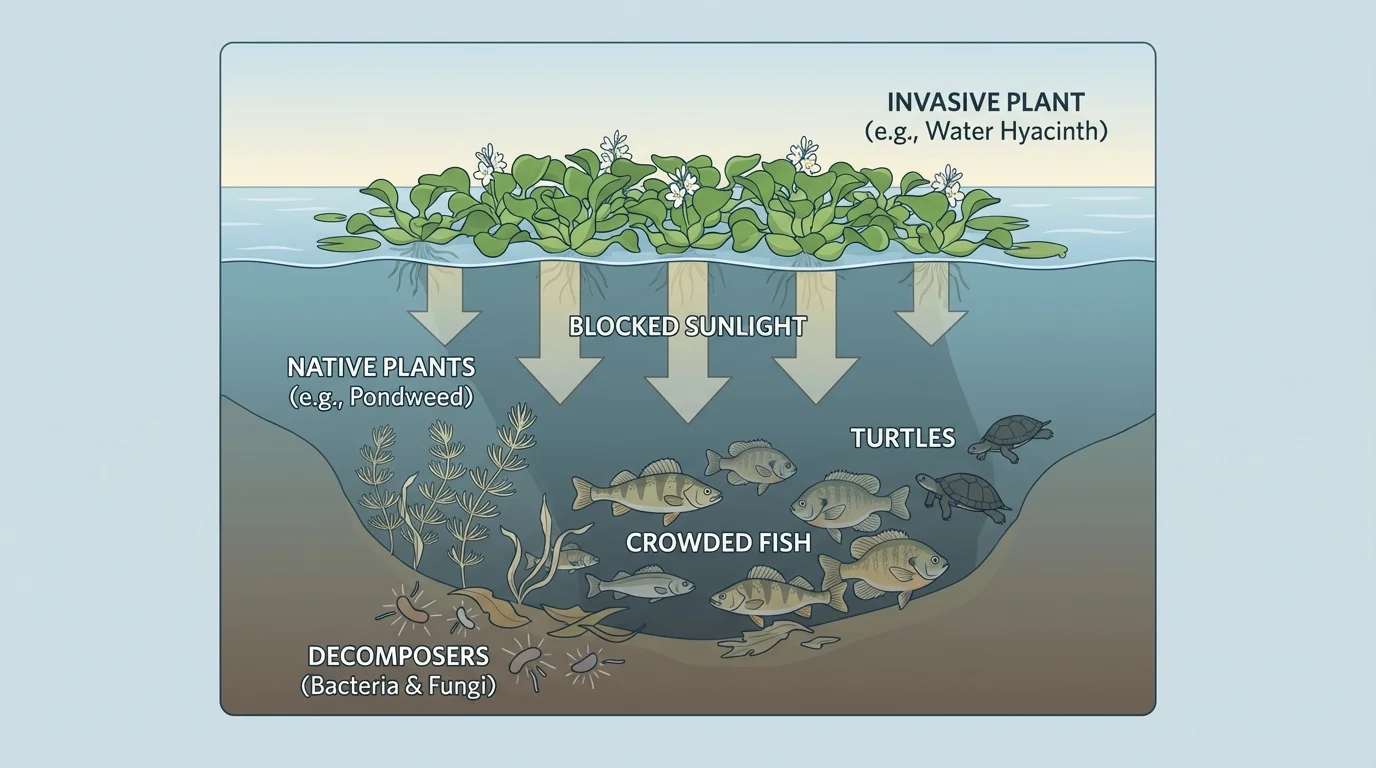
For example, a fast-growing water plant introduced into a lake may spread across the surface. It can block sunlight from reaching native water plants below. If those plants die, animals that depended on them for food or shelter may also decrease. Fish, insects, and turtles can all be affected.
Another example is when a nonnative insect arrives and feeds on local trees. If many trees are damaged, birds may lose nesting places, squirrels may lose food, and forest conditions may change. One new species can affect many others because of the food web connections.
Looking back at [Figure 5], we can see that the problem is not only the new species itself. The larger problem is the chain of effects through habitat, food, and survival. Ecosystems are connected, so disturbances can spread.
Why balance is easier to upset than to rebuild
In an ecosystem, many species fit together over time. When a new species suddenly appears, it may not fit into the existing web in a helpful way. If it grows too quickly or outcompetes native species, the ecosystem can change faster than other organisms can adapt.
This is why scientists, park workers, farmers, and communities pay attention to introduced species. Protecting ecosystems often means preventing harmful new species from spreading.
You do not have to visit a rainforest or coral reef to see these ideas. A backyard, park, farm, pond, beach, or patch of woods all contain ecosystems. In each one, producers capture energy, consumers feed, decomposers recycle, and organisms depend on suitable habitats.
On a farm, crops are producers. Insects may eat the crops, birds may eat the insects, and decomposers in the soil help recycle plant remains. Farmers care about healthy soil because it supports plant growth. They also watch for introduced pests that can damage crops and upset the system.
In a city park, squirrels eat seeds, robins hunt worms, grass grows from sunlight, and fungi break down fallen leaves. Even in places with sidewalks and playgrounds, living things are connected in food webs.
When people plant native flowers, protect wetlands, reduce pollution, and avoid releasing nonnative pets or plants into nature, they help keep ecosystems healthier. Understanding ecosystems helps people make better choices for the environment.
The big idea is simple but powerful: life is connected. Plants begin many food paths. Animals depend on plants directly or indirectly. Decomposers return materials to the soil. Organisms survive only where their needs are met. And when a new species changes the balance, the effects can travel through the whole web of life.
