A tree can grow from a tiny seed into something taller than a house, but it does not create all that new material from nothing. The matter that builds the tree comes from the air, water, and soil around it. That same matter may later become part of an animal, a mushroom, the soil, or the air again. Nature is full of amazing recycling systems, and living things are part of them every day.
Matter is anything that takes up space and has mass. The water you drink, the air around you, the soil in a garden, a blade of grass, a worm, and even a fallen leaf are all made of matter. Matter can change form or move from one place to another, but it does not simply disappear.
Ecosystem means a community of living things and the nonliving parts of their environment working together. Organism means any living thing, such as a plant, animal, fungus, or microbe. Waste is material an organism releases back into the environment, such as gases, liquids, or solids.
In an ecosystem, matter moves between living and nonliving parts. Some matter is in the air as gases like \(\textrm{O}_2\) and \(\textrm{CO}_2\). Some is in water as \(\textrm{H}_2\textrm{O}\). Some is in soil as tiny bits of rock, dead material, and nutrients. Living things take in matter, use it to live and grow, and then return some of it as waste or when they die.
This movement does not happen in a straight line. It happens in cycles. A drop of water in soil can be taken up by a plant root, move into a rabbit that eats the plant, leave the rabbit as waste, and later return to the soil or air. The same atoms can be used again and again.
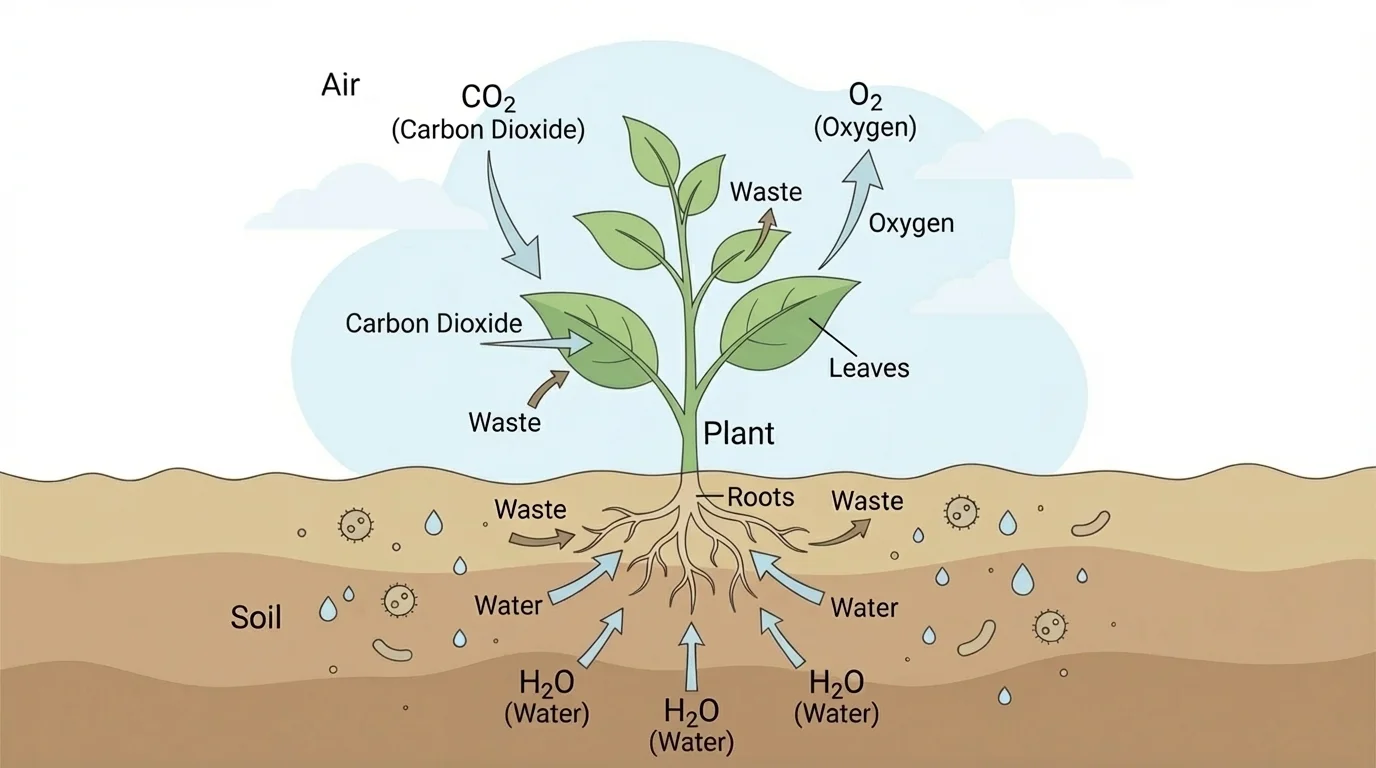
[Figure 1] Plants are amazing because they take matter from more than one place. A plant gets water from the soil through its roots and gets gases from the air through tiny openings in its leaves. Plants use this matter to live, grow, and make more plant parts such as stems, leaves, flowers, and fruits.
Plants absorb water, \(\textrm{H}_2\textrm{O}\), from the soil. They also take in carbon dioxide, \(\textrm{CO}_2\), from the air. Using energy from sunlight, plants make sugars that help build their bodies. During this process, they also release oxygen, \(\textrm{O}_2\), back into the air. This is one way matter moves between organisms and the environment.
A plant does not just "eat dirt." The soil provides water and nutrients, and the air provides carbon dioxide. The matter in a growing tree trunk, a tomato, or a pumpkin comes from these materials. That is one reason plants are so important in ecosystems: they bring matter from the nonliving environment into living systems.
This movement of matter helps connect the nonliving environment to living systems in ecosystems.
When animals eat plants, some of the matter in the plant becomes part of the animals' bodies. For example, when a deer eats grass, matter from the grass helps build the deer's muscles, bones, and fur. Some matter is also used for energy, and some is released as waste.
Plants connect air, water, and soil to food webs. Plants take in matter from the environment and turn it into living material that other organisms can use. Without plants and other producers, much less matter would move from the air and soil into animals.
Even plants release matter back into the environment. They give off oxygen, they lose water vapor to the air, and when leaves, fruits, or branches fall, those materials become part of the soil system. So plants both take in matter and return matter.
Animals cannot make their own food the way plants do. They get matter by eating plants or other animals, by drinking water, and by breathing gases from the air. Every bite of food and every sip of water adds matter to an animal's body.
Animals use food to build and repair body parts. A growing puppy uses matter from food to make bigger bones, more muscle, and thicker fur. A bird uses matter from food to build feathers and eggs. A child uses matter from food and water to grow taller and stronger.
Animals also exchange gases with the environment. Many animals breathe in oxygen, \(\textrm{O}_2\), and breathe out carbon dioxide, \(\textrm{CO}_2\). This means matter moves from the air into an animal and then back into the air. Animals also release liquid waste, such as urine, and solid waste, such as feces. These wastes still contain matter that can return to soil and water systems.
Think about a squirrel eating an acorn. Some of the matter in the acorn helps the squirrel move, stay warm, and grow. Some leaves the squirrel as carbon dioxide when it breathes. Some leaves as waste. Matter enters the squirrel, changes form or location, and then leaves again.
Real-world example: A simple food chain
Step 1: Grass takes in water from soil and carbon dioxide from air.
Step 2: A rabbit eats the grass, so some grass matter becomes part of the rabbit.
Step 3: The rabbit releases waste and breathes out carbon dioxide.
Step 4: If the rabbit dies, decomposers break down its body and return matter to the soil and air.
In this way, matter keeps moving instead of stopping with one organism.
Animals return matter not only through waste, but also when they die. Their bodies do not stay unchanged forever. Other organisms begin to use that matter next.
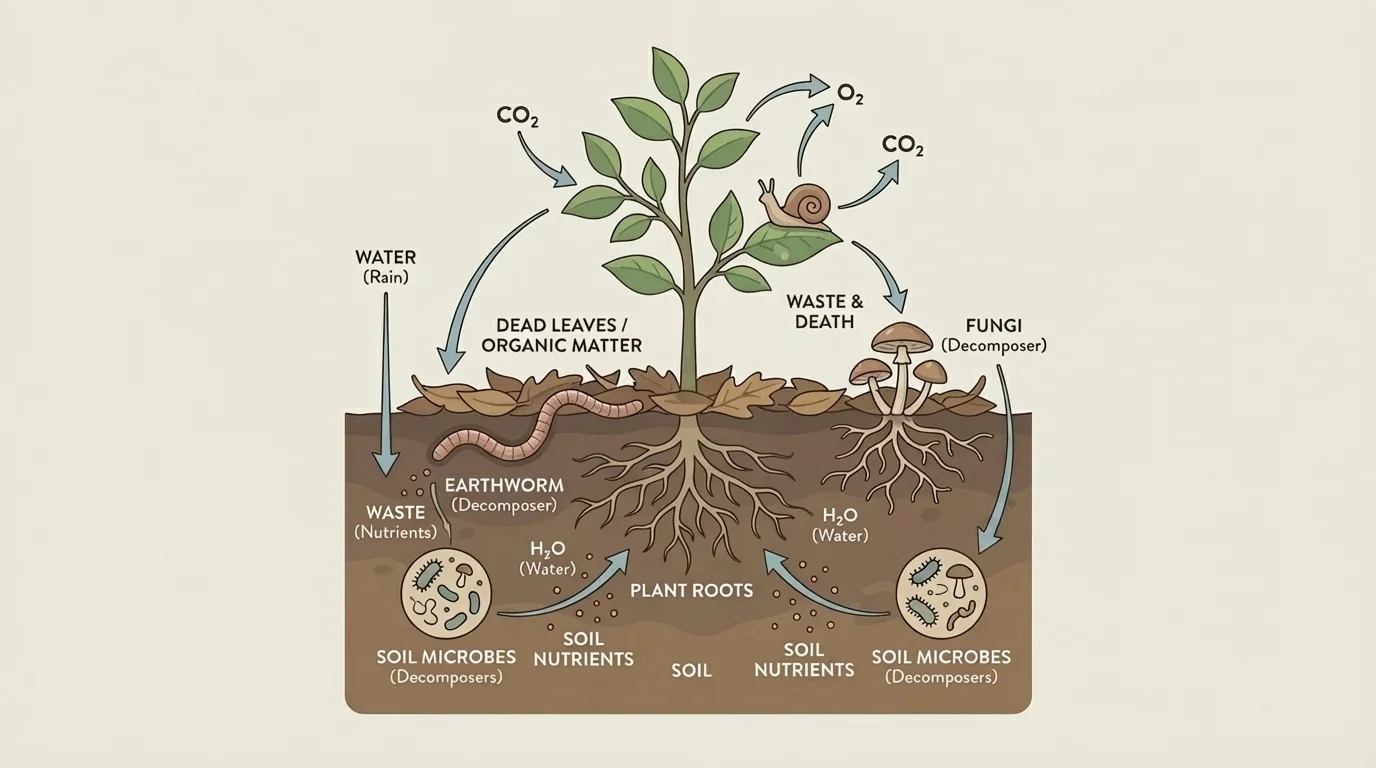
[Figure 2] Nature has expert recyclers called decomposers. Decomposers such as fungi, worms, and many microbes break down dead plants, dead animals, and waste materials. This process returns matter to the soil and air, where it can be used again.
A microbe is a living thing so small that it usually can only be seen with a microscope. Many microbes live in soil, water, and even inside other organisms. Some microbes help break down dead material into simpler substances. These substances can then mix with soil or be taken in by plants.
Imagine fallen leaves on the ground in autumn. At first they may look dry and crisp. Over time, decomposers break them into smaller pieces. Eventually, the matter in those leaves becomes part of the soil. Later, plant roots may take in water and nutrients from that soil, and the cycle continues.
This is one example of how decomposers return matter to the environment for reuse.
When a log rots in a forest, it may seem like it is disappearing. It is really being changed and moved. Some matter becomes part of the soil. Some returns to the air as gases. Some becomes part of the decomposers themselves. Matter is not gone; it has simply entered new parts of the ecosystem.
A spoonful of healthy soil can contain millions of tiny organisms. Many of them are busy breaking down dead material and helping nutrients move through the ecosystem.
Without decomposers, dead organisms and waste would pile up, and much less matter would return to the soil for new growth. Decomposers help keep ecosystems working.
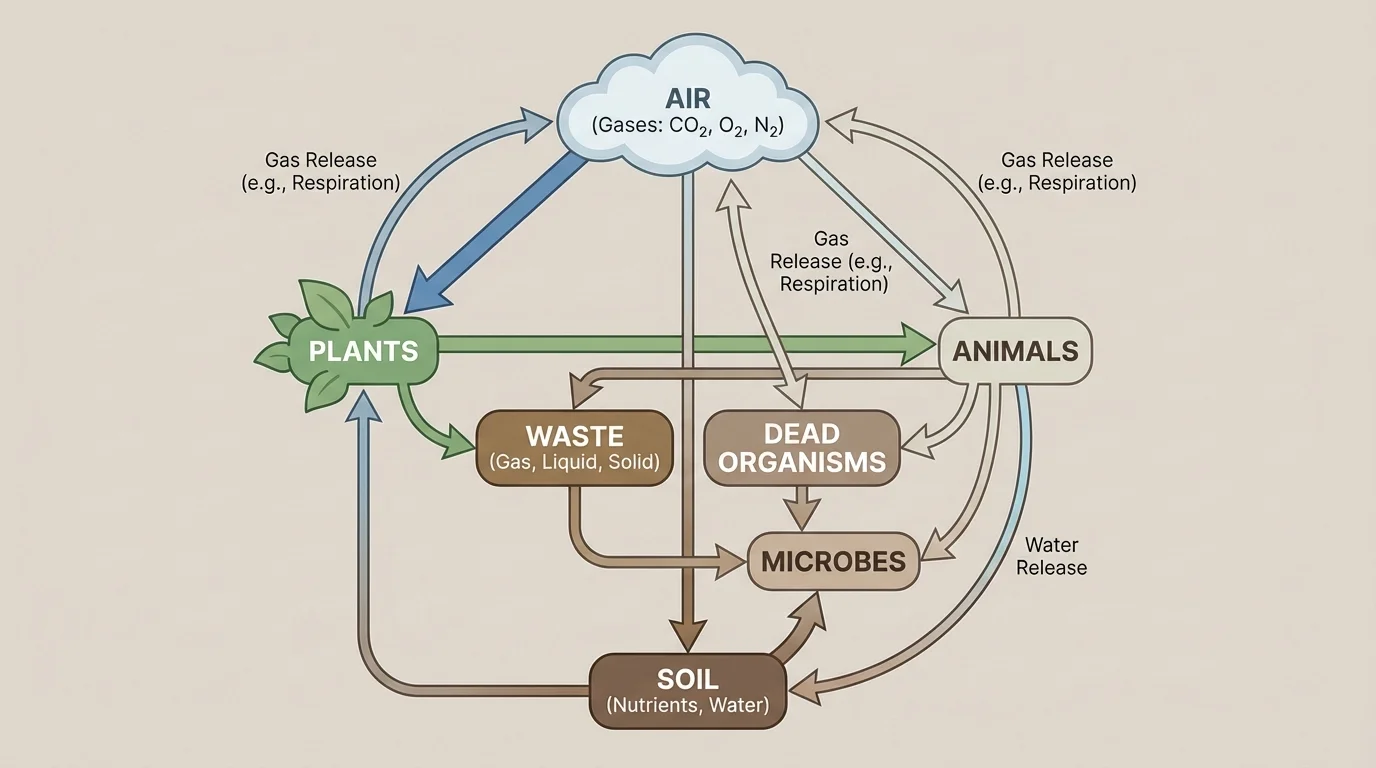
[Figure 3] Matter moves in loops through ecosystems, with arrows between air, soil, plants, animals, and microbes. These loops are called matter cycles. They are not always fast. Some happen in hours or days, and others take years.
One important cycle involves water. Water can be in puddles, streams, clouds, soil, plants, animals, and the air. A plant takes in \(\textrm{H}_2\textrm{O}\) through roots. An animal drinks water or gets it from food. Water can leave organisms through sweat, breath, urine, or water vapor from leaves. Then it may return to soil, lakes, rivers, or the air.
Another important cycle involves gases such as oxygen and carbon dioxide. Plants take in carbon dioxide, \(\textrm{CO}_2\), and release oxygen, \(\textrm{O}_2\). Animals often take in oxygen and release carbon dioxide. Decomposers also release gases as they break down dead matter. This means the air is part of the ecosystem's recycling system too.
Nutrients in soil also cycle. Plants take nutrients in through roots. Animals get them by eating plants or other animals. When organisms release waste or die, decomposers return some of these materials to the soil. Then plants can use them again. The same matter may pass through many different organisms over time.
Together, these pathways show that matter is constantly being reused within ecosystems.
A forest, pond, garden, or farm all have matter cycles. In a pond, algae take matter from water and air. Fish eat algae or smaller animals. Waste sinks into the mud. Microbes break it down, and the matter can be reused. In a garden, vegetable plants, insects, worms, and soil microbes all help move matter around.
This is why ecosystems are dynamic. Things are always changing, but the matter keeps moving. The tree in [Figure 1] is linked to the forest floor recyclers in [Figure 2], and both are part of the larger cycling pattern in [Figure 3].
You can see matter cycling in everyday life. In a compost bin, fruit peels, leaves, and other plant scraps are broken down by decomposers. Over time, the material turns into dark compost that can be added to garden soil. Then plants grow in that soil, and the matter that was once a banana peel may become part of a bean plant or flower.
On a farm, cows eat grass or feed made from plants. The cows use that matter to grow and to produce milk. They also release waste, which can add matter back to the soil. Plants grow again, and the cycle continues.
Real-world example: Compost in a school garden
Step 1: Vegetable scraps and dead leaves are placed in a compost pile.
Step 2: Worms, fungi, and microbes break down the material.
Step 3: The broken-down matter becomes rich soil material.
Step 4: Garden plants use that soil material to grow new stems, leaves, and fruits.
This shows matter moving from living things, to waste, to soil, and back into living things again.
In forests, fallen trees, animal droppings, and dead leaves all become part of the recycling system. In oceans, coral reefs, fish, seaweed, and tiny drifting organisms all exchange matter with water and one another. Matter cycling happens everywhere life exists.
You can observe matter cycling by watching dead leaves in soil or compost over time. Put a few dry leaves in a container with moist soil and leave it where it is safe to observe. Over days and weeks, the leaves become softer, darker, and smaller. Decomposers are breaking them down.
This observation helps answer an important question: where does the leaf go? It does not vanish. Its matter becomes mixed into the soil, released into the air as gases, or used by decomposers. Later, plants may use some of that matter again.
Living things need resources from their environment. Plants need sunlight, water, air, and nutrients. Animals need food, water, air, and shelter. Matter cycling helps keep those resources moving through ecosystems.
Scientists study these processes to understand healthy soil, forests, farms, and even climate. People who grow food, protect habitats, and care for water systems all depend on matter cycling, whether they use that exact phrase or not.
Once you start looking for it, you can spot this recycling everywhere: a leaf becoming soil, soil feeding a plant, a plant feeding an animal, and waste or death returning matter to the environment. Life depends on these connected pathways.
