Have you ever looked up at the night sky and wondered why the Sun does not seem like the other stars? During the day, the Sun fills the sky with light. At night, stars look like tiny sparkling dots. This may seem like a mystery, but the answer is simple and amazing: the Sun is a star. It appears much bigger and brighter than the other stars because it is much closer to Earth.
The star we know best is the Sun. A star is a huge ball of very hot gas that gives off its own light and heat. The Sun is made mostly of hydrogen and helium. Deep inside the Sun, energy is produced and then travels outward into space. That energy reaches Earth as sunlight and warmth.
Even though the Sun looks very different from the stars we see at night, it belongs to the same group of objects. The Sun is not a planet, and it is not a moon. It is a star at the center of our solar system. Earth and the other planets move around it.
Sun means the star at the center of our solar system. Solar system means the Sun and all the objects that travel around it, including planets, moons, asteroids, and comets.
Because the Sun is so important to us, people have studied it for a very long time. We feel its heat on our skin, see its light every day, and depend on it in many ways. But when we compare it with the stars in the night sky, we begin to understand something important about space: what we see depends a lot on distance.
The Sun looks enormous and very bright because it is much closer to us than any other star, as [Figure 1] shows. When an object is closer, it usually looks larger. It also often seems brighter because more of its light reaches our eyes. That is true for stars too.
Think about a lamp in your room. If you stand near it, the light seems very bright. If you walk to the other side of a large room, the same lamp seems less bright. The lamp did not change. Your distance from it changed. The same idea helps explain the Sun and the stars.
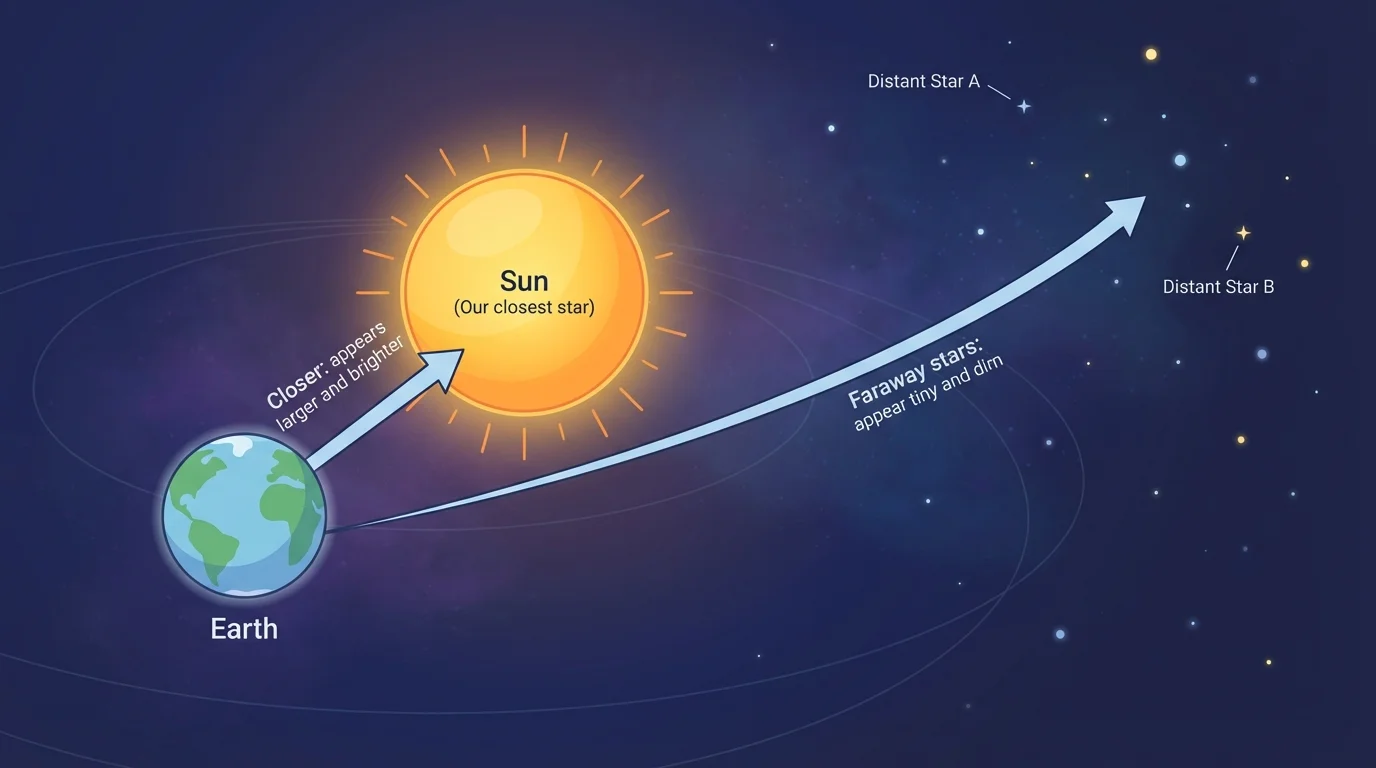
The Sun is about 150 million kilometers from Earth. That is extremely far away, but other stars are so much farther away that the Sun is our close neighbor in space. Because it is our nearest star, it looks like a large glowing disk in the sky instead of a tiny point of light.
This does not mean the Sun is the biggest star in the universe. In fact, some stars are much larger than the Sun. They still look tiny from Earth because they are incredibly far away. Distance can change how large and bright something appears, even when the object itself is huge.
Apparent size and brightness
Apparent means how something looks to an observer. A nearby object can appear larger than a faraway object, even if the faraway object is actually bigger. The Sun appears larger and brighter than other stars because it is much closer to Earth.
You can test this idea in daily life. Hold your thumb close to your face and then compare it to a building far away. Your thumb can seem to cover part of the building, even though the building is much bigger. The same kind of effect happens when we compare the Sun with distant stars.
Stars are not all lined up at the same distance from Earth. They are spread out through space, and their distances vary greatly, as [Figure 2] illustrates. Some are closer to our solar system, and many are far, far beyond it.
That is why stars do not all look equally bright. A star may look bright because it is close, because it is intrinsically very luminous, or for both reasons. Another star may look dim because it is very far away, even if it is actually huge and bright.
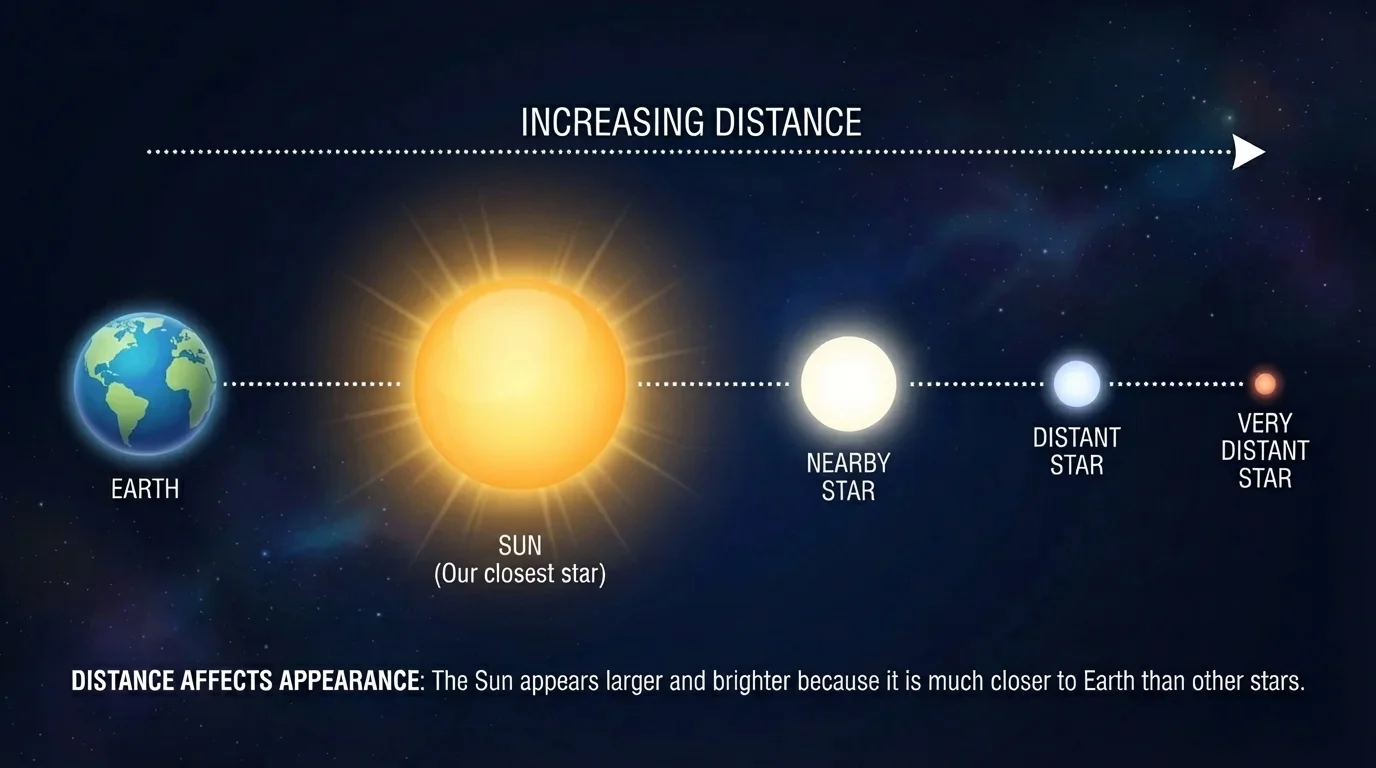
The nearest star to Earth is the Sun. After the Sun, the next nearest star is Proxima Centauri. It is so far away that even light, which travels extremely fast, takes more than four years to get from there to Earth. This shows just how enormous space is.
When scientists say stars range greatly in distance from Earth, they mean the universe is not packed like a small room. It is more like a vast ocean of space with stars scattered throughout it. Some are relatively nearby neighbors, and others are at distances that are hard to imagine.
Light from the Sun takes about 8 minutes to reach Earth. Light from many other stars takes years, centuries, or even longer to arrive.
This also means that when we look at stars, we are looking into the past. If a star is 10 light-years away, the light we see today left that star 10 years ago. So astronomy helps us learn not just about distance, but also about time.
Distance changes how things look all the time. Think about a car driving away on a road. At first it looks large, and then it looks smaller and smaller. The car is not shrinking. It only appears smaller because it is moving farther away.
Another good example is a flashlight. If you shine a flashlight on a wall from very close up, the light looks bright and strong. If you move the flashlight farther back, the light spreads out and seems dimmer. Light from distant stars also spreads through space before it reaches us.
Real-world example: streetlights
Imagine standing on a long street at night with many streetlights.
Step 1: Look at the nearest streetlight.
It appears brighter and larger because it is closer to you.
Step 2: Look at a streetlight far down the road.
It appears smaller and dimmer because it is farther away.
Step 3: Compare this to stars.
The same idea helps explain why our nearby Sun looks so different from stars that are much farther away.
Everyday observations like these help us understand a very important rule in astronomy: how something looks from Earth is not always the same as what it is really like. A distant star may look tiny, but it can still be larger than the Sun.
When people look at the night sky, they often notice groups of stars that seem to make shapes. These patterns are called constellations, and [Figure 3] shows how we see them from Earth. Long ago, people imagined these patterns as animals, heroes, or objects.
It is important to remember that stars in one constellation are usually not side by side in space. They only seem to form a pattern from our point of view on Earth. In reality, one star in the pattern might be much closer to Earth than another.
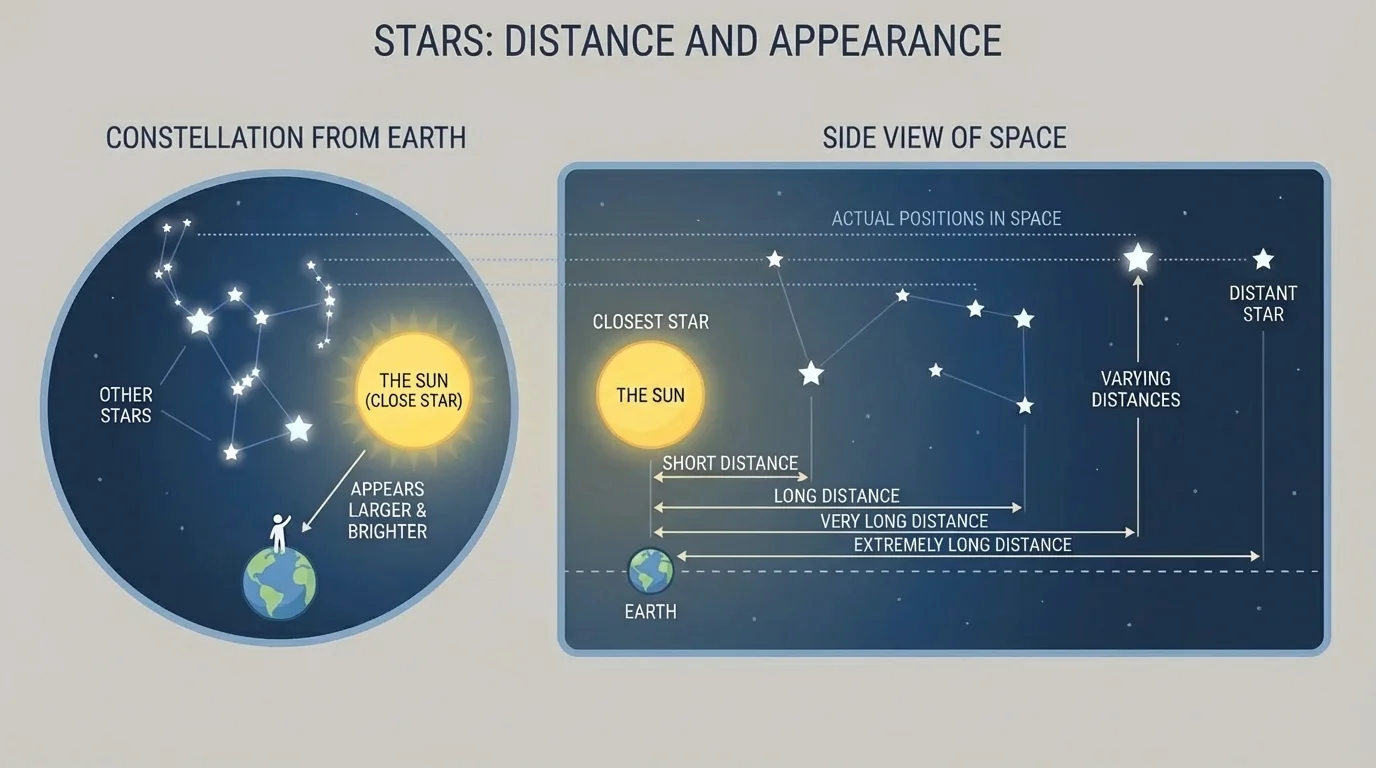
This is another way distance matters in astronomy. The sky can look flat, like a giant dark wall with lights on it, but space is three-dimensional. Stars are spread out in many directions and at many depths.
As we saw earlier with the scattered stars in [Figure 2], stars range greatly in distance from Earth. A constellation is a pattern made by our viewpoint, not a sign that all those stars are close together.
Scientists study stars using careful observation and special tools. One of the most important tools is the telescope. A telescope helps us see objects that are very far away, and [Figure 4] highlights how telescopes gather more light than our eyes alone.
Some telescopes are on Earth, and others are in space. Space telescopes can observe without looking through Earth's atmosphere, which can blur or block some light. These tools help scientists learn about stars' brightness, color, size, temperature, and movement.
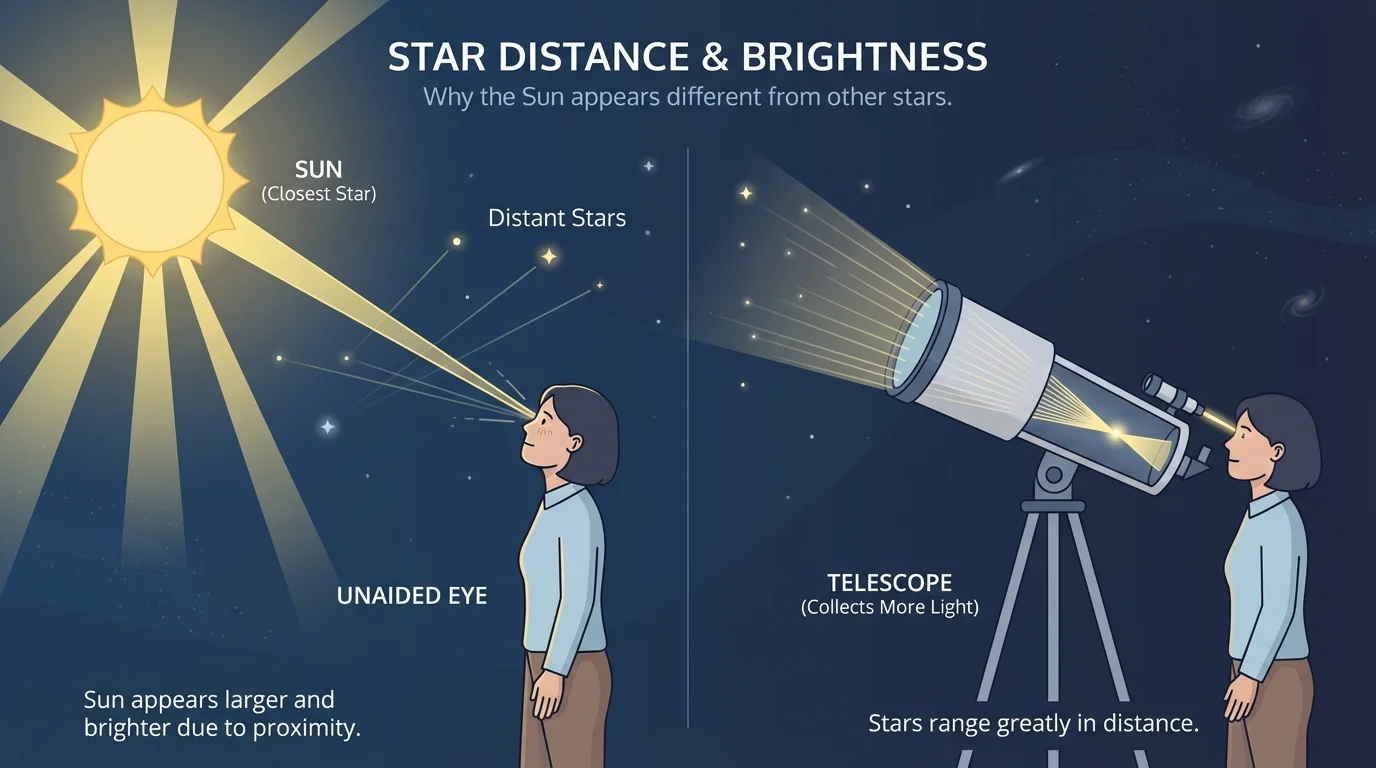
Scientists also use instruments to break starlight into different colors. This can reveal what stars are made of and how hot they are. Even though stars are very far away, their light carries clues that astronomers can study.
You already know that our eyes can only see so much detail from far away. Tools like magnifying glasses and microscopes help us study tiny things. In a similar way, telescopes help us study very distant things in space.
Later, when astronomers compare different stars, they use observations from telescopes to decide which stars are intrinsically bright and which only look bright because they are closer. This is why understanding distance is so important in astronomy.
The Sun is not just another star in the sky. It is the main source of energy for Earth. Sunlight warms land, water, and air. It helps drive weather patterns and the water cycle. Plants use sunlight to make food, and animals depend on plants directly or indirectly.
Without the Sun, Earth would be dark and extremely cold. Most life as we know it could not survive. The Sun's light also helps us tell day from night and supports many human activities, from growing crops to making electricity with solar panels.
Real-world application: solar energy
People use the Sun's energy in practical ways.
Step 1: Solar panels absorb sunlight.
They collect energy from the Sun.
Step 2: The system changes that energy into electricity.
This electricity can power lights, homes, and schools.
Step 3: This works because the Sun is a nearby star giving Earth a steady supply of light and energy.
The Sun's closeness makes life and many technologies possible.
The Sun's closeness is helpful for Earth, but it also means we must observe it safely. We should never look directly at the Sun with our eyes. Scientists use special filters and tools to study it without harming their vision.
The Sun appears to move across the sky each day, rising in the east and setting in the west. This happens because Earth rotates. At night, when our part of Earth faces away from the Sun, we can see other stars.
During the daytime, the Sun's light is so bright that it makes it hard to see most stars. The stars are still there, but the bright sky hides them from view. This is another reason the Sun seems so different from the stars we notice at night.
On clear nights, some stars look brighter than others. As shown earlier in [Figure 1], brightness in the sky can be strongly affected by distance. Some bright stars are very powerful, and some are simply closer than other night-sky stars.
The Sun is a star, but stars can differ in many ways. Some are hotter, cooler, larger, smaller, redder, bluer, older, or younger. What they all share is that they are hot balls of gas that give off light.
The table below compares the Sun with typical night-sky stars as we see them from Earth.
| Feature | Sun | Many Other Stars |
|---|---|---|
| Type of object | Star | Star |
| How it looks from Earth | Large, bright disk | Tiny points of light |
| Main reason for that appearance | Very close to Earth | Much farther from Earth |
| Seen most easily | Daytime | Nighttime |
| Importance to Earth | Provides most of Earth's light and heat | Usually too far away to affect Earth much |
Table 1. A comparison of how the Sun and other stars appear and affect Earth.
When you look at the Sun and stars, you are really learning an important lesson about the universe. Things in space can look different not only because they are different, but also because they are at different distances. The Sun stands out because it is our nearest star.
When you notice star patterns in the sky, remember the idea from [Figure 3]: stars that seem grouped together may actually be separated by huge distances. And when scientists use telescopes, as shown in [Figure 4], they gather more information about those distant stars and their true nature.
"The Sun is a star, and the stars are suns far away."
— A simple astronomy idea
Learning about the Sun and other stars helps us understand Earth's place in space. Our planet is part of a solar system centered on one star, while countless other stars fill the universe at many different distances. The night sky may look simple at first, but it is really showing us a vast and varied universe.
