A drop of rain can help a forest grow, wear away a mountain, fill a river, and finally reach the ocean. One tiny drop can travel through air, water, land, and living things. That is because Earth is not made of separate parts that never meet. It is made of connected systems that are always affecting one another.
Scientists often describe Earth as four big connected systems, as [Figure 1] shows. These systems are the geosphere, the hydrosphere, the atmosphere, and the biosphere. Each system has its own parts, but none of them works alone.
The geosphere includes the solid parts of Earth, such as rocks, mountains, soil, sand, and even molten rock deep inside Earth. The hydrosphere includes all of Earth's water, whether it is liquid water in oceans and rivers or frozen water in glaciers and ice caps. The atmosphere is the layer of gases around Earth. The biosphere includes all living things, from tiny bacteria to giant whales to humans.
When rain falls on soil, the atmosphere and hydrosphere affect the geosphere. When a tree grows roots into the ground, the biosphere affects the geosphere. When ocean water warms the air above it, the hydrosphere affects the atmosphere. These connections help explain weather, landforms, and life on Earth.
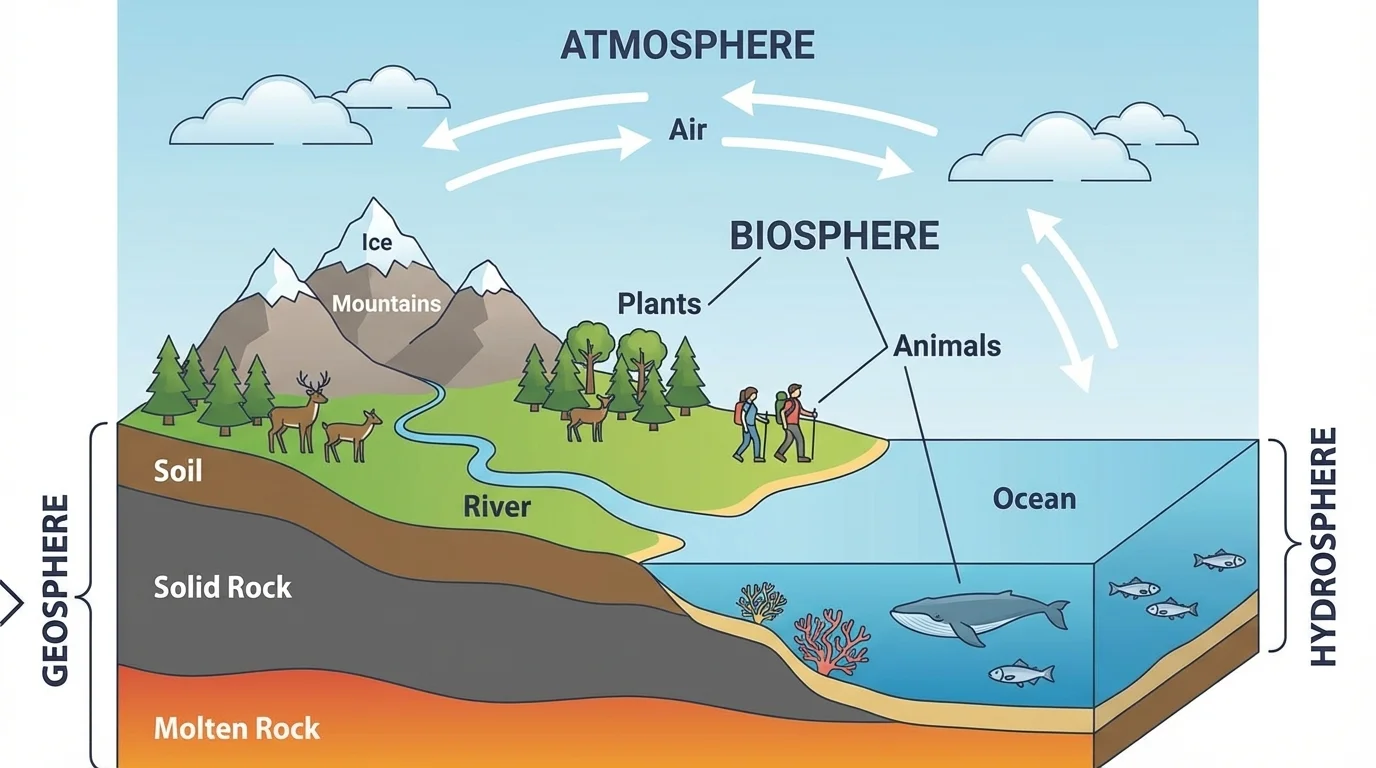
Earth systems are the major parts of Earth that interact with one another. The four main systems are the geosphere, hydrosphere, atmosphere, and biosphere.
You can think of Earth as a team. If one player changes what that player does, the rest of the team changes too. For example, a drought means less water in the hydrosphere, which can dry out soil in the geosphere, reduce plant growth in the biosphere, and even change local air conditions in the atmosphere.
The geosphere is the part of Earth made of rock, minerals, soil, and sediments. Sediments are small pieces of rock, sand, and soil that are moved from one place to another by water, wind, ice, or gravity. The geosphere includes giant features like mountains and canyons, and smaller features like pebbles on a beach.
Earth's surface is not perfectly still. Wind can move sand to make dunes. Rivers can cut valleys through rock. Waves can wear away cliffs. Volcanoes can pour out lava, which cools and becomes rock. Earthquakes can cause the ground to shift. All of these processes change the geosphere over time.
Soil is also part of the geosphere, and it is very important for life. Soil forms slowly as rocks break into smaller pieces and mix with decayed plants and animals. Good soil can hold water and air, making it possible for many plants to grow.
Some mountains are still rising today because huge pieces of Earth's crust continue to push against each other. Earth's surface may look steady, but it is always changing.
The geosphere gives living things places to live. Burrowing animals live in soil. Plants anchor their roots in the ground. Humans use rocks and minerals to build roads, homes, and tools. This shows that the geosphere supports both natural life and human life.
The hydrosphere includes all of Earth's water. Most of this water is in the ocean, but water is also found in rivers, lakes, ponds, glaciers, ice caps, groundwater, and clouds. Even living things contain water, so water connects strongly to the biosphere too.
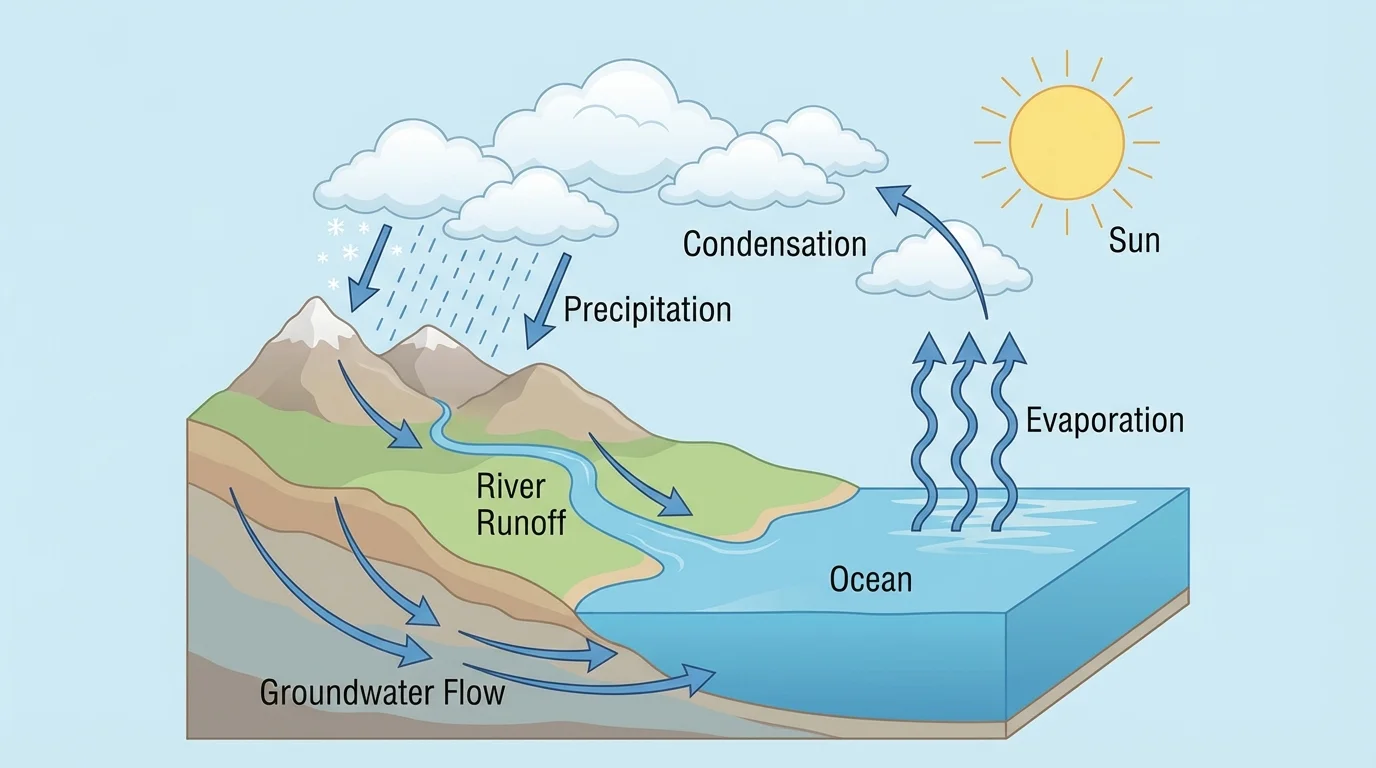
Water is always moving, as [Figure 2] illustrates in the water cycle. The Sun warms water in oceans, lakes, and puddles, and some of that water changes into water vapor and rises into the air. This process is called evaporation. Later, the water vapor cools and forms tiny droplets that make clouds. This process is called condensation. When the droplets grow heavy, water falls back to Earth as rain, snow, sleet, or hail. That is precipitation.
After precipitation falls, some water soaks into the ground, some flows downhill into streams and rivers, and some returns to lakes or the ocean. This continuous movement helps shape the land. Flowing water can carry sediments from one place to another and can slowly carve deep valleys.
Frozen water is also part of the hydrosphere. Glaciers are large masses of moving ice. They can scrape the land beneath them and create valleys. Ice can also break rocks apart when water enters cracks, freezes, and expands.
Why water matters so much
Water is special because it can be found as liquid water, ice, and water vapor. That lets it move through many parts of Earth. Water carries heat, shapes land, and supports all known life on our planet.
In daily life, people depend on the hydrosphere for drinking water, farming, transportation, and recreation. When communities protect rivers, lakes, wetlands, and oceans from pollution, they are helping one of Earth's most important systems stay healthy.
The atmosphere is the layer of gases surrounding Earth. It is made mostly of gases such as nitrogen and oxygen. It also contains small amounts of other gases, including carbon dioxide, written as \(\textrm{CO}_2\), and water vapor, which is part of the water cycle.
The atmosphere does several important jobs. It provides the air that animals and people breathe. It helps keep Earth warm enough for life. It also protects Earth from many small rocks from space, because many of them burn up before reaching the ground.
Weather happens in the atmosphere. Winds move air from place to place. Clouds form when water vapor cools and condenses. Storms develop when air, water, and temperature differences work together. A warm, humid day and a cool, dry day feel very different because the atmosphere is changing.
Air can also shape the geosphere. Strong winds can pick up sand and dust and move them to new locations. Over time, this can wear down rocks and build up dunes. In dry places, wind is one of the most important forces changing Earth's surface.
The biosphere includes all living things. Forests, grasslands, deserts, coral reefs, and backyard gardens are all parts of the biosphere. Humans are part of the biosphere too, even though we also build cities and change the land around us.
Living things depend on the other Earth systems. Plants need soil from the geosphere, water from the hydrosphere, and gases from the atmosphere. Animals depend on plants or other animals for food and need air and water to survive. Even tiny organisms in the soil or ocean play important roles.
Living things also change Earth. Plant roots can crack rocks and hold soil in place. Beavers build dams that change water flow. Coral animals build reefs that become large ocean habitats. Humans grow crops, build roads, dig tunnels, and create lakes with dams. These actions can be helpful, harmful, or both, depending on how they affect the rest of the systems.
Real-world example: tree roots and soil
A hillside with many plants is often more stable than a bare hillside.
Step 1: Rain falls on the hill.
Water from the hydrosphere reaches the geosphere.
Step 2: Roots hold the soil.
Plants in the biosphere help keep the geosphere from washing away too quickly.
Step 3: Less soil enters streams.
This helps keep nearby water cleaner and changes how sediments move.
This is one example of several Earth systems interacting at the same time.
Because humans are living things, our choices matter. Planting trees, saving water, and reducing pollution can help more than one Earth system at once.
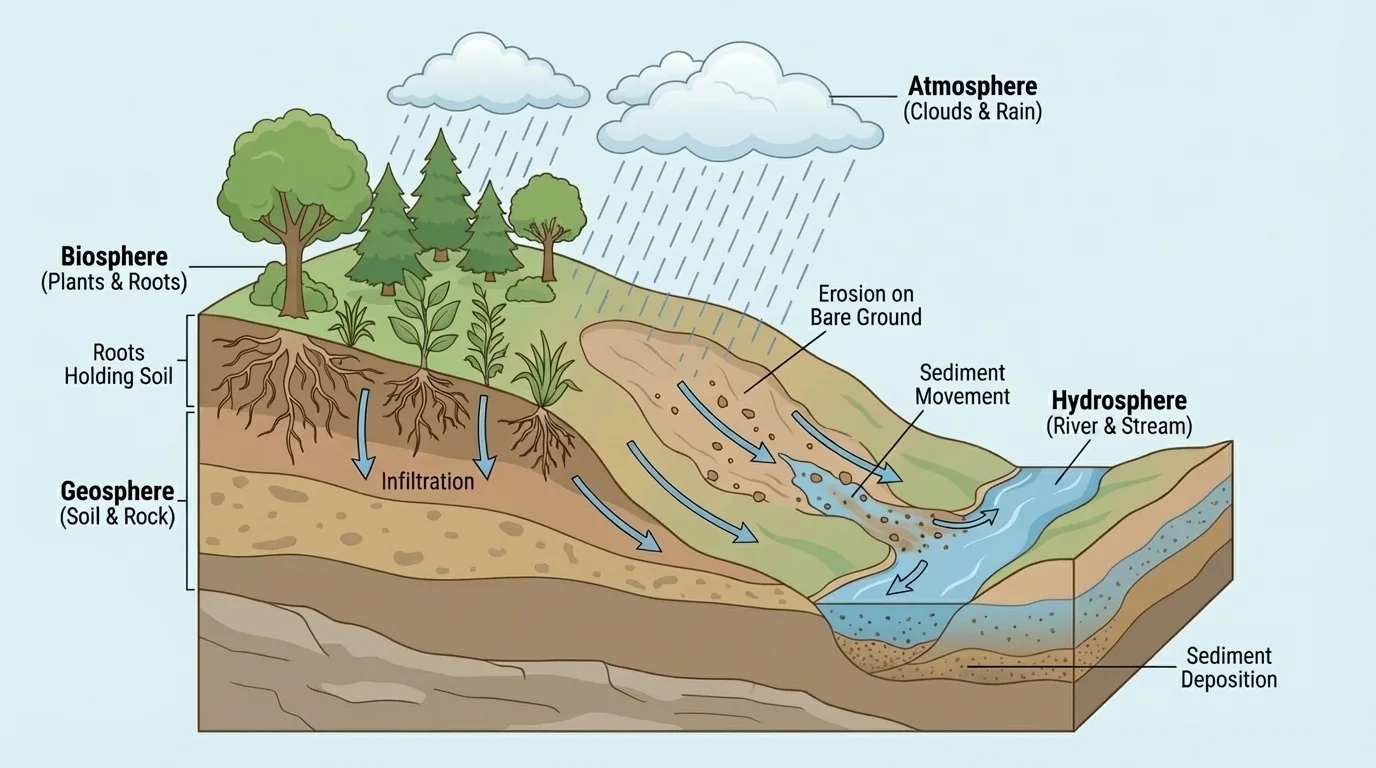
Earth systems interact constantly, and [Figure 3] shows one common example. Rain from the atmosphere falls onto land in the geosphere. The water may soak into soil, run downhill, or collect in streams as part of the hydrosphere. Plants in the biosphere may slow the water and hold the soil with their roots.
If heavy rain falls on bare ground, more soil can wash away. This process is called erosion. Erosion can carry sediments into rivers, turning the water muddy. That means a change in the atmosphere, such as a storm, can lead to changes in land and water, and can also affect fish and other living things.
Another example happens in winter. Water enters cracks in rock, freezes, and expands. As it expands, it pushes the crack wider. Later, pieces of rock can break off. Here, the hydrosphere affects the geosphere through freezing and thawing.
Humans are part of these interactions too. When people pave roads and parking lots, less rain can soak into the ground. More water may run quickly into storm drains and streams, which can increase flooding. When forests are cut down, the loss of roots may lead to more erosion.
Remember that a system is a group of parts that work together. Earth's systems are easiest to understand when you look at how one change can spread to other parts of Earth.
Later, when you study ecosystems, climate, or natural hazards, you will keep returning to this same idea: Earth works through connections, not isolated parts.
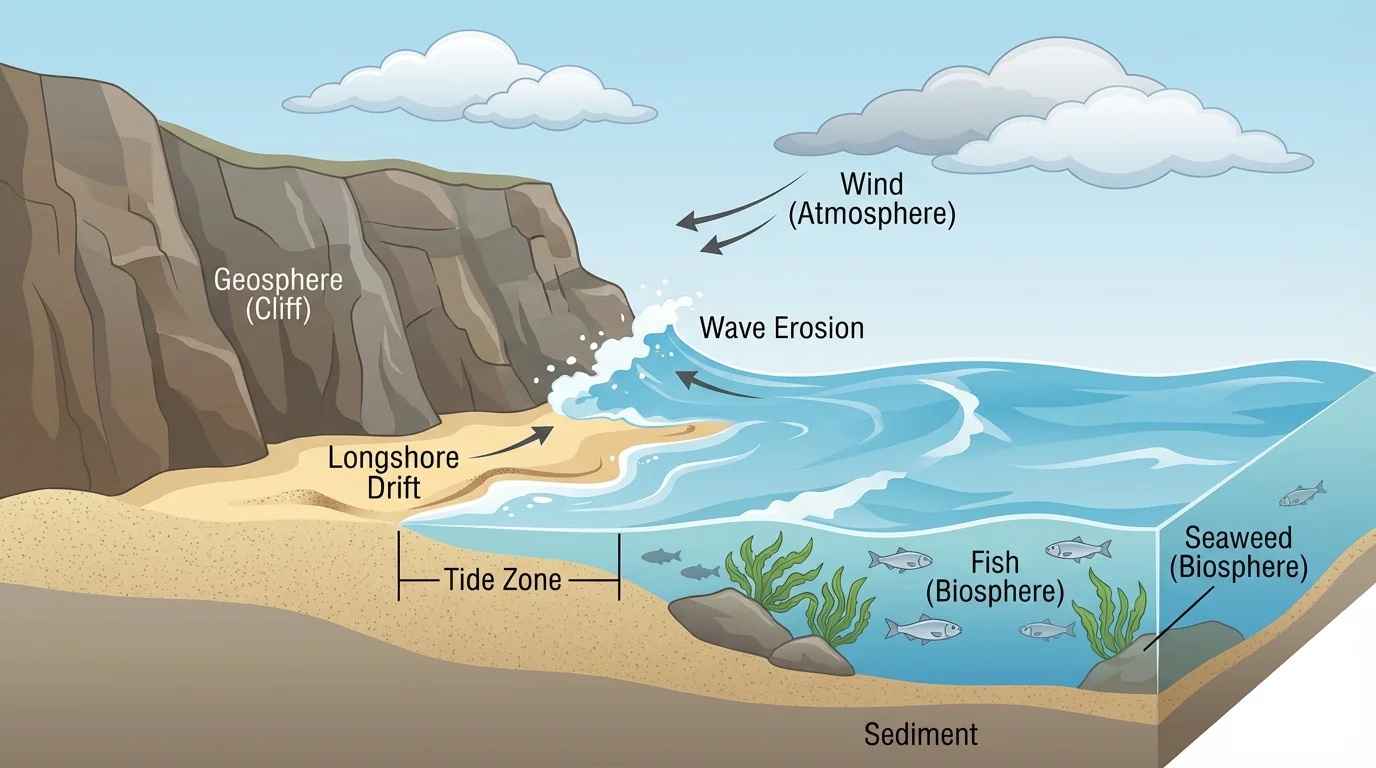
[Figure 4] The ocean is the largest part of the hydrosphere, and it does many important jobs. It supports a huge variety of ecosystem types. An ecosystem is a community of living things and the nonliving environment around them. Ocean ecosystems include tide pools, coral reefs, open ocean waters, and deep-sea habitats.
Many organisms live in the ocean, from plankton so small they drift in the water to giant blue whales. Fish, crabs, sea stars, sharks, turtles, seaweed, and coral are all part of ocean life. Different ocean habitats provide food, shelter, and places to reproduce.
The ocean also shapes landforms. Waves crash against shores and slowly wear away rock. They move sand to create beaches, spits, and sandbars. Strong storms can reshape a coastline in a short time, while everyday waves can change it slowly over many years.
The ocean influences climate because water warms and cools more slowly than land. That means the ocean can store heat and release it gradually. Places near the coast often have milder temperatures than places far inland. Ocean currents also move warm and cool water around the planet, helping affect weather and climate in many regions.
For example, a city near the ocean may have cooler summers and warmer winters than a city deep inside a continent at the same latitude. Farmers, fishers, and weather forecasters all pay attention to ocean conditions because they affect human life in important ways.
The deepest parts of the ocean are so dark that sunlight never reaches them, yet living things still survive there. Some depend on unusual food chains near hot vents on the seafloor.
When we think again about the coastal scene, we can see that the ocean is not just a giant pool of water. It is a living, moving system that shapes coasts, supports habitats, and helps control climate.
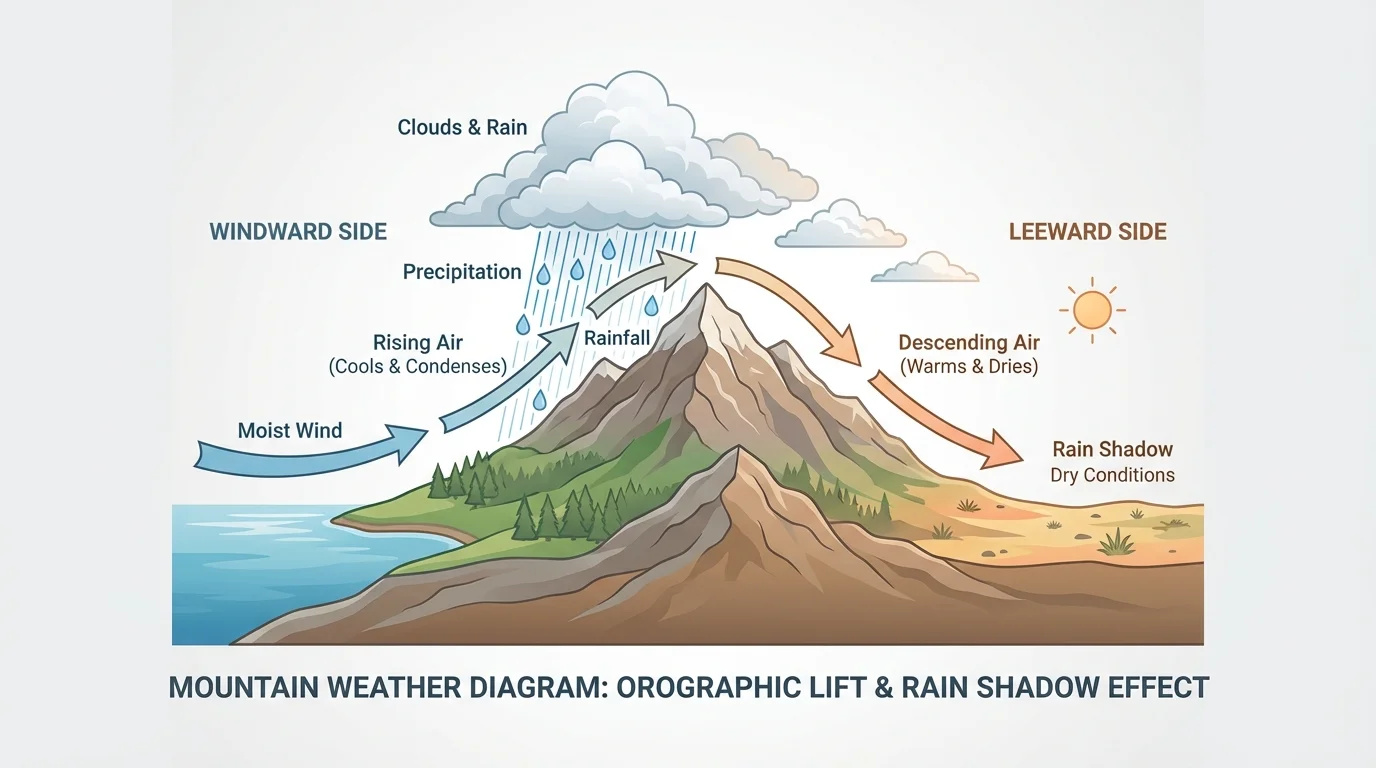
Winds and clouds in the atmosphere interact with landforms in the geosphere to shape weather patterns, as [Figure 5] shows. A landform is a natural feature of Earth's surface, such as a mountain, hill, valley, plain, or plateau.
When moist air blows toward a mountain, the air is forced to rise. As it rises, it cools. Cooler air holds less water vapor, so clouds form and rain or snow may fall. This often makes one side of a mountain wetter than the other side.
After the air crosses the mountain, it may sink and warm again. Warmer air can hold more water vapor, so fewer clouds may form. This can create a drier area on the far side of the mountain. Because of this pattern, mountains can strongly affect where forests, grasslands, or deserts form.
Large lakes and oceans also affect local weather. Water can add moisture to the air, helping clouds form. In some places, winds blowing over water pick up moisture and then drop heavy snow over land. Hills and valleys can guide winds too, changing local temperatures and storm paths.
As you saw earlier with the ocean and coasts, and now with mountains and rain, weather is not controlled by the atmosphere alone. Weather patterns come from interactions among air, water, and land.
You experience Earth's systems every day. If you walk on soil after a rainstorm, you feel the geosphere and hydrosphere interacting. If wind bends the trees, the atmosphere is interacting with the biosphere. If you notice that a beach looks different after a storm, you are seeing the hydrosphere change the geosphere.
People use their understanding of Earth systems to solve real problems. Builders study soil before constructing homes. Farmers watch rainfall, temperature, and wind. City planners create drains to move storm water safely. Scientists track hurricanes over warm ocean water and study droughts, floods, and wildfires.
Simple observation investigation
After a rainy day, look outside with an adult and observe a safe outdoor area such as a yard, school ground, or sidewalk edge.
Step 1: Look for moving water.
Notice where water collects and where it flows downhill.
Step 2: Look for changes in soil or sand.
You may see tiny channels where water has carried sediments.
Step 3: Look for effects on living things.
Plants may stand taller after rain, and worms or insects may appear near the surface.
This helps you observe interactions among the hydrosphere, geosphere, and biosphere.
Understanding Earth systems also helps us take better care of our planet. Protecting wetlands can reduce flooding and provide habitats. Planting vegetation can reduce erosion. Reducing pollution helps keep air and water healthier for living things.
Earth is always changing, but the changes are easier to understand when we pay attention to the four connected systems and the many ways they work together.
