Have you ever tossed something in the trash and never thought about it again? That wrapper, bottle, or old battery may seem to disappear, but Earth keeps the story going. Water can carry waste to streams, wind can move pollution through the air, and human-made objects can even end up circling above Earth in space. People use Earth's resources every day, but our actions can change the world around us in big ways.
Humans grow food, build homes, make products, travel from place to place, and use energy for light, heat, and machines. These activities help us live, but they also affect the planet. The good news is that people are not only causing changes. Many individuals, schools, towns, and countries are also working hard to protect nature and use resources more wisely.
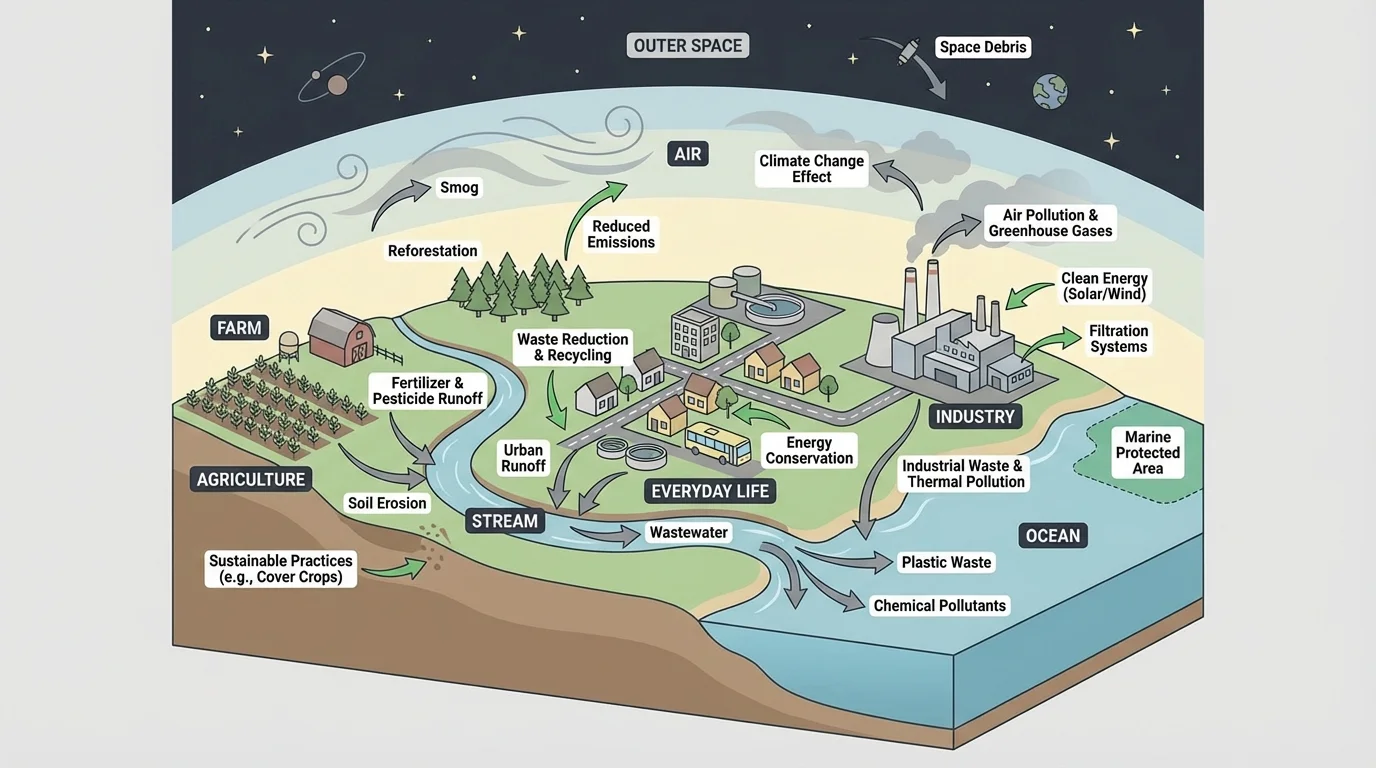
Earth is made of connected parts: land, water, air, living things, and ice. A change in one part can lead to changes in another part. A polluted stream can affect fish, plants, and people downstream. Dirty air can travel far from the place where it started. This connectedness, shown in [Figure 1], helps us understand why human actions matter so much.
For example, rain falls on land and can soak into the ground or flow across the surface. If that water passes over bare soil, roads, or farms, it may pick up mud, chemicals, or trash. Then it can carry those materials into a stream, river, lake, or ocean. Earth's systems are linked like parts of a giant team.
Natural resource is something from Earth that people use, such as water, soil, wood, air, sunlight, rocks, and fuels. Environment means the surroundings where living and nonliving things interact. Pollution is harmful material added to the environment, such as smoke, trash, or chemicals in water.
Because Earth's systems are connected, helping one part often helps another part too. Planting trees can protect soil, give animals homes, and improve air quality. Cleaning a stream can help fish and also help people who use that water.
Agriculture means growing crops and raising animals for food, clothing, and other useful products. Farming is very important because people need food every day. Farms give us apples, wheat, milk, eggs, and many other things. But farming can also change the land and water around it.
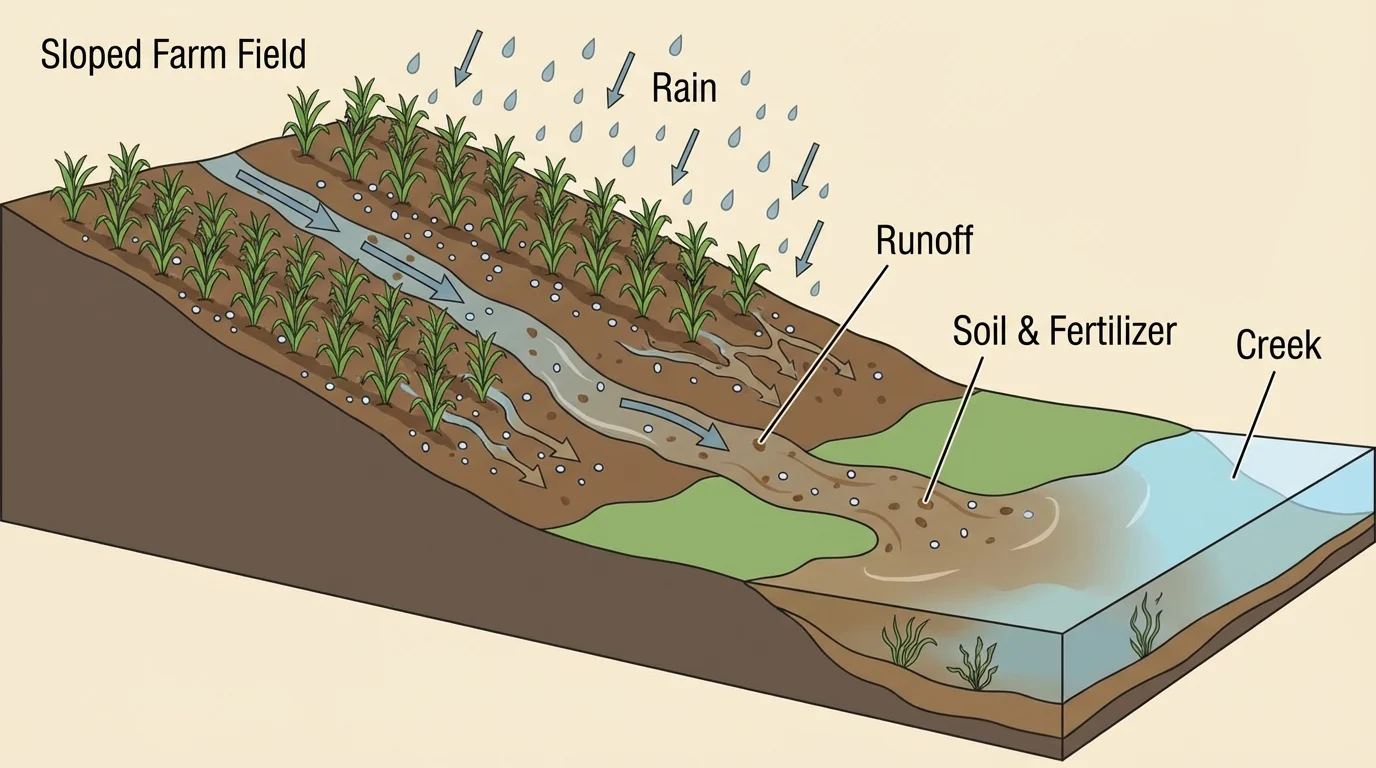
When farmers clear land for fields, some natural vegetation may be removed. Vegetation includes grasses, bushes, and trees that help hold soil in place. Without enough plants, wind and rain can move soil away. This wearing away of soil is called erosion, and [Figure 2] shows how rain can wash soil off a field and into a stream.
Farmers often use water to help crops grow. This is called irrigation. Irrigation can be helpful in dry places, but if too much water is taken from rivers or underground sources, there may be less water left for wildlife and people. Farmers may also use fertilizers to help plants grow and pesticides to control pests. If rain washes these materials into streams, they can affect fish, frogs, insects, and water plants.
Sometimes extra nutrients from fertilizer enter ponds, lakes, or slow-moving streams. Water plants and tiny algae may then grow too fast. When those living things die and break down, they can use up oxygen in the water. Fish and other animals need oxygen, so low-oxygen water can be dangerous.
How runoff works
Runoff is water that flows over the land instead of soaking into the ground. As runoff moves, it can carry soil, fertilizer, oil, and trash. This is one reason why actions on land can quickly affect streams and lakes.
Many farmers are helping protect the environment. Some plant cover crops during seasons when fields might otherwise be bare. Some leave strips of grass or trees next to streams so roots can hold soil and slow runoff. Others use drip irrigation, which delivers water more carefully and reduces waste.
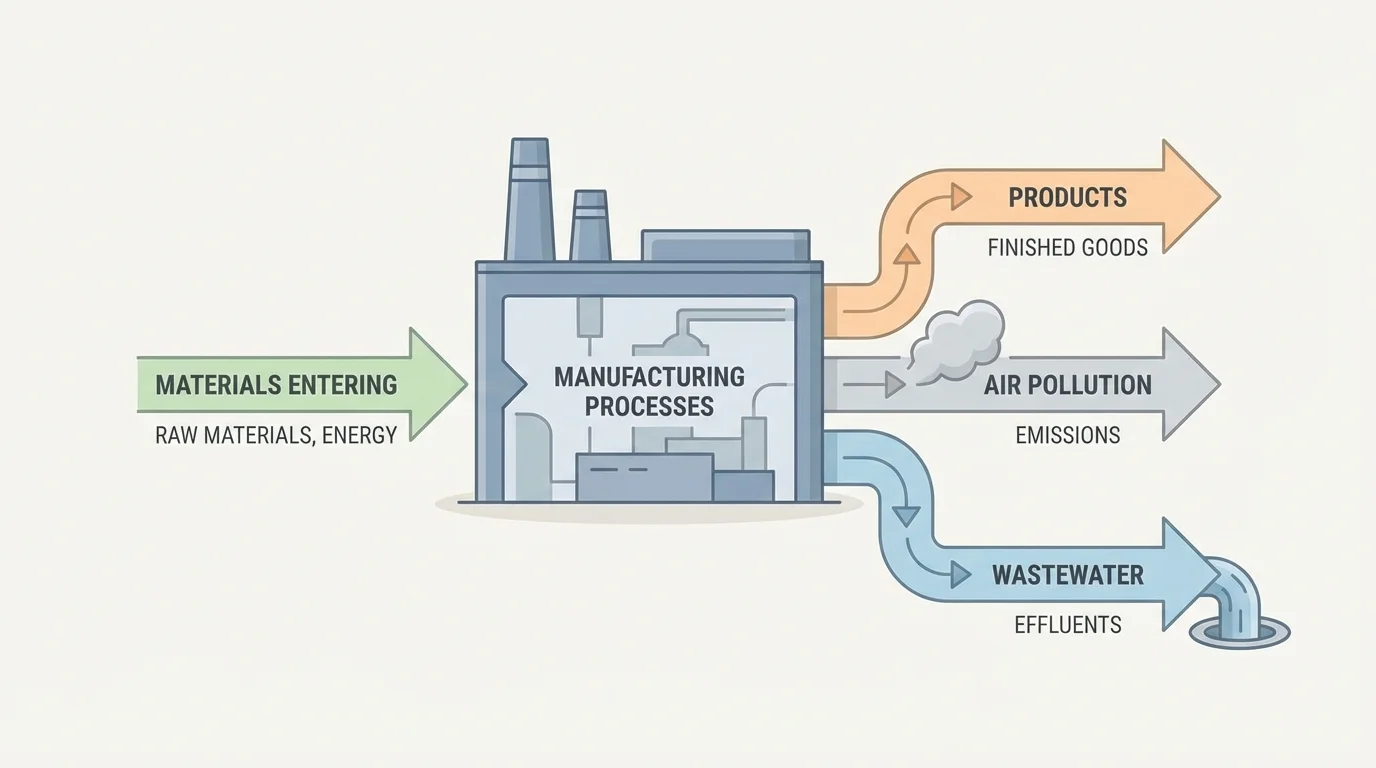
Industry includes factories, construction, mining, and other activities that make or move products people use. Industries turn raw materials from Earth into items such as paper, metal tools, clothing, electronics, and building supplies. As [Figure 3] illustrates, materials go into factories, but waste and pollution can come out if care is not taken.
Mining can remove coal, metals, sand, and stone from the ground. These resources are useful, but mining can change landforms, remove habitats, and pollute water if harmful materials are released. Building roads, parking lots, and large buildings also covers soil with hard surfaces. Water then has a harder time soaking into the ground, so more runoff can happen.
Many factories and vehicles use fuels such as coal, oil, and natural gas. Burning these fuels releases gases into the air, including carbon dioxide. Carbon dioxide is a gas with the chemical formula \(\textrm{CO}_2\). When too much \(\textrm{CO}_2\) builds up in the atmosphere, it can trap extra heat around Earth. Some factories may also release smoke, dust, or chemicals that make the air less healthy to breathe.
A single product, such as a plastic toy or a can, may use resources from several places: metal from one region, oil from another, factory energy from somewhere else, and transportation across land or sea.
Industries can protect Earth too. Many modern factories use filters and scrubbers to reduce air pollution. Some clean wastewater before releasing it. Some companies recycle metal, paper, glass, and plastic so fewer raw materials need to be taken from Earth. Others switch to wind or solar energy.
People do not need to own a factory to affect Earth. Everyday actions matter. Driving cars, turning on lights, heating homes, buying packaged goods, washing clothes, and throwing away trash all use resources. Small actions by one person may seem tiny, but when millions of people do the same thing every day, the effects add up.
For example, when people leave lights on in empty rooms, extra electricity is used. In some places, electricity is made by burning fuels, which can add more \(\textrm{CO}_2\) to the air. When people use many single-use plastics, more waste is created. Plastic bags and bottles can end up in rivers and oceans if they are not handled properly.
Lawns and gardens can also affect the environment. If too much fertilizer is spread on grass before a rainstorm, some of it may wash into storm drains and then into local streams. Washing cars in a driveway can send soap and dirt into drains as well. Even pet waste left on the ground can be carried by rainwater into waterways.
Homes also use water. Long showers, dripping faucets, and overwatering plants waste fresh water. Fresh water is a limited resource in many places, so saving water helps both people and ecosystems.
Real-world example: one neighborhood, many effects
A neighborhood has roads, houses, lawns, and a small creek nearby.
Step 1: Rain falls on roofs and streets.
Because these surfaces are hard, less water soaks into the ground.
Step 2: Water becomes runoff.
The runoff picks up litter, soil, and chemicals from the ground.
Step 3: Runoff enters drains and the creek.
The creek may become dirtier, and animals living there may be harmed.
Step 4: People make changes.
If the neighborhood plants rain gardens, picks up litter, and uses less fertilizer, cleaner water reaches the creek.
This example shows how local choices can improve a place people see every day.
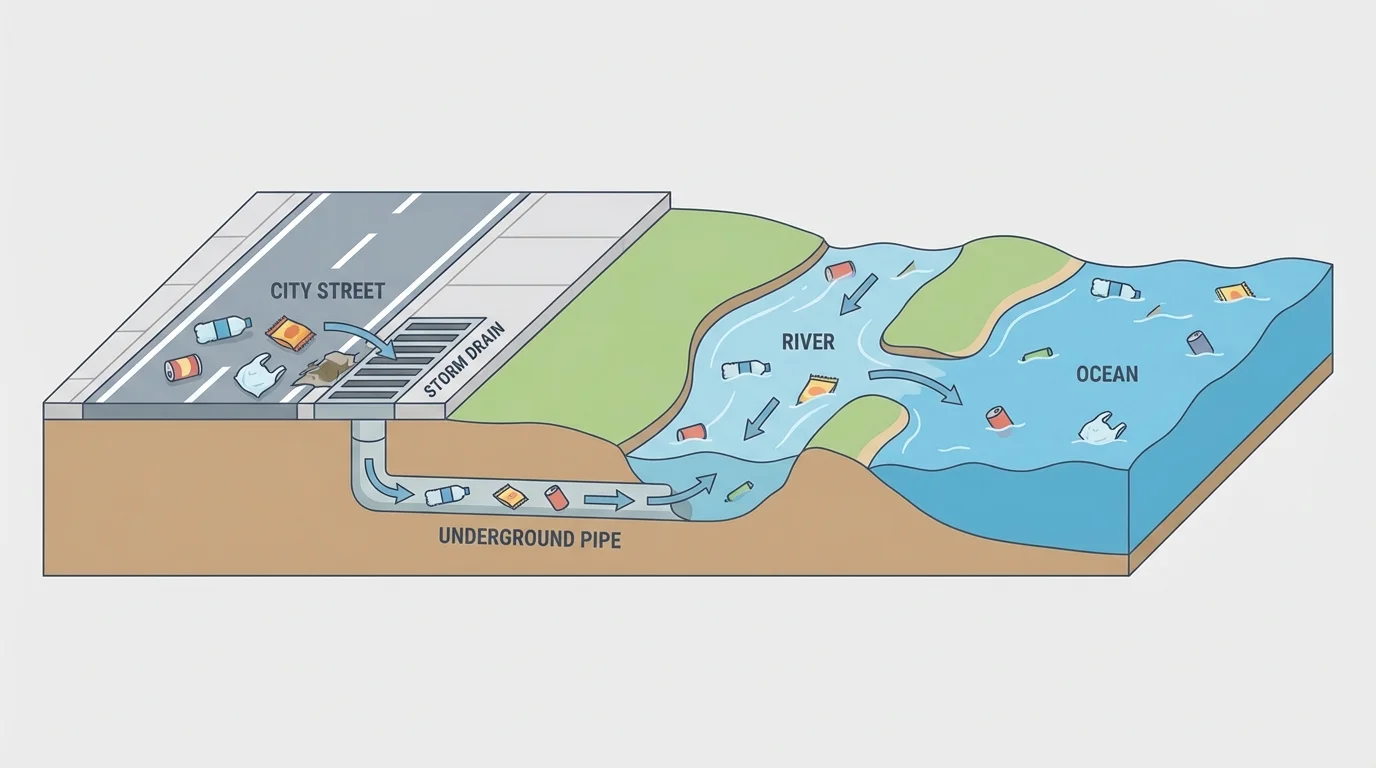
Many people live far from the ocean, yet their actions can still affect it. Litter dropped on a street may travel into a storm drain, then into a river, and later into the sea. This pathway appears in [Figure 4], which shows how pollution can move from land to ocean.
Plastic in the ocean can injure animals such as turtles, seabirds, and fish. Some animals get tangled in plastic. Others mistake it for food. Tiny pieces called microplastics can spread through ocean water and may be eaten by sea life.
Oil spills are another problem. Oil can coat feathers, fur, and shorelines. It can make it hard for animals to stay warm, move, or find food. Chemicals and sewage in ocean water can also damage habitats such as coral reefs and wetlands.
The air is affected too. Cars, trucks, airplanes, factories, and power plants can release gases and particles. Some air pollution can make it harder for people to breathe. Some gases, especially carbon dioxide and methane, are greenhouse gases. Carbon dioxide has the formula \(\textrm{CO}_2\), and methane has the formula \(\textrm{CH}_4\). These gases trap heat in Earth's atmosphere. When too much builds up, Earth's average temperature can rise over time. That can change weather patterns, melt ice, and affect oceans and habitats.
Scientists often explain this with a simple idea called the greenhouse effect. Certain gases act a bit like a blanket that keeps some heat from escaping into space. Earth needs some of this effect to stay warm enough for life, but too much can cause problems.
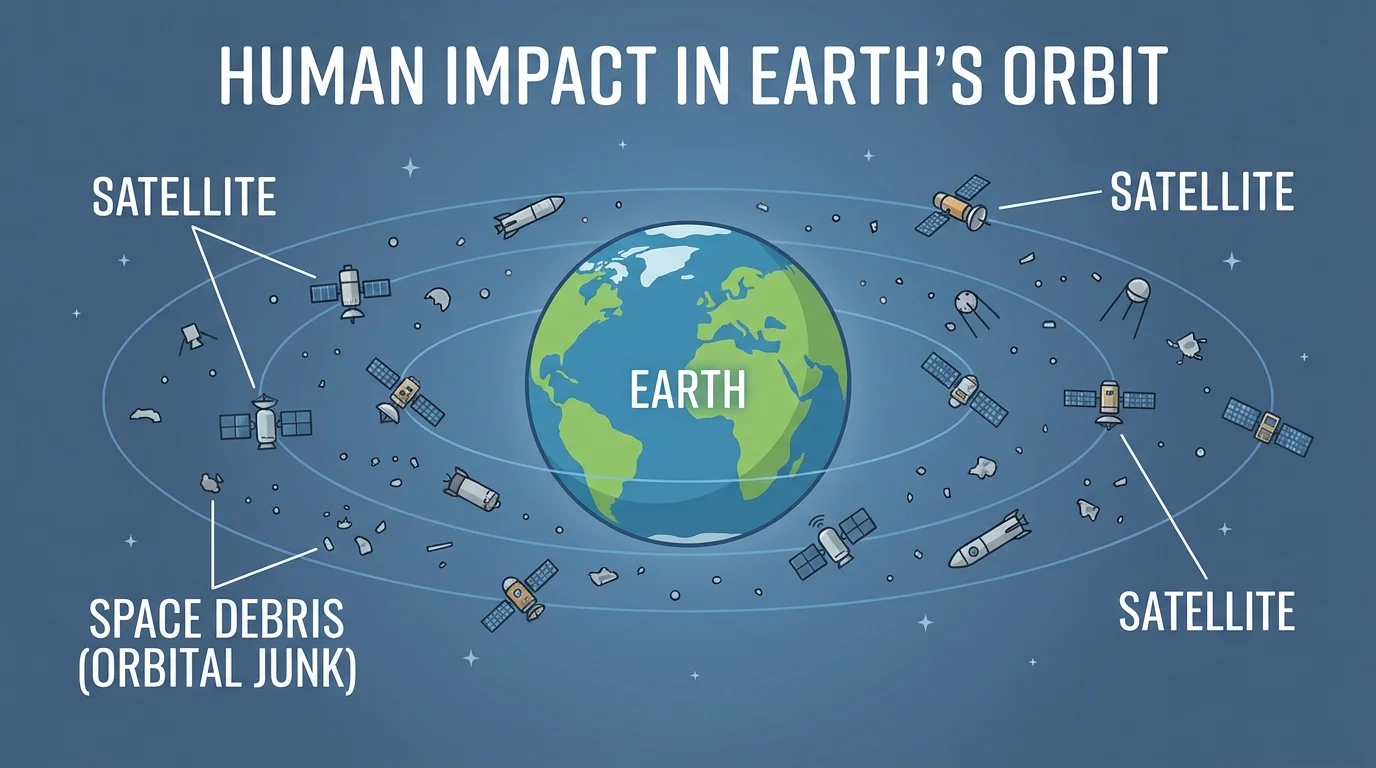
Human activity does not stop at the top of the atmosphere. We launch rockets and place satellites in orbit to study weather, help communication, and learn about space. But these useful tools can also leave behind space debris, as shown in [Figure 5]. Space debris includes broken satellite parts, old rocket pieces, and other human-made objects that still circle Earth.
Even small pieces of debris can move very fast and damage working spacecraft. This makes outer space another environment that people must care for. Engineers are studying ways to design satellites that burn up safely or move out of busy orbits when their jobs are done.
Satellites help people on Earth every day. They can track storms, guide maps on phones, and send signals for television and communication.
Looking at space reminds us that humans can affect places far beyond where we stand. Caring for Earth includes using technology responsibly, both on the ground and above it.
Communities around the world are finding smart ways to protect resources and environments. A community might clean up a beach, plant trees in parks, restore wetlands, protect forests, or create rules that reduce pollution. When a whole town or city works together, the results can be much bigger than one person working alone.
For example, some communities build recycling programs so materials can be used again. Recycling aluminum cans, paper, glass, and some plastics can reduce waste and lower the need for new raw materials. Some places also compost food scraps and yard waste. Compost can return nutrients to the soil instead of filling up landfills.
Other communities protect habitats by setting aside parks, wildlife refuges, and marine protected areas. These places help plants and animals survive. Trees planted along streams can reduce erosion, just as we saw earlier in [Figure 2], and wetlands can soak up water and help filter pollution before it reaches larger rivers.
Communities also save energy by using buses, bike paths, and renewable energy. Renewable resources are resources that can be replaced naturally in a shorter time, such as sunlight and wind. Solar panels and wind turbines can help make electricity without burning as much fossil fuel.
| Human activity | Possible effect | Helpful solution |
|---|---|---|
| Clearing too many plants | More erosion and habitat loss | Plant trees and protect native plants |
| Using too much fertilizer | Polluted streams and lakes | Use less and keep buffer strips near water |
| Burning fossil fuels | Air pollution and more greenhouse gases | Save energy and use wind or solar power |
| Throwing trash carelessly | Litter in neighborhoods and oceans | Reduce, reuse, recycle, and clean up |
| Leaving old objects in orbit | More space debris | Design safer missions and remove debris |
Table 1. Examples of how human activities can affect Earth and ways people can reduce harm.
Protecting Earth is not only a job for scientists, leaders, or large groups. Individual choices matter. One student can use a reusable water bottle, turn off lights, save water, pick up litter, and remind others to care for local parks and streams. Families can sort recycling, avoid wasting food, and walk or bike when possible.
Students can also learn to ask good questions. Where does our water come from? Where does our trash go? How is our electricity made? Asking these questions helps people notice the hidden paths of resources and waste. The connected systems in [Figure 1] remind us that what happens in one place can affect another place.
"We do not inherit the Earth from our ancestors; we borrow it from our children."
When people understand how their actions affect land, vegetation, streams, oceans, air, and space, they can make wiser choices. Caring for Earth does not mean stopping all human activity. It means using resources responsibly, reducing harm, and finding better ways to live and work.
