Earth is sometimes called the "water planet," and from space it looks bright blue. That sounds like great news for thirsty people, animals, and plants. But here is the surprising part: almost all of that water is salty ocean water. The water we can more easily use for drinking, farming, and many living things is only a small part of all the water on Earth.
Water covers much of Earth's surface, and every living thing needs it. Our bodies need water. Plants need water to grow. Animals need water to survive. Yet even though Earth has a huge amount of water, most of it is not fresh water.
The largest storage place for water on Earth is the ocean. Ocean water contains dissolved salts, so it is called salt water. Fresh water has much less dissolved salt. People cannot safely drink ocean water because its salt content causes the body to lose more water than it takes in.
That means Earth has a lot of water, but only a small amount is the kind most land plants, animals, and people can use directly. This is one reason water is such an important part of Earth's systems.
Salt water is water that contains a lot of dissolved salts, like ocean water.
Fresh water is water with very little dissolved salt. It is the kind found in rivers, many lakes, glaciers, and underground.
When scientists talk about where Earth's water is, they are thinking about different storage places, such as oceans, ice, groundwater, lakes, rivers, wetlands, and the air. Water moves between these places, but not equally. Some places hold enormous amounts, while others hold only a tiny fraction.
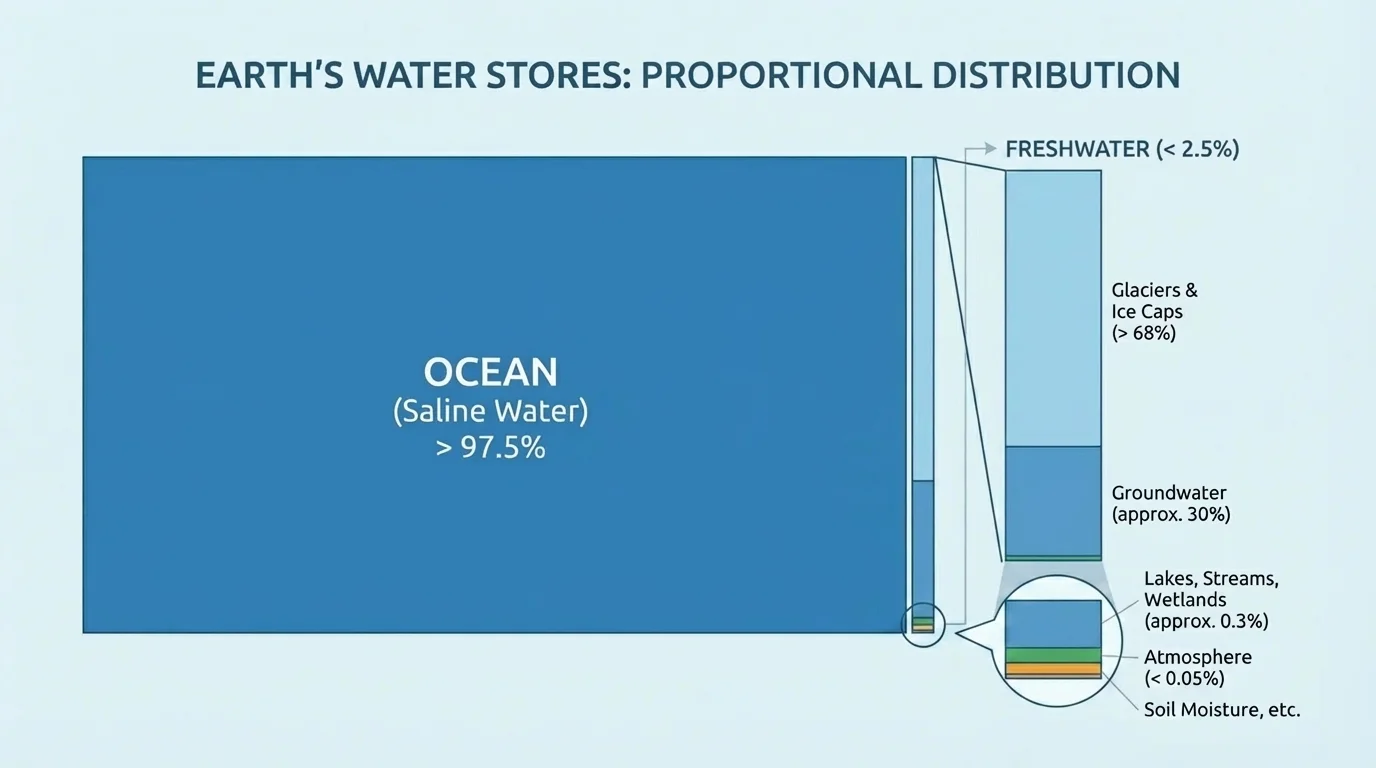
Most of Earth's water is in the ocean, as [Figure 1] shows. If you pictured all of Earth's water as one giant collection, nearly all of it would be salt water in the oceans. Only a much smaller part would be fresh water.
Even inside the fresh-water part, the water is not spread out evenly. Most fresh water is frozen in glaciers and ice caps or stored underground. Only a very small amount is found in streams, lakes, wetlands, and the atmosphere. Those are the places people notice most often, but they hold only a tiny share.
This idea can feel backwards. We see puddles after rain. We visit lakes. We cross bridges over rivers. We watch clouds in the sky. Because these are easy to notice, they can seem like major water stores. In fact, they are only a small visible part of a much bigger water system.
A useful way to think about this is to imagine a large school filled with students. Suppose almost everyone is in the gym, a smaller group is in the library, and only a few are in the hallway. If you stand in the hallway, you might think lots of students are there because that is what you see. Earth's water can be like that: we often see the "hallway water," but most water is somewhere else.
Scientists often use approximate percentages to compare Earth's water. A common estimate is that about \(97\%\) is ocean water and about \(3\%\) is fresh water. Of that fresh water, most is frozen or underground, and far less than \(1\%\) of all Earth's water is in rivers, lakes, wetlands, and the atmosphere together. The exact values may vary slightly in different science sources, but the big idea stays the same: the ocean holds nearly all Earth's water.
Some of the oldest water people use may have been underground for hundreds or even thousands of years before it came out of a spring or a well.
When you look again at [Figure 1], the most important pattern is not the exact size of every small part. The main pattern is that the ocean is by far the biggest water store, while lakes, streams, wetlands, and the atmosphere are tiny by comparison.
Why is ocean water salty? Over a very long time, rain and moving water wear tiny bits of rock away from land. Some dissolved materials are carried by rivers to the ocean. When ocean water evaporates, the water leaves, but many salts stay behind. Over time, this helps keep ocean water salty.
Fresh water is different. It may be found in rivers, lakes, glaciers, underground, and sometimes in the air as water vapor or tiny droplets. Fresh water is essential for drinking, cooking, growing food, and supporting many ecosystems on land.
Still, not all fresh water is easy to get. Water locked in thick ice sheets is fresh, but it is frozen far away in very cold places. Groundwater is fresh in many places, but it may be deep underground. So even though fresh water exists, the water that is easiest for people and animals to reach is much less than many people expect.
Places on Earth are connected by this difference. Oceans affect weather, temperature, and the water cycle. Fresh water supports forests, farms, wetlands, and cities. Both salt water and fresh water are important parts of Earth's systems, but they play different roles in our daily lives.
A huge amount of Earth's fresh water is stored as ice or underground water, as [Figure 2] illustrates. These are not always easy to see, but they are major parts of Earth's water supply.
Glaciers are large, slow-moving masses of ice formed from snow that builds up over many years. Ice caps are similar large areas of ice. The biggest ice stores on Earth are in Antarctica and Greenland. The water in that ice is fresh water, but because it is frozen, it is not easy for most people or animals to use directly.
Groundwater is water stored below Earth's surface in soil and rock. Rain and melting snow can soak into the ground. This process fills spaces between particles of soil and cracks in rocks. Some underground layers hold a lot of water and can provide water to wells.
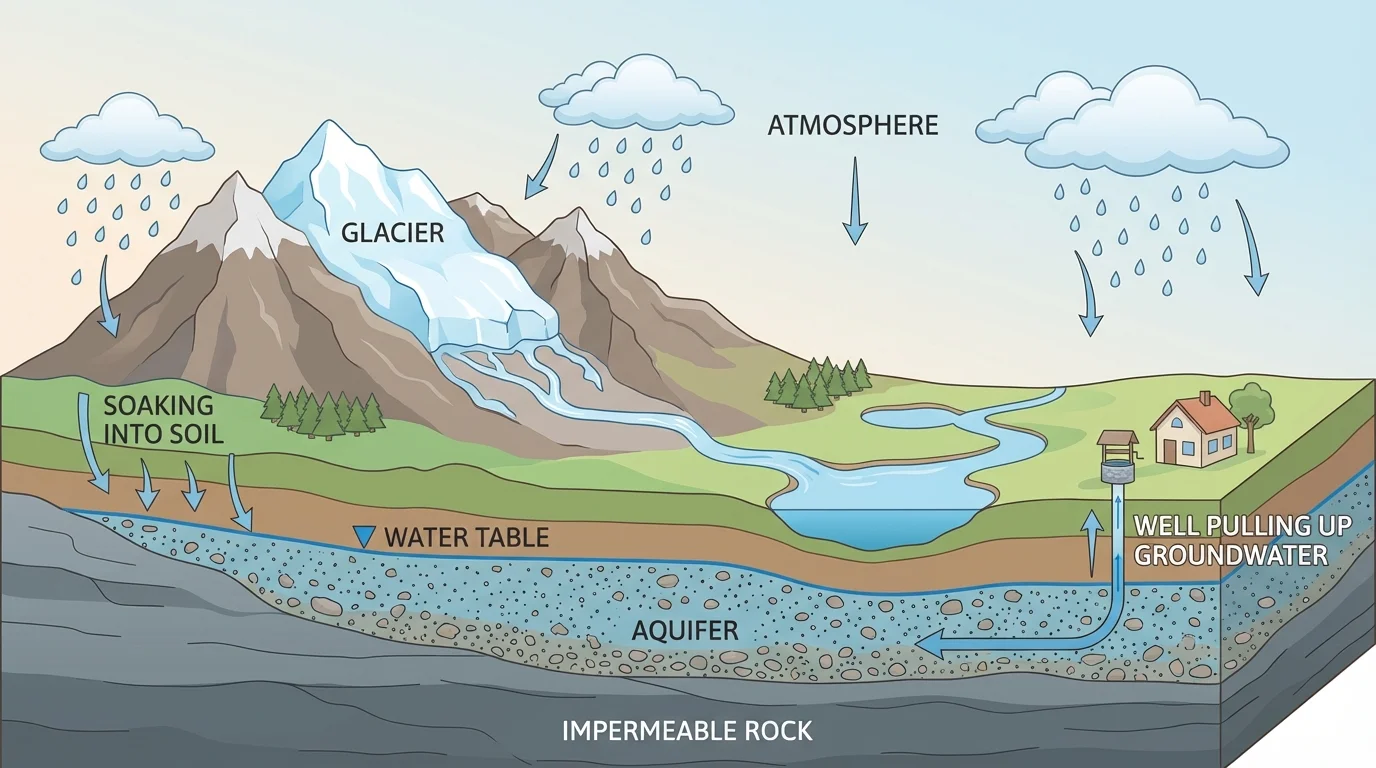
An aquifer is an underground layer of rock, sand, or gravel that stores and carries groundwater. Some aquifers are close to the surface, and some are deep underground. In many communities, wells reach into aquifers to bring water up for homes, farms, or towns.
Groundwater is very important because it can keep supplying water even when there has not been rain for a while. However, it is not endless. If people pump out groundwater faster than nature replaces it, water levels underground can drop.
Why underground water matters
Groundwater often acts like a hidden savings account of water. During wet times, some water soaks into the ground. During dry times, people, plants, and even streams may depend on that stored water. But like money in a savings account, it can be used up faster than it is replaced.
Glaciers also matter far beyond the cold places where they are found. In some mountain regions, melting glacier ice feeds rivers during warmer months. That water can help supply farms, towns, and wildlife. As we see from the land layers in [Figure 2], water stored underground is part of the same Earth system as water at the surface.
The fresh water people notice most often is found in streams, lakes, wetlands, and the atmosphere. These are important places, but together they hold only a tiny fraction of Earth's water.
Streams and rivers carry water across land. Some are small enough to jump over, and some are so wide they look like moving lakes. They are important for habitats, transportation in some regions, irrigation, and drinking water. But compared with the ocean or giant ice sheets, rivers and streams contain very little of Earth's total water.
Wetlands are places where water covers the ground or keeps the soil wet for much of the time. Marshes and swamps are examples. Wetlands are home to many plants and animals. They also help clean water and reduce flooding by soaking up extra water like a sponge.
Lakes can look enormous. The Great Lakes in North America, for example, hold a very large amount of fresh surface water. Yet even large lakes are still just a small part of all the water on Earth. Surface water is important because it is easier to reach, not because it is the biggest store.
The atmosphere also contains water, mostly as invisible water vapor and tiny droplets in clouds. This amount is extremely small compared with the ocean, glaciers, or groundwater. But it is powerful because it moves quickly through the water cycle and helps create weather such as clouds, rain, snow, and storms.
Real-world example: Why a tiny amount can still be important
A town may get most of its drinking water from a nearby lake even though lakes hold only a tiny fraction of Earth's water.
Step 1: Notice the size problem
Earth has a huge amount of water overall, but almost all of it is salty or hard to reach.
Step 2: Notice the access advantage
A lake at the surface is much easier to use than ice in Antarctica or water deep underground.
Step 3: Connect it to daily life
That is why small surface-water stores are often the water people depend on most directly.
This is one of Earth science's most important ideas: a place can hold only a tiny share of the total water and still be extremely important to life.
Earth's water is always moving through a process called the water cycle, as [Figure 3] shows. Water does not stay forever in one place. It moves between the ocean, land, ice, underground, living things, and the atmosphere.
When the Sun warms water in oceans, lakes, rivers, or soil, some liquid water changes into water vapor and rises into the air. This is called evaporation. Plants also release water vapor in a process called transpiration, which adds water to the atmosphere.
Higher in the sky, water vapor cools and changes into tiny droplets or ice crystals. This is called condensation. These droplets gather to form clouds. When droplets or ice crystals become heavy enough, water falls back to Earth as precipitation, such as rain, snow, sleet, or hail.
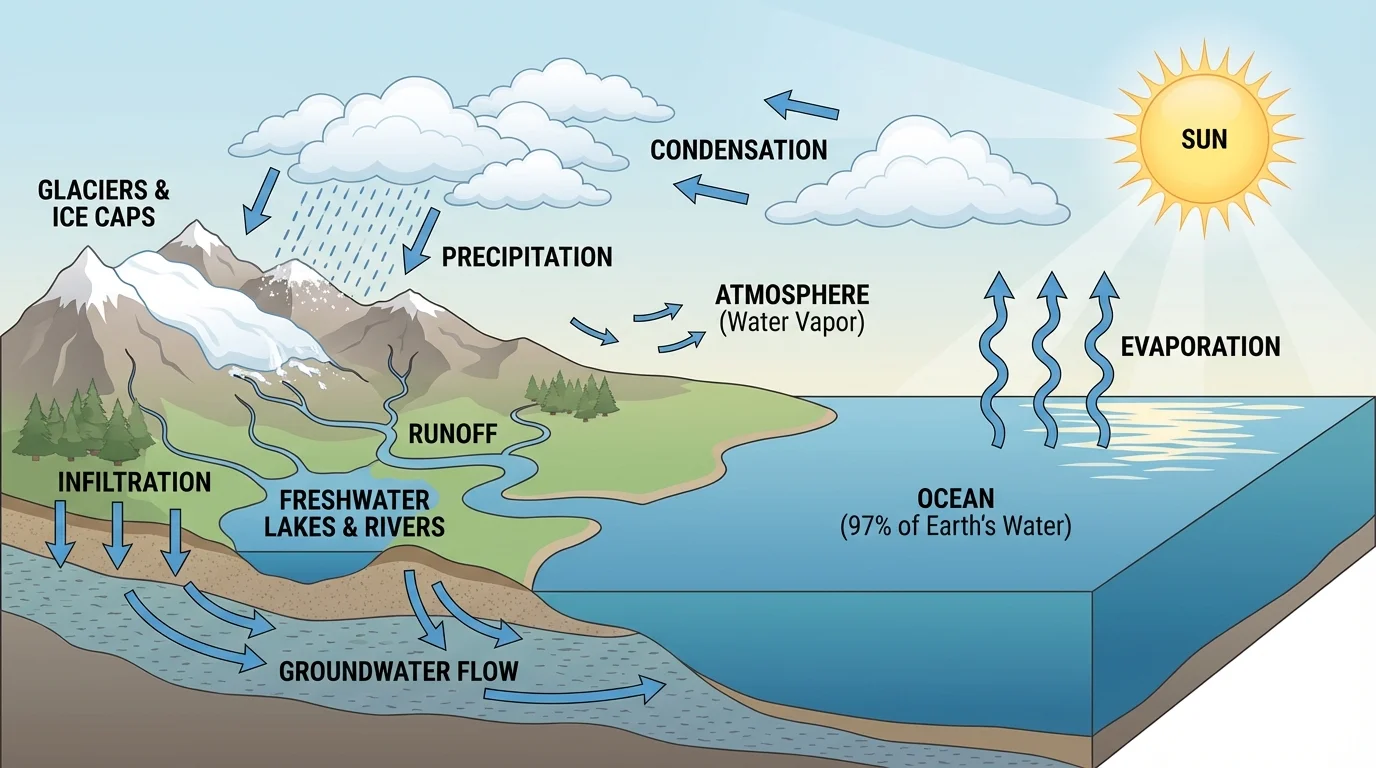
After precipitation reaches the ground, some water flows over land into streams and rivers. This is called runoff. Some soaks into the ground, which is called infiltration. Some becomes groundwater. Some freezes into snow or ice. Some is taken up by plants. Eventually, much of this water returns again to lakes, rivers, groundwater, glaciers, or the ocean.
The water cycle helps explain why the atmosphere contains only a tiny amount of water at one time but still matters a lot. Water in the air moves quickly. It can evaporate from the ocean, form clouds, and fall as rain or snow somewhere else. In [Figure 3], arrows connect these stores to show that Earth's systems work together rather than separately.
Water can change state. It can be a solid like ice, a liquid like river water, or a gas like water vapor. These changes help water move through the water cycle.
Because water is always moving, a drop of water might have an amazing journey. It could spend years frozen in a glacier, then melt into a stream, flow into a river, reach the ocean, evaporate into the atmosphere, and fall again as rain hundreds of miles away.
Where water is stored matters almost as much as how much water exists. If water is in the ocean, it affects climate, sea life, and weather. If it is frozen in glaciers, it is stored for long periods. If it is underground, it may feed wells and springs. If it is in rivers and lakes, people can often reach it more easily.
Farmers need reliable fresh water to grow crops. Cities need water for drinking, cleaning, and firefighting. Fish and other water animals need healthy lakes, rivers, wetlands, and oceans. Forests and grasslands depend on rain and soil moisture. A change in where water is stored can affect all of these.
During a drought, an area gets less precipitation than usual. Streams may shrink, lake levels may fall, wetlands may dry out, and groundwater may drop if people use more than nature replaces. This shows how a tiny fraction of surface fresh water can have a huge effect on communities.
Flooding is the opposite problem. When too much water falls too quickly or the ground cannot absorb it, water spreads over land. Wetlands can help by slowing and storing some of that water. This is one reason wetlands are so valuable.
Clouds look light and fluffy, but a large cloud can hold an enormous amount of water in tiny droplets spread throughout the air.
The same Earth system can cause both drought and flood in different places or at different times. That is why scientists study water storage, movement, and weather together.
Earth's water stores are found in many different places around the globe. Antarctica and Greenland contain huge amounts of frozen fresh water. Mountain glaciers in places such as the Himalayas and the Andes also store water that can feed rivers used by millions of people.
Large lake systems, such as the Great Lakes of North America and Lake Baikal in Asia, are important fresh surface-water stores. Wetlands such as the Everglades in Florida or the Pantanal in South America support many species and help manage water on the land.
Some dry regions depend heavily on groundwater. In places with little rain, water from wells may be one of the main ways people get fresh water. This can be helpful, but it also means groundwater must be used carefully.
| Water store | What it is like | Why it matters |
|---|---|---|
| Oceans | Salty, largest water store | Affects climate, weather, and marine life |
| Glaciers and ice caps | Frozen fresh water | Stores most fresh water for long times |
| Groundwater | Fresh water underground | Supplies wells, springs, and some streams |
| Lakes and streams | Surface fresh water | Easy for people and wildlife to use |
| Wetlands | Waterlogged land areas | Provide habitats and help reduce floods |
| Atmosphere | Water vapor and droplets in air | Drives weather and precipitation |
Table 1. Major water stores on Earth and why each one is important.
Even though these places are different, they are all connected. Ocean evaporation can become snow on a mountain. Melting snow can feed a river. River water can soak into the ground. Groundwater can flow into wetlands or back into streams. Earth's systems keep moving water from one place to another.
Because only a small amount of Earth's water is easy for people to use, protecting fresh water is very important. Pollution can make rivers, lakes, wetlands, or groundwater unsafe. Overuse can lower water levels. Waste can leave less for people, farms, and wildlife.
People can help by using water carefully, fixing leaks, keeping trash and chemicals out of drains and streams, and protecting wetlands and forests. Communities can clean wastewater, monitor water quality, and plan how much groundwater they use.
Understanding where water is stored helps people make better choices. When we know that nearly all water is in the ocean and that most fresh water is frozen or underground, we understand why clean, reachable fresh water must be treated as a precious resource.
