Why does a soccer ball fly across a field when kicked, but stay still when no one touches it? Why can two teams in tug-of-war pull so hard and still not move the rope? These questions are all about forces and motion. Forces are happening all around you when you open a door, ride a bike, slide a book, or drop a pencil. Scientists study these changes carefully so they can explain what makes objects start moving, stop moving, speed up, slow down, or turn.
When scientists want to learn how something works, they do not just guess. They plan and conduct an investigation. That means they decide what to test, what to observe, and how to collect evidence. Evidence is what helps us know if an idea is correct. In this topic, the evidence comes from watching how an object moves when different forces act on it.
An object can be still, like a toy block sitting on a table. An object can also be moving, like a marble rolling across the floor. Motion is the way an object moves. We can describe motion with words such as start, stop, speed up, slow down, and change direction.
Objects do not usually change motion by themselves. A push or a pull must act on them. If you push a wagon, it starts moving. If you pull a drawer, it opens. If you catch a ball, your hands apply a force that stops it. These changes tell us that forces affect motion.
Force is a push or a pull.
Balanced forces are forces that match and do not change an object's motion.
Unbalanced forces are forces that do change an object's motion.
Sometimes the change is easy to see. A toy car at rest moves after one push. A rolling ball slows down after the floor and air push against it. A swing changes direction again and again because pushes and pulls act on it during its motion. By watching carefully, students can find patterns and use those patterns to predict what may happen next.
Forces are not rare or unusual. They are part of everyday life. When you press clay, your hands push it. When you pull on your backpack zipper, the zipper moves. When the wind moves leaves, the wind pushes them. Even when you are standing still, forces are acting on you.
Many objects have more than one force acting on them at the same time. A book on a desk is pulled down by gravity, and the desk pushes up on the book. A child pulling a sled may pull forward while the ground pushes against the sled in the opposite direction. To understand motion, we need to think about how these forces work together.
A force can act even when you cannot see it directly. You cannot see gravity, but you can see what it does when an apple falls, a dropped crayon hits the floor, or rain falls from clouds.
Scientists often begin with simple questions: What happens if the push is stronger? What happens if the push comes from the other side? What happens if two people push equally in opposite directions? Questions like these help shape an investigation.
Balanced forces and unbalanced forces help explain why an object's motion changes or stays the same. As [Figure 1] shows, when forces are balanced, they cancel each other in effect. The object may stay still, or it may keep moving in the same way without changing. When forces are unbalanced, one side has a stronger effect or there is a force in only one direction, so the object's motion changes.
Think about a game of tug-of-war. If both teams pull with equal strength in opposite directions, the rope may not move. That is an example of balanced forces. But if one team pulls harder, the rope moves toward that team. That is an example of unbalanced forces.
A second example is a box on the floor. If one child pushes the box to the right and another child pushes equally to the left, the box may stay in place. But if only one child pushes, or one child pushes harder than the other, the box moves. The important idea is not exact numbers. The important idea is whether the forces are equal or not equal in size, and whether they act in the same or opposite directions.
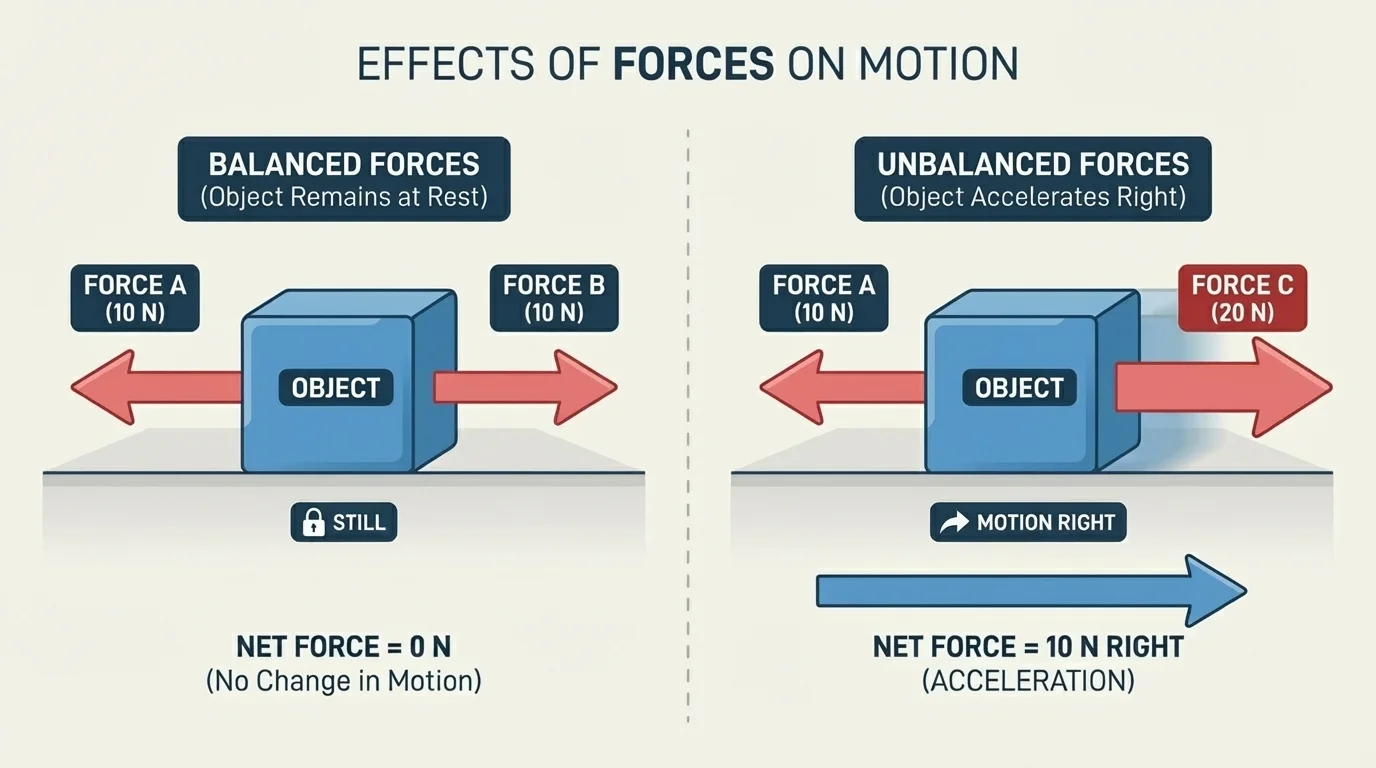
Balanced forces do not mean that no forces are present. It means the forces work against each other in a way that does not change motion. Unbalanced forces do mean a change in motion. The object may start moving, stop moving, move faster, move slower, or turn.
Later, when you look at investigation results, remember the picture in [Figure 1]. It helps explain why some tests show no change while other tests show a clear change in motion.
When students investigate forces, they look for patterns in motion. A pattern is something that happens in a regular or repeated way. If the same kind of push makes a toy car roll farther again and again, that pattern gives evidence about how force affects motion.
You can observe several kinds of motion changes: an object can begin to move, stop, speed up, slow down, or change direction. For third-grade science, these observations are enough to show how forces affect motion. You do not need to measure exact force amounts. Instead, you can compare forces with words like gentle, stronger, same, opposite, or different direction.
For example, if you gently roll a ball, it moves a short distance. If you give it a stronger push, it may roll farther. If you roll it toward a wall, it changes direction after bouncing. If you place your hand in front of it, your hand can stop it. These observations give evidence about the effects of forces.
Patterns help us predict motion. If the same force action leads to the same kind of motion many times, we can use that pattern to make a good prediction. For example, if a toy car always rolls farther when it gets a stronger push, we can predict that another stronger push will also make it roll farther.
Patterns do not come from one quick look. Scientists repeat tests and compare results. If the same result happens again and again, we trust that evidence more.
A good investigation begins with one clear question. In this topic, the question should focus on one variable at a time. You might ask, "How does the direction of a push change the motion of a toy car?" or "How does the number of pushes affect how a box moves?" or "How does the size of a push affect how far a ball rolls?"
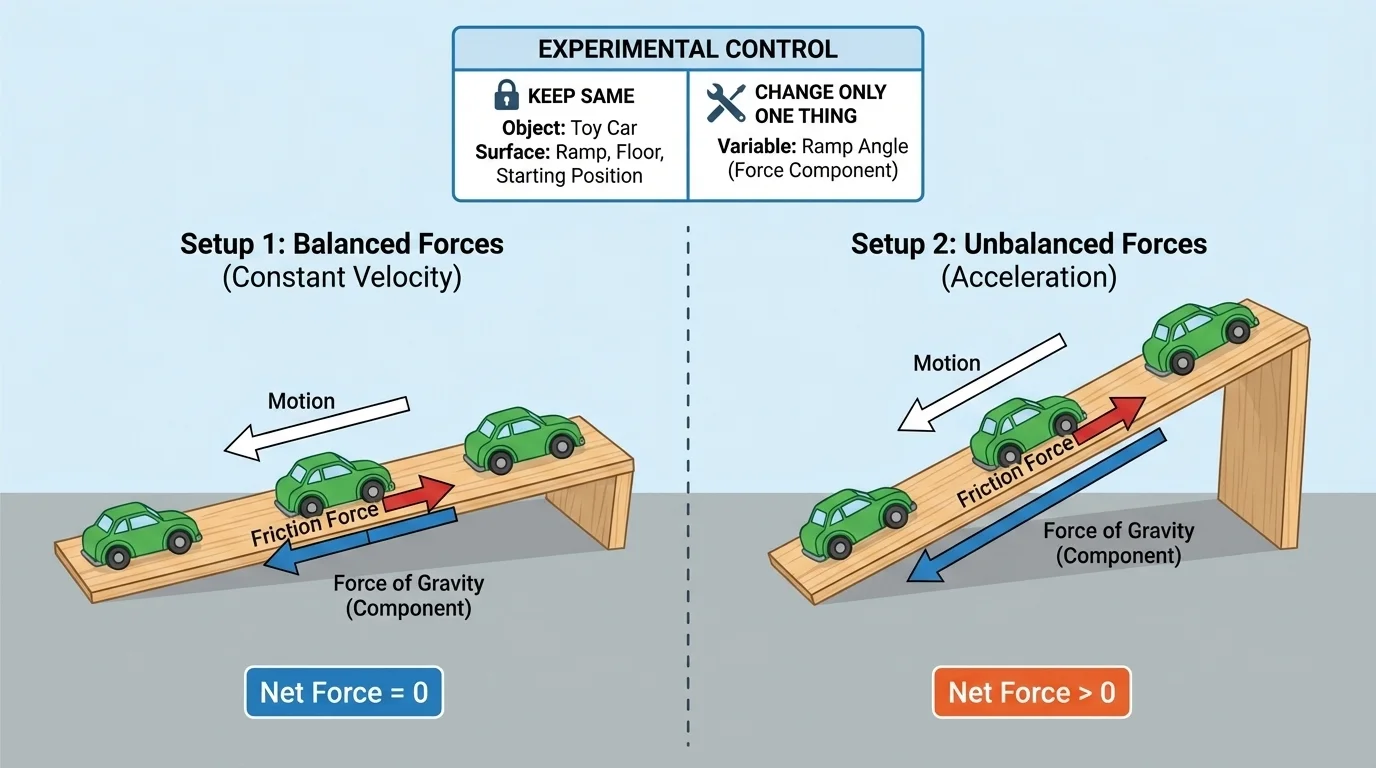
[Figure 2] It is important to change only one thing at a time. This is called a fair test. If you change many things at once, you cannot tell which change caused the result. For example, if you use a different car, a different floor, and a different push all in the same test, the results will be confusing.
Everything except the one variable should stay the same. If you are testing push size, use the same object, the same starting place, and the same surface each time. If you are testing direction, keep the object and surface the same but change the way you push. If you are testing number of pushes, keep the object and type of push the same but change only how many pushes are given.
You also need a plan for observing and recording. Decide what you will look for. Will the object start moving? Will it move farther? Will it turn? Will it stop? You may use simple tools like a ruler for distance, masking tape for a start line, and a chart to record what happened. Measurements can be simple and used only to compare results, such as whether one roll went farther than another.
Safety matters in every investigation. Use open floor space, roll objects away from faces, and choose objects that are safe for the classroom. A soft ball or toy car is often a good choice.
Good science habits include asking one question, changing one variable, observing carefully, and recording what actually happens instead of what you think should happen.
When your plan is clear before you begin, your evidence will be stronger and easier to understand.
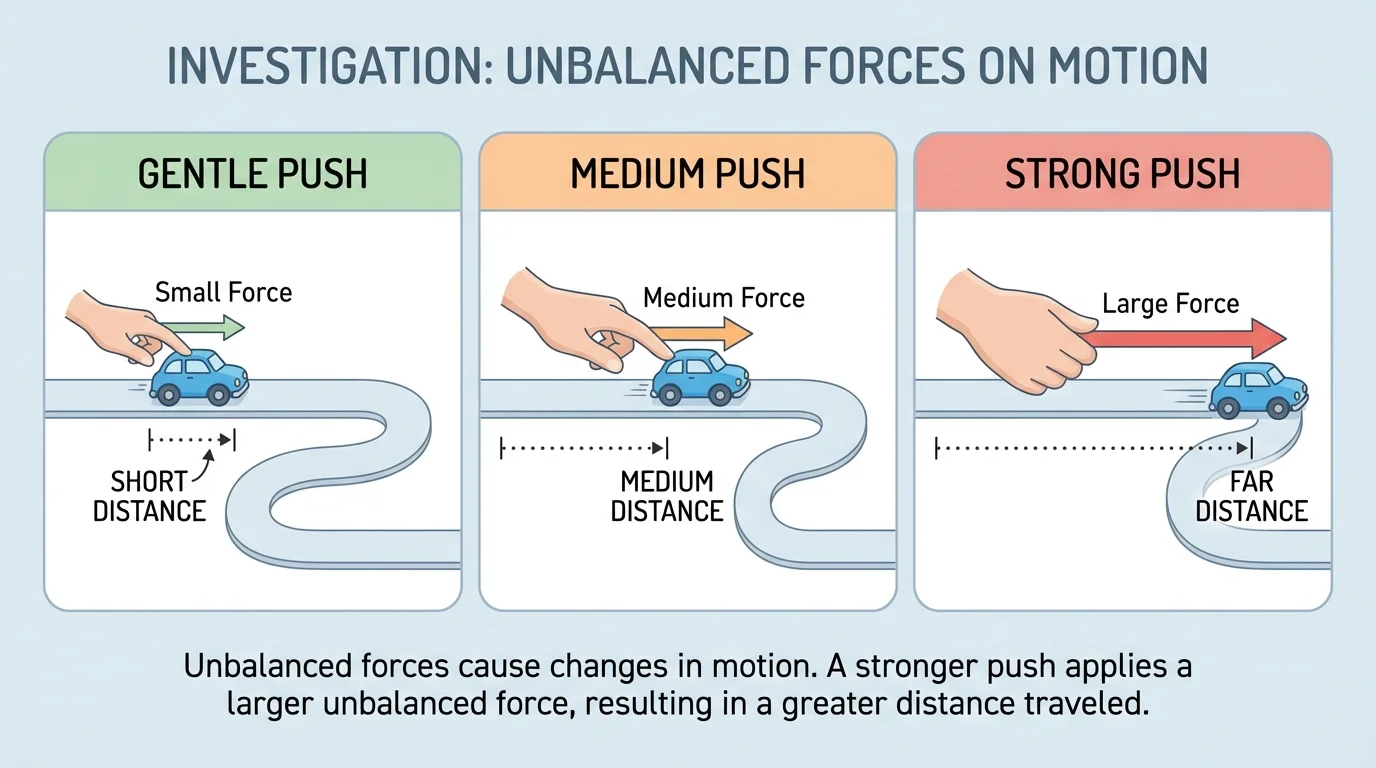
Suppose a class wants to learn how the variable of push size affects the motion of a toy car. The class chooses one toy car and one smooth floor. The starting line stays the same each time. One student gives a gentle push, then a medium push, then a stronger push. The class watches how far the car goes.
Example investigation: Testing push size
Step 1: Ask a question.
How does the size of a push affect the motion of a toy car?
Step 2: Keep most things the same.
Use the same toy car, the same floor, and the same start line each time.
Step 3: Change one thing.
Change only the push: gentle, medium, or stronger.
Step 4: Observe and record.
Notice whether the car starts moving quickly, rolls slowly, or travels a longer distance.
Step 5: Repeat.
Try each kind of push more than once to see whether the pattern stays the same.
If the stronger push makes the car move farther in repeated trials, the class has evidence that a bigger push causes a greater change in motion. This is an example of unbalanced forces. The stronger push changes how the object moves.
A different class might test direction instead. They could push a toy car forward, then push the same car from the side. They would observe whether the car changes direction. Another class might test the number of pushes by using one push and then two pushes on the same object. Each investigation changes only one variable.
These kinds of investigations stay within an important limit: students compare forces in simple ways such as one versus two pushes, gentle versus stronger pushes, or left versus right pushes. They do not need exact force numbers.
Scientists collect evidence by observing carefully and writing down what happens. A simple chart can help students see patterns, as [Figure 3] demonstrates with repeated pushes and motion results. When results are organized, it is easier to compare them.
Here is an example of a simple class data table.
| Test | What changed? | Observation | What it shows |
|---|---|---|---|
| \(1\) | Gentle push | Car moved a short distance | Unbalanced force changed motion a little |
| \(2\) | Medium push | Car moved farther | Stronger unbalanced force changed motion more |
| \(3\) | Stronger push | Car moved farthest | Largest push caused the greatest motion change |
Table 1. A simple comparison of how different push sizes affect the motion of the same toy car.
Notice that the table uses words and observations rather than complicated calculations. That is enough to build an explanation. If the same pattern happens several times, students can make a claim based on evidence. For example: "The toy car rolled farther when the push was stronger."
A useful investigation often includes repeated trials. If one test gives a strange result, repeated trials can help show whether it was just a mistake. Maybe the car hit a crack in the floor one time. Testing again gives more reliable evidence.
Looking back at [Figure 3], you can see how patterns become easier to notice when observations are placed in order. Scientists use these patterns to explain what happened and to predict what may happen in the next test.
Forces and motion are not just classroom ideas. They matter in sports, transportation, and play. When a basketball player passes the ball, the push from the hands changes the ball's motion. When a goalie stops the ball, the goalie applies a force that changes the ball from moving to not moving. When a cyclist presses the brakes, the bike slows down because forces are changing its motion.
On a playground, a child on a swing moves because pushes and pulls keep changing the swing's motion. On a slide, gravity pulls the child downward while the slide surface affects how the child moves. In a wagon race, stronger pulls can make the wagon move faster. In each case, forces help explain the motion pattern.
Real-world example: Soccer ball
A soccer ball resting on the grass does not move much until a player kicks it. The kick is an unbalanced force that starts the ball moving. If another player stops it with a foot, that force changes the ball's motion again. If two players kick from opposite sides with equal effect at the same moment, the ball may not move much because the forces are balanced.
These examples matter because they show that science helps us understand ordinary events. The same ideas used to explain a toy car in class also explain what happens to balls, wagons, swings, and bicycles.
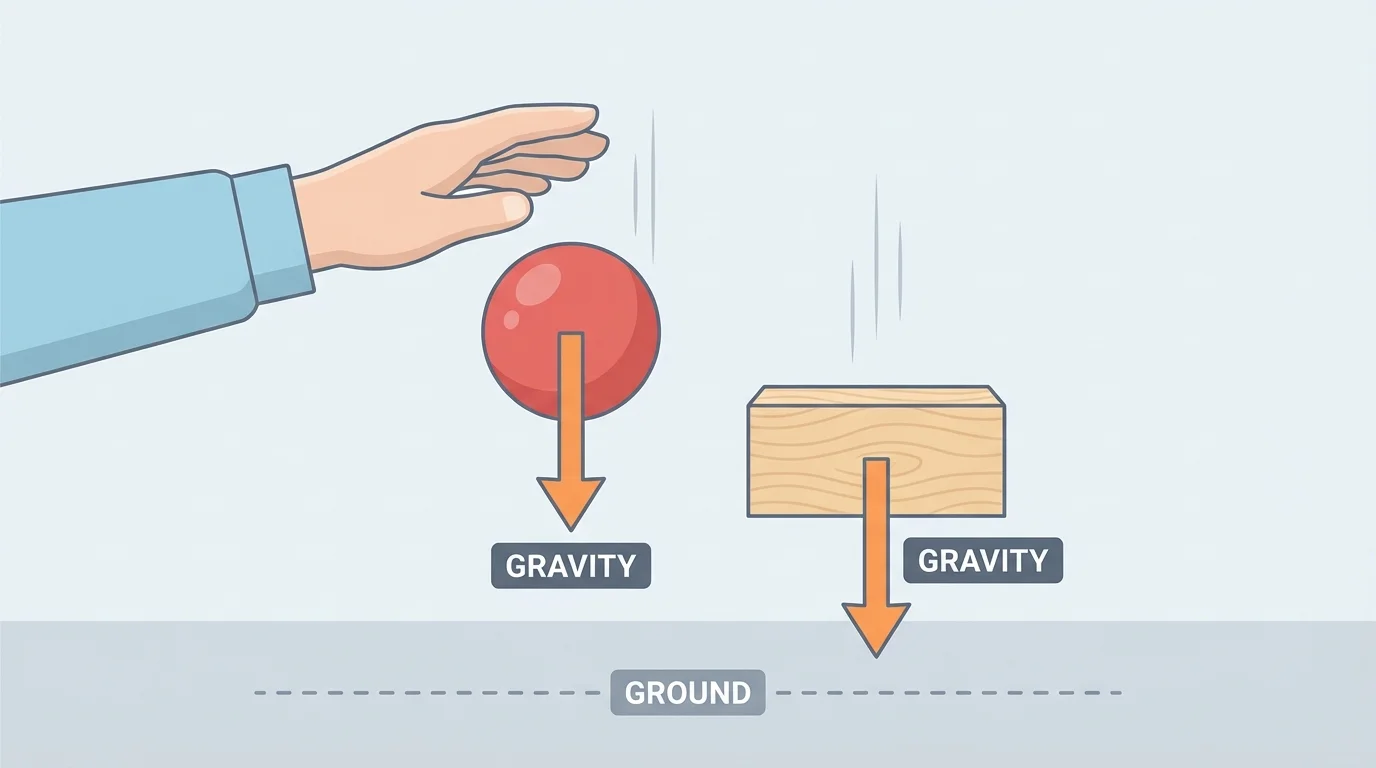
Gravity is a force that pulls objects down toward Earth. If you let go of a pencil, it falls. If you toss a ball upward, it comes back down. Gravity is always acting, even when we are not thinking about it.
[Figure 4] For this topic, it is enough to understand gravity in a simple way: gravity pulls things downward. You do not need to calculate gravity with numbers. You only need to notice its effect on motion. A dropped object moves down because of this pull.
Gravity can also work with other forces. When you roll a ball off a table, the ball first moves forward, then falls down. The forward motion comes from the push, and the downward motion comes from gravity. Watching both motions helps students see that more than one force can affect an object.
When you compare this idea to [Figure 4], it becomes clear that gravity gives a steady downward pull. That is why objects do not float away when released near Earth.
One common mistake is changing too many things at once. If a student uses a heavier ball, a different floor, and a different push in the same test, the results are hard to understand. Good investigations keep most things the same and change only one variable.
Another mistake is making a claim without enough evidence. If a student tries only one test and says, "A stronger push always makes the object go farther," that claim may be too quick. Repeating the test helps make the evidence stronger.
It is also important to describe what was actually observed. A scientist should say, "The car moved farther with the stronger push in three tests," rather than "I think strong pushes are better." Clear observations lead to clear explanations.
"Science is a way of learning from careful observation and evidence."
When students plan carefully, test fairly, and record honestly, they can explain how balanced and unbalanced forces affect motion. They can also use patterns from their evidence to predict what will probably happen next.
