Have you ever noticed that a swing keeps going back and forth, or that a ball bounces lower and lower each time? These motions may look simple, but they teach us an important science idea: when motion follows a pattern, we can often predict what will happen next. Scientists do this all the time. They watch carefully, measure what they see, and use those patterns as evidence.
We live in a world full of moving things. Cars travel down roads. Birds flap through the sky. A fan spins over your head. Even your own body moves when you walk, run, or jump. Some motion is easy to predict because it happens in a pattern. A ceiling fan blade returns to the same places again and again. A swing moves forward, then backward, then forward again. When we notice a pattern like that, we can make a smart guess about future motion.
That smart guess is called a prediction. A prediction in science is not just any guess. It is a guess based on evidence. If you say, "The swing will move back toward me," you are using what you observed before. If you say, "The toy car moved about the same distance each second, so it will probably keep going forward a little more," you are using measurements as evidence.
Motion is a change in an object's position. Observation means using your senses, especially seeing, to notice what happens. Measurement means finding out how much, how far, or how long by using tools such as rulers, measuring tape, or timers. Prediction is a statement about what will probably happen next based on evidence.
Science becomes powerful when we combine these ideas. We observe motion, measure parts of it, look for a pattern, and then predict future motion.
An object is moving if its position changes. Position means where something is. If a marble starts near your hand and then rolls to the edge of the table, its position changed, so it moved. If a book stays in the same place on a desk, it is not moving.
Sometimes motion is fast, and sometimes it is slow. Sometimes motion goes in a straight line, and sometimes it curves, spins, or goes back and forth. No matter what kind of motion we study, we can ask the same questions: Where is the object now? Where was it before? Which way is it moving? Does its motion repeat? Does it change in a regular way?
These questions help us pay attention like scientists. We do not just say, "It moved." We look for details. We notice whether a scooter rolls farther each moment, whether a bouncing ball reaches a lower height each time, or whether a clock pendulum swings in the same path again and again.
You already know how to compare lengths and tell time. Those skills are important in science because they help you describe motion more clearly. Instead of saying "the car went far," you can say it moved about 20 cm. Instead of saying "it moved quickly," you can say it traveled that distance in about 2 s.
Clear observations and simple measurements make our evidence stronger.
One useful way to study motion is to check where an object is at equal times. For example, a toy car can start at a line on the floor. After 1 s, you check its position. After another 1 s, you check again. If you record each position, you can compare them.
You can also measure how far the object moved. A ruler, a measuring tape, or marked floor tiles can help. If a toy car moves 10 cm in the first second and about 10 cm in the next second, that suggests a pattern. If it moves 10 cm, then 7 cm, then 4 cm, that shows a different pattern: the car is still moving, but less each time.
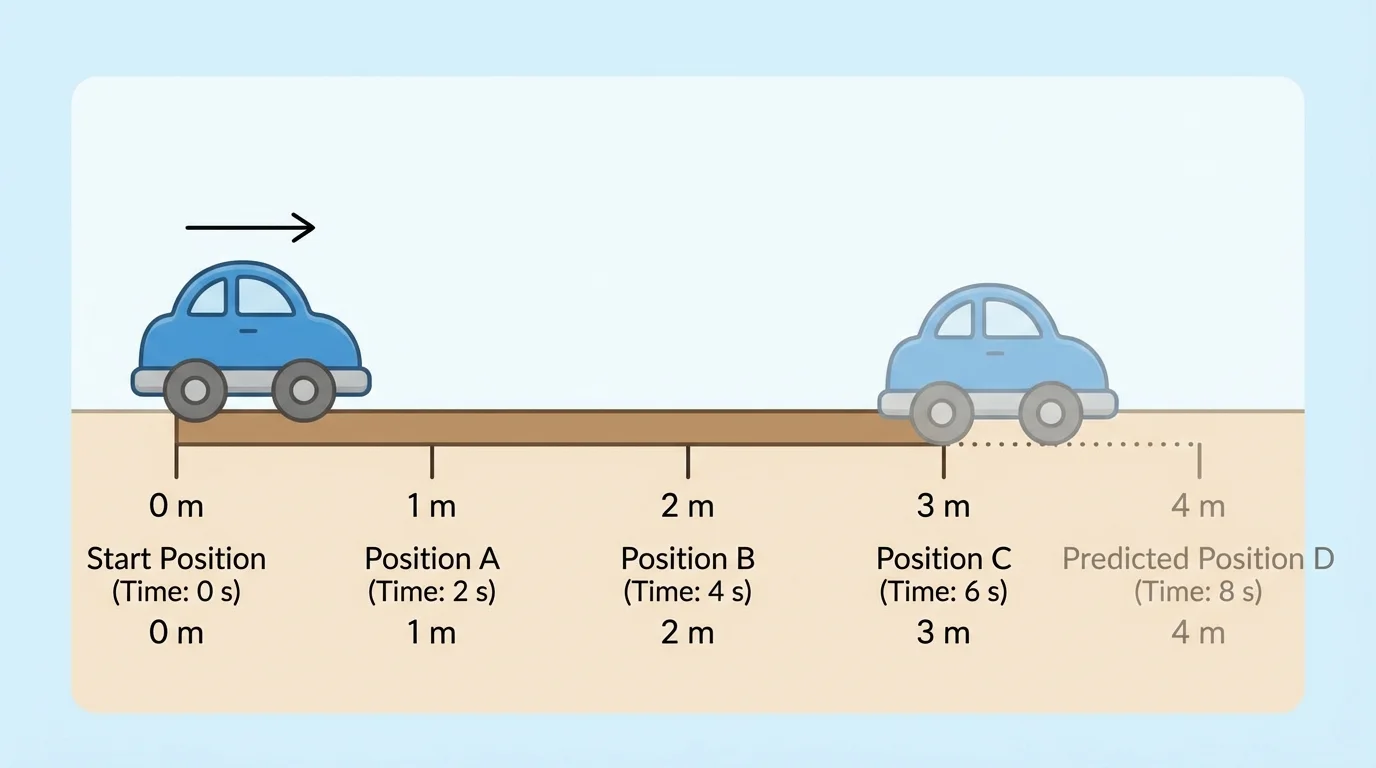
Measurements do not need to be complicated. For third-grade students, simple measurements are enough. You might measure distance with centimeters or inches. You might measure time with a clock, a stopwatch, or counting seconds. You might simply observe direction by noting whether the object goes left, right, up, down, forward, or backward.
Scientists often compare observations and measurements together. You may observe that a ball rolls straight at first, then slows down. You may measure that it moved 30 cm, then 20 cm, then 10 cm in equal time parts. Those measurements give evidence that the ball is slowing.
| What to Notice | Question to Ask | Possible Tool |
|---|---|---|
| Position | Where is the object now? | Eyes, floor marks |
| Distance | How far did it move? | Ruler, measuring tape |
| Time | How long did the motion take? | Clock, stopwatch |
| Direction | Which way is it moving? | Eyes, arrows on a drawing |
Table 1. Simple ways to observe and measure an object's motion.
When we use these tools carefully, our ideas are based on evidence, not just opinion.
A pattern is something that repeats or changes in a way we can notice. Motion patterns can be very clear. A swing moves back and forth along the same path many times. A spinning top turns around and around. A bouncing ball rises and falls again and again, though the height may change.
Some patterns stay almost the same. If a toy train goes around a circular track, it returns to the same places over and over. Some patterns change in a regular way. A dropped ball may bounce to a lower height each time. A rolling marble may travel a shorter distance during each equal amount of time because friction slows it down.
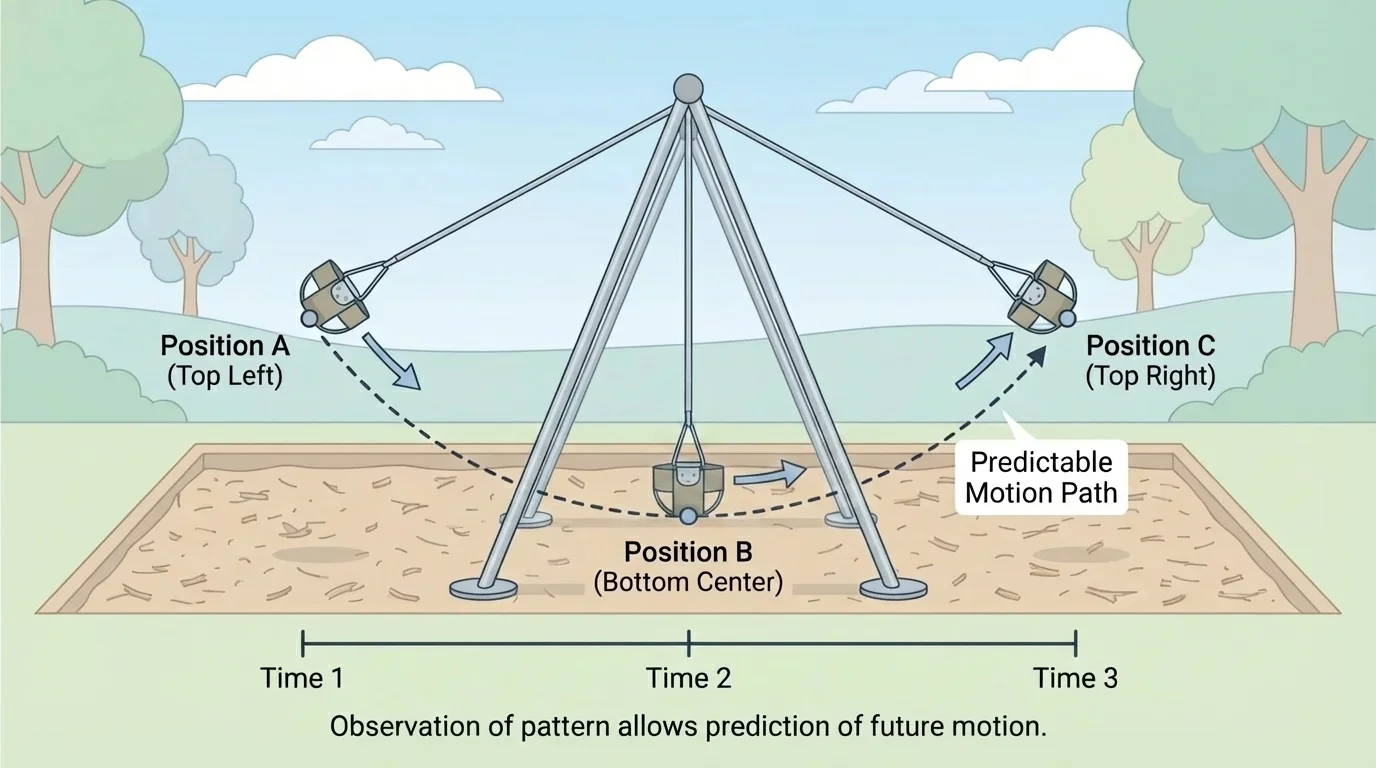
To find a pattern, we compare what happens again and again. Suppose you watch a swing and record its positions: forward, middle, backward, middle, forward. That repeating order is evidence of a back-and-forth pattern. Suppose you watch a toy car and mark where it is every second. If the spaces between the marks are almost equal, the motion follows one pattern. If the spaces get smaller, the motion follows a slowing pattern.
Patterns can involve direction, distance, or position over time. They can also be described in words. For example: "The ball bounced lower each time." "The fan blade returned to the top, right, bottom, and left positions again and again." "The toy car moved forward in nearly equal steps."
Patterns help us see order in motion. When motion is not random, it often leaves clues. Repeating positions, equal distances in equal times, or a regular rise-and-fall change are clues that future motion may be predicted. Scientists trust patterns more when they can observe them more than once and when the conditions remain the same.
That is why repeated observations matter. If you only watch once, you may miss the pattern. If you observe several times, the pattern becomes easier to see.
Once we have evidence, we can make a prediction. A prediction tells what will probably happen next. If a swing has moved forward, backward, forward, backward, you can predict that it will move forward again if nothing changes. If a ball's bounces get lower each time, you can predict that the next bounce will also be lower than the one before it.
Predictions are strongest when they match the pattern closely. If a toy car moved 12 cm in the first second, 11 cm in the next, and 12 cm in the third, a reasonable prediction is that it will move about 11–12 cm in the next second, if the floor and push stay about the same.
Here is another example. A ball bounces to heights of about 40 cm, then 25 cm, then 15 cm. We notice that each bounce is lower. We may not know the exact next height, but we can predict with evidence that the next bounce will be lower than 15 cm.
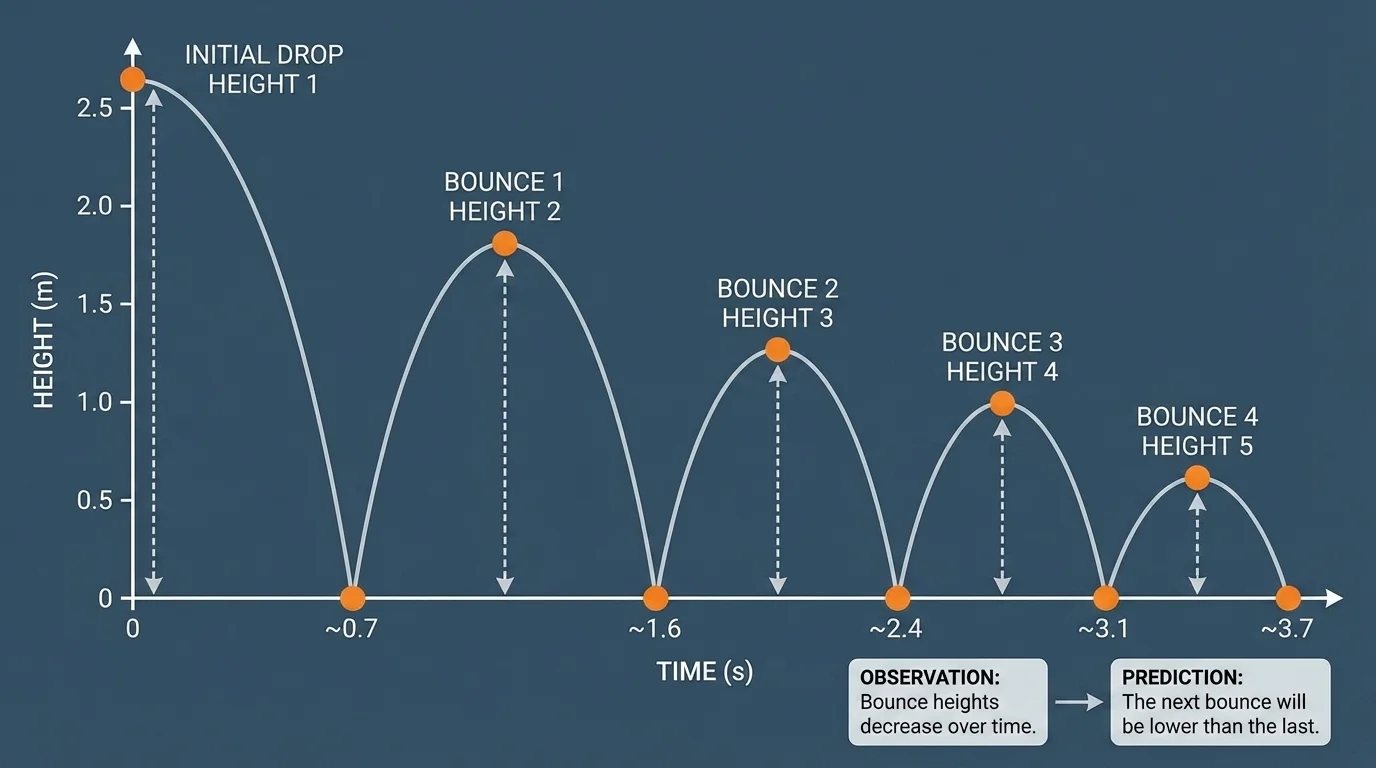
Predictions do not have to be perfect to be scientific. They need to be based on evidence. If the pattern is clear, the prediction is stronger. If the pattern is messy or conditions change, the prediction is weaker.
Example: Using measurements to predict motion
A toy bug moves along a table. Its positions are checked every 1 s.
Step 1: Record the measurements.
After 1 s, it is 5 cm from the start. After 2 s, it is 10 cm from the start. After 3 s, it is 15 cm from the start.
Step 2: Look for the pattern.
The toy bug moves 5 cm each second.
Step 3: Make a prediction.
After 4 s, it will probably be about 20 cm from the start.
The evidence is the repeated increase of 5 cm each second.
The same idea from [Figure 1] applies here: when positions are checked at equal times, a pattern can appear clearly and help us predict the next position.
Motion patterns are not just for toys. They appear everywhere in daily life. Windshield wipers move back and forth. A basketball dribbled on the floor rises and falls in a pattern. A rocking chair moves forward and backward. A person walking often makes repeated steps. Even blinking lights on some signs follow a motion-like sequence as the light seems to travel across the sign.
On a playground, a child on a swing gives a great example of repeated motion. Because the swing follows the same path many times, you can often predict where it will be next. That is useful for staying safe. People know not to walk right in front of a moving swing because they can predict it will come back through the same space, just as we saw with the path in [Figure 2].
Sports also use motion patterns. A coach may watch a ball bounce, a runner's stride, or the path of a jump rope. By observing and measuring, coaches and players can predict timing better. They do not need fancy science words to do this. They just need careful evidence and pattern noticing.
Some animals use motion patterns too. A cat can watch a swinging string and predict where it will move next, which helps the cat pounce at the right moment.
Engineers and inventors study motion patterns when they design machines. A washing machine drum spins in a repeating way. Elevator doors open and close in a regular motion. Predictable motion helps machines work safely and smoothly.
Suppose a class studies a toy car on a smooth floor. The car is pushed gently from the same start line each time. Students mark where the car is after 1 s, 2 s, and 3 s. If the car's positions are 15 cm, 28 cm, and 39 cm from the start, they may notice that it moves a little less each second. That pattern gives evidence that the car is slowing.
Now suppose students observe a hanging object that swings. They notice the object goes left, center, right, center, left. They do not need difficult vocabulary to describe the pattern. They can simply say, "It keeps moving back and forth in the same path." From that evidence, they can predict it will continue the same path for a while.
In both cases, the important science idea is the same. Observations and measurements provide evidence. The evidence reveals a pattern. The pattern supports a prediction about future motion.
Example: Predicting from a bounce pattern
A rubber ball bounces to about 30 cm, then 18 cm, then 10 cm.
Step 1: Observe the measurements.
Each bounce is lower than the one before.
Step 2: State the pattern.
The heights decrease in order: 30 cm, 18 cm, 10 cm.
Step 3: Predict the next motion.
The next bounce will probably be lower than 10 cm.
This is a good scientific prediction because it is based on the observed pattern, like the ball path shown in [Figure 3].
Scientists often repeat investigations because more evidence makes predictions more trustworthy.
Predictions work best when conditions stay the same. If you push the same toy car in the same way on the same smooth floor, you may see a similar pattern each time. But if the floor changes to carpet, or someone gives the car a harder push, the motion may change too.
That is why we must be careful with evidence. A pattern from one situation does not always fit a different situation. A ball rolling on tile may travel farther than the same ball rolling on grass. A swing with a stronger push may move higher than before. The object still moves, but the pattern can change because the conditions changed.
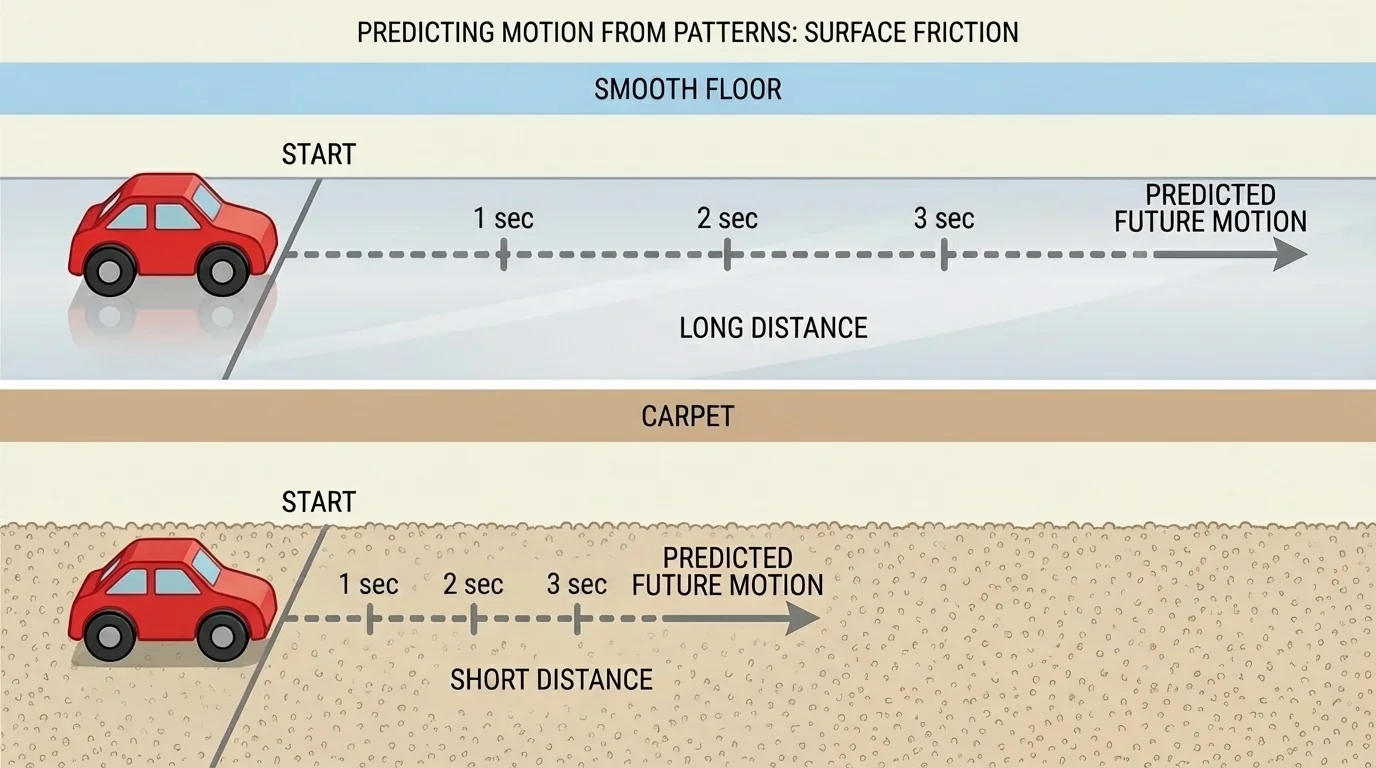
Think about a toy car again. On a smooth floor, it may move 10 cm, then 8 cm, then 6 cm in equal times. On carpet, it might move only 6 cm, then 3 cm, then stop. The observations are different, so the prediction must also be different.
This does not mean science failed. It means science is careful. We use the evidence from the actual situation we are studying. We do not ignore changes.
Evidence makes predictions fair. A fair prediction comes from what was really observed and measured. If the object, surface, push, or path changes, scientists collect new evidence before making a new prediction.
That idea helps us understand why repeated tests are useful. If the same pattern appears again and again under the same conditions, we can trust the prediction more.
When scientists study motion, they use evidence from observation and measurement. They look for patterns and use those patterns to predict future motion. These words connect together. An observation might be "the swing moved back and forth." A measurement might be "the car moved about 10 cm in 1 s." The evidence from both can support a strong prediction.
You do not need advanced words to think like a scientist. You need careful eyes, simple tools, and the habit of asking, "What pattern do I see?" and "What does that pattern help me predict?"
That is a big idea in physical science: objects move in ways we can study. When motion forms a pattern, the future motion is often not a mystery. It becomes something we can predict using evidence.
