Have you ever seen a balloon cling to a wall or tiny bits of paper jump toward a comb? It looks almost like magic. But it is not magic at all. It is science. Sometimes one object can make another object move even when the two objects are not touching. When scientists notice something surprising like that, they ask questions to figure out the cause and the effect.
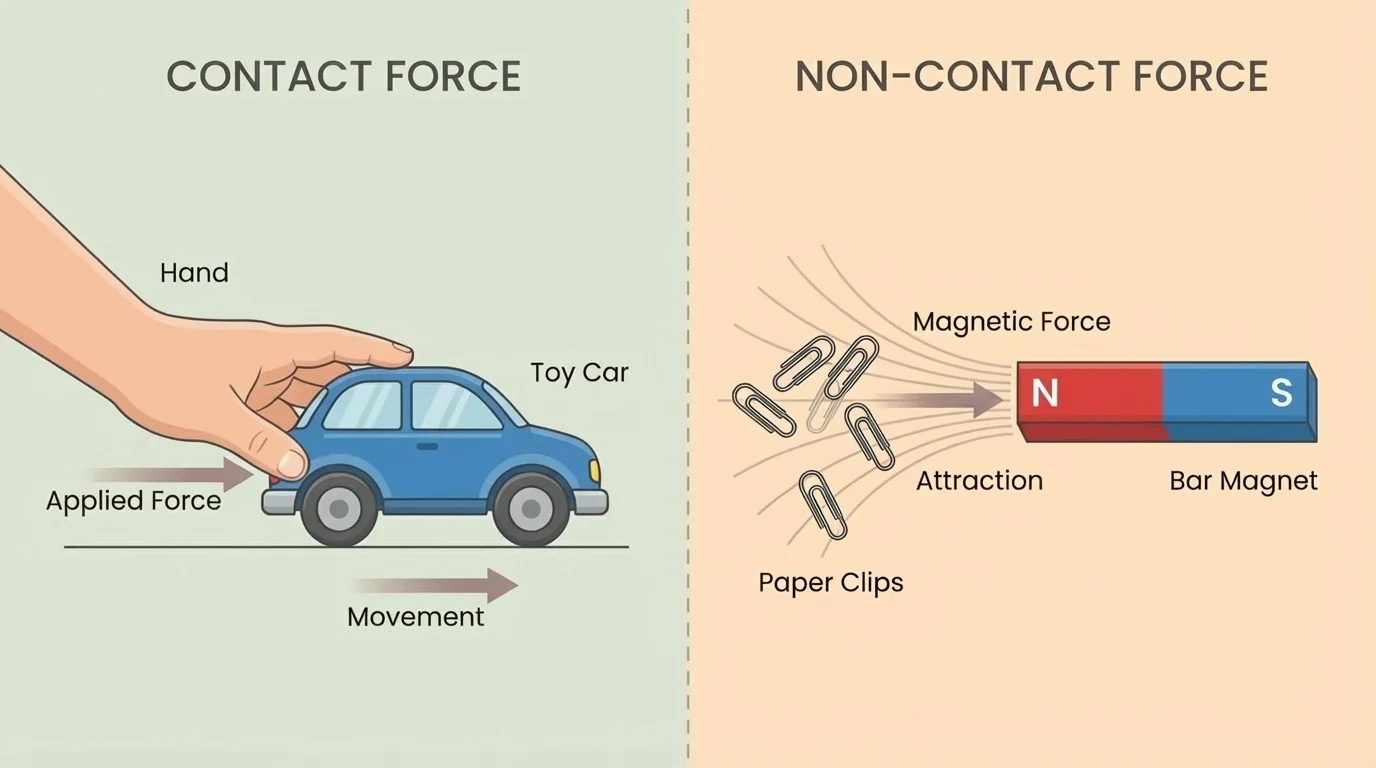
Many forces happen when objects touch. A hand pushes a door. A foot kicks a ball. But some forces do not require contact. Objects can affect each other across a small space, as [Figure 1] shows. In this lesson, we will focus on two kinds of non-contact interactions that students can explore safely: electric interactions from static electricity and magnetic interactions from magnets.
When two objects are in contact, they are touching. When they are not in contact, there is space between them. If one object still makes the other move, we know there is a force acting without contact.
Cause is why something happens. Effect is what happens because of the cause. A force is a push or a pull. A non-contact force is a push or pull that happens without objects touching.
For example, if a magnet pulls a paper clip across a table, the cause is the magnetic force from the magnet. The effect is the paper clip moving. If a charged balloon makes hair stand up, the cause is the electric interaction. The effect is the hair moving.
One important science idea is that we do not just say, "It moved." We ask, "What made it move?" That question helps us discover the cause. Then we ask, "What happened because of that cause?" That helps us identify the effect.
You already know that pushes and pulls can change motion. A push can start movement, stop movement, or change direction. A pull can do the same. Electric and magnetic interactions are special because they can push or pull even with no touch.
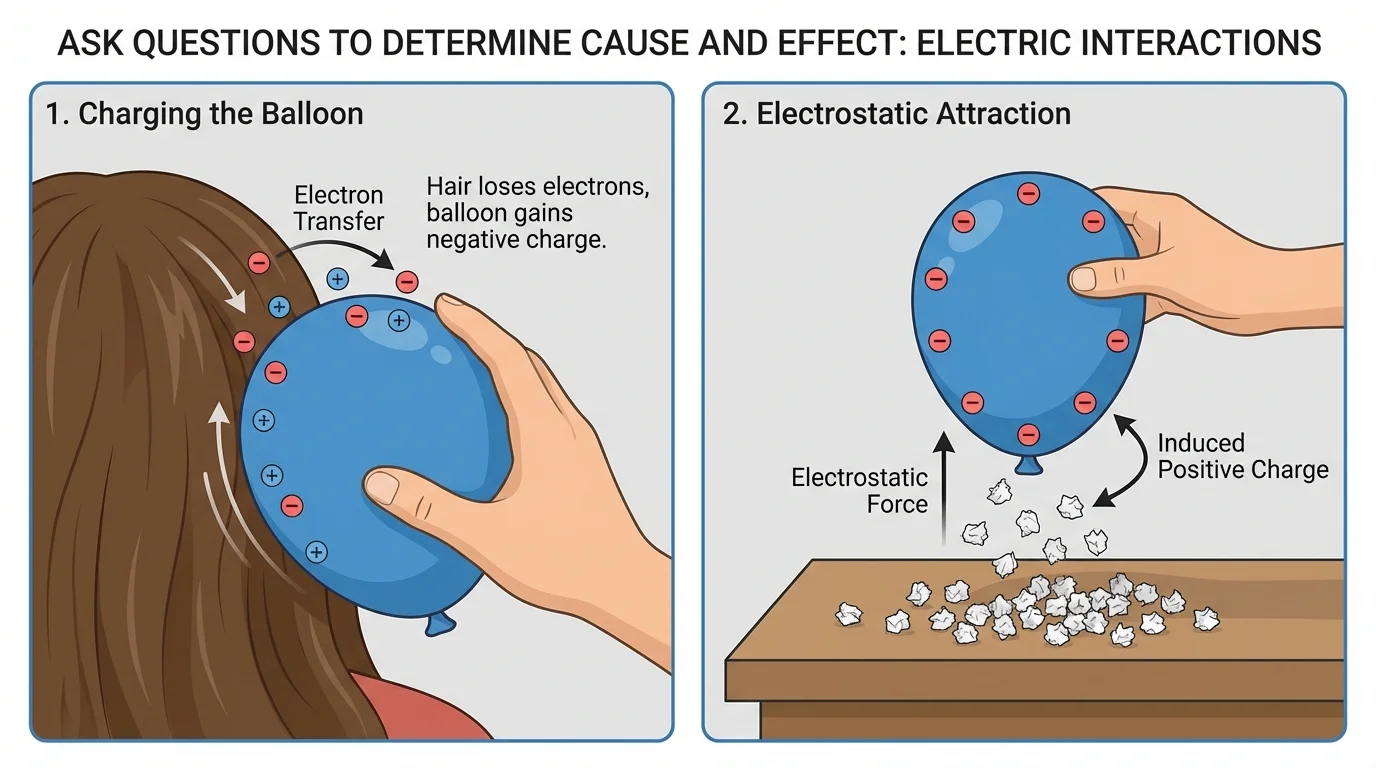
Static electricity happens when electric charge builds up on an object. A common way this happens is by rubbing two objects together, such as rubbing a balloon on hair or running a plastic comb through hair. As [Figure 2] illustrates, the rubbed object can then attract lightweight things like tiny paper pieces without touching them.
When you rub a balloon on your hair, something changes on the surface of the balloon and hair. After rubbing, the balloon may stick to a wall or pull on hair. You do not need to know all the tiny details inside matter yet. What matters is this: rubbing can cause an electric interaction, and that interaction can create a pull.
A good observation is to notice what changes. Before rubbing, the balloon may not attract paper. After rubbing, it may attract paper. That tells us the rubbing is an important cause. The paper moving toward the balloon is the effect.
Sometimes electric interactions can also make objects push away from each other. In that case, the objects repel each other. A push-apart effect is harder to see with some classroom objects, but it can happen with charged objects. If two objects have the same kind of charge, they may repel. If they have opposite charges, they may attract.
Static electricity usually works best with very light objects. Tiny paper bits, hair, or tissue pieces are easier to move than heavy books or chairs. That gives us another cause-and-effect idea: the type and mass of the object can affect what happens. A light object may move, while a heavy object may not show a clear effect.
How static electricity helps us explain observations
If an object changes after rubbing and then pulls on another object without touching it, we can connect the cause and effect. The rubbing is part of the cause. The electric interaction is the force. The movement, sticking, or lifting is the effect we can observe.
Suppose a student rubs a comb through dry hair and then brings the comb near paper bits. If the paper jumps up, the student can ask: What caused the paper to move? Was it the rubbing? Was it the comb being close? The best explanation uses both observations together: rubbing the comb helped create static electricity, and bringing the comb near the paper let the electric force act.
Dry air often makes static electricity easier to notice. On some days, a balloon may work very well. On humid days, the effect may be weaker. That does not mean the science changed. It means conditions can affect how strongly we see the interaction.
A magnet is an object that can pull on certain materials, such as iron or steel, without touching them. Paper clips are often made from steel, so magnets can attract them. If a magnet moves a paper clip across a desk, the cause is the magnetic force, and the effect is the paper clip's motion.
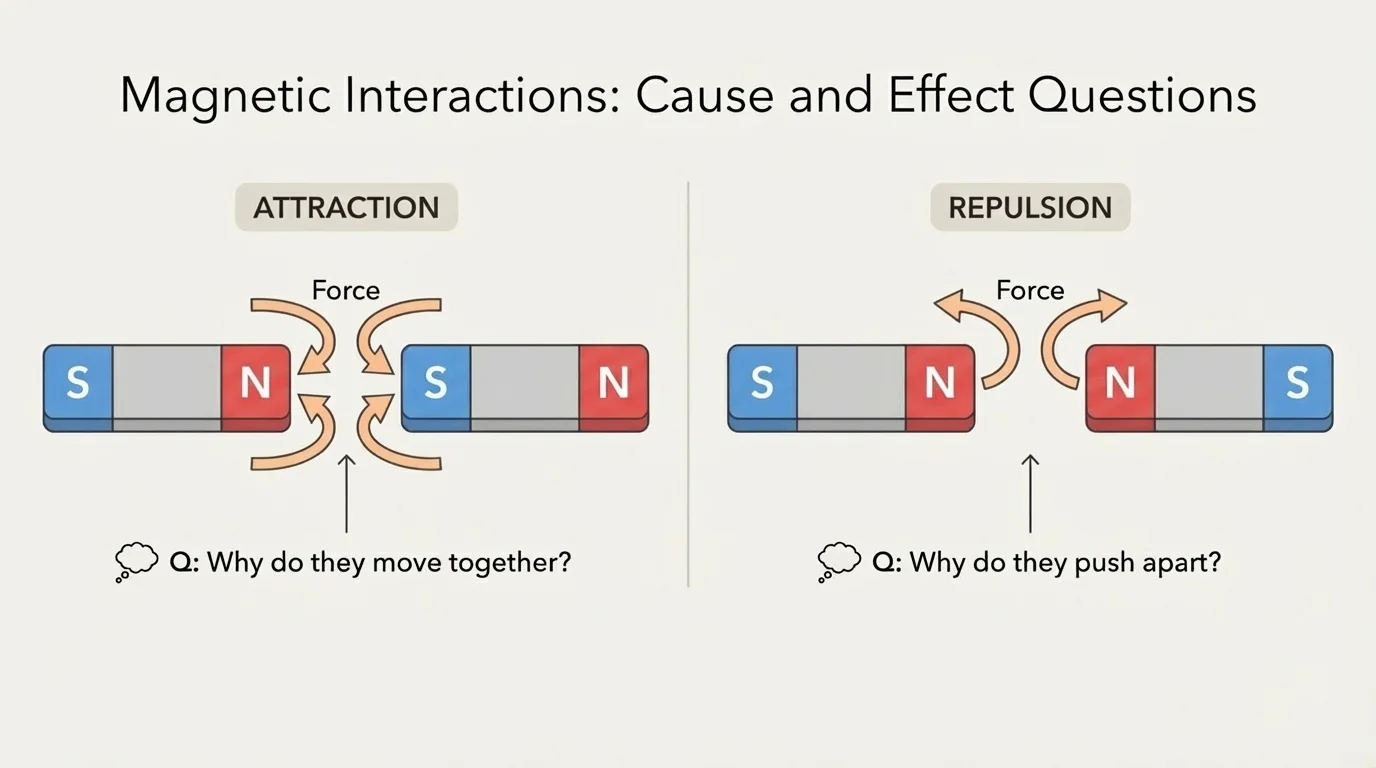
Magnets have two ends called poles. These ends are where magnetic effects are strongest. As [Figure 3] shows, magnets can either attract or repel each other depending on which poles face each other.
When opposite poles face each other, the magnets attract. They pull together. When like poles face each other, the magnets repel. They push apart. This is a clear cause-and-effect relationship: the way the poles are arranged is the cause, and the magnets moving together or apart is the effect.
Magnets do not attract everything. They pull on some metals, but not on wood, plastic, paper, or most coins. This is another place where asking questions matters. If one object is pulled by a magnet and another is not, students can ask: What is different about the materials? The material type can be part of the cause.
Distance matters too. A magnet held very close to a paper clip may move it. The same magnet held farther away may not. That means the distance between objects can change the effect we observe. A stronger effect often happens when objects are closer together.
Magnets can even act through some materials. For example, a magnet under a sheet of paper can pull a paper clip on top of the paper. The paper is between them, but the magnetic force still works. That helps students understand that not touching does not mean "nothing is there." A force can still act across space.
Earth itself acts like a giant magnet. That is why a compass needle points in a direction. A compass is a small magnet that lines up with Earth's magnetic field.
Later, when you compare magnetic and electric interactions, you can think back to [Figure 1]. Both kinds of forces can act without direct contact, but they do not affect the same objects in the same way.
Scientists learn by asking questions. In this topic, the most helpful questions are about what caused a change and what effect followed. [Figure 4] A simple organizer helps us separate the cause from the effect instead of mixing them together.
Here are strong science questions to ask: What happened first? What changed? What moved? What object caused the change? Did the objects touch? What stayed the same? What was different this time?
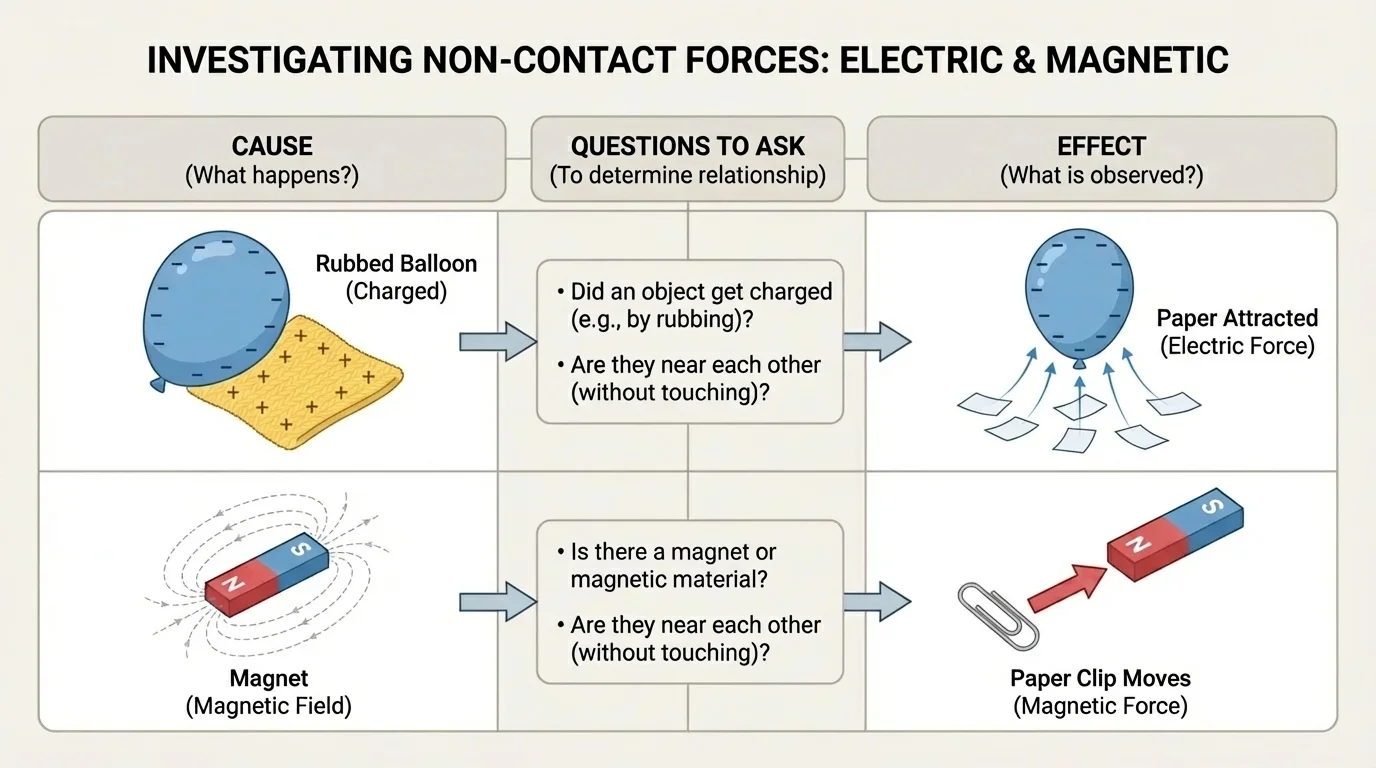
These questions help you build explanations. For example, "Why did the paper move toward the balloon?" leads to a cause-and-effect statement: The balloon was rubbed, so static electricity built up, and the paper moved toward the balloon. Or, "Why did one magnet push another magnet away?" leads to: The same poles faced each other, so the magnets repelled.
Cause-and-effect example 1
A balloon is rubbed on hair and then held near small paper pieces.
Step 1: Identify the observation.
The paper pieces move toward the balloon even though the balloon does not touch them.
Step 2: Ask what changed.
The balloon was rubbed on hair before it was brought near the paper.
Step 3: State the cause and effect.
Cause: Rubbing the balloon created static electricity. Effect: The paper pieces were attracted and moved.
Notice that a good explanation includes evidence from what was observed. You are not guessing. You are using what you saw happen.
Cause-and-effect example 2
A magnet is moved near a paper clip, and the paper clip slides across the table.
Step 1: Identify the interaction.
The magnet and paper clip are not touching at first.
Step 2: Find the cause.
The magnet creates a magnetic force on the paper clip.
Step 3: Find the effect.
The paper clip moves toward the magnet.
Sometimes more than one question is needed. If a magnet attracts one paper clip but not a plastic button, ask what is different about the two objects. The answer points to material. The kind of material can help explain the effect.
Cause-and-effect example 3
Two bar magnets are brought near each other. In one trial they snap together. In another trial they push apart.
Step 1: Compare the two trials.
The magnets are the same, but the ends facing each other are different in each trial.
Step 2: Identify the cause.
The pole arrangement changed.
Step 3: State the effects.
Opposite poles cause attraction. Like poles cause repulsion.
To understand cause and effect, it helps to change only one thing at a time. If you change many things at once, it becomes hard to tell what caused the effect. For example, if you use a different balloon, a different table, and different paper pieces all at once, you may not know which change mattered most.
Scientists often compare one setup to another. One setup might use a rubbed balloon. Another might use a balloon that was not rubbed. If only the rubbed balloon attracts paper, then rubbing is likely an important cause. In a magnet test, one setup might use a paper clip and another might use a wooden block. If only the paper clip moves, then the material is an important cause.
| Situation | Possible Cause | Observed Effect |
|---|---|---|
| Rubbed balloon near paper | Static electricity on balloon | Paper moves toward balloon |
| Magnet near paper clip | Magnetic force | Paper clip moves toward magnet |
| Like poles of magnets face | Pole arrangement | Magnets push apart |
Table 1. Examples of causes and effects in electric and magnetic interactions.
You can also compare distance. A magnet that is very near a paper clip may produce a stronger effect than the same magnet farther away. In a similar way, a charged balloon held close to paper may attract it more easily than when it is far away. Distance is not the only cause, but it can change how clearly the effect appears.
When you look back at [Figure 4], you can see how a cause-and-effect chart helps organize thinking. It turns a surprising event into a clear science explanation.
Magnets and static electricity matter in everyday life. Refrigerator magnets stick to metal doors because of magnetic force. Some cabinet doors use small magnets to stay shut. A magnetic wand can pick up dropped paper clips or nails. These are useful examples because the objects can be held and tested by students.
Static electricity also appears in daily life. Clothes may cling together after drying. Hair may stand up after pulling off a hat. A balloon may stick to a wall after being rubbed. These examples remind us that electric interactions can happen around us, even when we cannot see the force itself.
Seeing the effect even when the force is invisible
We usually cannot see magnetic force or electric force directly. We infer that the force is there because something changes. If a paper clip slides, if magnets push apart, or if hair lifts up, those visible effects provide evidence of an invisible interaction.
This is one of the most exciting parts of science. You may not see the force itself, but you can see what it does. The movement is evidence. The sticking is evidence. The pushing apart is evidence.
One common mistake is saying that an object "just moved by itself." In science, we look for causes. If the paper moved toward the balloon, ask what force caused that motion. If the paper clip moved toward the magnet, ask what interaction caused it.
Another mistake is thinking all objects will react the same way. They do not. Magnets attract only certain materials. Static electricity is easiest to notice with very light objects. If there is no movement, it does not always mean there was no force. Sometimes the object may be too heavy, too far away, or made of a material that does not respond.
A third mistake is forgetting to ask whether the objects touched. That question is very important in this topic. If they did not touch, but one still moved, then a non-contact force may be the cause.
"Science begins with noticing, then asking why."
As you think about magnets and static electricity, keep returning to two powerful questions: What caused the change? and What happened because of it? Those questions help turn a surprising observation into a clear explanation.
