A single animal can be strong, fast, or clever. But in nature, one animal is often even stronger when it is not alone. A wolf pack can catch food together. A school of fish can move like one giant shape. A group of penguins can huddle to stay warm in freezing wind. These examples show an important science idea: for some animals, living in a group helps members survive.
Scientists make arguments by using observations and evidence. In science, an argument is not a fight. It is a claim that is supported by facts. Here, the claim is that some animals form groups that help members survive. To support that claim, we can look at what groups do. They can help animals find food, protect one another, and deal with changes such as cold weather or moving from place to place.
Not all animals live in groups, and not every group works in the same way. Some groups are small, like a wolf pack. Some are huge, like a swarm of insects or a school of fish. What matters is that the group gives members some kind of survival help.
Group means two or more animals living, moving, or working close together.
Survive means to stay alive.
Evidence means facts or observations that help support an idea.
When we study animals in groups, we focus on what we can observe. We can watch how animals move, how they gather food, and what happens when danger comes near. Those observations help us build a strong scientific explanation.
An animal group is made of members of the same kind living or moving together for a reason. A herd of zebras on a grassland is a group. A flock of geese flying together is a group. A colony of ants in one nest is a group. A school of fish swimming in the same direction is also a group.
Groups can look different. Some move together all the time. Others stay together in one place. Ants and bees live in nests or hives. Deer gather in herds. Birds may flock together during migration. Penguins often stand close together in cold weather. Even though these groups are different, they can all help the animals that belong to them.
Being in a group does not mean every animal does exactly the same job. Young animals, adults, and different members may do different things. But as a whole, the group helps the members live in their environment.
Living things need food, water, air, and shelter. They also need ways to stay safe and handle changes in their surroundings. Animal behaviors often help meet those needs.
One helpful way to think about animal groups is to ask three questions: How does the group help get food? How does the group help with safety? How does the group help during change? If we can answer these with evidence, we can build a strong argument.
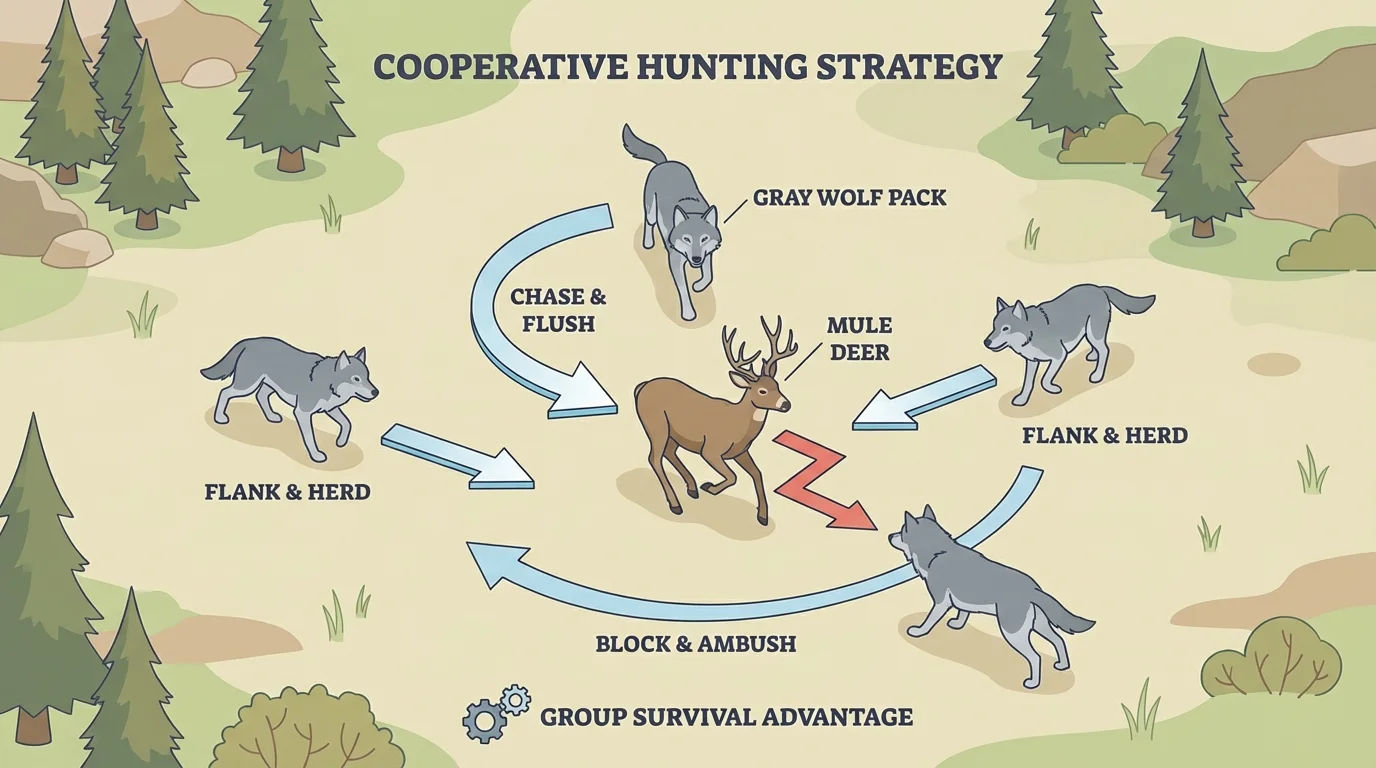
Some animals find or catch food more successfully when they work with others, as shown in [Figure 1]. A single hunter may have trouble catching a large or fast prey animal, but a group can spread out, surround, or chase together. This means members may get food that would be harder to get alone.
Wolves are a clear example. A pack of wolves can work together to chase large animals such as elk or deer. One wolf alone might not catch such a large animal easily. But when wolves hunt as a pack, they can move as a team. Lions also often hunt in groups. Several lions can sneak close, then rush from different directions.
Other animals gather food together instead of hunting. Ants follow trails to food sources and carry food back to the nest. Honeybees collect nectar and pollen that help feed the colony. Some dolphins work together to herd fish into a tighter area, making the fish easier to catch.
These examples provide evidence for the claim. If animals regularly get more food by staying together, then group living helps them survive. Food gives animals energy to move, grow, and stay healthy. Without enough food, survival becomes difficult.
Using evidence to support a claim
Step 1: Make a claim.
Some animals survive better in groups because groups help them get food.
Step 2: Add evidence.
Wolves hunt in packs, and dolphins can herd fish together.
Step 3: Explain the reasoning.
If a group helps animals catch or gather more food, the members are more likely to have the energy they need to stay alive.
We can return to [Figure 1] to notice an important idea: the group does not just add more animals. It also creates a better strategy. Working together changes what the animals can do.
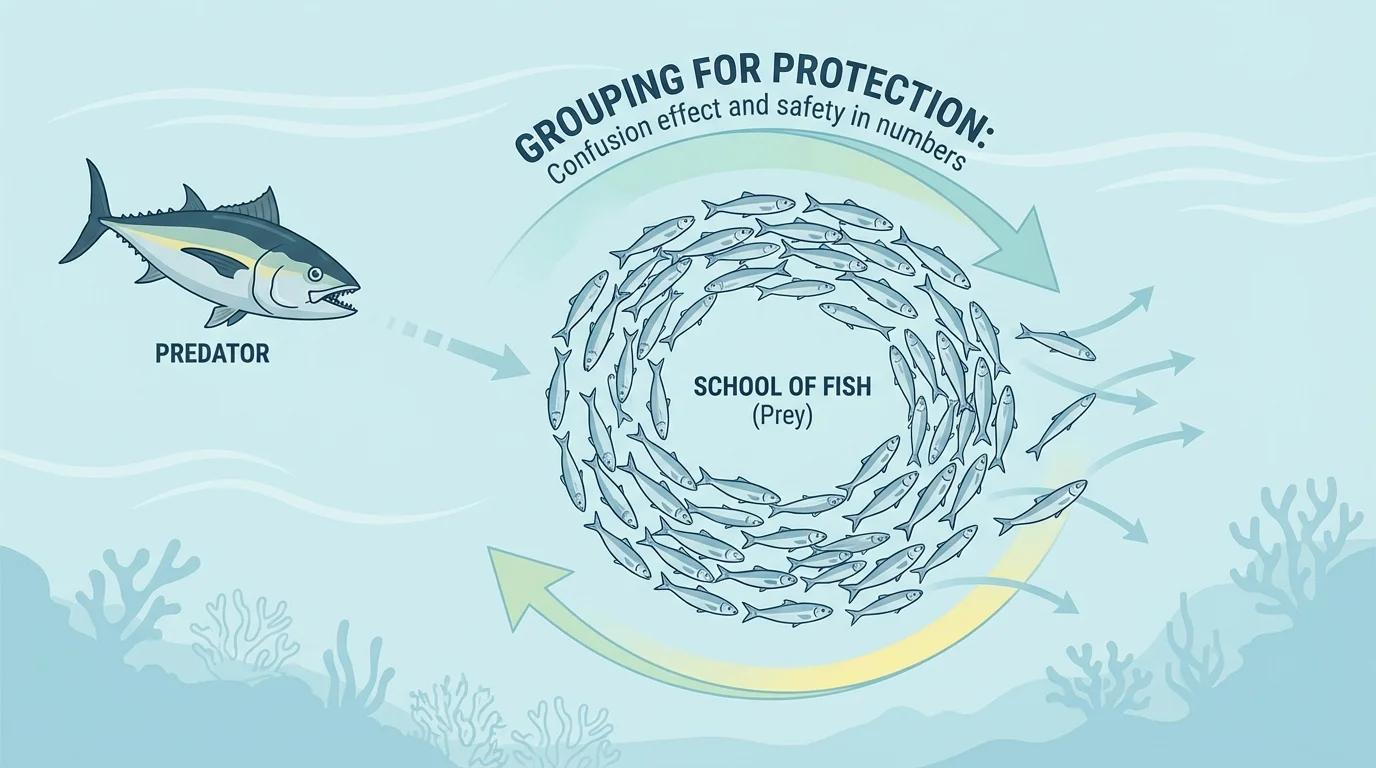
Groups can also help animals stay safer from predators, as [Figure 2] illustrates. When many animals are together, there are more eyes, ears, and bodies in one place. That can make it easier to notice danger and harder for a predator to attack a single animal.
Zebras in a herd, bison in a group, and fish in a school all show this idea. If one animal notices danger and starts moving, others often move too. A school of fish can twist and turn together very quickly. This makes the group look confusing to a predator and can help many fish escape.
Musk oxen also provide a strong example. When danger approaches, adults may stand close together with the young in the center. This places the more protected members in a safer spot. Elephants may do something similar by keeping calves close to adults.
Birds in flocks also gain safety. A flock of small birds can quickly rise into the air together if danger appears. With many birds moving at once, a predator may have a harder time choosing one target. In this way, group living helps lower risk.
A large school of fish can move so smoothly that it seems like one giant animal. Each fish is small, but together the school can react very quickly to danger.
The idea from [Figure 2] connects to the claim we are building. If animals in groups are less likely to be caught by predators, then being in a group helps members survive. Safety is one of the most basic needs of living things.
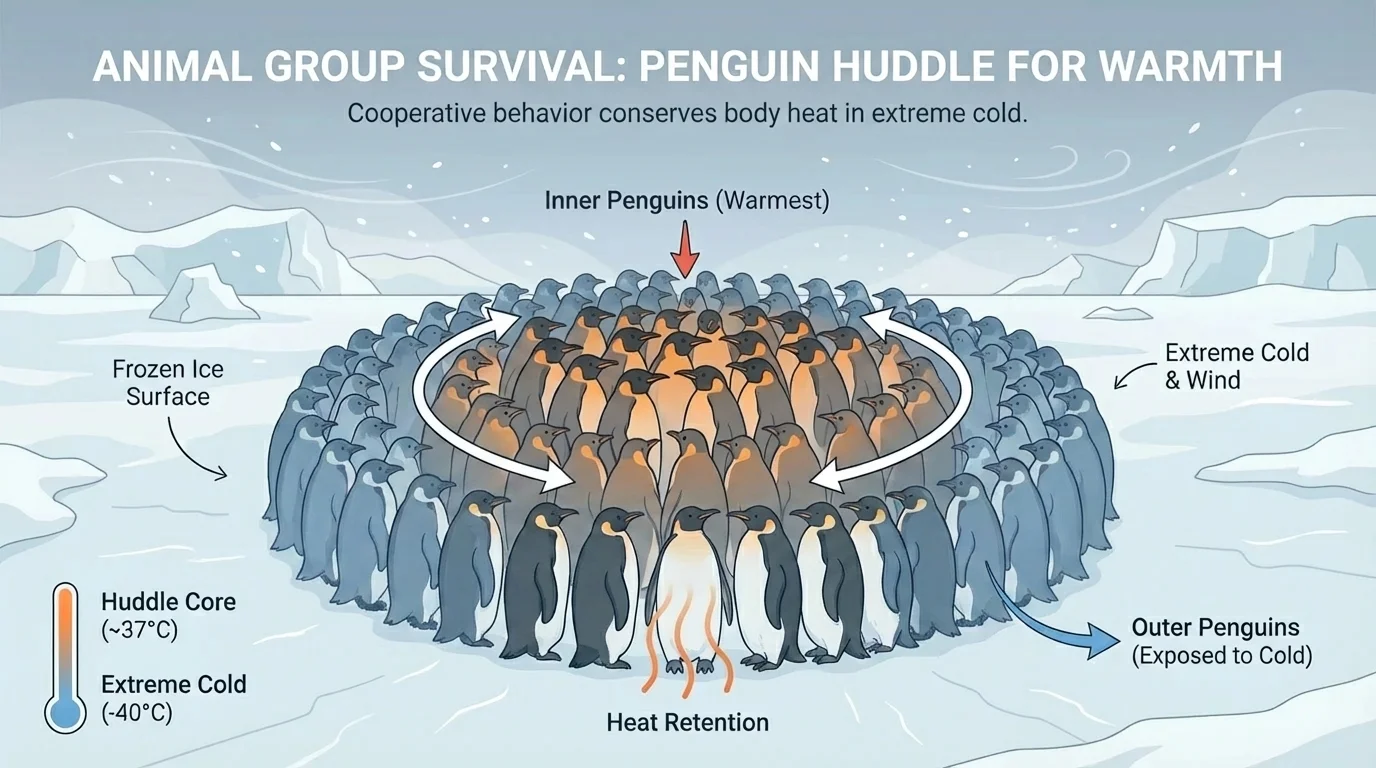
Group living can also help animals deal with changes in weather, temperature, or location, as [Figure 3] shows with penguins. Some environments are harsh, and staying together helps animals keep living when conditions become difficult.
Emperor penguins live in an extremely cold place. They huddle close together to reduce heat loss. The animals on the outside face more wind for a while, and then the group shifts so others can move inward. The group acts like a living shelter against the cold.
Geese and other birds often travel in flocks during seasonal movement from one place to another. Moving as a flock can help the birds stay together and reach feeding or nesting areas. Caribou also travel in herds across large distances. Staying together can help members keep up with the group and move through changing environments.
Some insects survive changing conditions by living together in nests, hives, or colonies. Bees in a hive and ants in a colony use shared spaces that help protect the group from outside conditions. A nest or hive gives shelter, and living together helps animals use that shelter effectively.
How a group helps with survival
A group can improve survival in more than one way at the same time. The same group may help animals get food, stay safer, and deal with cold or travel. When one behavior helps meet several needs, it can be very important for survival.
Looking back at [Figure 3], we can see that a huddle is not about finding food or escaping a predator. It is another kind of survival help. It helps animals handle an abiotic part of the environment: cold temperature and wind.
Now we can put the pieces together into a clear scientific argument. A strong argument has a claim, evidence, and reasoning. The claim tells what you think is true. The evidence gives examples and observations. The reasoning explains why the evidence supports the claim.
For this topic, a good claim is: Some animals form groups that help members survive. The evidence can include wolves hunting in packs, fish swimming in schools, zebras living in herds, and penguins huddling in the cold. The reasoning is that these groups help animals meet important survival needs.
| Animal group | How the group helps | Survival benefit |
|---|---|---|
| Wolf pack | Hunts together | Gets food |
| School of fish | Moves together | Improves safety |
| Zebra herd | Stays in a large group | Helps watch for danger |
| Penguin huddle | Stands close in cold weather | Keeps warm |
| Ant colony | Works together in a nest | Gets food and shelter |
Table 1. Examples of animal groups and how group living supports survival.
Notice that this argument says some animals, not all animals. This is important. Science arguments must match the evidence carefully. Many animals benefit from groups, but some animals often live alone and survive in different ways.
A solitary animal is one that often lives alone. Tigers, many bears, and some kinds of cats often spend much of their time alone. They may still meet others at certain times, but they do not usually stay in a group the way wolves or zebras do.
This comparison helps us understand the main idea better. If an animal lives alone, it must find food, avoid danger, and handle changes without group support. If an animal lives in a group, the group may share some of those challenges. That does not mean one way is always best for every animal. It means that for some animals, group living is an important survival strategy.
We should stay focused on evidence we can observe. We do not need to explain how group behavior first began. We also do not need to study special signaling systems to support the claim. The key point is simply that groups can help animals survive now.
Building a complete argument
Step 1: State the claim.
Some animals survive better in groups than they do alone.
Step 2: Use more than one piece of evidence.
Wolves catch food in packs. Fish in schools can avoid predators more effectively. Penguins huddle to stay warm.
Step 3: Connect the evidence to survival.
Food, safety, and protection from harsh conditions all increase an animal's chance of staying alive.
That is what makes the argument strong: it uses several examples from different habitats and shows the same pattern. Group living helps animals meet their needs.
People can observe group behavior in the real world. At a zoo, students may see meerkats standing together, flamingos gathered in a flock, or ants moving in lines. In a park or neighborhood, birds may fly in groups and squirrels may search alone. These observations help us compare different survival strategies.
Farmers and animal caretakers also notice that some animals do better when they are with others of their kind. Sheep often stay in flocks. Chickens gather in groups. Watching animals carefully can help people understand what conditions help them stay healthy and safe.
"Science helps us explain what we observe in the natural world."
When we observe animals, we are gathering evidence from nature itself. A pack hunting, a herd moving together, and a huddle in the snow all support the same idea. Some animals form groups because those groups help members survive.
