Have you ever noticed that puppies in the same litter can all look related, but no two puppies look exactly alike? Seeds from one kind of flower can grow into plants with many similarities, yet each plant may still be a little different. Scientists study these patterns by observing, comparing, and collecting data. When we look carefully, we find evidence that living things get many traits from their parents, and we also find that variation exists within a group.
All around us, living things show patterns. Young foxes look like their parent foxes. Oak tree seedlings grow into oak trees, not pine trees. Baby ducks have bodies shaped like ducks. These patterns help scientists understand how living things stay similar to their own kind from one generation to the next.
At the same time, living things are not copied exactly. One kitten may have longer fur than another. One tulip plant may grow taller than another tulip plant. Careful observation helps us notice both kinds of evidence: similarity and difference.
Trait means a characteristic or feature of a living thing, such as fur color, leaf shape, or beak size.
Inherited trait is a trait that is passed from parent organisms to their offspring.
Variation means differences in traits among organisms of the same kind.
Offspring are the young of parent plants or animals.
Scientists often begin by asking questions such as: What traits do the offspring share with their parents? Which traits are different within a group? What does the data show? These questions help turn simple noticing into real science.
A trait is something you can observe about a plant or animal. Some traits are easy to see, such as feather color, petal color, tail length, or stripe patterns. Other traits have to do with how a body part works, such as the shape of a bird's beak for eating certain foods or the size of a rabbit's feet for hopping.
Traits can help organisms live in their habitats. For example, a duck's webbed feet help it swim, and a cactus has thick stems that help it store water. In this lesson, we focus on noticing traits and using evidence to explain where many of them come from.
When we say a trait is inherited, we mean it came from parent organisms. A young plant gets traits from the parent plant that produced the seed. A young animal gets traits from its parents. This is why offspring usually look more like their own kind and their own parents than like other organisms.
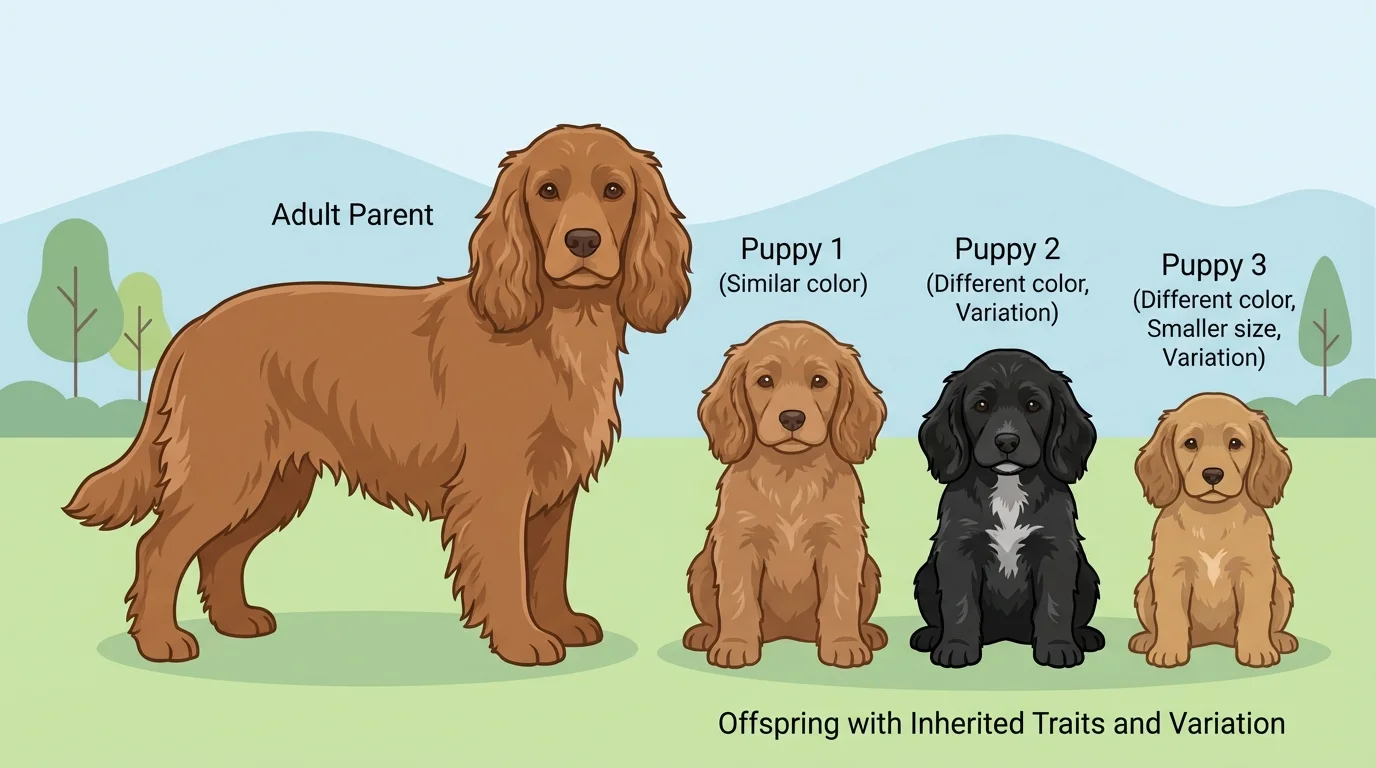
When scientists compare parents and young, they often see shared traits right away. In a dog family, as [Figure 1] shows, the puppies may have the same kind of ears, similar fur texture, or a similar body shape as the parent dog. Those shared features are evidence that traits are inherited from parents to offspring.
Plants show this pattern too. If a parent pea plant has round peas and climbing stems, the new pea plants grown from its seeds will also be pea plants with pea plant traits. If a parent apple tree produces apples of a certain shape and has a certain leaf type, the young apple trees will share important traits of apple trees.
Scientists do not stop at one example. They collect evidence from many organisms. Suppose a farmer observes a group of lambs and their parents. The lambs may share wool, face shape, and leg structure with the adults. These repeated observations build strong evidence that offspring inherit many traits.
Inherited traits are not only about color. Body covering, body shape, number of petals, type of leaves, and shell pattern can also be inherited. A turtle hatchling may have a shell pattern that resembles its parents. A sunflower seed grows into a sunflower with traits of that type of plant, such as broad leaves and a flower head made of many tiny flowers packed together.
Case study: Observing a rabbit family
A scientist observes one adult rabbit and four young rabbits. The scientist records whether the young rabbits share certain visible traits with the parent.
Step 1: Observe the parent rabbit
The adult rabbit has long ears, brown fur, large back feet, and a short tail.
Step 2: Observe the young rabbits
All four young rabbits have long ears, large back feet, and short tails. Three have brown fur, and one has lighter tan fur.
Step 3: Interpret the data
The shared ear length, feet, and tail are evidence of inherited traits. The difference in fur shade shows variation within the group.
This kind of evidence is powerful because it is based on what is observed and recorded, not on guessing. Scientists use patterns in data to support their ideas.
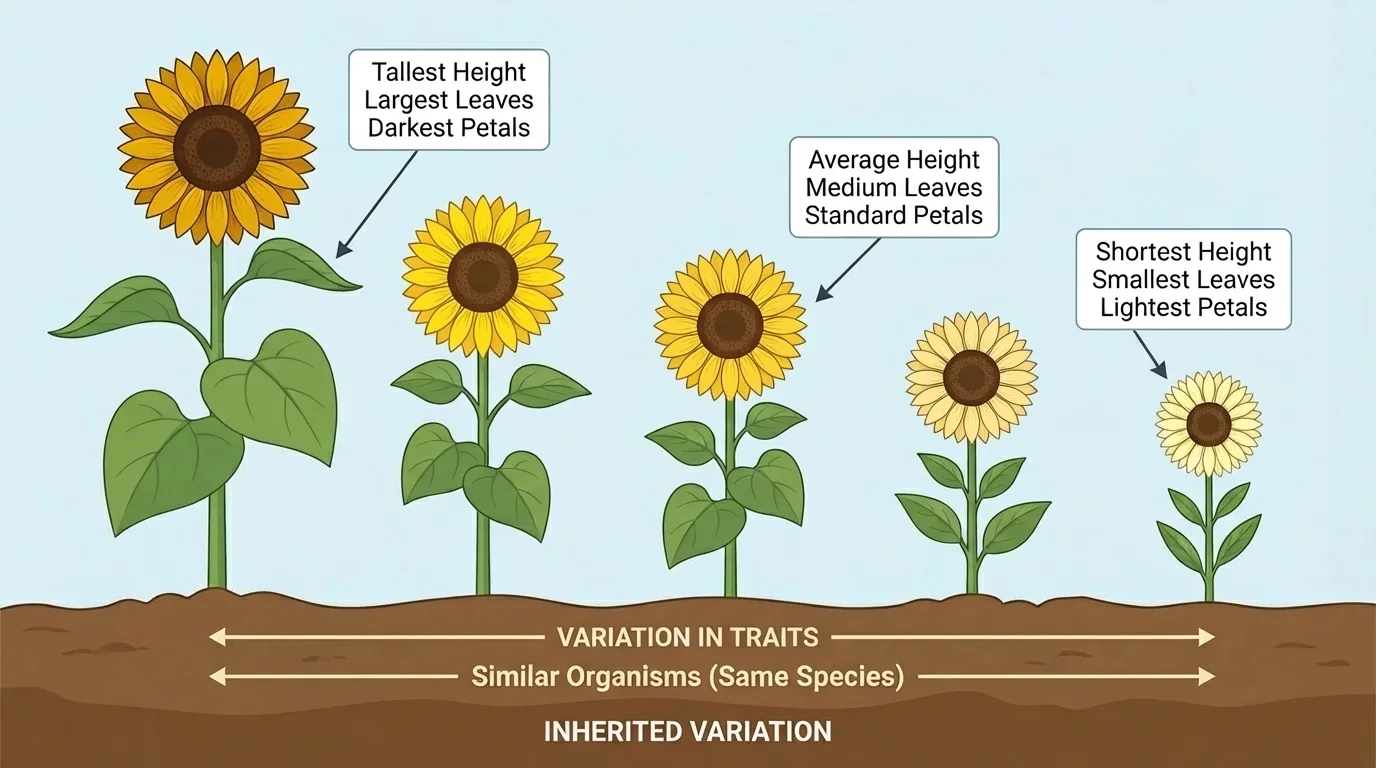
Now let us look at a group of similar organisms. A group can be animals of the same kind, such as puppies, or plants of the same kind, such as bean plants. Even within one group, individuals are not exactly the same. That pattern of differences is called variation. In a group of sunflowers, [Figure 2] illustrates that plants can all be sunflowers while still having different heights and slightly different petal shades.
Variation can be seen in many traits: color, size, shape, length, pattern, or number. A class might observe six marigold plants and find that all have orange or yellow flowers, but one has more petals, one grows taller, and one has wider leaves. These are examples of variation in a group of similar organisms.
Scientists often organize their observations in a table so the evidence is easier to read.
| Sunflower Plant | Height | Petal Shade | Leaf Size |
|---|---|---|---|
| A | 30 cm | bright yellow | medium |
| B | 36 cm | golden yellow | large |
| C | 28 cm | pale yellow | small |
| D | 34 cm | bright yellow | medium |
Table 1. Data showing variation in height, petal shade, and leaf size among sunflower plants of the same kind.
What does this table tell us? All four organisms are sunflowers, so they share many important traits. But the heights are not all the same, the petal shades are not all the same, and the leaf sizes are not all the same. The data gives evidence of variation in a group of similar organisms.
Variation also appears in animals. A flock of finches may all have feathers, wings, and beaks, but some may have slightly longer beaks or different feather markings. A group of frogs may all be greenish, yet one frog may have darker spots than another. These differences matter because they help us describe and compare living things carefully.
Some plants make hundreds or even thousands of seeds, and the new plants can still show small differences from one another. A whole field of the same crop can look similar from far away, but close-up observations reveal many variations.
Variation does not mean the organisms are different kinds of living things. It means they are the same kind, but each one has its own set of traits.
In science, it is not enough to say, "I think the young look like the parents." A scientist should be able to point to observations and data. Data can be counts, measurements, drawings, or notes from careful watching.
Suppose a class studies four baby birds in one nest and records beak color, feather color, and body size. They notice that all four have the same kind of beak shape as the parent birds, but their body sizes are a little different. That gives evidence for two ideas at once: some traits are inherited from parents, and variation exists among the offspring.
Here is another simple data table.
| Kitten | Ear Shape Like Parent Cat? | Tail Type Like Parent Cat? | Fur Color |
|---|---|---|---|
| 1 | yes | yes | gray |
| 2 | yes | yes | black |
| 3 | yes | yes | gray |
| 4 | yes | yes | striped gray |
Table 2. Data comparing shared traits and variation in a group of kittens.
From this table, we can make a claim: the kittens inherited some traits from the parent cat, such as ear shape and tail type. We can also make another claim: the kittens show variation in fur color. The evidence comes from the recorded data.
How scientists interpret data
To analyze data means to look at it carefully for patterns. To interpret data means to explain what those patterns mean. If most offspring share a trait with a parent, that supports the idea that the trait is inherited. If individuals in one group show differences, that supports the idea that variation exists.
A good explanation uses words like evidence, observed, compared, and recorded. Scientists try to base their ideas on what the data shows.
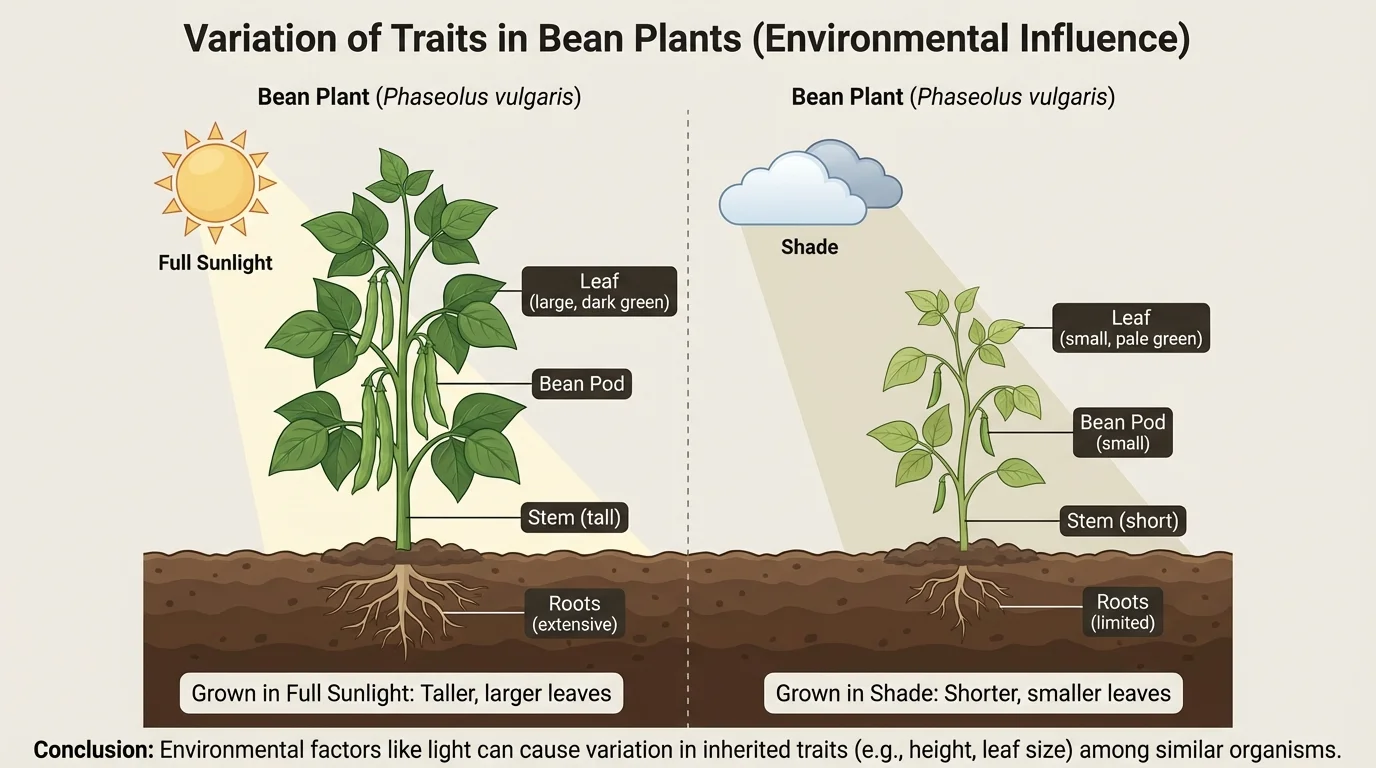
Not every difference in an organism comes only from its parents. The environment, which means the surroundings and conditions where an organism lives, can affect how some traits develop. Two bean plants of the same kind may start with similar inherited traits, but the one with more sunlight and enough water may grow taller and stronger than one growing in shade.
As [Figure 3] shows, environmental conditions such as light and water can affect how some traits develop.
For example, two plants of the same kind may have inherited the same basic leaf shape, but if one does not get enough water, it may not grow as well. A young animal may inherit a certain body shape, but the food it gets can affect how large and healthy it becomes. This means scientists must be careful when explaining traits. Some traits are inherited, and some are influenced by environmental conditions.
Think about a plant growing in a cracked sidewalk and another of the same kind growing in rich garden soil. They are still the same kind of plant and may share many inherited traits, but their growth can look different because their environments are different.
This does not change the main idea that plants and animals inherit traits from their parents. Instead, it adds an important science idea: organisms are shaped by both inherited information and the world around them. When we looked at sunflower differences in [Figure 2], some variation could come from inherited traits, and some could be affected by growing conditions such as light, water, and space.
Case study: Two groups of bean plants
A class grows bean plants from the same kind of seeds in two places.
Step 1: Observe the setup
Group A grows near a sunny window and gets regular water. Group B grows in a dim corner and gets less water.
Step 2: Record the results
Most plants in Group A are taller and greener. Most plants in Group B are shorter and paler.
Step 3: Interpret the evidence
The plants are the same kind, so they share inherited traits. The differences in growth are evidence that the environment affects how some traits develop.
Scientists often compare inherited traits and environmental effects together. For example, all ducklings may have webbed feet from their parents, but how strongly they grow can depend on food and habitat conditions.
Farmers, gardeners, wildlife scientists, and animal caretakers all use information about traits. A gardener may choose seeds from plants that grew healthy flowers. A wildlife scientist may study shell patterns in turtles or feather markings in birds to learn about populations. A farmer may compare traits in lambs, calves, or chicks to understand how a group is developing.
These jobs depend on close observation and data. The same kind of thinking you use in science class is used in the real world: compare organisms, record traits, and explain patterns using evidence.
For example, a park ranger might count how many foxes in an area have certain coat patterns. If young foxes share coat features with adult foxes, that supports the idea of inherited traits. If the coats vary among foxes in the same area, that shows variation in the population.
Living things need food, water, air, and space to live and grow. Those needs are part of the environment, and they can affect how well an organism develops.
Even pet owners notice this science. A group of kittens from the same mother cat may share face shape and tail type, like the pattern seen in Table 2, but their fur colors and sizes can still vary. Careful observation turns everyday experiences into scientific evidence.
One common mistake is thinking that if organisms are the same kind, they should all look exactly alike. That is not true. Variation is normal in groups of similar organisms.
Another mistake is thinking every trait difference must have come from the parents. Some differences are influenced by the environment. The bean plants in the diagram remind us that light and water can affect growth.
A third mistake is mixing up inherited traits with behaviors that are learned or changes caused by life experiences. In this topic, we focus on visible traits and observable features in non-human plants and animals.
When scientists explain traits, they stay close to the evidence. They ask: What traits are shared? What varies? What does the data support? Those questions help keep scientific thinking clear and accurate.
A strong explanation has three parts: a claim, evidence, and reasoning. The evidence is what was observed or measured. For example, you might claim that puppies inherited traits from a parent dog. Your evidence could be that all the puppies have similar ear shape and fur texture, like the pattern first discussed with [Figure 1]. Your reasoning is that shared traits between parents and offspring support inheritance.
You can also make a claim about variation. For example, you might claim that a group of sunflower plants shows variation. Your evidence could be the differences in height and petal shade from Table 1. Your reasoning is that organisms of the same kind can still differ in their traits.
This way of thinking helps scientists communicate clearly. They do not just say what they notice. They explain how the data supports the idea.
