A tiny seed can become a tall sunflower. A chick can grow into a hen. A baby frog does not even look much like an adult frog at first. Living things may begin in different ways and change in different ways, but they all follow a pattern through life. That pattern is one of the most important ideas in life science.
Every living thing, from a tree to a turtle, has a life story. Scientists call that story a life cycle. Some life cycles are short, and some are long. Some organisms change a lot as they grow, while others keep a more similar shape. Even with all of this variety, living things share important stages in common.
A life cycle is the series of stages an organism goes through during its life. The common pattern, shown in [Figure 1], includes being born, growing, reproducing, and dying. A life cycle helps us understand how living things change over time.
When scientists study life cycles, they look for both differences and similarities. A mushroom, a bird, and a bean plant are not the same, but each one begins life, grows, makes more of its own kind, and eventually dies. That shared pattern helps scientists compare many kinds of organisms.
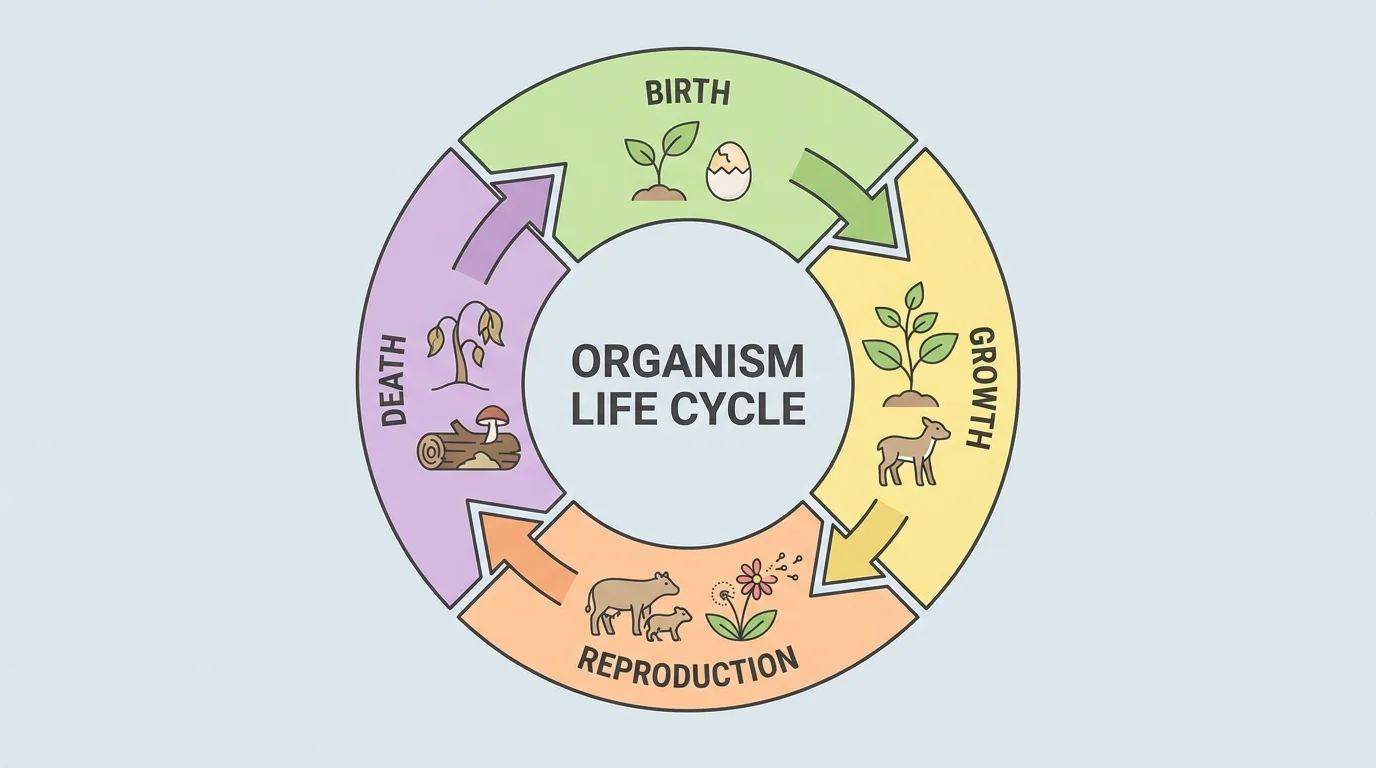
Birth is the beginning of an organism's life. Growth is the process of getting bigger and changing. Reproduction means making more organisms of the same kind. Death is the end of an organism's life.
Birth does not always look the same. A puppy is born from its mother. A plant may begin from a seed. A bird hatches from an egg. These beginnings are different, but each one is a start of life.
Growth also looks different in different organisms. A young oak tree grows taller and stronger. A young rabbit grows larger and faster. As living things grow, their bodies become better able to survive in their environment.
Living things do not stay exactly the same from the start of life to the end. A young organism often looks, moves, or behaves differently from an adult. For example, a kitten is smaller and less skilled than an adult cat. A seedling is much smaller and simpler than a full-grown plant.
This change over time is an important part of life cycles. Growth can include getting bigger, developing new body parts, or becoming able to do new things. A young bird may first stay in a nest, but later it can fly. A young plant may first have only a few leaves, but later it can grow flowers.
Growth is more than getting bigger
Growth means that an organism changes as it develops. It may grow new structures, become stronger, or gain the ability to find food, move, or protect itself. These changes help the organism live and eventually reproduce.
Some changes are easy to see. We can notice when a sprout becomes a plant with leaves and flowers. We can notice when a young duck becomes an adult duck with full feathers. Other changes happen slowly, so we understand them better by observing over time or by using models. [Figure 2]
Although every organism follows the common pattern of life, the stages between birth and death can look very different. The comparison shows that a plant, a frog, and a bird do not grow in the same way. This is why scientists say that organisms have unique and diverse life cycles.
A flowering plant may begin as a seed. It grows roots, a stem, and leaves. Later it may grow flowers and make seeds. Those seeds can begin the cycle again. A frog starts life in water and changes as it grows. A bird begins in an egg, hatches, grows feathers, and becomes an adult bird.
Even animals that seem similar can have different life cycles. A fish and a bird are both animals, but one lives in water its whole life and the other develops wings and feathers. A tree and a flower are both plants, but one may live for many years while the other lives for only one season.
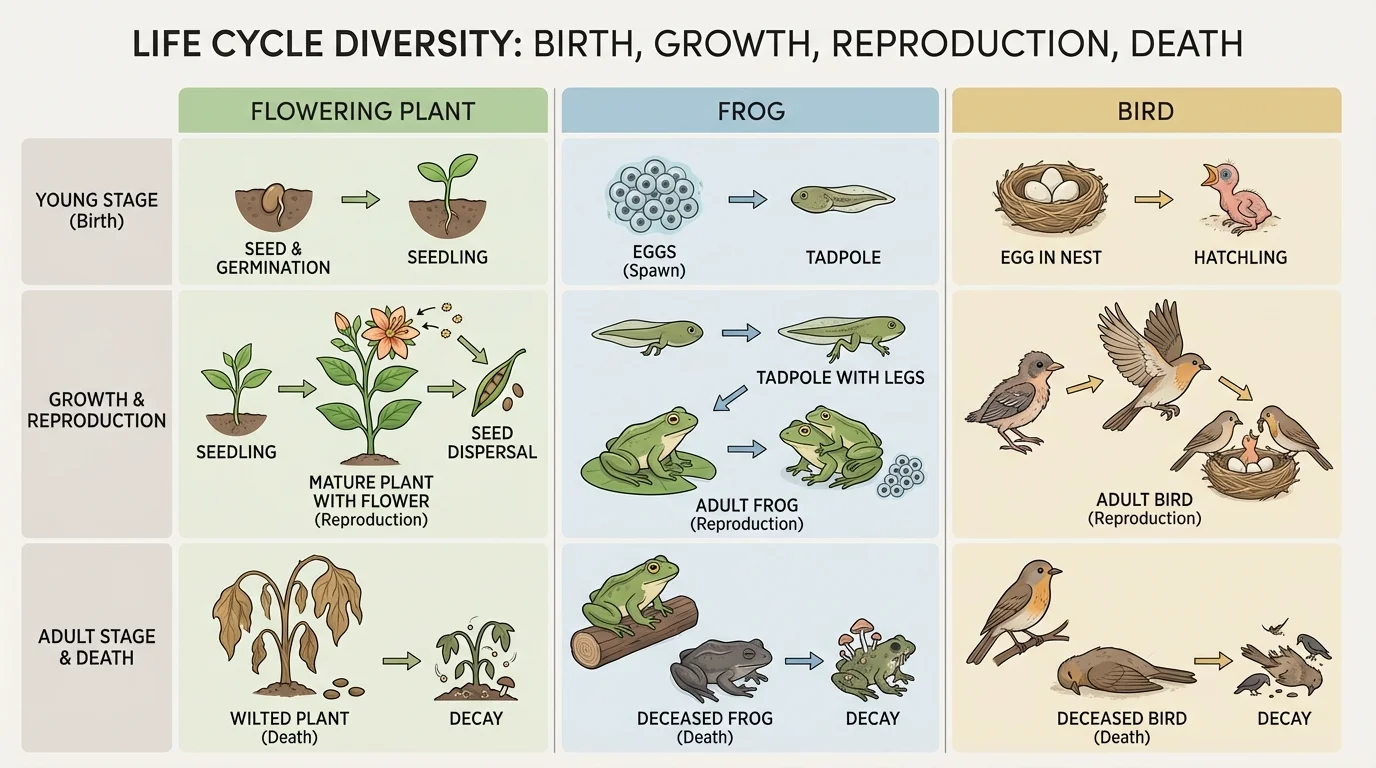
These differences are part of the diversity of life on Earth. Diverse means showing many kinds or forms. Life on Earth is full of diversity, and life cycles are one place where we can see it clearly.
Some insects live only a short time as adults, while some trees can live for hundreds or even thousands of years. Life cycles can be very short or very long, but they still include the same big stages of life.
Even when the details are different, the main stages stay the same. That is why scientists can compare many organisms. As we saw earlier in [Figure 1], the shared pattern helps us notice what all living things have in common.
Scientists often use a model to explain something that happens over time or is hard to watch all at once. In life science, a model can be a drawing, a diagram, a chart, or a set of labeled pictures. The examples in [Figure 3] show how models can organize stages in order.
A model does not have to show every tiny detail. Instead, it helps us focus on the main idea. For life cycles, a model helps us see the order of stages and the changes that happen from one stage to the next.
Some models are circles because life cycles repeat when new organisms are born. Other models are flowcharts with arrows that show what comes next. A good model is clear, simple, and accurate.
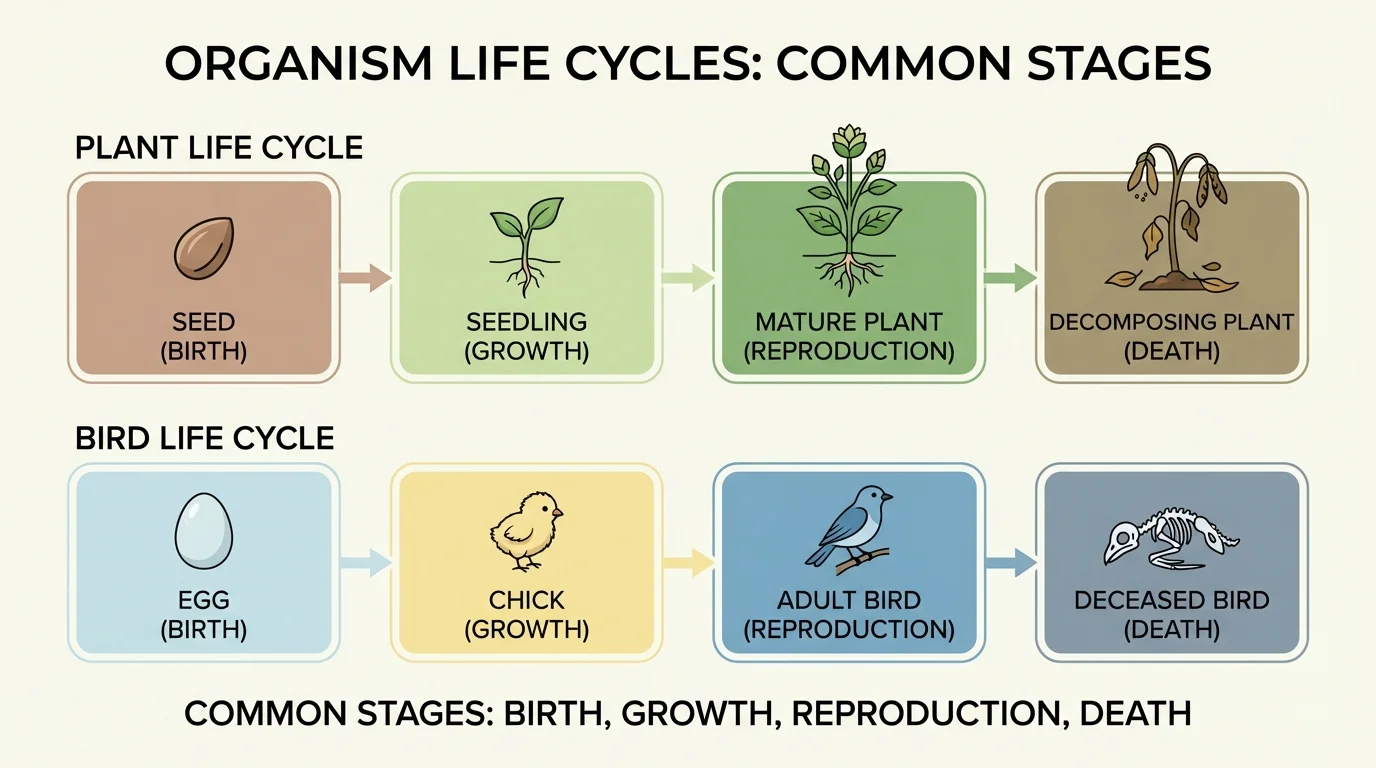
Example: Making sense of a plant life cycle model
Step 1: Start with the first stage.
A seed begins the life of a new plant.
Step 2: Follow the arrows.
The seed grows into a seedling, then into a mature plant.
Step 3: Find reproduction.
The mature plant makes flowers and seeds.
Step 4: Complete the pattern.
Those seeds can begin the cycle again.
This model helps us understand both change and repetition.
Models are useful because some organisms grow quickly and others take a long time. We cannot always watch every moment, but a model helps us show the whole pattern in one place. Later, when students compare several organisms, the model in [Figure 3] makes it easier to notice what is similar and what is different.
No matter how different organisms seem, they share the same big life events. They begin life, they grow, they reproduce, and they die. This idea is one of the most important patterns in biology.
Reproduction is especially important because it allows life to continue. If organisms could not make more of their own kind, the species would not continue. A plant makes seeds. Birds lay eggs. Mammals have young. The details are different, but the purpose is the same.
Living things need resources such as food, water, air, and space. As organisms move through their life cycles, they use these resources to grow, survive, and reproduce.
Death is also a natural part of the life cycle. It may sound sad, but it is part of how living systems work. When organisms die, they no longer live, but new organisms continue the cycle. In nature, life continues across generations.
Scientists sometimes use the word stage to describe each part of a life cycle. Stages help us break a long process into smaller parts. This makes it easier to study and describe how an organism changes.
Understanding life cycles helps people make good decisions in everyday life. The scenes in [Figure 4] connect this science idea to gardening, farming, and caring for habitats. When gardeners know a plant's life cycle, they know when to plant seeds and when to expect flowers or fruit.
Farmers also use knowledge of life cycles. They care for young animals differently from adults because young animals have different needs. A chick needs warmth and protection. An adult chicken needs space, food, and conditions for laying eggs.
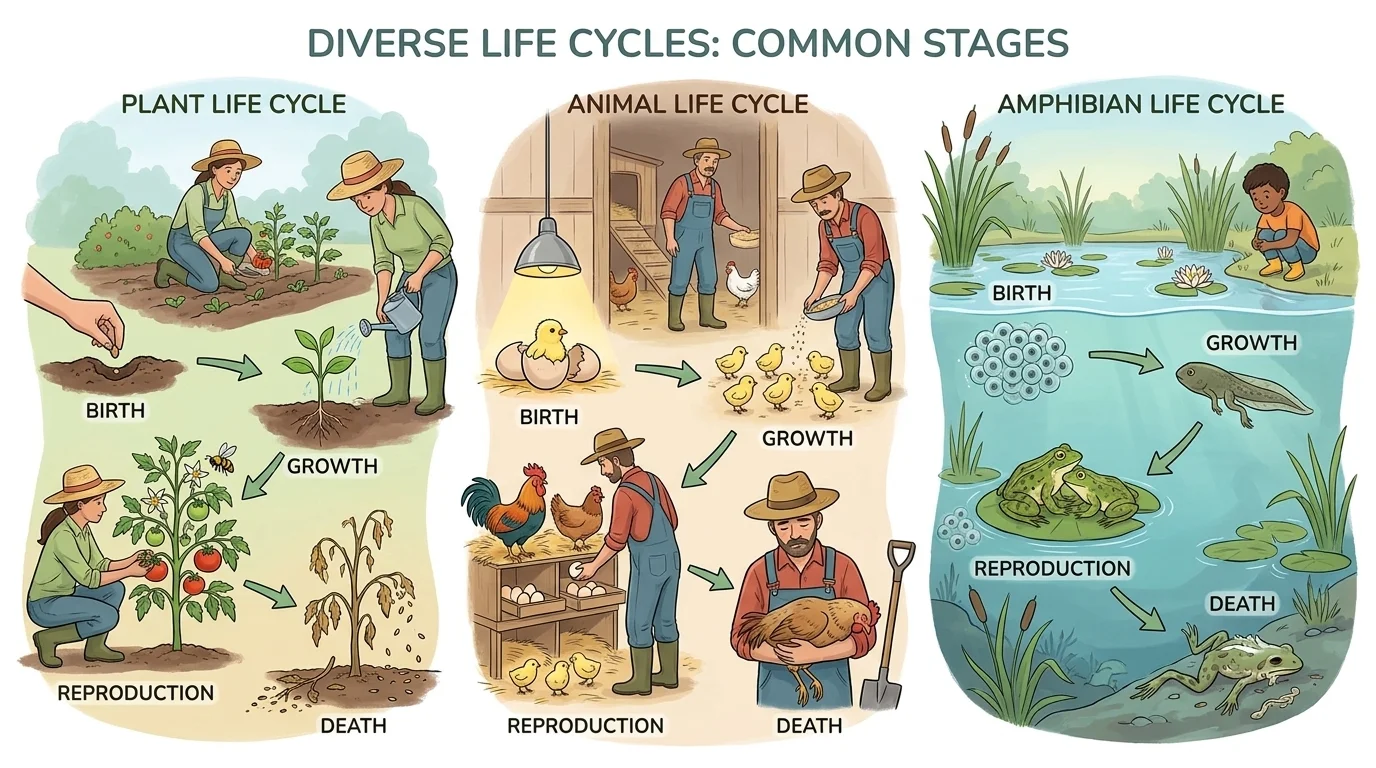
People who protect nature also study life cycles. If a pond dries up, frogs may lose an important place to begin life and grow. If flowers disappear from an area, some insects and birds may have trouble finding food or reproducing. Knowing the life cycle of an organism helps people protect it.
Real-world example: A school garden
Step 1: Students plant seeds.
They know the seeds are the beginning stage of the plant's life cycle.
Step 2: They observe growth.
The seeds sprout, grow stems and leaves, and become larger plants.
Step 3: They look for reproduction.
Flowers appear, and later the plants make new seeds.
Step 4: They use the model to predict what comes next.
The new seeds can start new plants in the next season.
Life-cycle knowledge helps students understand what they see in the garden.
The same idea works for pets and wild animals. A young pet may need special food and care while it grows. Wild animals also need safe places for their young. When people understand these needs, they can care better for living things.
Let us compare a few broad examples. A bean plant starts as a seed, grows into a plant, produces flowers and seeds, and dies. A robin begins in an egg, hatches, grows into an adult bird, lays eggs, and dies. A frog begins as an egg in water, grows and changes, becomes an adult frog, reproduces, and dies.
These examples help us notice an important science idea: the path is not identical for every organism, but the pattern is still there. This is why life cycles are useful for comparing plants and animals.
| Organism | Beginning of Life | Growth | Reproduction | End of Life |
|---|---|---|---|---|
| Bean plant | Seed | Seedling to adult plant | Makes seeds | Dies |
| Robin | Egg | Chick to adult bird | Lays eggs | Dies |
| Frog | Egg in water | Young frog to adult frog | Makes more frogs | Dies |
| Butterfly | Egg | Young stage to adult butterfly | Lays eggs | Dies |
Table 1. Broad comparison of life cycle stages in several organisms.
Notice that the chart does not list every detail. That is because a broad science model often focuses on the biggest ideas. Here, the biggest ideas are the same shared stages and the different ways organisms move through them.
When you compare the organisms in Table 1 and the real-world scenes in [Figure 4], you can see why life cycles matter both in science class and outside of school. They help us observe change, make predictions, and care for living things wisely.
"Life is a cycle of change, and science helps us notice the patterns."
Scientists observe, compare, and model life cycles because patterns help explain the natural world. When we look closely, we discover two big truths at the same time: living things are wonderfully different, and living things are connected by the same basic life pattern.
